
A team ships a small prompt update on Thursday afternoon. Nothing dramatic changed. The user story still passes. The API still returns a response. The chatbot still sounds fluent.
By Friday morning, support tickets start piling up.
The bot is now skipping a refund policy step for some users. In another flow, it cites the wrong account rule because retrieval pulled a loosely related document. A third issue is harder to see. The agent calls the right tool, but in the wrong order, so the final answer looks polished while the underlying action is wrong.
Many engineering leaders realize they aren't dealing with normal test automation anymore. Traditional UI and API tests answer deterministic questions: did the button appear, did the endpoint return 200, did the field equal the expected value. AI systems don't stay inside that box. Outputs vary, retrieval changes context, prompts evolve, and model updates can shift behavior without breaking syntax.
An AI testing framework exists to handle that uncertainty in a disciplined way. It gives your team a way to test behavior, not just code paths. It turns prompt changes, model swaps, retrieval updates, and agent tool decisions into something you can evaluate repeatedly and govern over time.
That matters because this isn't a niche concern anymore. One industry summary reports the global AI quality assurance testing market at $2.45 billion in 2023, with a projected rise to $18.7 billion by 2030 and a 33.4% CAGR. The same source says 89% of organizations are piloting or deploying generative AI in quality engineering, while only 15% have reached enterprise-wide deployment, which tells you two things at once: adoption is moving fast, and operating maturity still lags behind (industry summary cited in arXiv).
Table of Contents
- Introduction Why AI Testing Needs Its Own Framework
- What an AI Testing Framework Really Is
- Architecture of a Scalable AI Testing Framework
- Core Components Every Framework Must Include
- Example Patterns for Testing LLMs and Agents
- How to Integrate Your Framework Into CI/CD
- Building a Sustainable AI Testing System That Lasts
Introduction Why AI Testing Needs Its Own Framework
Most QA leaders first meet AI testing through a failed release, not a strategy deck.
A common pattern looks like this. Product wants faster iteration on an assistant, copilot, or agent. Engineering makes prompt edits, swaps a model version, or changes retrieval logic. The team runs a few manual checks, sees acceptable answers, and pushes to production. A week later, someone notices that a critical journey has degraded, but only for a certain phrasing, customer type, or document mix.
Why traditional automation stops short
Selenium, Playwright, Cypress, Postman, and API contract tests still matter. They verify the application shell around the AI system. They tell you whether the page loads, the endpoint responds, the auth token works, and the tool call schema is valid.
They don't answer the harder questions:
- Behavioral correctness: Did the answer solve the user's task?
- Context quality: Did retrieval bring the right evidence into the prompt?
- Safety: Did the system refuse unsafe requests and handle adversarial prompts well?
- Stability: Did a prompt tweak degrade a workflow that used to perform well?
That gap is why an AI feature can pass conventional regression while still failing users.
The shift from release testing to continuous confidence
An AI testing framework isn't just a set of prompt checks. It is a production system for continuous evaluation. It stores representative tasks, runs them automatically, judges outputs against defined criteria, tracks reliability, and feeds production observations back into the suite.
Practical rule: If your team only evaluates the model before launch, you don't have an AI testing framework yet. You have a demo checklist.
This is also part of a much longer testing tradition than many teams realize. NIST says its AI test, evaluation, validation and verification work dates back to the late 1960s, beginning with measurement and evaluation of automated fingerprint identification systems. NIST also states that it has since conducted hundreds of evaluations covering thousands of AI systems, showing how AI testing evolved from narrow pattern recognition checks into a broader validation discipline (history summary referencing NIST).
The practical question isn't whether AI needs testing. It does. The question is how to build a framework that keeps working after the first release, when prompts, models, tools, and business rules keep moving.
What an AI Testing Framework Really Is
Think of an AI testing framework as a quality lab, not a pile of scripts.
In a physical lab, you need instruments, standards, and procedures. A thermometer without calibration isn't enough. A lab technician without a test protocol isn't enough either. The same idea applies here. Your model and prompts are the instruments. Your metrics and acceptance criteria are the standards. Your test suites and rerun policies are the procedures.
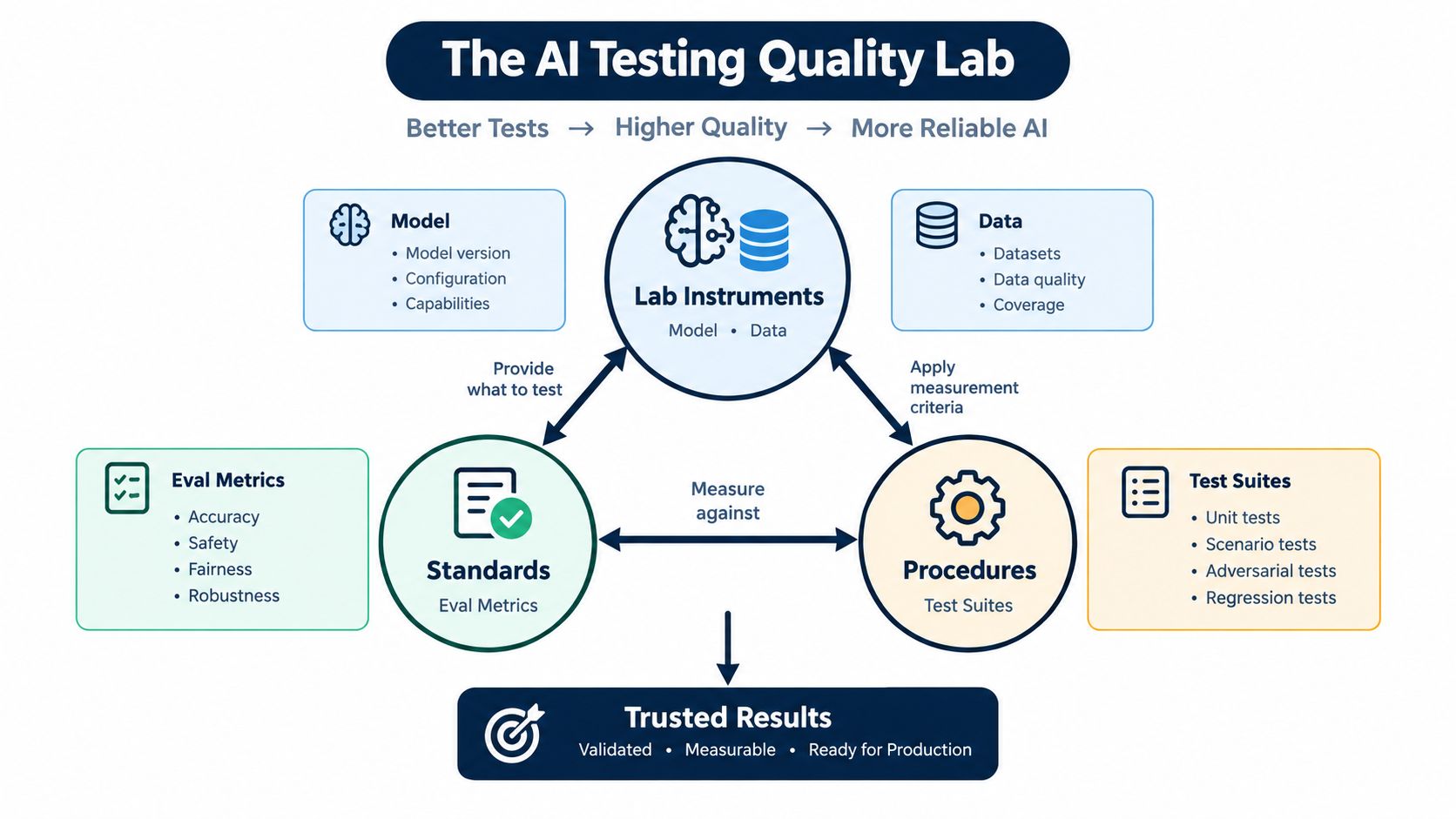
Teams exploring AI testing services usually find this distinction useful because it separates raw model behavior from the system built around it.
From exact assertions to bounded judgment
A normal automated test might say, "response body must equal this JSON." That works when one correct output exists.
An AI test often asks a different kind of question: "Is this answer accurate, complete enough for the task, grounded in retrieved evidence, and safe for the user?" That requires oracles, meaning mechanisms for deciding whether an output is acceptable. Sometimes the oracle is a rule. Sometimes it's a rubric. Sometimes it's a reference answer paired with semantic comparison. Sometimes it's a model judge, with safeguards around consistency.
Instead of exact equality, you work with tolerances and evaluation criteria.
For example, a support assistant answering "How do I reset MFA?" may be acceptable if it includes the right steps in the right order, even if wording varies. A financial assistant, by contrast, may require stricter checks because a missing disclaimer or incorrect policy detail creates risk.
Why prompt flows, RAG, and agents need special handling
An LLM feature usually isn't one thing. It's a chain.
A retrieval-augmented generation system can fail because the retriever fetched weak documents, not because the model is bad. An agent can fail because it selected the wrong tool or repeated a tool call loop. A prompt flow can fail because one intermediate transformation dropped key user context before the final generation step.
That means the framework must evaluate separate layers:
- Inputs: prompts, retrieved context, tool responses
- Intermediate behavior: tool choice, sequence, retries, schema validity
- Final outputs: correctness, completeness, tone, safety
- Operational behavior: latency, parsing success, execution reliability
Good AI testing doesn't ask only, "Was the answer bad?" It asks, "Which part of the system made it bad?"
This is the mental model that helps teams stop treating AI testing like fuzzy UI automation and start treating it like a controlled evaluation discipline.
Architecture of a Scalable AI Testing Framework
A scalable AI testing framework works best when you design it in layers. Not because layers are fashionable, but because each layer isolates a different failure mode.
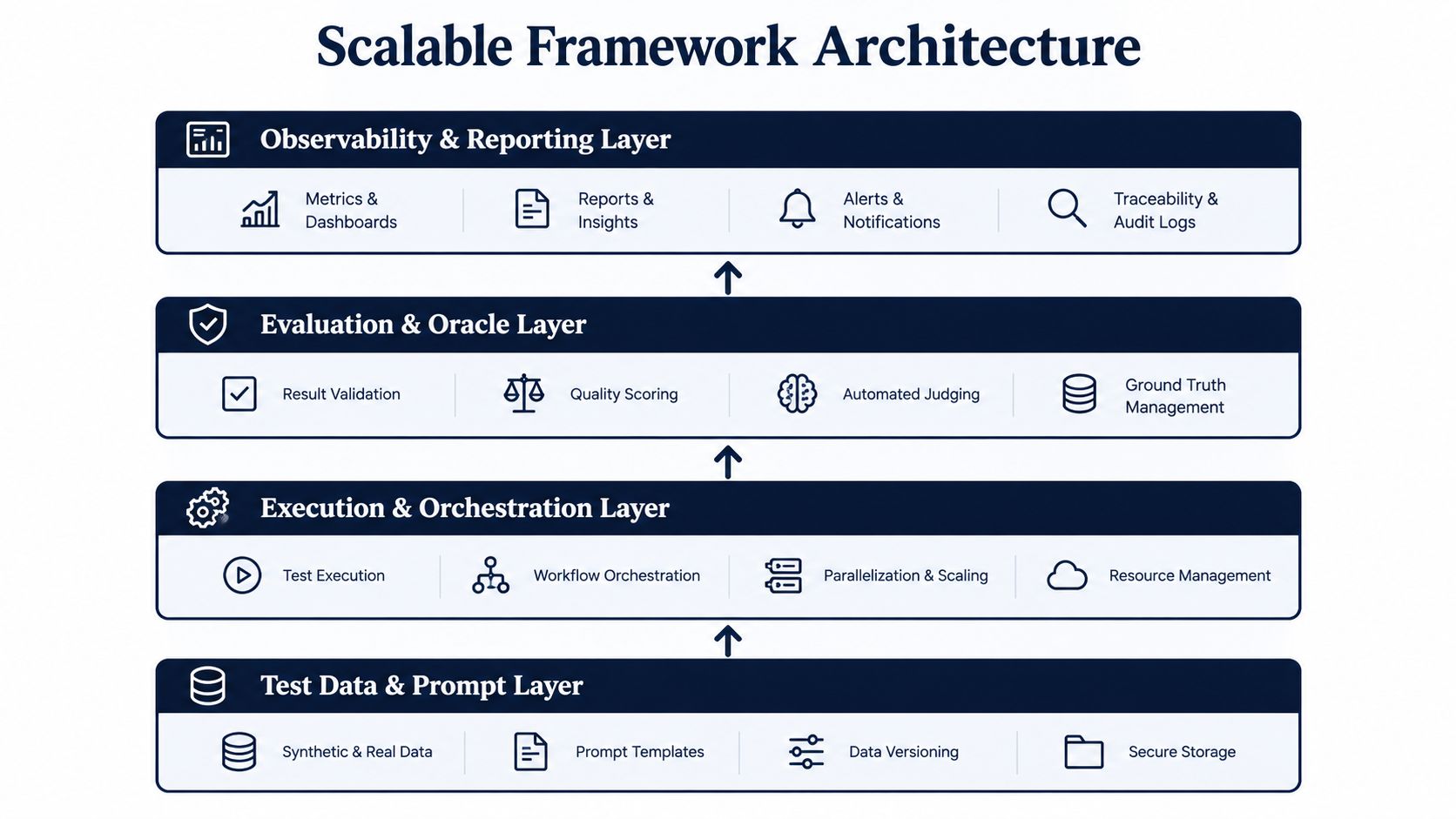
The four layers below are the pattern I see hold up best in production systems.
Test data and prompt layer
This is the foundation. It stores the tasks you care about, the prompts that drive behavior, and the expected evaluation criteria.
A weak foundation usually shows up as random examples copied from Slack, one-off prompts in notebooks, and no clear mapping to business risk. A stronger foundation uses curated datasets built from real user journeys, edge cases, failure reports, and policy-sensitive interactions.
The most useful suites are rarely the biggest ones. They are the most representative. If a support chatbot handles billing, cancellations, returns, and account access, those journeys should be explicit artifacts. Each test case should include user input, expected behavior, context needs, and the rubric used later for evaluation.
Execution and orchestration layer
This layer runs the tests. It resolves prompt templates, calls models, triggers retrieval, invokes tools, captures traces, and handles retries.
The execution engine must also deal with a reality many teams underestimate: AI evaluation runs can fail for operational reasons unrelated to quality. A recent evaluation paper formalizes this by defining Evaluation Completion Rate (ECR@1) as the percentage of evaluations that succeed on the first attempt, explicitly counting failures such as API timeouts, malformed JSON, and schema violations. The same work introduces reliability-adjusted cost metrics so teams can assess not just model quality, but whether the framework itself is sufficiently resilient for production use under retry pressure and parsing failures (evaluation reliability paper).
That is a major architectural point. If your framework only measures answer quality and ignores execution reliability, it can look healthy while failing at scale.
A short example helps. Suppose your agent answer is judged correct after three retries, one tool timeout, and one JSON parse failure. Product sees "pass." Operations sees "fragile." The framework should preserve both truths.
Here's a practical walkthrough of AI testing workflows in motion:
Evaluation and oracle layer
This layer answers the central question: how do we score what happened?
It combines methods. Deterministic checks handle schema compliance and required fields. Rubric-based judgments score answer quality. Retrieval checks compare returned documents against expected evidence. Safety evaluation looks for prohibited outputs, unsafe instructions, or policy violations.
For retrieval-heavy systems, this layer needs separate measurements for retrieval quality and final answer quality. Otherwise, teams end up trying to fix prompts when the issue lives in indexing or ranking.
Observability and reporting layer
This top layer turns raw runs into decisions.
Good reporting doesn't just show pass or fail. It shows which user journeys are covered, which prompt versions were used, which model generated the outputs, where failures cluster, and whether reliability changed after a release. It should also keep artifacts: prompts, outputs, traces, retrieved documents, tool call logs, and evaluator decisions.
A scalable framework isn't just test code. It's a record of how the system behaved, why it passed or failed, and whether you should trust the next release.
Core Components Every Framework Must Include
A lot of articles stop at architecture diagrams. That's useful, but teams still need to know which components are essential.
Three components matter most in practice: prompt management, oracles, and an evaluation engine with metrics.
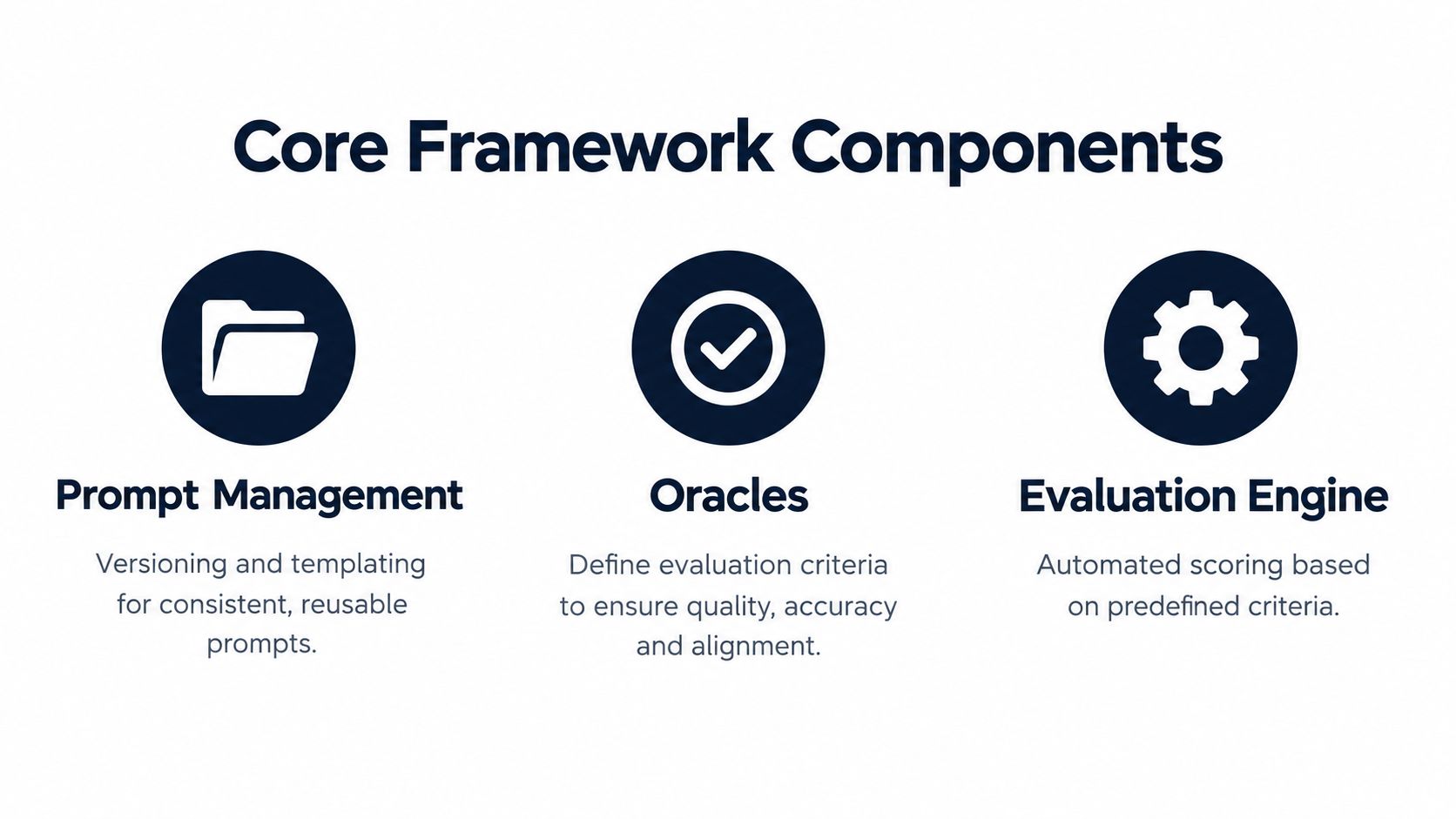
Prompt management
Prompt management is version control for AI behavior.
If a developer changes a system prompt, modifies a retrieval instruction, or adds a tool use rule, that change should be traceable just like code. Prompts need templates, variables, environment awareness, and release history. They also need test case linkage, so you can ask which flows a prompt change is likely to affect.
For agent and LLM systems, a stable golden dataset matters too. One recent industry paper on AI agent testing recommends a golden evaluation dataset of 150 to 300 real representative tasks, rerunning evaluation suites whenever prompts, tools, or models change, logging every intermediate tool call, and monitoring live traffic continuously for production drift (AI agent testing paper).
That recommendation is practical because prompt management isn't just about files. It's about preserving representative work so your framework can detect drift over time.
Oracles
Oracles are where teams get stuck.
If there is no single correct sentence, how do you decide whether the answer is good enough? The answer is to use the right oracle for the right failure mode.
Some examples work well together:
- Rule-based checks: required disclaimers, valid JSON, banned phrases, citation presence.
- Reference-based checks: compare the answer to a known correct outcome or expected action.
- Retrieval-specific checks: did the system fetch the right evidence before answering.
- Safety checks: prompt injection resistance, refusal behavior, policy adherence.
- Model-judge evaluation: useful for nuanced qualities like completeness or helpfulness, especially when paired with rubrics and spot checks.
For LLM and agent testing, Singapore's IMDA recommends a two-stage process: identify relevant risks, then test outputs and components. The starter kit also emphasizes precision and recall against ground truth for retrieval-heavy systems, which is especially useful for RAG, prompt-flow, and agent validation where correctness, completeness, and safety need separate measurement rather than one blended score (IMDA LLM starter kit).
Decision cue: If a team argues over whether an answer "feels okay," the oracle isn't defined well enough.
Evaluation engine and metrics
The evaluation engine runs the tests, applies the oracles, stores the artifacts, and computes the metrics your release process depends on.
Below is a simple decision matrix.
| Component | Option A | Option B | When to Choose |
|---|---|---|---|
| Prompt Management | Git-managed prompt files | Dedicated prompt registry in an internal platform | Choose Git-first when prompts change alongside application code. Choose a registry when many teams share prompts across services. |
| Oracles | Rule-based and reference checks | Rubric-based model judging with human review on sampled cases | Choose rules when compliance and determinism matter most. Choose rubric judging when tasks have acceptable variation in wording. |
| Evaluation Engine | CI job scripts with stored artifacts | Dedicated evaluation service with trace logging and dashboards | Choose CI scripts for an early-stage feature or narrow use case. Choose a service when multiple models, agents, or product teams need shared governance. |
Good metric collection should include quality, reliability, and operational visibility. That means not just "did it pass," but "what failed, how often, under which prompt and model version, and with what execution issues."
One practical option in this category is a managed implementation partner. AskYourQA builds AI validation systems that include structured evaluations for prompts, LLM features, and agents, along with CI/CD integration and release-oriented reporting.
Example Patterns for Testing LLMs and Agents
The easiest way to understand an AI testing framework is to follow one feature across several test patterns.
Take a support assistant for a SaaS product. It answers billing questions, searches policy docs, and can trigger account actions through tools. One feature. Several failure modes.
Teams that already run functional automation testing often adapt faster here because they already think in business journeys rather than isolated endpoints.
Prompt regression testing
Use this when the wording or structure of prompts changes frequently.
A test case might be: "I was charged twice. Can you reverse one payment?" The oracle checks whether the assistant identifies the duplicate charge scenario, asks for the right missing information if needed, and avoids inventing refund authority.
This pattern is best for catching silent behavior shifts after prompt edits or model swaps. It won't tell you whether retrieval is the root cause unless you also log context inputs.
RAG retrieval validation
Use this when the assistant relies on a knowledge base.
Here the test has two layers. First, did retrieval bring back the right policy articles or help documents? Second, did the answer use those documents correctly? That split matters because a polished answer can still be grounded in the wrong source.
For this pattern, useful artifacts include the retrieved documents, ranking order, final answer, and any missing expected evidence. The trade-off is that these tests take more setup because you need ground truth about what should have been retrieved.
Retrieval bugs often look like generation bugs. If you don't test both layers separately, teams fix the wrong component.
Agent tool-call tracing
Use this when the system can take actions, not just produce text.
Suppose the assistant can look up an invoice, verify account status, and submit a refund request. A good test doesn't stop at the final answer. It checks tool selection, sequence, parameters, and whether the agent retried safely after failure.
This pattern catches a class of errors that users experience as "the bot sounded right but did the wrong thing." It is especially useful when multiple tools can produce similar surface-level responses.
Safety and guardrail checks
Use this across all AI features, not only high-risk ones.
A support bot should refuse requests to expose another customer's data. It should resist prompt injection attempts embedded in retrieved documents or pasted by users. It should follow tone and escalation rules when uncertainty is high.
These tests often mix adversarial prompts, malformed input, policy traps, and refusal expectations. They are less about user delight and more about controlled failure.
Here is the side-by-side takeaway:
- Prompt regression catches output drift after prompt or model changes.
- RAG validation catches missing or incorrect evidence before it corrupts the answer.
- Tool-call tracing catches action errors hidden behind fluent language.
- Safety checks catch harmful or non-compliant behavior before release.
A mature framework combines all four. No single pattern gives enough coverage on its own.
How to Integrate Your Framework Into CI/CD
The biggest operational mistake is treating AI evaluation like one heavyweight test job at the end of the pipeline.
That model breaks down fast. AI tests differ in runtime, cost, determinism, and diagnostic value. Some should run on every pull request. Others belong on merges, release branches, or scheduled jobs. Production monitoring then feeds new edge cases back into the suite.
Match suite depth to delivery stage
A practical CI/CD setup usually separates suites by speed and signal.
- Pull request smoke checks: run a small set of business-critical prompts, schema checks, and a few safety probes.
- Merge-level regression: run broader journey coverage, retrieval validation, and tool-call tests.
- Release candidate evaluation: run the highest-signal regression pack with trace capture and stricter review of risky flows.
- Scheduled monitoring runs: rerun stable suites outside deployment events so drift is visible even when code didn't change.
This matters even more for LLM systems because the model environment can change outside your repo.
Handle nondeterminism without accepting chaos
AI outputs vary. Your pipeline still needs a clear release decision.
One practical pattern is repeated-run scoring for tests that are known to vary near a threshold. Instead of asking whether a single run passed, ask whether the feature behaves acceptably across repeated executions. Pair that with reliability-aware metrics from the orchestration layer so retries and malformed outputs remain visible.
Another good practice is artifact versioning. Every run should record:
- Prompt version
- Model version
- Retriever or index version
- Tool definitions
- Evaluation rubric version
- Observed traces and outputs
Without that metadata, teams can't explain why a result changed.
Feed production drift back into evaluation
A production-ready framework doesn't end at deployment. It learns from live use.
Recent analysis points to a broader operational gap here. One industry report cited that 50% of organizations still lack AI/ML expertise, while generative AI became the most in-demand skill for quality engineers at 63%. Another analysis argues that the bottleneck is procurement, governance, skills, and organizational authority, not the technology itself (AI testing operating model analysis).
That matches what many teams experience. The technical part is only half the work. Someone must own triage, dataset updates, evaluation policy, and release gating.
Your pipeline shouldn't ask only, "Did this build pass?" It should ask, "Did this release preserve acceptable AI behavior for the journeys we care about most?"
Building a Sustainable AI Testing System That Lasts
The framework only lasts if ownership is clear.
Someone has to own evaluation criteria. Someone has to decide when a prompt change is risky enough to trigger deeper regression. Someone has to review production failures and convert them into reusable tests. If nobody owns those decisions, the framework slowly turns into a side project with stale datasets and ignored dashboards.
A better model spreads ownership by responsibility, not by committee. Product defines the user journeys and business risk. QA defines test design and release gates. Security defines abuse and policy scenarios. Platform or ML engineering owns execution plumbing, trace capture, and versioning. That operating model matters more than another spreadsheet comparing tools.
Continuous evaluation is also the safer mental model than snapshot testing. Prompts change. Models change. Retrieval indexes change. Agents gain tools. The test system has to keep up without being rebuilt from scratch each month. That's why high-signal coverage mapped to critical journeys usually beats giant suites with weak relevance.
If your team is still deciding how to structure that ownership, this guide on choosing a test automation framework is a useful companion because many of the same governance questions apply. The difference is that AI adds probabilistic behavior, operational drift, and policy risk on top of the usual maintainability concerns.
The strongest AI testing framework isn't the one with the most checks. It's the one your team can run, trust, explain, and improve release after release.
AskYourQA helps engineering teams build this kind of system in practice: AI evaluations for LLMs and agents, high-signal journey coverage, and CI/CD integration that catches regressions before release. If you're moving from ad hoc prompt testing to a durable operating model, visit AskYourQA to see how that framework can be designed and implemented.