
Continuous delivery stops before production with a manual release decision, while continuous deployment releases validated software to users automatically on every commit. The practical choice depends less on the approval click than on whether your tests, monitoring, rollback controls, and governance can safely replace it.
The popular advice says that continuous deployment is continuous delivery with one human removed. That definition is correct, but it isn't sufficient for a release engineer deciding whether to remove a production gate. A manual approval can be a bottleneck, a useful control, or an admission that the pipeline's signals aren't trustworthy enough yet.
The better question is operational: can your team detect a bad change, limit its blast radius, and restore service without relying on someone to spot the problem before release? If the answer is no, automatic deployment doesn't remove risk. It moves risk into production.
Table of Contents
- Understanding Continuous Delivery and Continuous Deployment
- Side-by-Side Comparison of Release Models
- When to Choose Continuous Delivery
- When to Choose Continuous Deployment
- Risk, Compliance, and Organizational Readiness
- Practical Readiness Checklist
- Making the Decision That Fits Your Team
Understanding Continuous Delivery and Continuous Deployment
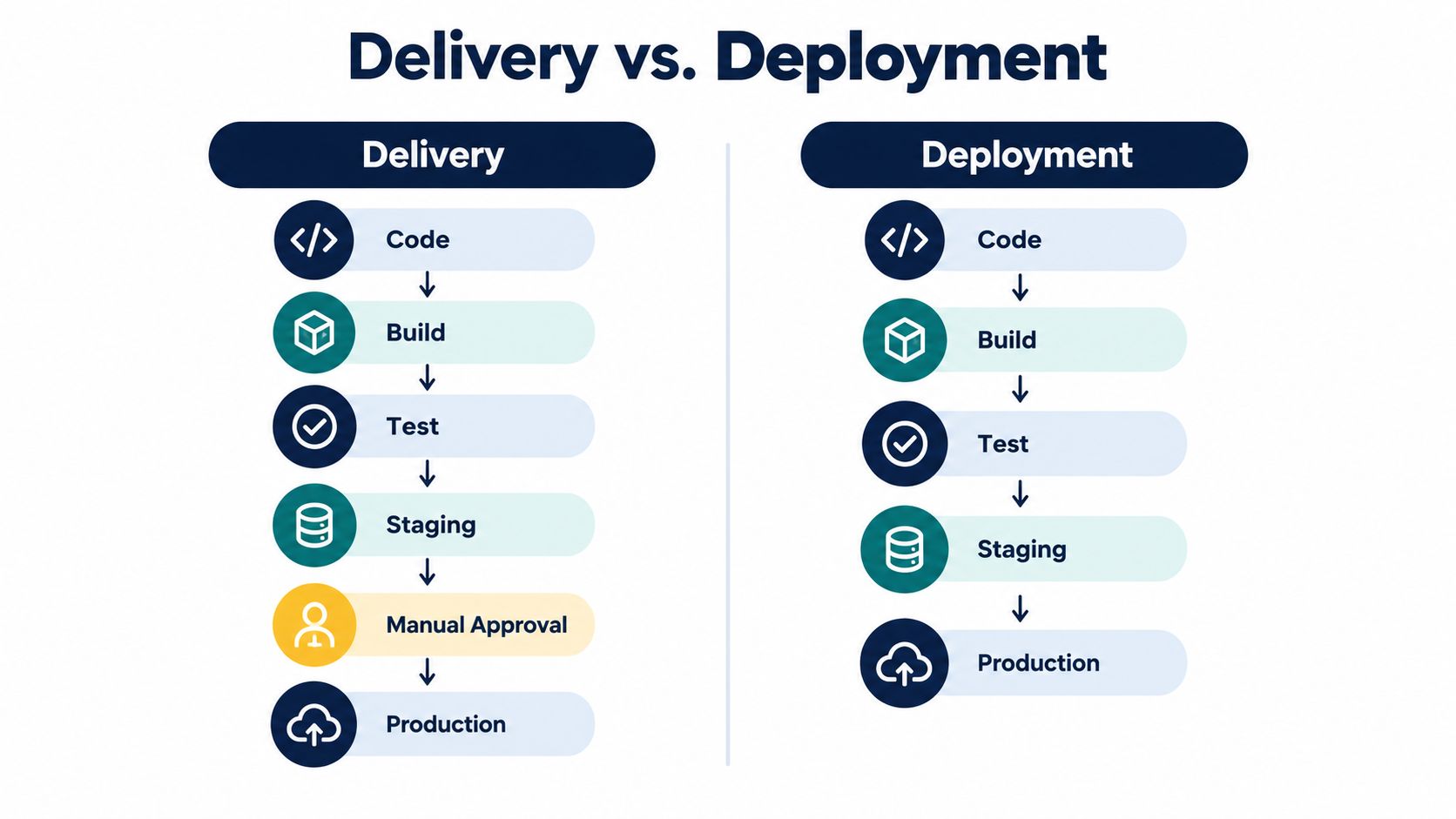
The distinction between continuous deployment vs. continuous delivery is often presented as a single button. That framing ignores what the button represents. In continuous delivery, the pipeline builds, tests, and prepares a change so it remains ready for production, but a person still decides when the release happens. In continuous deployment, validated changes proceed into production automatically, without that approval step.
The historical distinction supports this interpretation. Continuous delivery emerged as a formal software practice in the mid-2000s and was codified in 2006 in the Agile2006 paper “The Deployment Production Line” by Jez Humble, Chris Read, and Dan North. The practice was later described as well established by 2009, according to the Agile Alliance glossary definition of continuous deployment.
Delivery is a readiness discipline
Continuous delivery was designed around a disciplined state: the code should always be deployable. A merge can trigger compilation, unit checks, integration checks, packaging, environment deployment, and acceptance validation. The result is not necessarily a live release. It's a production-ready artifact waiting for an explicit decision.
That separation matters for coordinated launches, sensitive changes, and teams that need an evidence trail. Product and engineering leaders can choose the release window, confirm dependencies, and preserve a documented approval without returning to manual server work. The pipeline handles repeatable execution, while the organization retains control over the final promotion.
Continuous delivery also creates a useful diagnostic. If a team says it has delivery but production releases still involve manual file copying, ad hoc commands, or undocumented environment changes, the team hasn't automated delivery fully. The manual part should be the decision to release, not the mechanics of deployment.
Deployment turns readiness into a rule
Continuous deployment extends the same pipeline by making the production decision automatic. Every commit that passes the required checks is released to users. The system, rather than a person, becomes the final gate.
That changes the engineering obligation. In delivery, a reviewer may notice a suspicious test result, a risky timing issue, or a missing operational check before promoting the artifact. In deployment, those concerns must be represented by reliable tests, policy checks, monitoring, rollout controls, or automated rollback.
Practical rule: Removing the approval step is safe only when the systems behind it provide better evidence and faster recovery than the human gate did.
The two models therefore share a foundation, but they express different organizational choices. Continuous delivery prioritizes release readiness with controlled promotion. Continuous deployment prioritizes immediate delivery of every passing change. Neither is automatically more mature. Maturity means choosing the level of automation your product and operating model can support.
Side-by-Side Comparison of Release Models
A useful comparison starts with the path from merge to production rather than with labels. Both models need a dependable build and test process. Both benefit from short feedback loops, clear ownership, and production monitoring. The decisive difference is what happens after the pipeline has produced a passing candidate.
| Criterion | Continuous delivery | Continuous deployment |
|---|---|---|
| Production decision | A person approves promotion | The pipeline promotes automatically |
| State of the code | Always ready to deploy | Automatically released after validation |
| Primary control | Manual release decision plus automated checks | Automated checks, policy gates, rollout controls, and recovery |
| Operator involvement | Required at the production boundary | Removed from the normal release path |
| Useful measures | Deployment frequency, mean time to production, pipeline stability, operator interventions, and changes per release | The same flow measures, plus evidence that automatic promotion and recovery operate safely |
| Failure response | A person may stop or delay promotion | Detection, rollback, or mitigation must work without waiting for approval |
| Governance fit | Preserves a visible approval trail | Needs automated evidence and compensating controls where approvals are required |
| Best operating condition | Release timing or risk requires deliberate coordination | Tests and operational signals are strong enough to act as the release authority |
The flow metrics matter because automation alone doesn't tell you whether a pipeline works well. AWS recommends measuring deployment frequency, mean time to production, pipeline stability, operator interventions, and changes per release. Those measures reveal whether a team has a smooth path from merge to production or has merely automated a fragile sequence.
Mean time to production is especially useful for continuous delivery. A manual gate doesn't automatically create a slow process. If the artifact is ready, the approver is available, and the decision is lightweight, the team can still move quickly. A long delay may indicate unclear ownership, excessive batching, weak confidence, or a governance process that isn't designed for frequent releases.
Measure the path, not just the outcome
DORA recommends breaking delivery into end-to-end process steps and measuring both elapsed time and value-add time. It also calls for tracking the percentage complete and accurate, or %C/A, for work sent back for rework in its continuous delivery capability guidance.
That distinction exposes hidden waste. A pipeline can appear automated while engineers spend time investigating flaky tests, repeating failed deployments, waiting for environments, or repairing artifacts. Continuous deployment may push changes automatically, but it doesn't solve poor signal quality. It can amplify it.
For a release engineer, the most revealing questions are practical:
- Where does work wait? Is the delay in testing, approval, environment provisioning, or release coordination?
- What causes rework? Do failures represent real product defects, infrastructure problems, or unreliable tests?
- Who intervenes? Are operators approving legitimate risk, or compensating for missing automation?
- How does recovery work? Can the team identify and contain a bad release before users experience a prolonged incident?
A high-performing continuous delivery pipeline can outperform a careless continuous deployment pipeline. The first model may retain a human decision while keeping lead time short and failures recoverable. The second may remove the click while sending uncertain changes into production.
When to Choose Continuous Delivery
Continuous delivery is the responsible choice when the release decision carries information that the pipeline can't reliably encode yet. That information might concern a coordinated launch, a dependency outside the service, a policy requirement, or a risk that automated checks don't observe well.
Regulated teams often need a documented human sign-off trail. Recent market guidance describes continuous delivery as easier to fit into environments governed by SOX, HIPAA, or PCI requirements, while continuous deployment may require compensating controls. The relevant comparison of continuous delivery and continuous deployment treats compliance and release control as reasons to retain a gate, not as evidence of weak engineering.
Keep the gate when governance needs a decision
A manual approval is useful when it records an accountable decision. For example, a healthcare team may need to demonstrate who authorized a production change, a financial product team may need evidence that a sensitive workflow was reviewed, and a mobile team may need to coordinate a release with external distribution or support processes.
That doesn't mean the rest of the pipeline should be manual. The stronger pattern is:
- Build and test automatically.
- Deploy the candidate to a production-like environment.
- Run release-readiness checks and collect evidence.
- Present the change, results, risk information, and rollback plan to an authorized approver.
- Promote through an automated deployment mechanism.
The gate then controls when the change becomes live, not how engineers copy it there.
Use delivery for coordination and blast-radius control
Some releases involve database changes, API compatibility, partner dependencies, or a customer communication plan. A human may need to confirm that several systems are ready at the same time. Continuous delivery gives the team a prepared artifact without forcing production to follow the moment the last test passes.
It also supports staged decisions. A team can approve a canary, observe it, and then authorize broader promotion. That sequence may be slower than automatic deployment, but speed isn't the only objective when a failure could affect payments, patient workflows, identity, or other critical operations.
DORA's guidance makes an important point: continuous delivery can remain high performance while retaining a manual release decision, provided it maintains short lead time, low change failure rate, short time to restore service, and timely release frequency. The approval step isn't the performance problem by itself. Unclear decisions, poor signals, and slow recovery are the actual problems.
When to Choose Continuous Deployment
Continuous deployment becomes a sound option when the pipeline can make a release decision with consistent evidence and the team can recover quickly when that evidence fails. The model works particularly well for products that benefit from small, independently deployable changes and rapid production feedback.
The central test is not whether engineers want fewer clicks. It's whether a passing pipeline has enough authority to act without a person interpreting the result.
Compare readiness by signal quality
| Readiness area | Evidence that supports continuous deployment | Warning sign that favors continuous delivery |
|---|---|---|
| Test reliability | Critical user journeys produce repeatable, actionable results | Flaky tests are routinely retried or ignored |
| Coverage | Automated checks exercise the paths where failure would materially harm users, data, or revenue | Important behavior depends on manual exploration or code review |
| Observability | Error, latency, and business-health signals can identify regressions quickly | The team learns about failures from customer reports |
| Rollback | A known, tested recovery path can restore the previous safe version | Recovery depends on an engineer improvising under pressure |
| Release design | Feature flags, canaries, or staged exposure limit impact | Every passing change reaches the full audience immediately |
| Ownership | An on-call team has runbooks and authority to respond | No clear owner exists outside working hours |
| Governance | Required evidence is generated automatically and policies are enforced in the pipeline | Approval is legally or operationally mandatory |
Continuous deployment shifts risk from human judgment to engineered controls. Strong end-to-end tests can detect broken user journeys before release. Contract checks can protect service boundaries. Security checks can block known unsafe changes. Observability can identify a regression after release, while a rollback or feature-flag change limits the damage.
That combination is more valuable than a large test count. A noisy suite that fails for irrelevant reasons doesn't provide a reliable release signal. High-signal checks should fail for conditions that matter, explain the failure clearly, and give engineers enough context to act.
Make automatic release reversible
Automatic release isn't safe because failures are impossible. It's safe when failure is contained and recovery is routine. A service may deploy behind a disabled feature flag, expose the change to a limited audience, or promote through a canary environment before full activation.
The release system should also separate deployment from user exposure where the product requires it. Code can be present in production while a product owner controls when a feature becomes visible. That arrangement preserves operational flexibility without turning every production change into a manual deployment exercise.
Continuous deployment isn't a license to skip review. Review moves earlier into test design, pipeline policy, observability, and rollout engineering. If those systems can't carry the responsibility, keep the gate and improve them before trying again.
Risk, Compliance, and Organizational Readiness
Technical capability doesn't settle the continuous deployment vs. continuous delivery decision. A team may have a fully automated pipeline and still need a manual production decision because the surrounding organization requires documented accountability, coordinated timing, or controlled exposure.
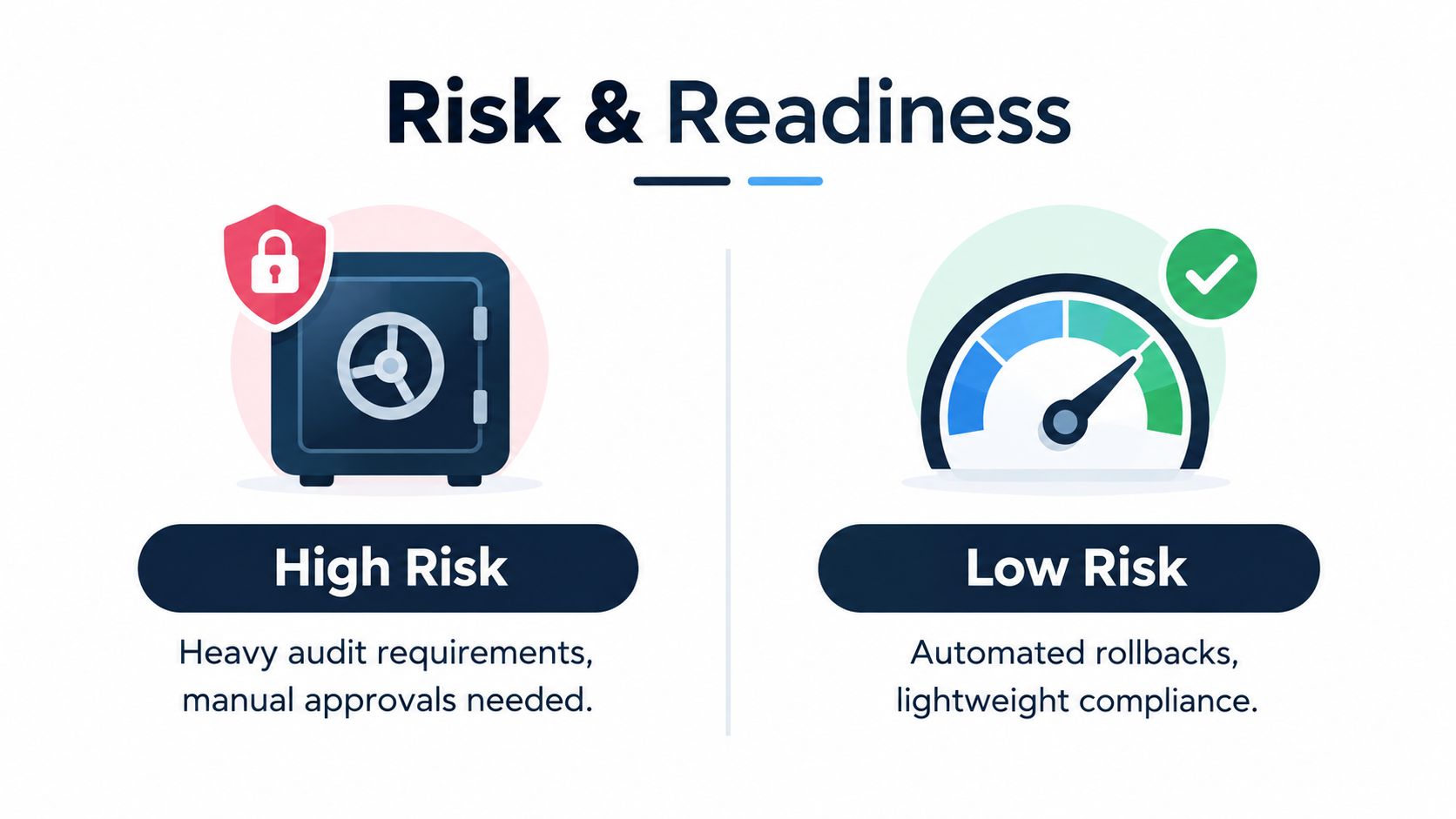
Risk also varies by product surface. A marketing page, an internal tool, a payment flow, a healthcare workflow, a mobile application, and an AI-powered feature don't carry the same consequences when behavior changes unexpectedly. The pipeline should reflect that difference rather than applying one release policy to every service.
Treat compliance as a design constraint
Compliance can justify a manual approval, but it doesn't justify slow or opaque delivery. A well-designed continuous delivery pipeline can automatically assemble test results, artifact details, environment information, policy outcomes, and the identity of the person who approved promotion.
That evidence gives auditors a clear record while giving engineers a repeatable release path. The gate becomes a policy control with a defined purpose. It shouldn't become a general-purpose pause button that conceals uncertainty.
The same principle applies to coordinated releases. If a database migration requires compatibility with an older application version, the release system may need a deliberate promotion sequence. If a mobile change depends on app-store distribution, production timing may not be fully controlled by the engineering pipeline. If an AI feature needs additional validation for unsafe or inconsistent outputs, a human review may remain appropriate for particular release classes.
Teams often discover that their releases feel risky not because deployment is inherently dangerous, but because they lack clear evidence about what will change, who owns the outcome, and how to recover. This analysis of why releases feel risky is useful context for separating technical uncertainty from governance requirements.
Decide what the gate actually protects
Ask what failure the manual approval prevents. If reviewers regularly catch missing test coverage, unclear migration behavior, or a broken critical journey, the gate is exposing weaknesses in the pipeline. Improve those signals before removing it.
If reviewers rarely change the release decision but spend time checking evidence the system could produce automatically, automate the evidence and narrow the approval's scope. If the gate exists because policy requires an accountable sign-off, retain it and make the surrounding process fast.
A gate is valuable when it blocks a known category of risk. It is expensive when it exists only because nobody trusts the pipeline.
Organizational readiness includes more than technical controls. Teams need ownership, incident response habits, clear escalation, and agreement about who can pause or reverse a release. Without those conditions, continuous deployment can create a false sense of progress. The system releases faster, but the organization responds slower.
Practical Readiness Checklist
Before removing the manual gate, evaluate the pipeline as an operating system, not as a collection of test cases. A green build is only one signal. You need confidence that the signal is trustworthy, that production behavior is visible, and that recovery doesn't depend on heroic intervention.
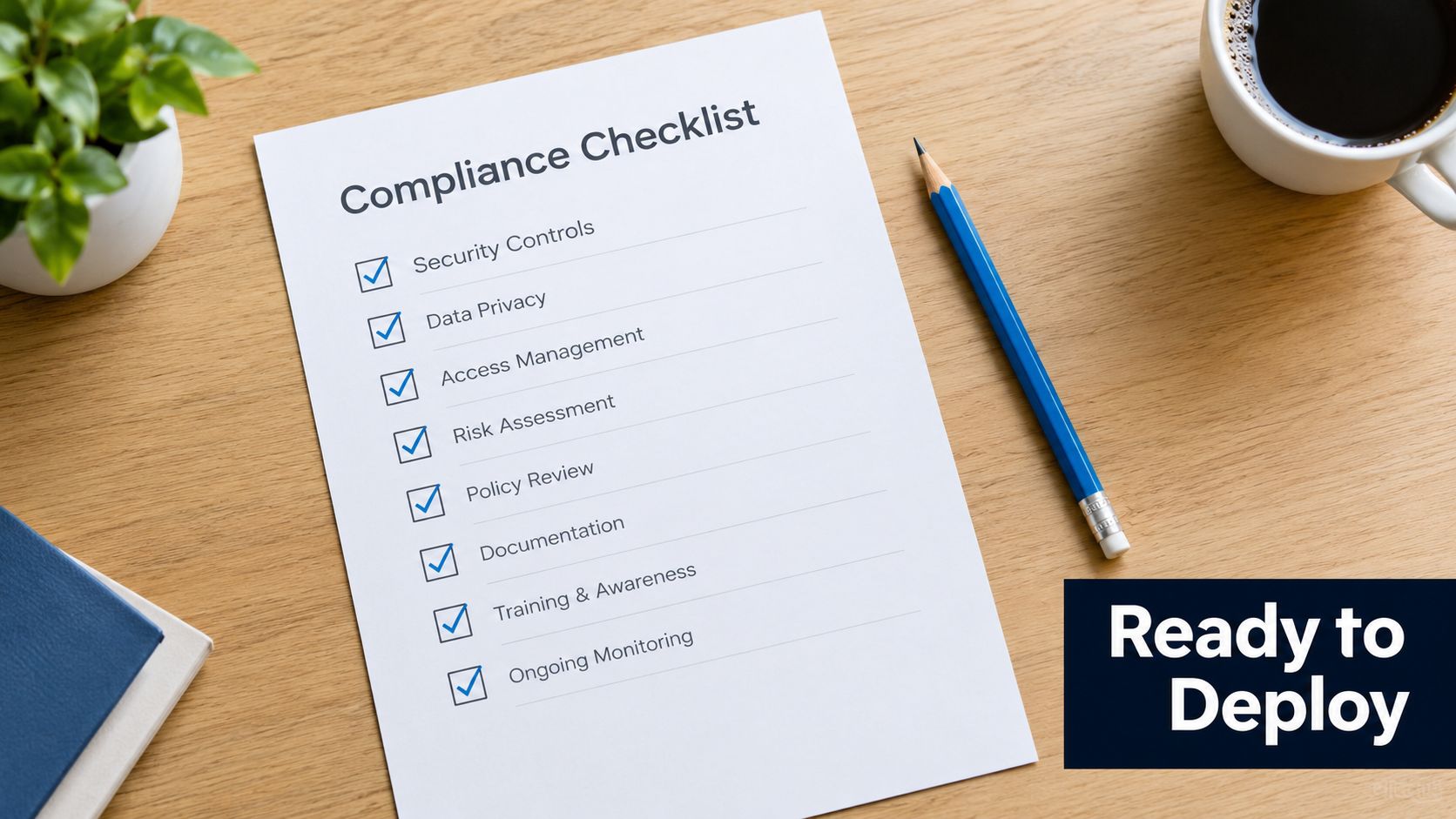
Use this checklist with the people who own development, QA, platform engineering, and operations:
- Test signals: Critical user journeys are automated, failures are reproducible, and the team treats flaky checks as defects rather than harmless noise.
- Environment confidence: Staging and production behave closely enough that a passing candidate means something. Differences in configuration, dependencies, or data handling should be visible.
- Observability: The team can see application errors, latency behavior, and important business outcomes after release. Alerts reach an accountable responder.
- Rollback control: The recovery path is documented, tested, and simple enough to execute during an incident. Don't assume rollback works because the platform offers a button.
- Incident response: An on-call owner knows how to investigate, disable a feature, stop promotion, and communicate impact.
- Release governance: Policy requirements are represented in the pipeline where possible. Mandatory approvals remain explicit, scoped, and auditable.
- Change isolation: Feature flags, canary exposure, or service-level independence can limit the effect of a defective change.
- Data safety: Schema and data changes support a safe transition between application versions. A code rollback shouldn't leave the database in an unrecoverable state.
A practical automation system should connect critical-flow coverage to the pipeline rather than treating QA as a final inspection. AskYourQA's functional automation testing services are one option for teams building end-to-end checks across application journeys and integrating them into CI/CD workflows.
The checklist is not a maturity badge. One serious gap in rollback, monitoring, or incident ownership is enough reason to keep continuous delivery while the team closes it.
Use the following video as a supplementary implementation reference when reviewing how your pipeline handles automated release decisions:
Making the Decision That Fits Your Team
Choose continuous delivery when regulation, coordinated timing, incomplete signals, or high blast radius requires an accountable production decision. Choose continuous deployment when automated tests, observability, rollback, incident response, and governance controls can safely carry that responsibility. A hybrid policy is often sensible, with automatic release for low-risk services and controlled promotion for sensitive changes.
The right framework matters because different tools fit different systems and teams. Review how to choose a test automation framework, then align the choice with your product's risk profile rather than treating deployment speed as the only measure of engineering maturity.
AskYourQA designs and implements functional, API, mobile, AI, security, and performance automation connected to CI/CD pipelines, with reporting focused on critical journeys and release readiness. Visit AskYourQA to assess whether your test signals and operational controls are strong enough for automatic deployment or need a safer delivery gate.