
You probably have this mess right now. Half the repo uses page objects, another chunk uses direct selectors, mobile scripts carry copied setup blocks, and the API folder has six different assertion styles because each team imported its own habits. The suite still runs, but nobody trusts it enough to gate a release without manual checking.
That's usually not a tooling problem. It's a template problem.
Good software testing scripts templates don't just standardize formatting. They standardize intent, traceability, setup, evidence, and failure behavior. That matters even more now because modern automation isn't just handwritten code anymore. Teams are mixing generated tests, self-healing selectors, keyword layers, risk-based CI selection, and observability hooks. Without a stable script contract underneath, all of that becomes noise.
The practical model that holds up is simple. Treat every test script template as a living contract. The static part comes from standardized documentation fields. The dynamic part comes from how that metadata drives execution, triage, and release decisions. That's the bridge that often goes overlooked.
Table of Contents
- What a Modern Software Testing Scripts Template Actually Looks Like
- Categories of Software Testing Scripts Templates and When to Use Each
- UI Test Script Template for Web Applications
- API Test Script Template for REST, GraphQL, and gRPC
- Mobile Test Script Template for Android and iOS
- Best Practices Built Into the Template Structure
- CI and CD Pipeline Integration Template
- Comparing Keyword-Driven, Data-Driven, and Behavior-Driven Templates
- Risk, Observability, and Self-Healing Fields Beyond the Basics
- Quick Reference, Checklist, and Related Resources
What a Modern Software Testing Scripts Template Actually Looks Like
A modern test script template isn't a code snippet you paste into a framework. It's the canonical header and execution contract that every script inherits, regardless of whether the test runs in Playwright, RestAssured, Appium, or a CI job wrapper.
This structure has a solid standards basis. ISO/IEC/IEEE 29119-3 formalized software testing documentation templates, first published on 2013-09-01 and revised on 2021-10-28, and it explicitly includes templates and examples of test documentation aligned to the test process structure defined in Part 2, as described by the IEEE 29119-3 standard page.
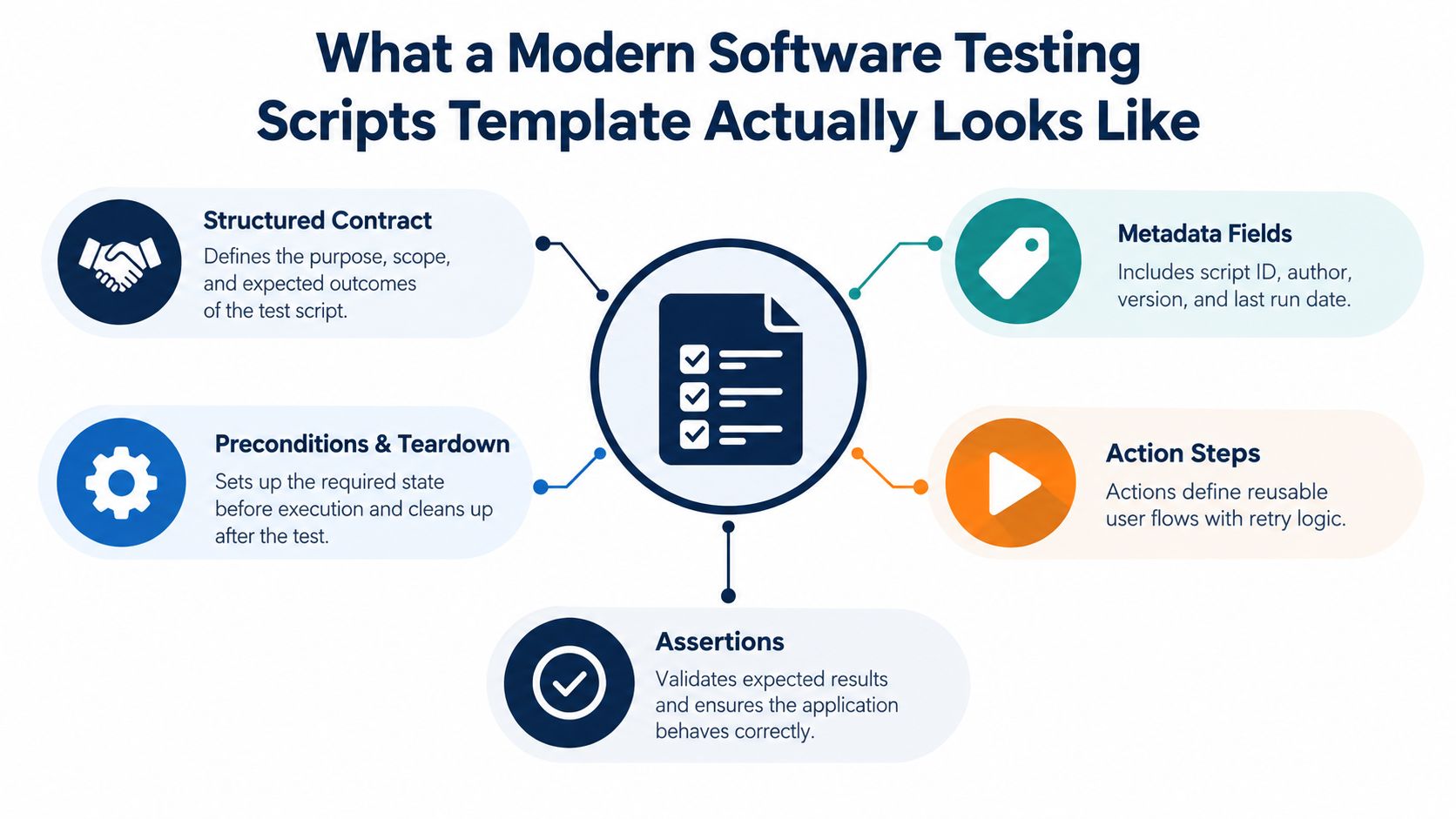
The nine fields that matter
The most useful template shape still starts with nine fields:
- Identifier
- Version
- Purpose
- Preconditions
- Test items
- Inputs
- Procedure
- Expected results
- Actual results
These fields sound old-school until you map them to runtime behavior.
- Identifier becomes the script ID, test path, and CI report key.
- Version becomes the script contract version, not just git history.
- Purpose becomes the human-readable scenario, often a Gherkin-style description.
- Preconditions become fixtures, seeded data, auth state, and feature flags.
- Test items become the page, endpoint, service, or app surface under test.
- Inputs become parameter sets, JSON fixtures, environment-driven credentials, or generated payloads.
- Procedure becomes ordered step blocks.
- Expected results become assertions and acceptance checks.
- Actual results become structured run evidence, logs, traces, screenshots, and outcome records.
Why static fields still matter in 2026
The teams moving toward AI-assisted generation and self-healing often make the same mistake. They generate steps but skip metadata.
That breaks fast. A generator can propose actions, but it can't make good decisions about priority, reusability, or release impact unless the script includes explicit purpose, risk context, and dependencies.
Practical rule: If a machine is going to create, repair, or select a test, a human must define the metadata contract first.
A minimal canonical header
Use one shared header across UI, API, and mobile:
- Script ID
- Owner
- Version
- Purpose
- Risk tier
- Linked requirement or design reference
- Preconditions
- Inputs and data scope
- Expected outcomes
- Evidence policy
That header is the shared DNA of your repo. It keeps software testing scripts templates coherent even when execution frameworks differ.
Categories of Software Testing Scripts Templates and When to Use Each
Many don't need more script types. They need fewer, sharper categories with clear ownership and CI purpose. In practice, four categories carry almost everything: UI, API, mobile, and cross-platform end-to-end.
How the categories differ in real life
UI templates exercise the browser surface. They're where user flows, accessibility checks, and visual regressions live. They're also where flake risk climbs fastest because selectors, rendering timing, and shared session state all drift.
API templates carry the bulk of serious regression value. They run headless, isolate business rules well, and usually fail with better diagnostics. If your suite is heavy on UI and light on API, you're paying a maintenance tax for coverage you could get cheaper elsewhere.
Mobile templates earn their place when native gestures, device permissions, push triggers, or platform-specific rendering matter. If the mobile app is a web shell with minimal native behavior, don't pretend every scenario deserves device-cloud time.
Cross-platform templates should stay thin. Their job is orchestration across layers, not deep validation at every step.
Script Template Categories at a Glance
| Category | Layer | Common Frameworks | Typical Runtime | Flake Risk | Best CI Stage |
|---|---|---|---|---|---|
| UI | Browser UI | Playwright, Cypress, Selenium | Slower | Higher | PR smoke, release smoke, visual gate |
| API | Service and contract layer | Postman/Newman, RestAssured, pytest, k6 | Faster | Lower | PR, post-merge, nightly regression |
| Mobile | Native and hybrid app layer | Appium, XCUITest, Espresso | Slower | Higher on real devices | Nightly, pre-release, platform gate |
| Cross-platform end-to-end | Orchestration across UI, API, and mobile | Mixed runners with workflow orchestration | Slowest | Highest if overused | Minimal release gating |
The rule that keeps suites sane
Choose categories by risk-weighted coverage, not by team enthusiasm for a framework.
A browser flow belongs in UI only if the browser itself is part of the risk. A business rule belongs in API if that's the cheapest stable layer that proves it. A mobile gesture belongs on devices if the gesture is the thing you're validating.
Teams get into trouble when they confuse realism with value. The most realistic test isn't always the most useful test.
UI Test Script Template for Web Applications
The strongest UI templates do two things at once. They stay readable enough for review, and they enforce enough structure that nobody can sneak unstable habits into the suite.
Here's a Playwright with TypeScript pattern that works well for web applications.

Template header and fixtures
import { test, expect } from '@playwright/test';
import loginData from '../data/login-valid.json';
import { LoginPage } from '../pages/LoginPage';
import { DashboardPage } from '../pages/DashboardPage';

const script = {
  id: 'UI-AUTH-LOGIN-VALID',
  version: '3.2',
  purpose: 'Valid user can sign in and reach the dashboard',
  riskTier: 'high',
  preconditions: [
    'user exists',
    'account is active',
    'feature flag auth_v2 enabled'
  ],
  testItems: ['login page', 'session creation', 'dashboard shell'],
  inputs: ['standard user fixture'],
  expectedResults: [
    'login succeeds',
    'dashboard heading visible',
    'session cookie present'
  ]
};

test.describe(script.id, () => {
  test.use({
    storageState: 'playwright/.auth/anonymous.json',
    viewport: { width: 1440, height: 900 },
    trace: 'retain-on-failure',
    video: 'retain-on-failure'
  });

  test('valid login', async ({ page, context }) => {
    const login = new LoginPage(page);
    const dashboard = new DashboardPage(page);
Procedure and assertions
    await login.open();
    await login.signIn(loginData.email, loginData.password);

    await expect(dashboard.heading).toBeVisible();
    await expect(page).toHaveURL(/dashboard/);

    const cookies = await context.cookies();
    expect(cookies.some(c => c.name === 'session')).toBeTruthy();

    await expect(dashboard.navProfile).toHaveAccessibleName(/profile/i);
    await expect(page.locator('[data-test-id="dashboard-shell"]')).toHaveScreenshot();
  });
});
The locator strategy belongs in the template, not in tribal memory. My rule is blunt:
- First choice is
data-test-id - Second choice is role-based selectors
- Last resort is CSS scoped to stable semantics
- Banned is XPath in normal UI flow tests
That's the layer where flakes usually start. If you want a broader view of framework choices behind this style, this guide on functional automation testing is useful context.
Teardown and failure evidence
Put teardown expectations in the template contract even if Playwright handles most cleanup:
test.afterEach(async ({ page }, testInfo) => {
  if (testInfo.status !== testInfo.expectedStatus) {
    await testInfo.attach('console-log', {
      body: Buffer.from('structured failure log placeholder'),
      contentType: 'text/plain'
    });
  }
  await page.close();
});
What breaks at scale is predictable.
- Shared state leaks between parallel workers.
- Artifact capture grows expensive when every failure stores full traces and video.
- Over-parameterization makes tests unreadable and harder to debug than duplicated intent.
A good template stops that drift by forcing every script to declare purpose, data scope, and evidence policy up front.
API Test Script Template for REST, GraphQL, and gRPC
API templates should read like contracts. If your API script is mostly request code plus a few inline asserts, it won't hold up once schemas evolve, auth rules branch, and CI starts running selective suites against multiple environments.
The useful template shape is stable across protocols: preconditions, request, schema, assertions, evidence.
A protocol-neutral script skeleton
const script = {
  id: 'API-ORDERS-CREATE',
  version: '2.1',
  purpose: 'Create order with valid payment token',
  preconditions: [
    'customer fixture seeded',
    'auth token available',
    'inventory item in stock'
  ],
  request: {
    protocol: 'REST',
    method: 'POST',
    target: '/orders',
    headers: ['authorization', 'content-type', 'x-correlation-id']
  },
  schemaRef: 'contracts/orders/create-order.schema.json',
  assertions: {
    structural: ['status code', 'schema match', 'required fields present'],
    semantic: ['order status pending', 'total matches line items']
  }
};
The split between structural and semantic checks matters. Structural checks tell you whether the API shape changed. Semantic checks tell you whether the business rule still works.
API Script Template Blocks Across Protocols
| Template Block | REST | GraphQL | gRPC |
|---|---|---|---|
| Request | Method, path, headers, body | Endpoint, operation name, query, variables | Service, method, protobuf message |
| Schema | OpenAPI or JSON Schema fixture | Response shape and field contract | Protobuf descriptors and message contract |
| Assertions | Status, headers, payload, business rules | Data, errors array, field semantics | Status, message fields, service behavior |
Examples by protocol
REST tends to be the cleanest for contract checks:
await expect(response.status()).toBe(201);
await expect(body).toMatchSchema(orderSchema);
expect(body.status).toBe('pending');
GraphQL needs stricter treatment around partial success. Don't stop at errors absence. Assert exact fields returned for the operation and guard against nullable drift in critical paths.
gRPC deserves the same discipline. Version protobuf descriptors with the script. Don't let generated clients hide contract changes until integration fails downstream.
If an API contract changes, you want the script to fail at the contract boundary, not three services later in a UI checkout test.
What to encode directly in the template
Put these in the template itself:
- Idempotency expectation for replay-safe operations
- Seed data ownership so test runs don't mutate shared fixtures blindly
- Performance threshold policy as a hard assertion when it's release-critical
- Contract file version linked to the same commit as the script
For software testing scripts templates at the API layer, the biggest win is fast failure with precise blame. That only happens when request shape, schema source, and business assertions live in separate blocks.
Mobile Test Script Template for Android and iOS
Mobile templates fail when teams try to hide platform differences behind one giant abstraction. You don't want duplicate scripts for Android and iOS, but you also don't want fake sameness. The right pattern is a shared scenario flow with platform-specific capability and gesture adapters.
A clean mobile template shape
Keep the script split into three files:
- Capabilities file for Android or iOS launch settings
- Gesture helper layer for tap, swipe, long press, biometric prompts, and permission handling
- Shared flow script for the business scenario
That lets the same test body run on both platforms while swapping only the launch and interaction details.
const script = {
  id: 'MOB-ONBOARDING-BIOMETRIC-ENABLE',
  version: '1.4',
  purpose: 'User enables biometric login during onboarding',
  preconditions: [
    'fresh install or reset app state',
    'test user available',
    'biometric simulator enabled'
  ],
  deviceCloud: {
    provider: 'configured in runner',
    deviceProfile: 'platform-specific capability file'
  }
};
Where mobile templates need explicit fields
Add fields most web teams forget:
- Permission prompt policy for camera, notifications, location
- Biometric setup state because simulator and real device behavior differ
- Network condition hook if device-cloud instability is part of validation
- Quarantine eligibility for known hardware-specific defects
A shared flow might look like this:
await app.launch();
await permissions.acceptIfPresent();
await onboarding.signIn(user);
await biometrics.enableIfSupported();
await home.assertLoaded();
The failure modes to design around
Mobile automation breaks in familiar ways.
OEM-specific gesture behavior can invalidate a swipe helper that worked everywhere last week. Device-cloud sessions go stale. Native prompts appear in a different order after an OS patch. Real hardware adds network variance you won't see in emulators.
Don't scatter retries inside test steps. Reserve retry policy at the script boundary so you can quarantine or re-run with context instead of masking a flaky gesture in ten different helper methods.
That's why mobile software testing scripts templates need stronger precondition and environment fields than browser tests. Mobile scripts aren't just validating app logic. They're negotiating with the operating system too.
Best Practices Built Into the Template Structure
Most test best practices fail because teams publish them as wiki advice instead of enforcing them in the template. If it's optional, someone under deadline will skip it.
Reliable automation guidance consistently points to modular, reusable scripts that separate test logic from test data, use descriptive naming, include explicit assertions, isolate setup and teardown, and avoid hard-coded environment values or unnecessary waits, as outlined in TestRail's guidance on automated test scripts. The practical move is to bake those rules into the template itself.
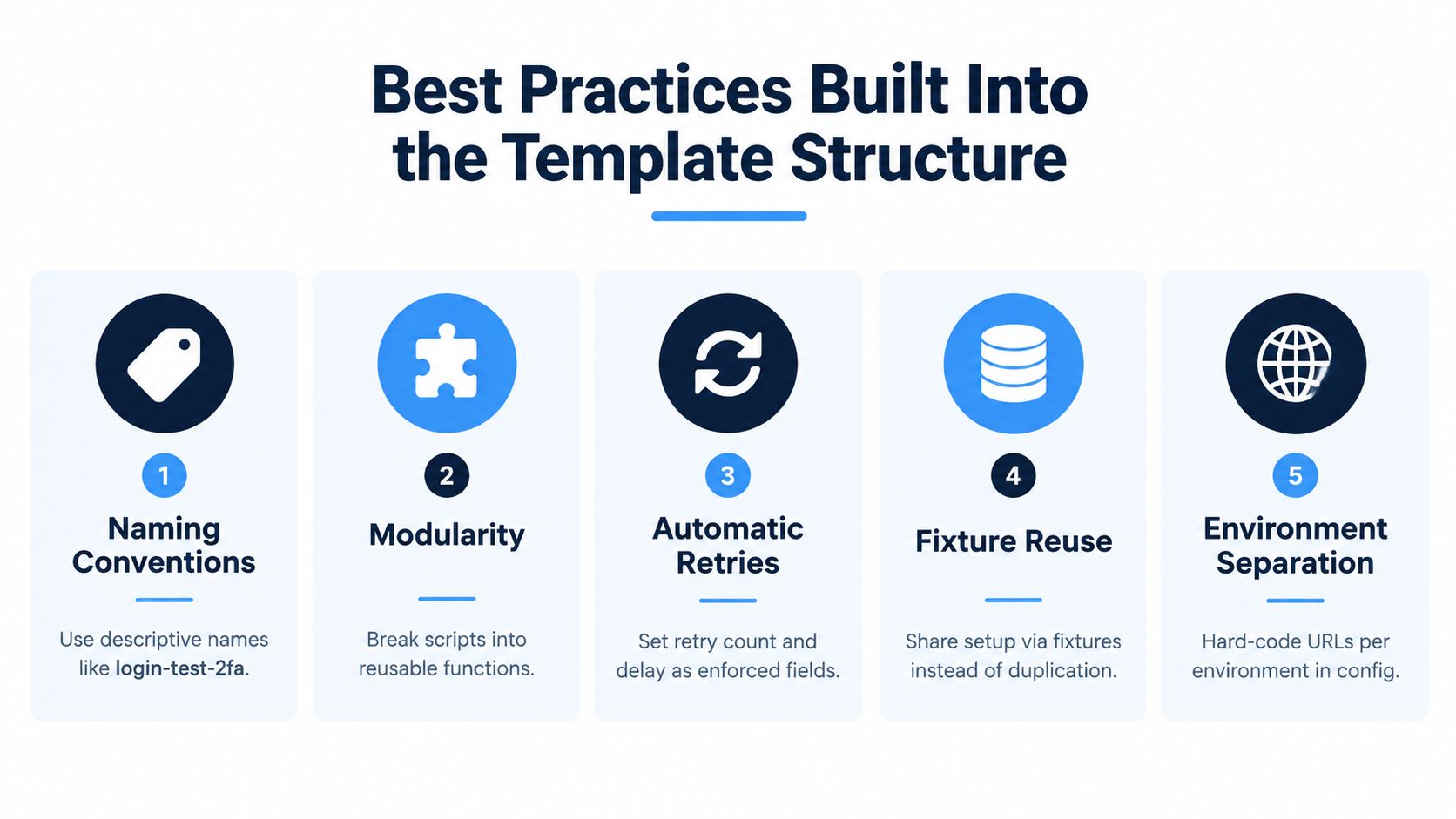
The structural rules worth enforcing
I'd enforce these before merge:
- Owner is mandatory so every script has a human accountable for breakage and review.
- Risk tier is mandatory so CI knows whether the script belongs in smoke, regression, or release-only gates.
- Test data scope is explicit so nobody relies on shared mutable fixtures without clear acknowledgment.
- Step references use abstractions such as page objects, service clients, or mobile screen models by ID.
- Teardown is non-optional even when setup fails halfway through.
What works and what doesn't
These rules are worth the friction:
- Descriptive IDs and names
- Separated fixtures and data
- Explicit assertion sections
- Centralized retry policy
- Versioned template contract
These usually collapse at scale if pushed too far:
- Overly generic reusable methods that hide intent
- Parameterizing every branch into one mega-script
- Global retries that rerun flaky tests without preserving context
- Huge base classes that every framework layer inherits
Good templates reduce freedom in the places that create chaos, and preserve freedom in the places that improve diagnosis.
Add a linting layer
A template becomes real when CI can reject incomplete scripts. Add a repository check that fails if a new script is missing fields like id, purpose, riskTier, owner, preconditions, assertions, or teardownPolicy.
That turns software testing scripts templates from style guidance into architecture. Teams stop arguing about conventions because the repo enforces them.
CI and CD Pipeline Integration Template
A test template without a pipeline contract is only half finished. The script tells you what the test validates. The pipeline template tells you when it runs, why it runs, and whether it can block delivery.
A practical CI shape uses separate lanes for smoke, regression, contract, and publish decisions.
CI/CD Stage Comparison
| Stage | Trigger | Suite | Budget | Gate |
|---|---|---|---|---|
| Smoke | Pull request | High-signal UI and API checks | Short | Blocking |
| Regression | Nightly or scheduled | Risk-weighted broader suite | Longer | Non-blocking for dev flow, blocking for release review |
| Contract | Post-merge against staging | API and integration contract tests | Moderate | Blocking before promotion |
| Publish | Manual or release event | Final release checks and artifact verification | Controlled | Manual approval or freeze-aware gate |
A GitHub Actions skeleton
name: qa-pipeline

on:
  pull_request:
  push:
    branches: [main]
  workflow_dispatch:

jobs:
  smoke:
    if: github.event_name == 'pull_request'
    runs-on: ubuntu-latest
    steps:
      - uses: actions/checkout@v4
      - run: npm ci
      - run: npx playwright test --grep @smoke
      - run: pytest -m smoke
      - run: newman run postman/checkout-smoke.json

  regression:
    if: github.event_name == 'workflow_dispatch'
    runs-on: ubuntu-latest
    steps:
      - uses: actions/checkout@v4
      - run: node scripts/select-risk-suite.js test-plan.json
      - run: npx playwright test --grep @regression
      - run: pytest -m regression
      - run: k6 run perf/smoke-api.js

  contract:
    if: github.ref == 'refs/heads/main'
    runs-on: ubuntu-latest
    steps:
      - uses: actions/checkout@v4
      - run: pytest tests/contracts
What the template should standardize
The CI template should define:
- Trigger condition
- Suite selection rule
- Artifact retention policy
- Failure routing
- Retry budget
- Quarantine lane behavior
If you're choosing or refining the automation stack behind these stages, this article on how to choose a test automation framework helps line up execution tooling with pipeline needs.
Where teams usually go wrong
They gate pull requests with too much UI. They let flaky tests retry indefinitely. They run full regression on every change because they haven't encoded risk. Or they bolt on monorepo support later and realize no test knows which module changes should trigger it.
A test-plan.json file fixes a lot of that. Let changed modules map to suites, environments, and evidence policy. Then both human-authored and generated scripts can plug into the same decision model.
Comparing Keyword-Driven, Data-Driven, and Behavior-Driven Templates
These three styles solve different problems. Teams waste time when they pick one as a religion.
The standards history matters here. The ISO/IEC/IEEE 29119 series began development in May 2007, was initially published in 2013, revised in 2021, and Part 5 on keyword-driven testing was first published in November 2016 and revised in 2024, as summarized in the ISO/IEC 29119 series overview. That progression is useful because it reflects a long move from general testing process guidance toward reusable execution patterns.
Template Style Trade-offs
| Style | Authoring Cost | Readability | Best Fit |
|---|---|---|---|
| Keyword-driven | Moderate setup, lower day-to-day script writing | High for mixed technical teams | Legacy migration, stable regression libraries, shared utility layers |
| Data-driven | Low to moderate once framework exists | Medium | Input matrices, validation rules, API variations |
| Behavior-driven | Higher if done well | High when product and QA share language | Acceptance scenarios, executable specifications |
When each style earns its keep
Keyword-driven works when you need reusable verbs that many contributors can compose. It's a practical bridge for teams moving off spreadsheet-driven or manual-heavy suites.
Data-driven is the default for repeated behavior with varying inputs. Form validation, pricing rules, locale matrices, and API permutations all fit naturally.
Behavior-driven is strongest when language matters as much as execution. Product, QA, and engineering can all review the same scenario and argue about intent before code exists.
Don't force every test into Gherkin. Use BDD where shared business language reduces ambiguity. Use something leaner where it doesn't.
The hybrid pattern that usually wins
Use BDD for top-level acceptance scenarios. Use data-driven tests under those scenarios for combinatorial coverage. Use keyword-driven utilities for stable, reusable action layers or migration paths from older suites.
That gives you readable specifications without stuffing every variation into feature files.
Risk, Observability, and Self-Healing Fields Beyond the Basics
Most public templates are complete in the wrong way. They capture steps, expected results, and execution notes, but they don't capture the three fields modern release systems need most: risk metadata, observability hooks, and self-healing directives.
Public template examples still focus on IDs, steps, prerequisites, expected results, and execution metadata, while recent coverage highlights a gap between those static artifacts and practices such as AI-assisted generation, self-healing automation, and hybrid codeless-code maintenance, as discussed in Smartsheet's review of test case templates and examples. A related gap is that many templates don't help teams make scripts high-signal for business-critical journeys or non-functional release risk, a problem noted in Lead With Skills' discussion of sample test case templates.
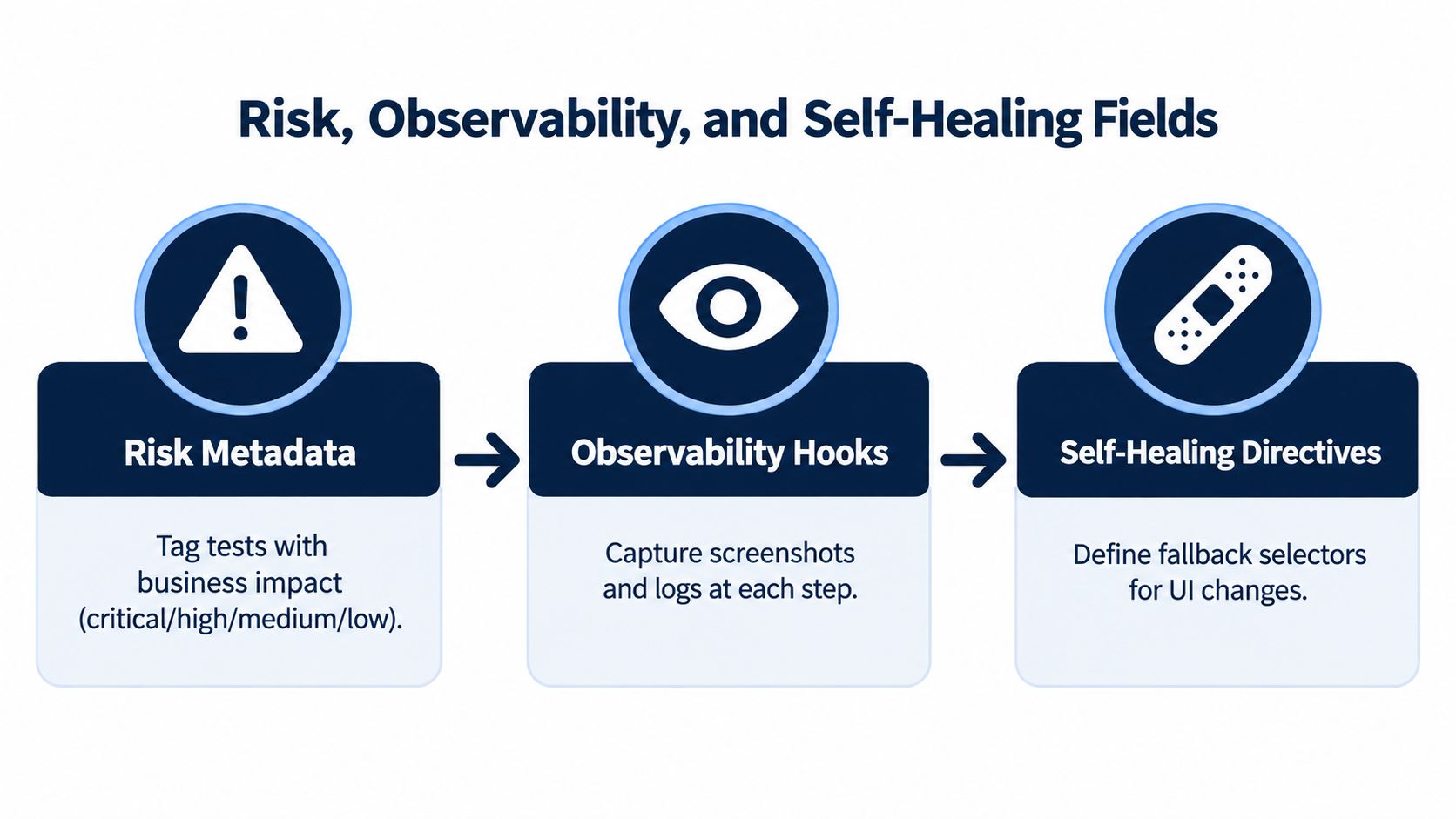
Add a real risk block
Every important script should declare something like this:
risk:
  businessImpact: critical
  blastRadius: checkout-and-revenue
  complianceContext:
    - PCI
  releaseGate: smoke
That lets CI select tests based on what changed and what could break, instead of dumping every scenario into one regression bucket. If your releases feel uncertain even when tests pass, the root issue often sits in this missing metadata layer. This breakdown of why releases feel risky lines up closely with that problem.
Observability and self-healing need boundaries
Add an observability block for trace IDs, structured logs, screenshot policy, HAR capture, and artifact destinations. Then add a selfHealing block that is explicit about fallback selectors, confidence thresholds, and triage requirements.
selfHealing:
  locatorFallbacks:
    - data-test-id
    - role
  confidencePolicy: review-required
  postRunTriage: mandatory
Here's the candid part. Self-healing can reduce noise, but it can also hide real product regressions if teams let repaired selectors pass without review. A template should never allow silent healing with no evidence trail.
Quick Reference, Checklist, and Related Resources
A useful template system ends with a drop-in checklist that engineers can use without reading a long playbook. Keep it in the repo root. Review it in pull requests. Version it like code.
The strongest formal baseline for that checklist is ISO/IEC/IEEE 29119-3:2021, which specifies software test documentation templates usable by any organization, project, or testing activity, and positions those templates as a consistent, auditable structure for reusable test artifacts, according to the ISO 29119-3:2021 standard description.
Ship checklist for every script
- Header is complete with script ID, owner, version, purpose, and linked requirement or design reference.
- Preconditions are executable as fixtures, seed data, auth state, or environment flags.
- Inputs are externalized from core logic unless the test needs inline data.
- Assertions are explicit and separated from action steps.
- Actual-result evidence is attached through logs, traces, screenshots, or protocol artifacts.
- Retry policy is declared at script or suite boundary, not hidden in helper methods.
- Risk metadata is present and mapped to CI gate behavior.
- Teardown exists for both success and failure paths.
- Self-healing policy is documented if locator repair or fallback behavior is enabled.
- Version control rules apply through branch protection and review on template changes.
Template Type Quick Reference
| Template Type | Primary Framework | Required Template Fields | Execution Layer |
|---|---|---|---|
| UI | Playwright, Cypress, Selenium | ID, purpose, preconditions, locator policy, assertions, evidence, teardown | Browser |
| REST | Postman/Newman, RestAssured, pytest | ID, auth preconditions, request block, schema ref, semantic assertions, evidence | Service |
| GraphQL | Postman, pytest, custom client | ID, operation, variables, schema rules, field assertions, evidence | Service |
| gRPC | grpcurl wrappers, generated clients, test runners | ID, service method, protobuf contract, message assertions, evidence | Service |
| Android | Appium, Espresso | ID, capabilities, permission policy, gesture hooks, assertions, teardown | Mobile |
| iOS | Appium, XCUITest | ID, capabilities, biometric policy, gesture hooks, assertions, teardown | Mobile |
| Cross-platform | Mixed orchestration | ID, dependent suites, workflow assertions, evidence routing | Orchestration |
| Smoke | Any runner | ID, gate policy, high-signal assertions, fast teardown | CI gate |
| Regression | Any runner | ID, risk tier, broader data coverage, diagnostics policy | Scheduled or release |
| Contract | API or integration runner | ID, schema version, protocol contract, fail-fast assertions | Service and integration |
Keep the templates alive
Don't store canonical templates in a stale wiki. Keep them in the same repository as the tests, protected by review rules, and versioned with the framework code that executes them.
When you change the template, publish a migration note and update validation tooling in the same pull request. That's how software testing scripts templates stay living contracts instead of turning into documentation theater.
AskYourQA builds the kind of automation systems this article describes. That includes template-driven frameworks, API and mobile coverage, CI/CD gating, and high-signal release feedback designed around critical user journeys. If you want help turning scattered scripts into a maintainable automation system, visit AskYourQA.