
At 11 p.m., a release lead watches a CI queue grind through thousands of regression checks. The dashboard shows failures, but it doesn't show which ones matter. Engineers reopen old tickets, rerun unstable tests, and search for the two genuine defects buried under noise. The release decision becomes a judgment call made under pressure.
That situation explains why test automation as a service has become an operating-model choice, not a tooling purchase. The market has moved far beyond occasional browser scripts. One forecast places the automation testing market at USD 40.44 billion in 2026, rising to USD 78.94 billion by 2031, with an implied 14.32% compound annual growth rate (market forecast and historical context). Buyers aren't purchasing test cases. They're purchasing ownership, maintenance, pipeline feedback, and clearer release decisions.
Table of Contents
- The Release-Day Bottleneck No One Wants to Own
- What Test Automation as a Service Really Means
- Engagement Models You Can Buy Today
- What Mature Service Delivery Actually Covers
- Why Fewer Higher-Signal Tests Beat Bigger Suites
- What to Demand From Any Vendor or Consultancy
- Measuring ROI Without Hand-Waving
- When the Service Model Is the Right Call
The Release-Day Bottleneck No One Wants to Own
The problem rarely starts with bad intentions. A developer writes a few Selenium checks for a critical flow. Another engineer adds coverage for a new feature. A QA specialist creates a regression pack before moving to another project. Over time, the organization accumulates browser scripts, test data dependencies, environment assumptions, and CI jobs that nobody fully owns.
The release lead inherits the consequences. A test fails because an asynchronous page loaded slowly. Another breaks because a shared account contains unexpected data. A third reports a timeout caused by a constrained environment. The team reruns the suite, but rerunning doesn't explain the failure. It only delays the decision.
This is why releases feel risky even when a company has plenty of automation. The issue isn't the absence of scripts. It's the absence of a system that tells people whether the product is safe to ship. Teams that want to understand the broader causes should examine why releases feel risky, especially where quality signals and delivery pressure collide.
The ownership gap
In-house automation often suffers from four structural weaknesses:
- No durable owner: The people who wrote the tests rotate to other work, while maintenance remains nobody's explicit responsibility.
- Weak pipeline integration: Tests exist in a repository but don't run at the right pull request, merge, deployment, or release stage.
- Poor failure diagnosis: Reports show pass or fail status without connecting failures to application code, test code, environment conditions, or data.
- Coverage inflation: Leaders track the number of scripts rather than the user journeys that those scripts protect.
Practical rule: A test that doesn't produce a trustworthy release decision is an operational liability, regardless of how much code sits behind it.
A managed service exists to close this ownership gap. The value isn't “more automation” in the abstract. It's less time spent triaging noise, faster feedback on meaningful changes, and a named team accountable for keeping the signal usable. Buying the service means buying back release velocity and decision clarity.
What Test Automation as a Service Really Means
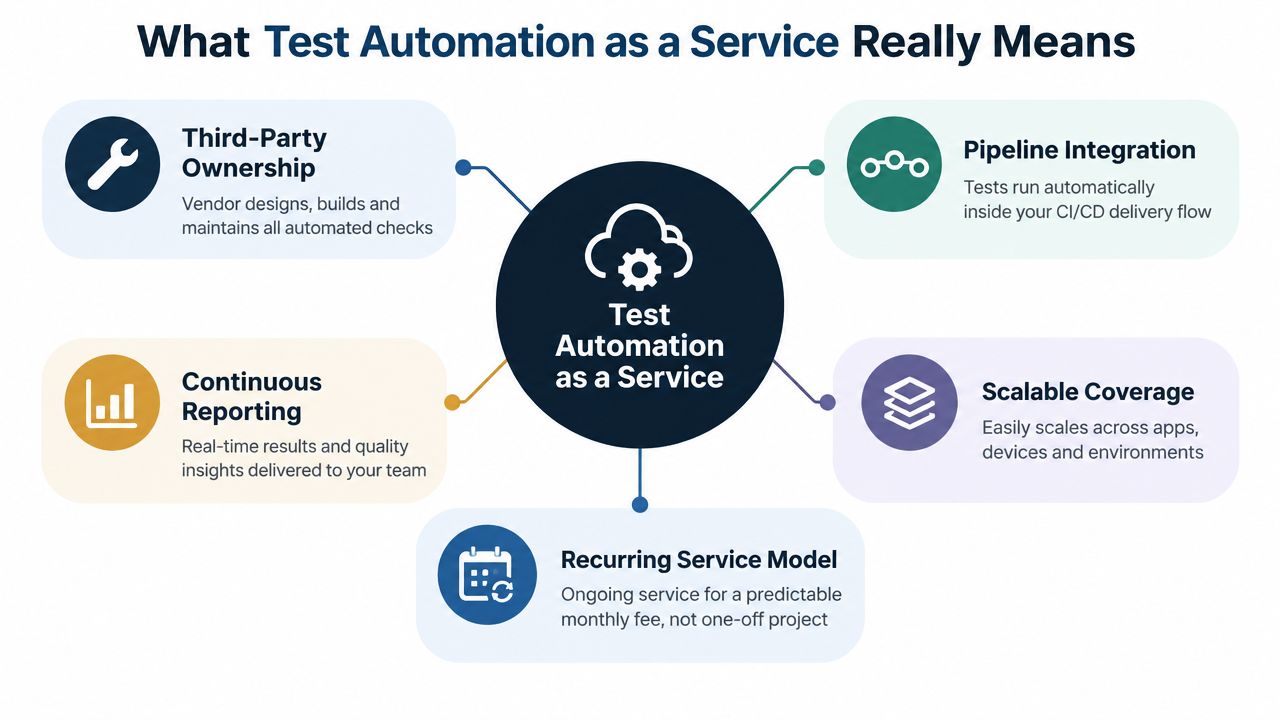
Test automation as a service is a recurring engagement in which a third party designs, builds, maintains, runs, and reports on automated checks for your product. The provider connects those checks to your delivery pipeline and accepts ongoing responsibility for keeping them useful as the application changes.
That definition matters because many vendors sell a project while calling it a service. They deliver a framework, demonstrate a passing suite, and leave your engineers with the maintenance burden. A real service continues after the initial build. It has accountable people, operating procedures, reporting, escalation paths, and agreed response expectations.
From scripts to a managed system
The shift from ad-hoc scripting to managed delivery has several parts:
- Checks become versioned engineering assets. Test code, data setup, configuration, and environment requirements live under disciplined change control.
- Maintenance becomes an explicit obligation. When a product flow changes, the provider updates the relevant checks instead of waiting for your team to discover the breakage.
- Execution becomes part of delivery. The suite runs through CI/CD at defined quality gates, not only when someone remembers to start it.
- Coverage becomes evidence. Reporting maps automated checks to business-critical journeys, risks, environments, and release decisions.
- Scale becomes planned capacity. The service can expand across web, mobile, APIs, performance, security, and AI-enabled behavior without forcing your product engineers to assemble every capability themselves.
Selenium's history illustrates how far the discipline has evolved. Jason Huggins created the original JavaScriptTestRunner at ThoughtWorks in Chicago in 2004, initially for an internal Time and Expenses application, before the project was discussed for open sourcing later that year (Selenium history and market context). A tool that began as an internal engineering solution helped establish browser automation as a repeatable practice. A service model adds the missing operating layer around that practice.
The tools still matter. Playwright, Selenium, Cypress, Appium, API frameworks, load-testing platforms, and security scanners all have legitimate uses. But the tool isn't the service. Accountability is the service.
Engagement Models You Can Buy Today
You have three practical models to choose from. The right answer depends less on brand preference than on how much domain knowledge you need to retain, how quickly you need capacity, and who will own the system after launch.
Dedicated QA team
A vendor embeds automation engineers who work as an extension of your organization. Your product leaders usually direct priorities, while the provider supplies hiring depth, technical management, and delivery capacity.
This model fits complex products with proprietary workflows, regulated processes, or frequent requirement changes. The team learns your domain and can participate in planning, test design, defect analysis, and release readiness. The trade-off is ramp-up time. You're paying for people and coordination, and the service can become dependent on individuals unless the vendor documents decisions and maintains knowledge transfer.
Managed automation framework
The provider owns a reusable framework and assigns a focused squad to build, maintain, execute, and report on checks. You define product risks and release priorities. The provider handles the automation system and its day-to-day operation.
This is the strongest default for companies seeking speed-to-value and predictable operating capacity. You get a smaller dedicated group than a full embedded team, but you should insist on direct access to the engineers making technical decisions. The danger is abstraction. If the vendor hides the framework, controls the code, or forces a proprietary platform, your exit risk rises.
Project-based consultancy
A consultancy delivers a defined outcome, such as a Playwright migration, mobile automation rollout, framework redesign, or initial CI integration. It works well when the deliverable has a clear boundary and your internal team can take over afterward.
The weakness is long-term maintenance. A successful launch can still fail operationally if no one owns test failures, data cleanup, environment drift, and application changes after the engagement ends.
| Dimension | Dedicated QA Team | Managed Automation Framework | Project-Based Consultancy |
|---|---|---|---|
| Cost predictability | Depends on team size and staffing | Usually clearer recurring capacity | Clear project scope, uncertain follow-on cost |
| Ramp-up time | Slower, because domain knowledge must develop | Faster, because the provider brings a working model | Fast for a defined deliverable |
| Knowledge transfer | Strong if embedded and documented | Must be contractually required | Often concentrated at handover |
| Maintenance ownership | Shared with your organization | Provider-owned by design | Usually returns to the client |
| Exit risk | People and knowledge dependency | Framework and platform dependency | Handover quality dependency |
| Best fit | Deep domain collaboration | Ongoing pipeline reliability | Bounded transformation or migration |
My recommendation is straightforward. Choose a managed framework when automation is a continuing operational need, a dedicated team when domain complexity dominates, and a project consultancy only when you can name the internal owner who will run the system afterward.
What Mature Service Delivery Actually Covers
A credible provider doesn't stop at browser scripts. It builds a connected quality system that feeds the same delivery process and produces evidence people can act on.
Eight layers of useful coverage
- Functional UI automation: Protects critical web and mobile journeys, such as authentication, checkout, account changes, and billing, so releases receive realistic end-to-end validation.
- API and contract testing: Checks service behavior and interface agreements earlier and more directly than a full browser flow, improving feedback for backend changes.
- AI-augmented test generation: Helps create or update candidate tests for changing behavior, but human reviewers still need to validate whether those tests represent meaningful risks.
- Security and DAST scanning: Examines the running application for weaknesses that functional checks won't reveal, helping teams identify security risk before production exposure.
- Performance and load testing: Shows how response time, stability, and bottlenecks behave under expected and stressed conditions.
- Cross-browser and device coverage: Confirms that important journeys work across the browsers and devices your customers use.
- CI/CD pipeline ownership: Ensures smoke, regression, API, security, and performance checks execute at the correct delivery stages and fail for actionable reasons.
- Analytics and reporting: Converts raw results into coverage maps, failure clusters, trends, and release-readiness signals.
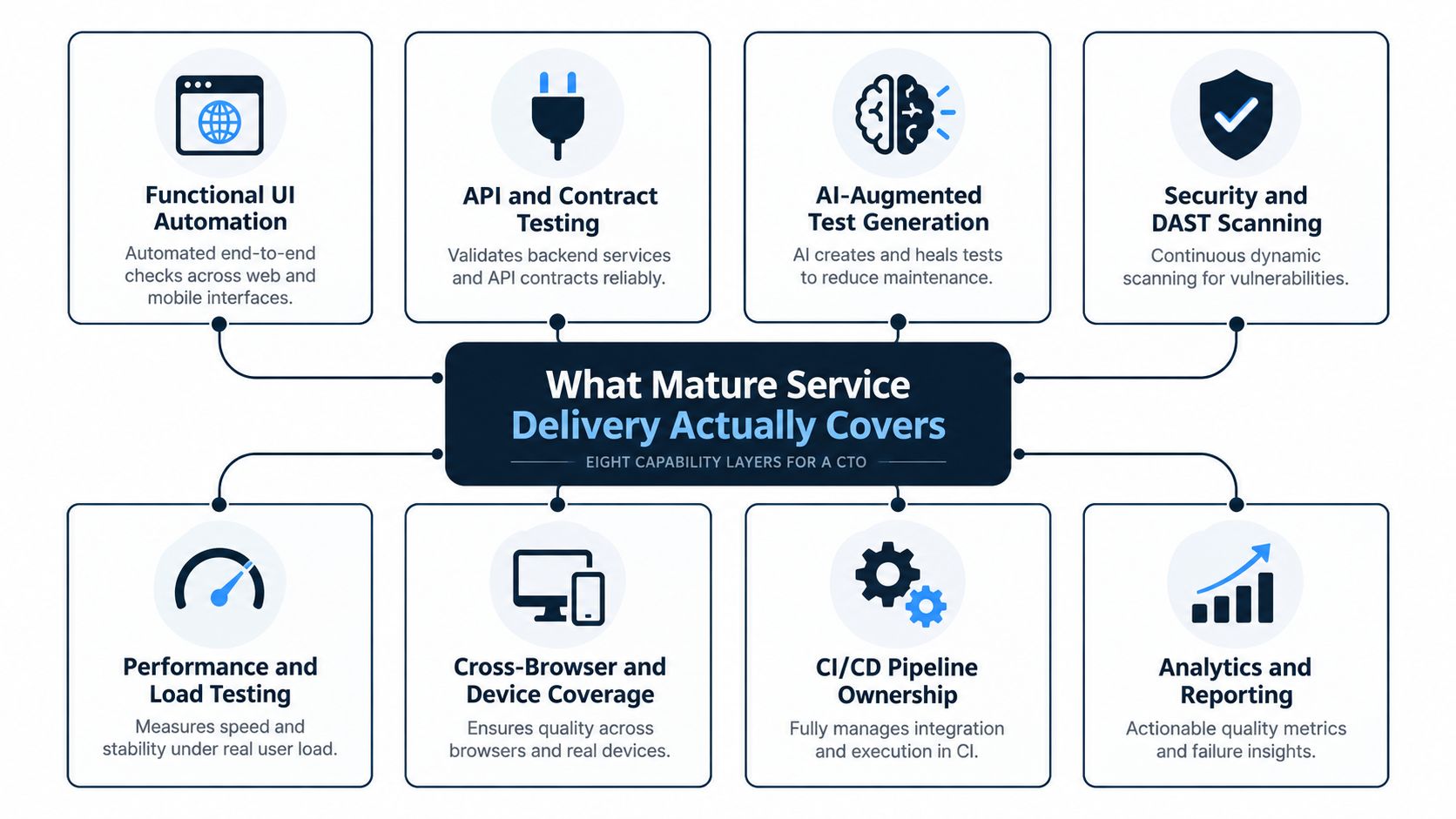
These layers should reinforce one another. An API check can provide faster feedback than a UI test. A security scan can run against the same deployed environment. A performance test can use controlled data and pipeline artifacts. Reporting should connect all of them to product risk rather than placing each result in a separate tool.
A common scope gap is pipeline plumbing. Vendors script tests, place them in a repository, and call the project complete. Your engineers then discover that the suite doesn't run reliably on pull requests, can't provision data, or produces reports nobody reads.
The deliverable isn't a test repository. It's a dependable feedback loop that fires when code changes.
A mature provider also advises on what not to automate. Exploratory testing, usability judgment, and ambiguous one-off investigation still need skilled humans. The service should reserve automation for repeatable checks while preserving human attention for questions automation can't answer.
The following video provides additional context on how an automation system can fit into a broader quality process.
Why Fewer Higher-Signal Tests Beat Bigger Suites
A large test count can impress a board while giving release teams weaker evidence. Redundant checks consume execution time and triage attention, so the suite grows even as confidence declines. Judge automation by the decisions it supports, not by the number of scripts a provider delivers.
Flakiness makes that failure visible. Empirical research in large industrial CI/CD environments reports flaky-test rates of 11–27% of tests and flaky-related rates of 5–16% of build failures (research on flaky tests and stabilization). Timing, resource contention, environment variation, asynchronous UI behavior, unstable test data, concurrency defects, and missing synchronization all contribute. Blind reruns conceal these causes and leave the operating model unchanged.
Require the service team to rank tests by business consequence. Start with journeys whose failure could block revenue, access, data integrity, customer trust, or compliance. Cover those paths end to end, then place detailed checks in unit, API, contract, and integration layers, where failures run faster and diagnosis is clearer.
Scale makes this discipline more important. Large CI/CD systems can execute more than 50 million tests daily, and a 5–10% flaky rate can spoil thousands of builds (CI/CD feedback and flaky-test remediation research). The service should therefore optimize signal per pipeline minute, not the number of checks it claims to have written.
| Dimension | Broad 2,000-Script Suite | Curated 250-Script Suite |
|---|---|---|
| Primary objective | Maximize visible coverage | Protect the most important risks |
| Maintenance burden | High, with more obsolete and overlapping checks | Concentrated on valuable flows |
| Failure triage | More noise and ambiguous alerts | Smaller set of failures to investigate |
| Pipeline effect | Can increase latency and queue pressure | Easier to prioritize and parallelize |
| Executive value | Impressive count, weak decision context | Clearer relationship to release risk |
| Pruning discipline | Often neglected | Built into normal service operation |
These figures are illustrations, not targets. Suite size must follow product risk. Every test should justify its place by protecting a meaningful failure mode, detecting a regression earlier, or supplying evidence for a release decision.
A practical stabilization example shows the value of that approach. In one industrial database-reliant system, removing redundant background tasks, explicitly disposing of test data, and disabling “dirty” tests raised the chance of a passing pipeline run from 27% to 95%, while monthly release rate moved from 60% to 96%. Treat those results as evidence that reliability work can improve delivery, not as promises a vendor can generalize. Make test stability an explicit service outcome.
What to Demand From Any Vendor or Consultancy
Procurement should test the provider's operating model, not its slide deck. Ask who owns the suite at 2 a.m., who investigates a failure that appears only in CI, and who decides whether a test should be fixed, redesigned, quarantined, or removed.
Start with the pipeline. The vendor should show how its work integrates with your source control, CI/CD stages, environments, secrets management, test data, and reporting. If the answer focuses only on framework selection, the proposal is incomplete.
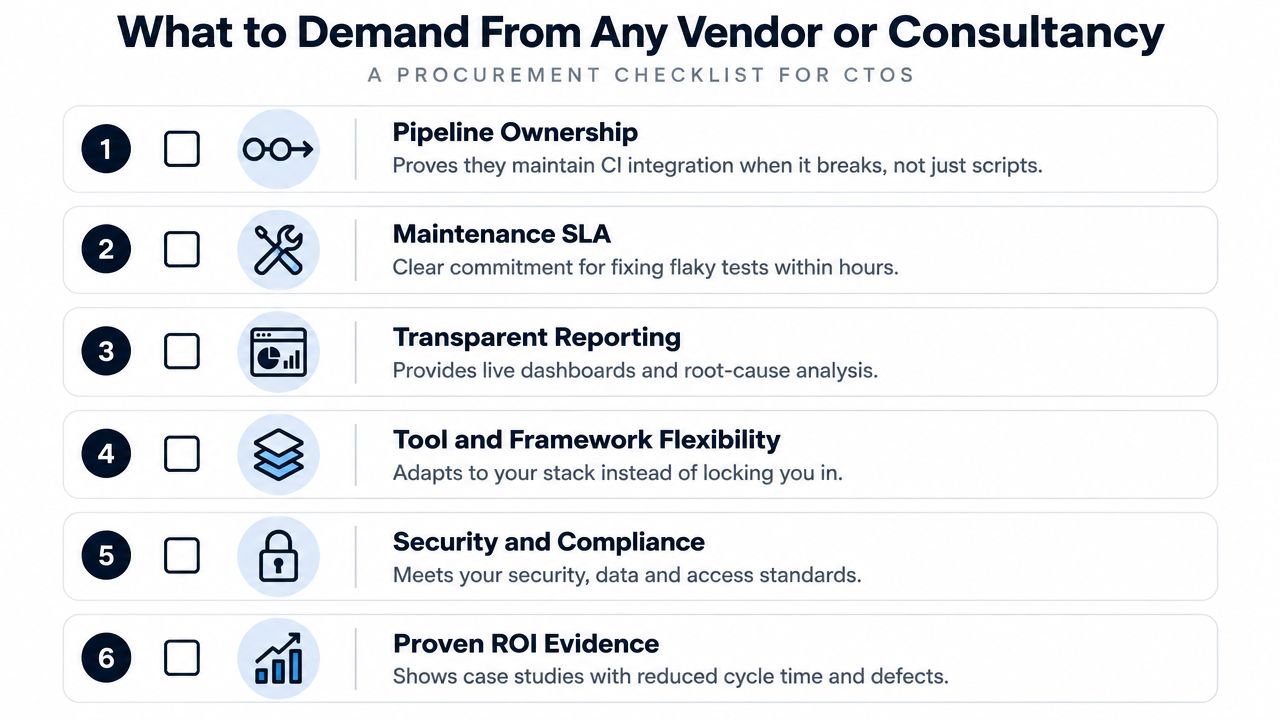
The procurement checklist
- Pipeline ownership: Require a named owner for CI integration, execution failures, environment issues, and reporting delivery.
- Maintenance SLA: Define how the provider classifies flaky tests, assigns triage, and repairs or retires unstable checks.
- Coverage mapping: Demand a map from automated checks to user journeys, business risks, services, devices, and release gates.
- Tool flexibility: Keep your code and test artifacts portable. Avoid contracts that make migration technically or commercially difficult.
- Security and data controls: Confirm how credentials, personal data, synthetic data, access permissions, and environment isolation are handled.
- ROI evidence: Establish baseline metrics before work starts and require reporting that shows movement against those baselines.
Use a framework evaluation guide such as how to choose a test automation framework, but don't let tool comparison replace service due diligence. A technically sound framework still fails if nobody maintains the pipeline or owns the failures.
Green flags and red flags
Green flags include a provider that challenges inflated scope, proposes removing low-signal checks, explains its failure-triage workflow, identifies the engineers assigned to your account, and discusses how the service will handle AI behavior, secure data, performance risk, and pipeline latency.
Red flags include fixed test-count deliverables, vague “coverage” language, proprietary lock-in, no commitment to CI/CD ownership, dashboards that show only pass or fail, and a handover plan that treats maintenance as your problem.
If a vendor refuses to define what a healthy suite looks like, don't sign. You're not buying activity. You're buying a reliable operating capability.
Measuring ROI Without Hand-Waving
ROI should appear in pipeline data, delivery records, incident history, and engineering time allocation. “Testing got faster” isn't a business case. A CTO needs to know whether the organization ships sooner, escapes fewer defects, releases more consistently, and returns engineering capacity to product work.
Track four measures from a defined baseline:
- Release cycle time: Measure the elapsed time from an approved change or development start to production deployment. A healthy direction is downward.
- Production defect escape rate: Count defects first detected after release against the agreed defect population and period. A healthy direction is downward.
- Release frequency: Count production releases over a consistent period. A healthy direction is upward when quality remains controlled.
- Engineer hours reclaimed: Record time previously spent on manual regression, repetitive triage, and test maintenance that the service removes or reduces. A healthy direction is upward for product work, not for more testing activity.
| Metric | How to Measure | Healthy Direction |
|---|---|---|
| Release cycle time | Compare timestamps across planning, merge, deployment, and production events | Down |
| Defect escape rate | Link production defects to the release and stage where they were missed | Down |
| Release frequency | Count completed production releases over the same reporting period | Up |
| Engineer hours reclaimed | Track time spent on manual regression and avoidable failure triage before and after engagement | Up |
A worked example should use your own baseline, not a vendor's invented promise. Suppose a 12-person engineering team releases monthly and records a 6% production escape rate. If it later reaches weekly releases and a 1.5% escape rate over 12 months, the organization has changed both delivery capacity and risk exposure. It has moved from 12 to 52 releases in that period, while the observed escape rate has fallen by 4.5 percentage points.
Those figures don't, by themselves, prove financial ROI. To calculate that, attach incident remediation cost, customer impact, delayed-feature opportunity cost, and the value of reclaimed engineering hours. The calculation should also include service fees, infrastructure, internal oversight, and transition costs.
The measurement discipline matters more than the arithmetic. Capture baselines before the first sprint, agree on definitions, and review trends with the vendor. Cost savings from QA automation can inform the conversation, but your contract should use your own pipeline and incident data.
When the Service Model Is the Right Call
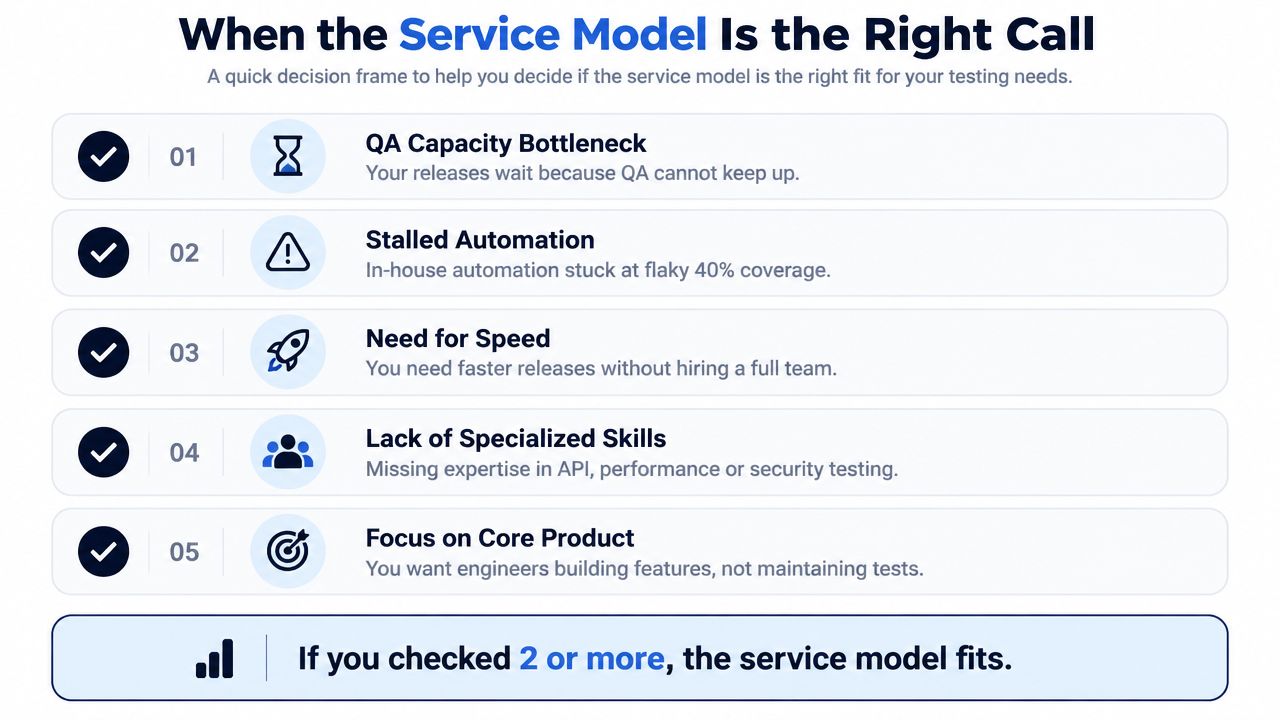
Buy test automation as a service when the bottleneck is operational capacity, not when automation sounds modern. The model fits organizations whose releases wait for QA, whose internal suite has become unreliable, whose release goals exceed hiring speed, or whose product requires specialist API, security, performance, mobile, or AI testing.
The market evidence supports that shift in priorities. Independent reports describe teams averaging about 40% automated testing today while aiming for 63% soon, while also identifying test breakages, data problems, skill shortages, and environment complexity as major barriers (Software Testing and Quality Report). The same report says only about 26% of QA teams are mostly or fully integrated with DevOps pipelines, and only 15% have scaled AI in QA enterprise-wide, despite 43% experimenting with it. These figures point to an execution gap, not a shortage of available tools.
AI features create another reason to demand a mature service. A global digital-quality survey reports that 80% of respondents lack in-house AI testing expertise, 60% struggle with secure, scalable test data, and synthetic data usage rose from 14% in 2024 to 25% in 2025 (World Quality Report 2025–26). The service must validate LLMs and agents with output checks, safety constraints, repeatable scenarios, and controlled data. Generic browser regression won't cover that risk.
A buyer checklist for this week
- Define the release bottleneck in one sentence.
- Baseline cycle time, escape rate, release frequency, and reclaimed engineering hours.
- Request a coverage map tied to critical user journeys.
- Ask how flaky tests are scored, owned, and repaired.
- Require pipeline ownership in the statement of work.
- Contract outcomes against agreed baselines, not script volume.
The model is the wrong call when the product is still searching for product-market fit, requirements are too unclear to define meaningful checks, or the team is too small to support the necessary domain and service relationship. In those cases, improve product clarity and engineering fundamentals first.
Test automation as a service is the right investment when you need a dependable quality operating model, not another pile of scripts. AskYourQA designs automation systems across frontend, backend, APIs, mobile, AI, security, performance, and CI/CD, with a focus on critical user journeys and high-signal feedback. Visit AskYourQA to discuss your current release bottleneck, define measurable baselines, and assess whether a managed automation engagement fits your delivery model.