
Shift-left testing moves quality checks earlier in the software lifecycle so defects are found when they're cheapest to fix, before code reaches staging or production. GitLab reported that 74% of organizations had shifted testing left in 2020, showing how the practice had moved beyond theory into everyday engineering.
You've probably seen the opposite pattern. A feature looks complete, then waits for a staging environment, a QA cycle, and a release candidate. A tester finds a broken API assumption or an ambiguous requirement. The developer has already moved to another task, the original context is gone, and a small defect now interrupts several people's work.
That delay is the problem shift-left testing addresses. It isn't a demand for more tests. It's a way to shorten the time between introducing a change and learning whether that change works.
Table of Contents
- What Shift Left Testing Really Means
- How Shift Left Testing Evolved Over Time
- Why Early Defect Detection Saves Time and Money
- Core Practices That Make Shift Left Work
- Metrics That Prove Shift Left Is Working
- Where Shift Left Falls Short and How to Mitigate It
- A 90-Day Roadmap to Adopt Shift Left Testing
What Shift Left Testing Really Means
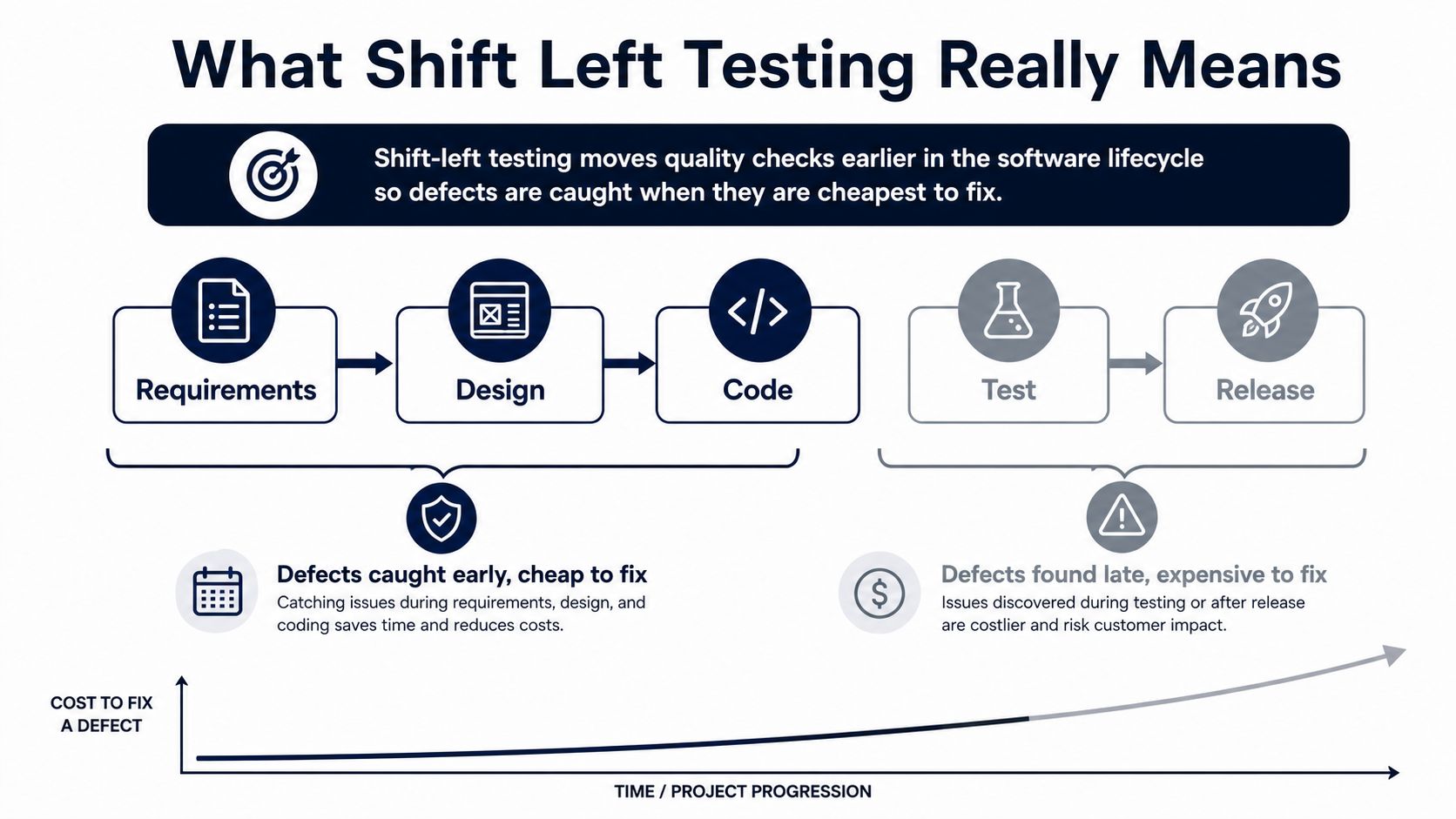
Shift-left testing is the practice of moving quality checks earlier in the software lifecycle so defects are caught when they're still isolated and relatively cheap to fix. Instead of treating testing as a final inspection, the team validates assumptions during requirements, design, coding, integration, and continuous delivery.
A kitchen offers a useful comparison. A restaurant that waits until a customer bites into a meal to discover a problem has missed several easy checks. The chef can taste ingredients during preparation, inspect the dish while plating, and confirm the order before it leaves the kitchen. Software teams use the same principle by checking behavior at multiple points rather than relying on one late QA phase.
Moving gates along the lifecycle
Think of development as a line running from requirements to design, code, integration, staging, and production. In a traditional waterfall-style process, quality activity tends to gather toward the right side. Testers receive a largely completed system and must discover problems after decisions, dependencies, and code paths have already accumulated.
Shift-left testing pulls useful checks toward the left:
- Requirements: clarify acceptance criteria, edge cases, privacy needs, and failure behavior.
- Design: review service boundaries, data flows, accessibility, and threat assumptions.
- Coding: run unit tests, linters, static analysis, and local security checks.
- Pull requests: validate APIs, contracts, dependencies, and critical workflows before merge.
- Staging and production: continue with exploratory, resilience, compatibility, monitoring, and real-world validation.
The distinction matters because earlier testing isn't automatically better testing. A slow, noisy scan that blocks every developer on every small change can create a new bottleneck. Effective shift-left testing uses small, high-signal checks close to the code that changed, with clear pass and fail criteria. The Software Engineering Institute describes the principle as starting testing “as early as practical” in the lifecycle, while its explanation of shift-left testing types also makes clear that teams need more than one testing layer.
Four forces make this approach especially relevant for engineering leaders: faster release cadence, the dependency complexity of microservices, AI-assisted code generation, and tighter security and compliance scrutiny. More code and more interconnected services increase the value of fast feedback, but they also make test selection and pipeline design more important.
How Shift Left Testing Evolved Over Time
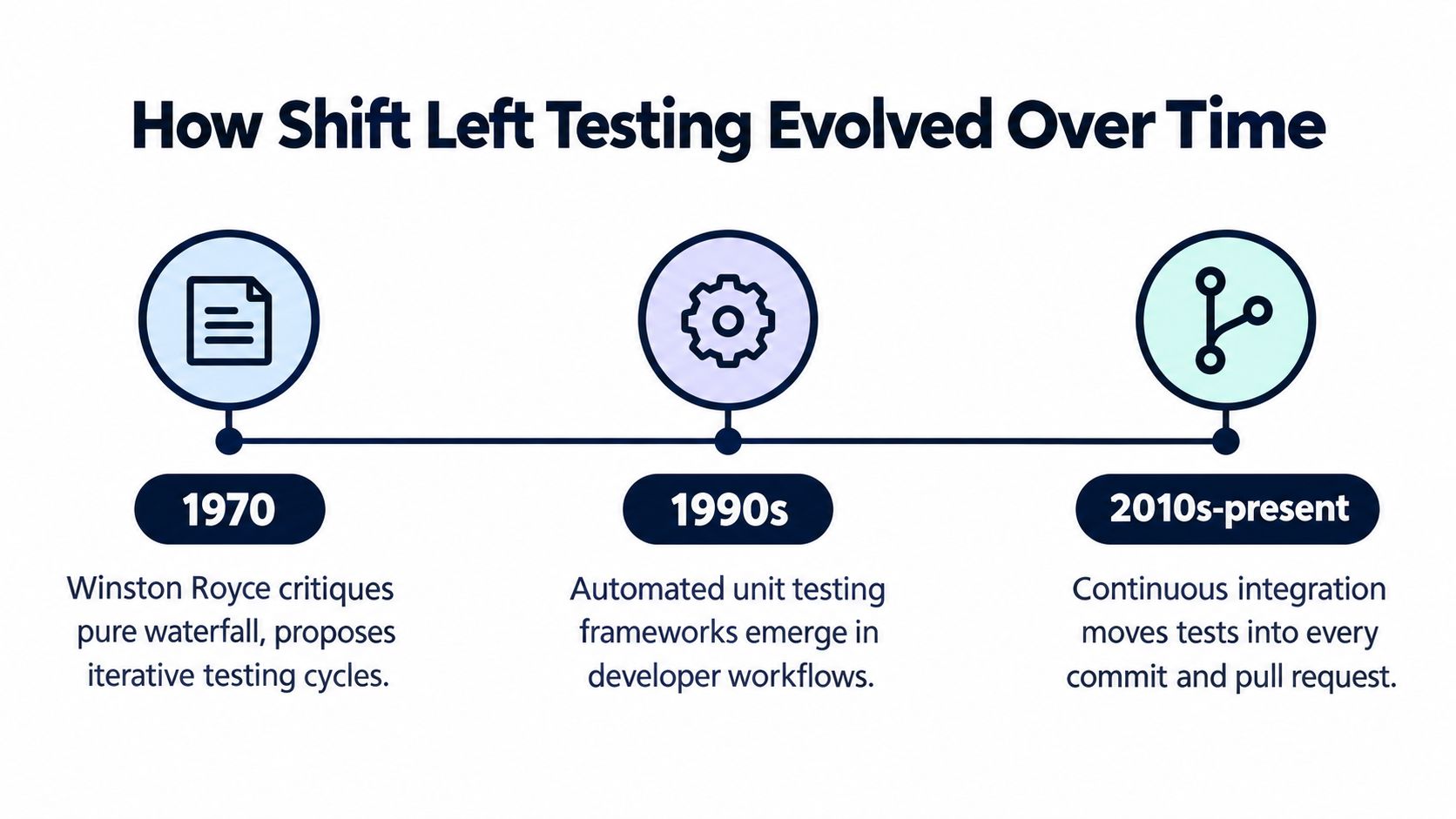
The idea developed as a response to late discovery, but its history is more nuanced than a simple “waterfall was bad, Agile fixed it” story. Winston Royce's 1976 paper on large software systems is a commonly referenced historical anchor for the sequential model that later shift-left thinking challenged. The paper illustrated a staged development approach, while also discussing the risks of treating that sequence as a rigid one-way process.
Larry Smith's 2001 paper is commonly associated with coining the phrase “shift left testing,” according to the historical account summarized in the GitLab DevSecOps survey material. The phrase gave engineering teams a compact way to describe a broader movement, testing and quality work should begin closer to requirements and code creation instead of waiting for a separate late-stage handoff.
From principle to pipeline behavior
The practical change came when automated testing and continuous integration made frequent validation possible. In the 2018 and 2019 survey data cited in a DZone and Sauce Labs automated testing guide, 54% of respondents said they began automated testing during development in 2018, rising to 66% in 2019. By contrast, the share beginning in staging, QA, or testing fell from 31% to 22% over the same comparison.
The same survey showed automated story-level tests increasing from 36% to 46%, and component tests increasing from 52% to 59%. Those figures describe a change in location and breadth, not just a larger test inventory. Teams were putting more validation into the development phase and covering more meaningful units of behavior.
This historical arc leads to a practical lesson for 2026. Shift-left testing isn't a test team's request to inspect work earlier. It's an engineering operating habit where developers, QA, security, and product clarify risk before implementation and automate feedback at the point where a change enters the system.
Why Early Defect Detection Saves Time and Money
The economic argument for shift-left testing rests on a defect-cost curve. An IBM Systems Sciences Institute figure, repeated in IBM's overview of shift-left testing economics, states that fixing a defect after deployment can cost around 100 times more than fixing it during the requirements phase.
That multiplier isn't a universal invoice for every bug. It represents the expanding work required as a defect travels through the lifecycle. A misunderstood requirement caught during planning may need a conversation and a clarified acceptance rule. The same misunderstanding found in production may involve code changes, regression analysis, deployment coordination, support communication, incident management, and customer remediation.
GitLab's 2020 DevSecOps survey reported that 47% of respondents identified testing as the number one reason for release delay, while the same report found that 74% of organizations had shifted testing left in that survey population. The relationship is practical: if testing waits until the end, it can become the release bottleneck; if useful checks run earlier, the final stage can focus on risks that require a complete environment.
| Lifecycle Stage | Indexed Cost Multiplier | Typical Fix Activity |
|---|---|---|
| Requirements | 1x reference point | Clarify behavior, acceptance criteria, and constraints |
| Design | Higher than requirements | Adjust interfaces, data flow, or architecture |
| Coding | Higher than design | Modify implementation and rerun affected tests |
| Testing or staging | Higher than coding | Diagnose integrated behavior and coordinate rework |
| Production | Around 100x the requirements-phase reference in the cited IBM figure | Hotfix, deploy, monitor, support affected users, and investigate cause |
Several costs hide behind a late defect:
- Rework: developers revisit code that has already been integrated with other changes.
- Context switching: the original author may have moved to unrelated work.
- Coordination: QA, development, operations, product, and support may all join triage.
- Release disruption: a hotfix can require an emergency branch and an expedited review.
- Opportunity cost: planned feature work pauses while the team restores expected behavior.
A useful financial model should therefore count more than engineering hours. Include on-call interruption, release delay, customer communication, support volume, and the chance that rushed remediation introduces another defect. The AskYourQA cost-savings resource can help teams frame that broader conversation, but the principle is simple: the earlier the team learns, the smaller the correction loop tends to be.
Practical rule: Measure the cost of feedback delay, not only the cost of writing tests.
Core Practices That Make Shift Left Work
A repository doesn't become shift-left just because it contains automated tests. The checks must run at useful moments, produce results developers can interpret, and protect the paths that matter to customers.
Start with behavior before implementation
During feature design, turn an important behavior into a small set of unit-level examples. For a subscription service, that might include a valid plan change, an expired payment method, and an unauthorized account access attempt. The developer can write the expected behavior before or alongside the implementation, using a test-first style where it makes sense.
For a service that depends on another service, add a contract test stub at the same point. The stub records the request shape and expected response without requiring the entire downstream system to be available. That exposes a broken assumption while the change is still local.
Test design also reveals unclear requirements. If nobody can agree whether a missing field should produce a validation error or a default value, the team has found a product decision before it becomes a defect. Guidance on choosing a test automation framework is useful here, but framework selection should follow the behaviors and feedback needs, not lead them.
Validate service boundaries in the merge pipeline
Unit tests can confirm local logic while missing a mismatch between services. API and contract tests fill that gap by checking request shapes, status codes, authentication behavior, error responses, and schema compatibility.
Suppose a billing service changes customer_id from a string to a numeric value. A consumer may still compile successfully while failing at runtime. A contract test running against the merge commit can flag the disagreement before the change reaches a shared integration environment.
Keep these tests targeted. They should answer a specific question about a boundary, not recreate every end-to-end scenario inside the pull-request job.
Make the pull request a quality checkpoint
A practical pre-merge pipeline often runs in this order:
- Fast feedback: formatting, linting, type checks, and focused unit tests.
- Change validation: API and contract tests relevant to the modified services.
- Repository safety: static analysis and dependency scanning.
- Targeted confidence: critical smoke checks, including a lightweight performance test where the change warrants it.
Require the pipeline to report a clear status and block merging when a genuine failure appears. Don't hide instability inside the same red gate. A flaky-test quarantine lane lets the team isolate unreliable checks, assign ownership, and repair them without training developers to ignore every failure.
Put security and performance beside functional checks
Security belongs near code creation because insecure patterns and vulnerable dependencies are easier to address before release packaging. SAST can flag suspicious code paths, dependency scanning can identify risky components, and configuration checks can expose unsafe defaults.
Performance checks should remain focused. A k6 smoke script might verify that an endpoint responds within an agreed operational boundary under a small, controlled load. It won't prove production scalability, but it can catch an obvious regression before the pull request merges.
Quality gates should be strict about important signals and modest about what they claim to prove.
Metrics That Prove Shift Left Is Working
A healthy dashboard doesn't show that a team has accumulated tests. It shows that developers receive useful information earlier and that fewer important problems escape.
Start with escaped defects per release, separated by severity and product area. A falling trend suggests that pre-merge checks are catching failures that previously reached staging or production. Don't interpret the number without release context, though. If the team stops reporting defects, the dashboard can look healthier while the product becomes less trustworthy.
Mean time to detect measures how quickly the team learns that a change is unsafe. A pull-request failure provides feedback while the author still remembers the implementation. A staging discovery arrives later and usually requires more investigation. Track the time from the relevant change to the first reliable signal, not merely the time between ticket creation and closure.
Pipeline reliability measures whether developers trust the signal. Count failed runs by cause, then separate product failures, infrastructure failures, assertion errors, and flaky behavior. A red pipeline caused by a broken test environment should not be treated as evidence that the code is defective.
Measure customer risk, not test volume
Raw line coverage can rise while critical workflows remain untested. Map coverage to business journeys such as account creation, payment, search, checkout, or a key mobile action. A smaller suite that reliably exercises those paths can be more valuable than a large collection of low-risk tests.
| Metric | Why it matters | Typical target after 90 days |
|---|---|---|
| Escaped defects by severity | Shows what the pre-merge system failed to catch | Define a downward trend and investigate every severe escape |
| Mean time to detect | Reveals whether feedback is arriving close to code creation | Move discovery toward the pull-request or merge window |
| Pipeline failure rate by cause | Separates useful failures from flaky or infrastructural noise | Set a team baseline, then reduce non-product failures |
| Critical journey coverage | Connects automation to customer and revenue risk | Cover the selected pilot journeys with reliable checks |
| Test count | Shows inventory, not effectiveness | Don't use it as a success criterion |
| Raw line coverage | Indicates execution, not meaningful behavior | Use only as supporting context |
The table's “typical target” column should be treated as a decision framework, not invented universal benchmarks. Your baseline depends on architecture, release process, and risk profile. What matters is that leaders can explain which signal improved, which risk remains, and what the team will change next.
Where Shift Left Falls Short and How to Mitigate It
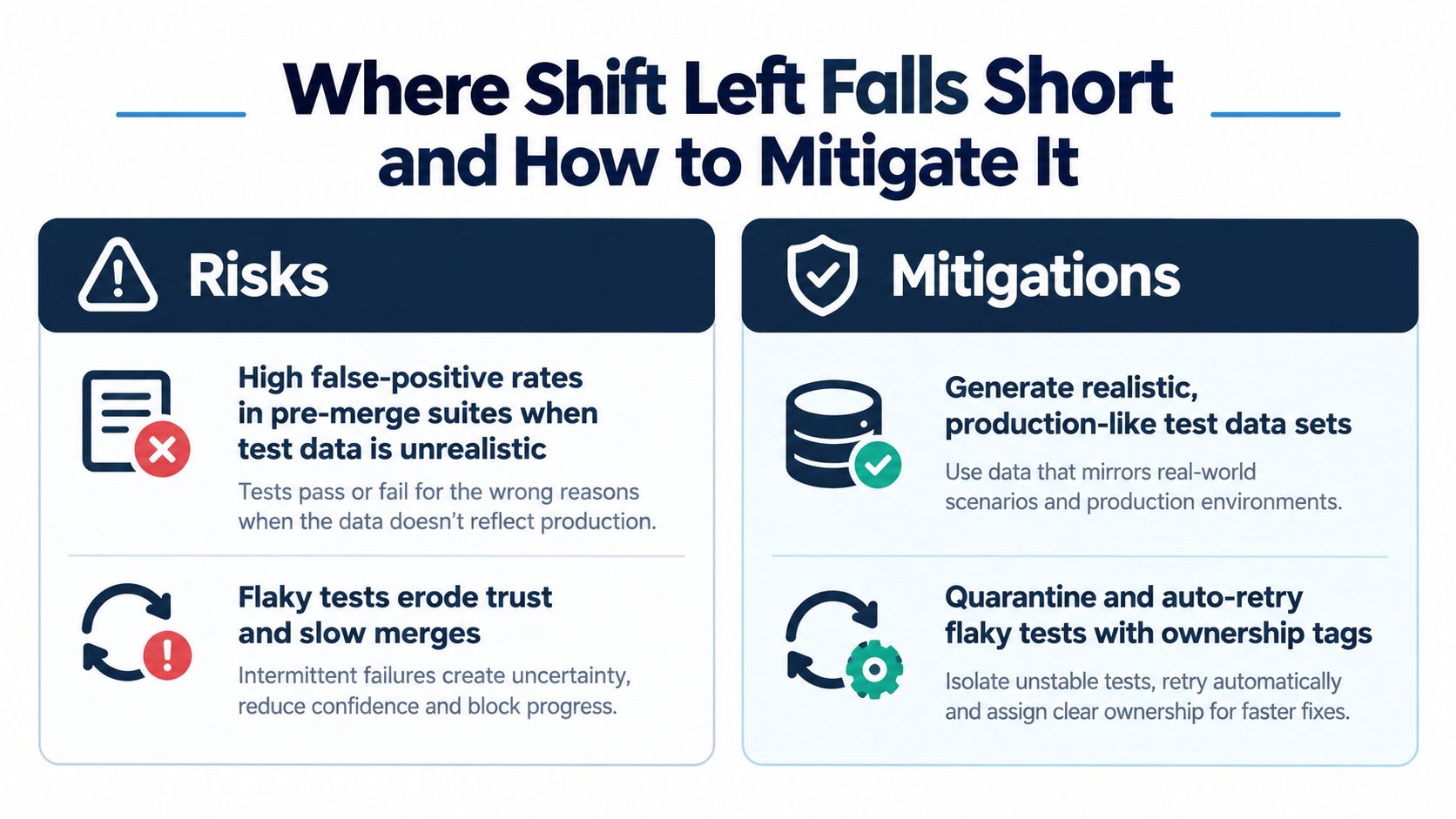
Earlier feedback helps only when it is accurate and actionable. A pre-merge test can fail because the code is wrong, its data is unrealistic, or the test is unstable. If developers repeatedly investigate failures that do not represent customer risk, the gate becomes background noise and people look for ways around it. Feedback latency falls, but useful signal does not.
The 2025 survey summary from Help Net Security on shift-left security strategies reported false positives as the top challenge for 35% of respondents. It also reported that 31% struggled to integrate shift-left security tools into development workflows, while 25% said the volume of vulnerabilities overwhelmed developers. Those results show why an earlier gate can increase workload when its output is difficult to trust or prioritize.
A security scan, accessibility check, contract suite, and performance test may all matter. Running every heavy check on every local save or pull request, however, fragments attention and slows the inner development loop. Put fast, diagnostic checks near code creation, then place tests that need broader environments later in the pipeline. The aim is shorter feedback latency without forcing every risk into the first gate.
Keep the early suite narrow and trustworthy
Use realistic data for workflows gated early. If a fraud rule fails only with a particular account history, a happy-path fixture offers little protection. Assign owners to noisy checks, quarantine flaky tests, and make that quarantine visible instead of relying on repeated retries to turn a failed build green.
Run fast unit checks immediately and parallelize heavier scanners where the tooling allows it. Reserve exploratory testing, long-running soak checks, complex device coverage, and full resilience exercises for post-merge environments.
Some failures depend on conditions developers cannot reproduce locally. Concurrency defects, mobile network changes, production-scale data, third-party outages, and interactions between services may require staging, canary release, observability, or controlled production experiments. The 2025 discussion of combining shift-left and shift-right approaches supports assigning different risks to different stages.
The core decision concerns which risks each stage can detect and how quickly the team can respond when a later stage finds behavior that earlier checks could not model. For a deeper look at why late discovery makes releases feel risky, see our analysis of why releases feel risky.
A 90-Day Roadmap to Adopt Shift Left Testing
Adoption works better as a controlled change than as a mandate to “test everything earlier.” Choose a narrow pilot, measure the current feedback path, and expand only when developers trust the results.
Days 1 to 30
Map the top ten critical user journeys for the product, such as registration, authentication, payment, search, or a core mobile action. Record where each journey is currently validated, how long feedback takes, which defects escape, and which environment dependencies make the checks difficult.
Select one journey for the pilot. Define its expected behavior with product, QA, and development together. The exit criteria are a documented risk map, an agreed baseline for pipeline lead time, and a small set of behaviors the team can validate without relying on a full staging deployment.
Ask three questions before moving on:
- Can the team identify the most important failure modes?
- Do developers and QA agree on what the first pipeline should block?
- Can the pilot produce a result that a developer can diagnose quickly?
Days 31 to 60
Pair a developer with a QA engineer to write unit and contract tests inside the relevant service repository. Wire them into a pre-merge GitHub Actions job or the equivalent CI system, then block merges on a confirmed red result.
Keep the first gate small. It should cover the selected journey's highest-risk logic and service boundaries, not every historical regression. Exit when the job runs consistently, failures identify an owner and a likely cause, and the team can explain any test excluded from the gate.
Days 61 to 75
Add static analysis, dependency scanning, and a smoke API test. Run independent checks in parallel where possible. Review findings with security and development so the team distinguishes exploitable or material risk from informational noise.
Turn off only the post-deploy checks that are now duplicated. Keep later validation for risks the pre-merge suite cannot represent, including environment behavior, exploratory discovery, and real integration conditions. The checkpoint is whether the pipeline catches useful issues without making developers wait unnecessarily or ignore alerts.
Days 76 to 90
Expand the curated suite to three more critical journeys. Publish a scorecard covering escaped defects, mean time to detect, pipeline failure causes, critical journey coverage, and developer sentiment.
Decide which legacy stage-gate scripts can be retired, which should remain post-merge, and which need redesign. Pause expansion if reliability is poor, false positives dominate, or developers bypass the gate. Scale when the pilot produces trusted feedback and the team can show that quality work is happening closer to code creation.
AskYourQA helps software teams map business-critical journeys, design maintainable automation, and integrate functional, API, security, performance, or AI checks into CI/CD workflows. If your release pipeline still discovers important defects late, visit AskYourQA to discuss a focused shift-left testing plan.