
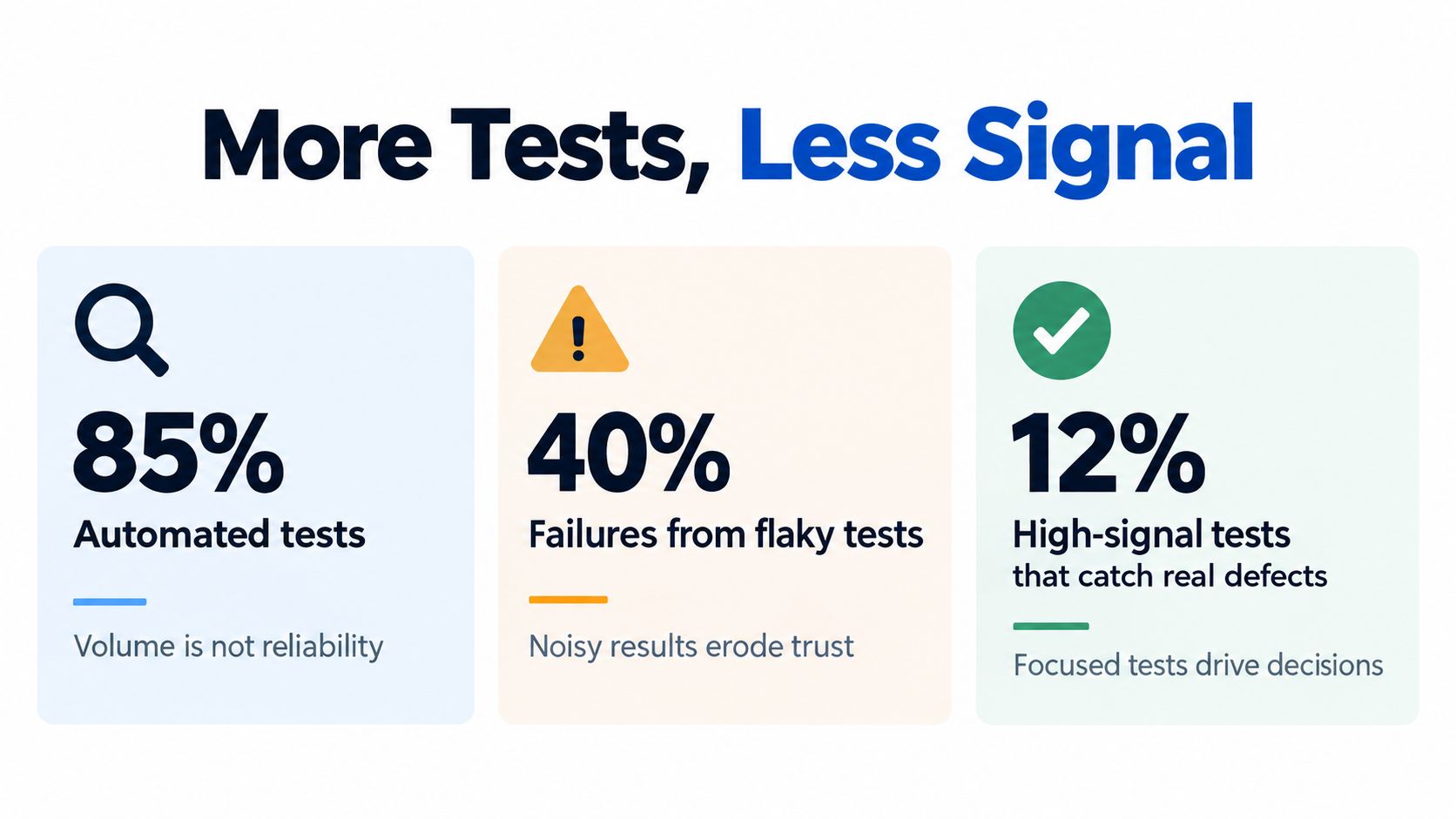
Effective QA test automation is defined by fast, reliable feedback inside CI/CD, not by the number of scripts a team owns. At Google scale, automation reached approximately 150 million test executions per day, yet only 1.23% of tests ever found a breakage and nearly 16% showed some flakiness, proving that volume without signal creates operational noise.
The popular advice is to automate more. That advice is incomplete and often expensive. A large suite that fails for environmental reasons, repeats the same shallow assertion, or blocks every pull request with uncertain results doesn't protect customers. It trains engineers to ignore failures.
The better objective is a high-signal feedback system. It connects business risk to the right test layers, produces trustworthy results quickly, and gives someone clear ownership when a check fails. Coverage still matters, but it's only one input. Reliability, diagnostic value, execution time, maintainability, and release impact matter more.
Table of Contents
- Why More Automated Tests Do Not Equal Better Quality
- The Evolution of Test Automation and Modern CI/CD Requirements
- Layered Test Automation Strategies for Maximum Signal
- Designing Scalable Automation Framework Architecture
- Handling Flakiness and AI-Generated Test Governance
- Integrating Automation into CI/CD Pipelines for Fast Feedback
- Actionable Checklist for Engineering Leaders
Why More Automated Tests Do Not Equal Better Quality
A team can raise its automation percentage while making release decisions less reliable. New scripts often duplicate existing checks, depend on unstable data, or verify implementation details customers never encounter. The inventory expands, maintenance consumes more time, and confidence falls.
Test volume measures activity. Test signal measures decision quality. A high-signal test catches a meaningful defect, explains the failure clearly, and produces a consistent result when the code and environment remain unchanged. A low-signal test creates investigation work without improving the release decision.
Coverage is a starting point, not a verdict
A 2020 study of test automation maturity reported scores from 23 to 94 out of 96, with an interquartile range of 56 to 77 (study of test automation maturity). The percentage of automated test cases was the strongest predictor of maturity. Organizations automating more than 90% of their tests achieved significantly higher maturity scores, with reported statistical significance of p < 0.001.
The finding supports setting a coverage target. It does not justify treating coverage as proof of quality. Organizations with substantial automation still differed widely in how their systems operated. Architecture, maintainability, execution reliability, and ownership determine whether coverage produces useful evidence.
Track these measures alongside automation coverage:
- Failure confidence: How often does a failed test identify a reproducible product defect?
- Diagnostic time: Can an engineer understand the failure without reconstructing the entire run?
- Flaky-test rate: How often does unchanged code produce inconsistent results?
- Business-risk coverage: Which critical journeys have trustworthy automated protection?
- Feedback latency: How quickly does the relevant result reach the developer?
Practical rule: If engineers routinely rerun a suite before believing it, the suite is not a quality gate. It is a source of uncertainty.
A reliable QA test automation program removes weak checks as aggressively as it adds valuable ones. Retire duplicates, split overloaded end-to-end scenarios, control test data, and record environment details. Give every quarantined test an owner and a deadline. Govern AI-generated tests with the same standards: require clear risk coverage, review their assertions, and delete output that adds noise. The goal is a release signal engineers trust enough to act on immediately.
The Evolution of Test Automation and Modern CI/CD Requirements
Test automation became valuable when it turned verification into repeatable evidence. In 1957, Charles Baker distinguished program testing from debugging in a review of a programming text. In 1958, Project Mercury created a dedicated software test team, demonstrating the need for systematic verification in safety-critical computing. Bill Hetzel formalized software testing in 1972 as an activity intended to verify that a program performs as intended (history of test automation).
Documentation and repeatability followed. IEEE published IEEE 829 in 1983, defining documentation across eight testing stages. Test-driven development gained prominence in 2002, and ISO 29119 introduced another major testing standard in 2007. These milestones established a principle that modern teams must retain: testing produces evidence, not activity alone.
Martin Fowler's 2000 discussion of continuous integration connected testing with rapid integration through self-testing code and automated builds. This changed what automation had to deliver. A suite could no longer exist only for a tester to run before release. It needed continuous execution, machine-readable results, concurrent operation, and a reliable way to distinguish product failures from failures in the test system.
CI turns automation into infrastructure
Continuous integration makes automation part of the delivery system. The framework must support partitioning, worker-level parallelism, dependable result aggregation, and controlled shared dependencies. Raw execution volume matters less than whether each result gives engineers enough confidence to act.
Legacy frameworks often assume sequential execution, persistent state, and human interpretation of logs. Those assumptions fail in fast delivery pipelines. Modern frameworks require isolated test data, deterministic setup and teardown, parallel-safe fixtures, traceable artifacts, and failure categories that downstream systems can process.
The historical lesson is direct. QA automation evolved from debugging support into documented, repeatable, continuous verification. CTOs should manage the framework as delivery infrastructure, with capacity planning, observability, clear ownership, and reliability standards comparable to other production engineering systems. The objective is a high-signal feedback system, not a larger script count or an impressive coverage figure.
Layered Test Automation Strategies for Maximum Signal
More automated tests can produce less useful feedback. Choose each layer according to the decision it must support, then place it where engineers can act on the result quickly.
A unit test checks isolated logic. An API test examines service behavior through a stable interface. An integration test verifies collaboration across components. An end-to-end test proves that a customer can complete a meaningful journey across the system.
Use the cheapest layer that provides convincing evidence:
| Test Type | Execution Speed | Maintenance Cost | Signal Value |
|---|---|---|---|
| Unit | Very fast | Low when behavior-focused | High for isolated business logic |
| API | Fast | Moderate | High for service contracts and workflows |
| Integration | Moderate | Moderate to high | High for component boundaries |
| End-to-end | Slowest | Highest | High for critical customer journeys, lower when overused |
Put business risk above technical convenience
A checkout service needs layered evidence. Unit tests should cover pricing rules, API checks should verify payment and order contracts, integration tests should examine inventory behavior, and a focused end-to-end journey should prove that a customer can complete the transaction.
Browser tests should remain limited to high-value paths. Repeating lower-level checks in the browser increases maintenance work while adding little signal, especially when tests depend on timing, selectors, third-party services, or shared environments.
A practical distribution is:
- Pull requests: Run fast unit, lint, smoke, and contract checks that can reject obvious regressions quickly.
- Merge validation: Add API and integration scenarios that verify service boundaries and data flows.
- Release validation: Run focused end-to-end, performance, security, and production-like checks against the change's risks.
- Scheduled exploration: Run broader compatibility and resilience scenarios outside the shortest developer feedback path.
Google's testing research illustrates why execution volume is a poor quality target. In its studied environment, only 1.23% of tests ever found a breakage (Google test execution research). Treat that figure as a warning, not a benchmark. A large suite can still provide weak feedback if failures are noisy, duplicated, or disconnected from business risk.
Governance matters as much as distribution. Map every test to a business capability, failure mode, owner, and pipeline stage. Review AI-generated tests against those same criteria before adding them to a shared suite. Remove tests that duplicate stronger checks or lack a clear failure action. Teams choosing automation targets can use a structured test automation prioritization approach.
The goal is failure confidence: when a test fails, engineers should know what risk changed, who owns it, and what to do next. That signal supports reliable delivery more effectively than raw coverage or script counts.
Designing Scalable Automation Framework Architecture
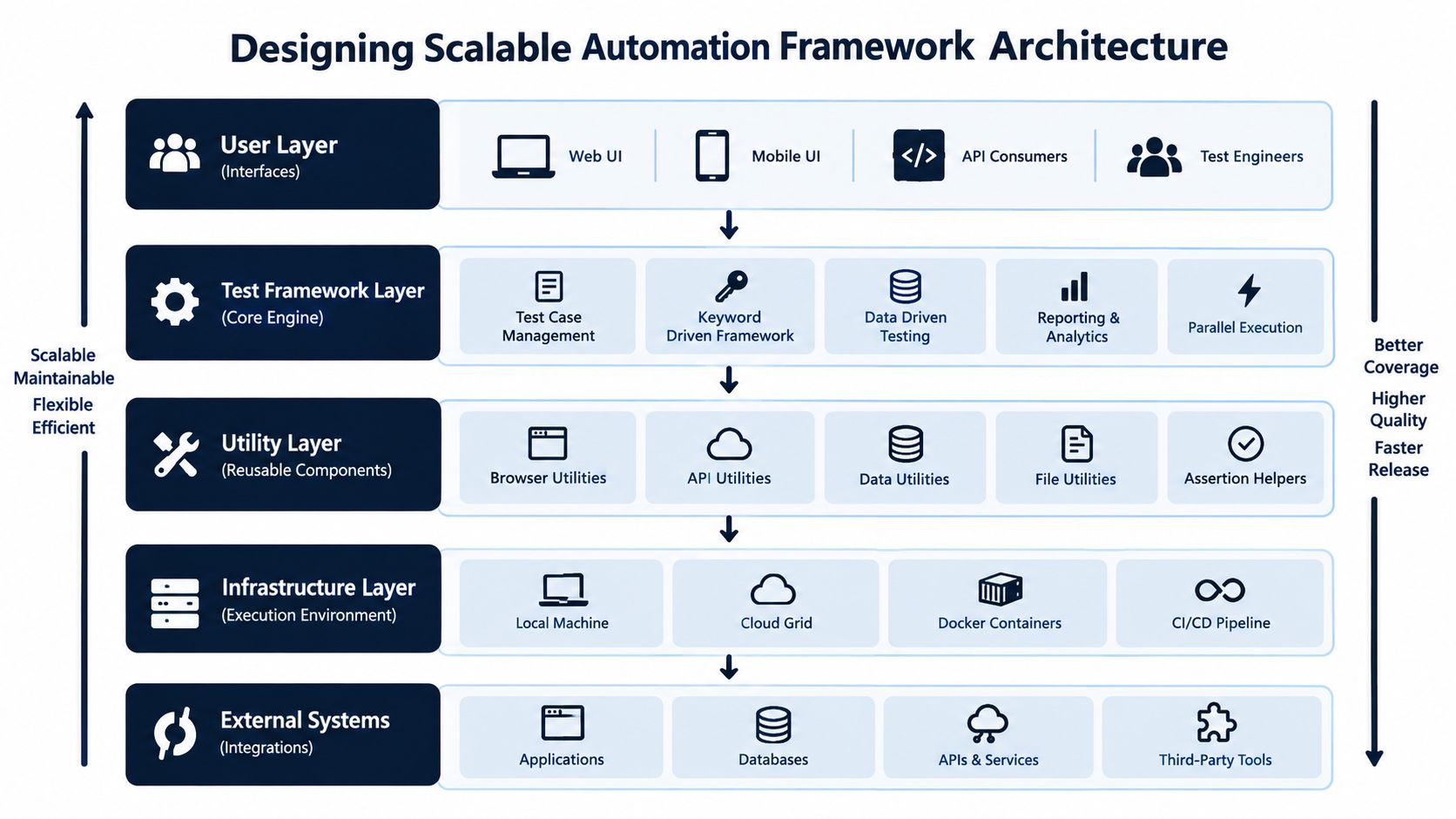
A scalable framework separates test intent, application interaction, test data, and execution infrastructure. When those concerns are mixed, a small UI change can force engineers to rewrite business scenarios, fixtures, and reporting logic together.
Start with a domain model. Name reusable actions after business behavior, such as createAccount, authorizePayment, or cancelSubscription, rather than exposing every CSS selector or transport detail to the test case. A page object model can help with browser interfaces, but don't turn page objects into large buckets of unrelated logic. Keep selectors and interaction mechanics close to the page boundary, while business workflows remain readable at the scenario level.
Separate the parts that change at different rates
Application interfaces change frequently. Business rules, test data policies, and reporting requirements change on different schedules. Design the framework so each can evolve independently.
- Interaction layer: Encapsulate Playwright or Selenium browser operations, Appium mobile actions, and API clients.
- Domain layer: Express customer workflows in business language, without exposing selectors or request construction.
- Data layer: Generate isolated accounts, orders, permissions, and fixtures through factories or controlled APIs.
- Assertion layer: Validate outcomes with meaningful business rules, not incidental text or unstable layout details.
- Execution layer: Handle parallel workers, retries with strict limits, environment selection, and artifact collection.
- Reporting layer: Publish screenshots, traces, logs, request details, and failure classifications in one searchable result.
Parallel execution only works when tests don't share mutable state. Give each scenario independent data, avoid order-dependent setup, and make cleanup safe to repeat. If a test requires a unique account or resource, generate it during setup and record its identifier in the result.
The framework should also make failure diagnosis easier than manual reproduction. Capture browser traces, API payloads with sensitive values masked, console output, service logs where appropriate, and the exact build and environment metadata. A green check is useful. A red check with precise evidence is much more valuable.
Before selecting a framework, evaluate language support, browser and device coverage, parallel execution, reporting, debugging artifacts, team skills, and CI compatibility. A structured test automation framework selection guide can support that evaluation, but the decision should follow product risk rather than tool popularity.
Handling Flakiness and AI-Generated Test Governance
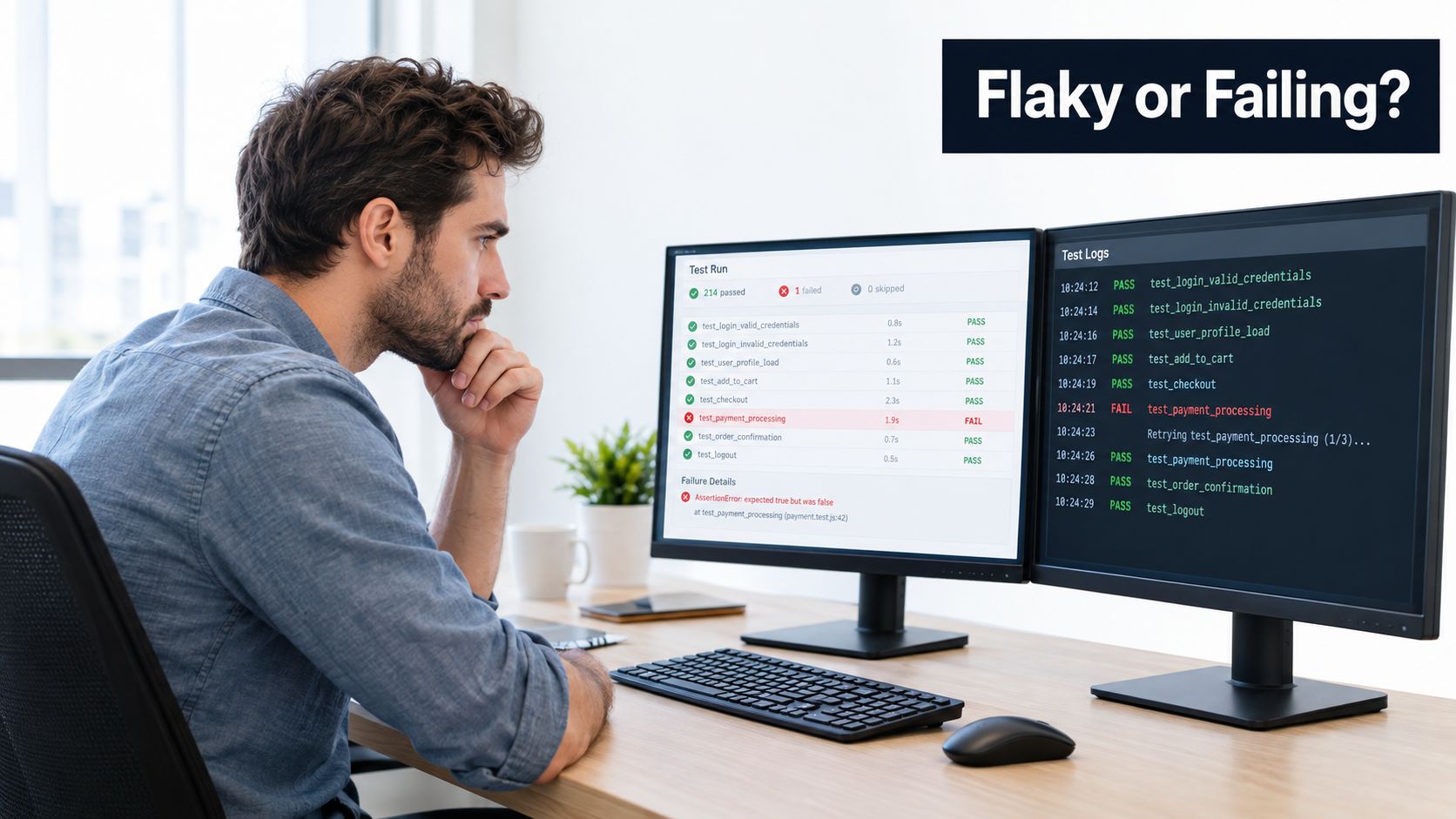
Flaky tests turn a quality signal into operational noise. The same commit can appear safe or broken depending on timing, load, or environment. Google reported that nearly 16% of tests showed some level of flakiness, while rerunning them consumed 2% to 16% of compute resources in its environment. Treat those figures as a warning: unreliable tests waste capacity and weaken release decisions.
A retry is useful for classification, not concealment. Preserve the first failure, collect timing and environment details, then rerun selectively in isolation. If the test passes on retry, route it into a flakiness workflow and keep the original failure in the release record. A green retry does not prove that the underlying signal was safe to ignore.
Quarantine requires governance
Classify failures into operational categories:
- Product defect: The application violates expected behavior under a reproducible condition.
- Test defect: The assertion, locator, fixture, or scenario is incorrect.
- Infrastructure failure: The runner, dependency, network, or environment failed.
- Nondeterministic outcome: The result varies without a confirmed product or infrastructure change.
Quarantine only the last three categories when evidence supports that decision. Every quarantined test needs an owner, expiry date, reason, and replacement plan. Without those controls, quarantine becomes permanent blind coverage. Review the queue as part of release governance, not as a maintenance task teams can postpone indefinitely.
AI-generated tests require the same controls as human-written tests. Google's 2025 DORA research, based on responses from nearly 5,000 technology professionals worldwide, associated AI adoption with improved perceived code quality but lower delivery stability when organizations lacked version control, automated testing, and fast feedback loops. The same report found that 62% of developers who write tests use AI assistance, while 59% perceive a positive effect on code quality (2025 DORA research on AI and delivery).
Use AI to expand reviewable test ideas, not to bypass engineering judgment. Require risk-based approval for tests covering payments, identity, permissions, safety, and other critical journeys. Validate generated assertions with mutation testing or fault injection. If deliberately breaking the implementation does not make the test fail, the test is decorative.
Maintain traceability from business-critical journeys to generated cases. Record the approver, covered risk, test data, and owner for future failures. Measure escaped defects, false positives, time to triage, and useful failure rate. Test-count growth is not an acceptable substitute for proof that generated tests detect meaningful defects. Build a high-signal feedback system, not a larger script inventory.
Integrating Automation into CI/CD Pipelines for Fast Feedback
Automation improves release decisions only when each check produces timely, trustworthy evidence. Continuous testing runs throughout the software lifecycle, with fast, reliable suites that identify real failures and pass only when the change meets release criteria, as described in DORA guidance on continuous delivery.
Assign every test to the pipeline stage where its result can change the next decision:
- Pull request stage: Run unit, lint, smoke, and contract checks in parallel. Keep failures close to the changed code.
- Merge stage: Run broader API and integration suites against controlled dependencies and isolated data.
- Pre-release stage: Run critical end-to-end, security, performance, and production-like checks according to release risk.
- Post-deployment stage: Validate service health, key journeys, and rollback signals. Monitoring supplements pre-release testing; it does not replace it.
The CI/CD pipeline testing lifecycle must also define responses to conflicting signals. A product defect blocks promotion. An unavailable test environment creates an infrastructure incident and a visible release decision, rather than a silent green result. A flaky check preserves its failure, assigns ownership, and avoids an unlimited retry loop.
Connect test results to delivery outcomes. Deployment frequency and lead time show throughput, while change-failure rate and recovery time show stability. Reliable automation shortens the time between introducing and diagnosing a defect. Unreliable automation creates rework and weakens release controls.
Run independent suites in parallel, publish machine-readable results, and make failures searchable by service, owner, risk, and category. The pipeline must answer one question quickly: Can this change move forward with acceptable evidence?
Actionable Checklist for Engineering Leaders
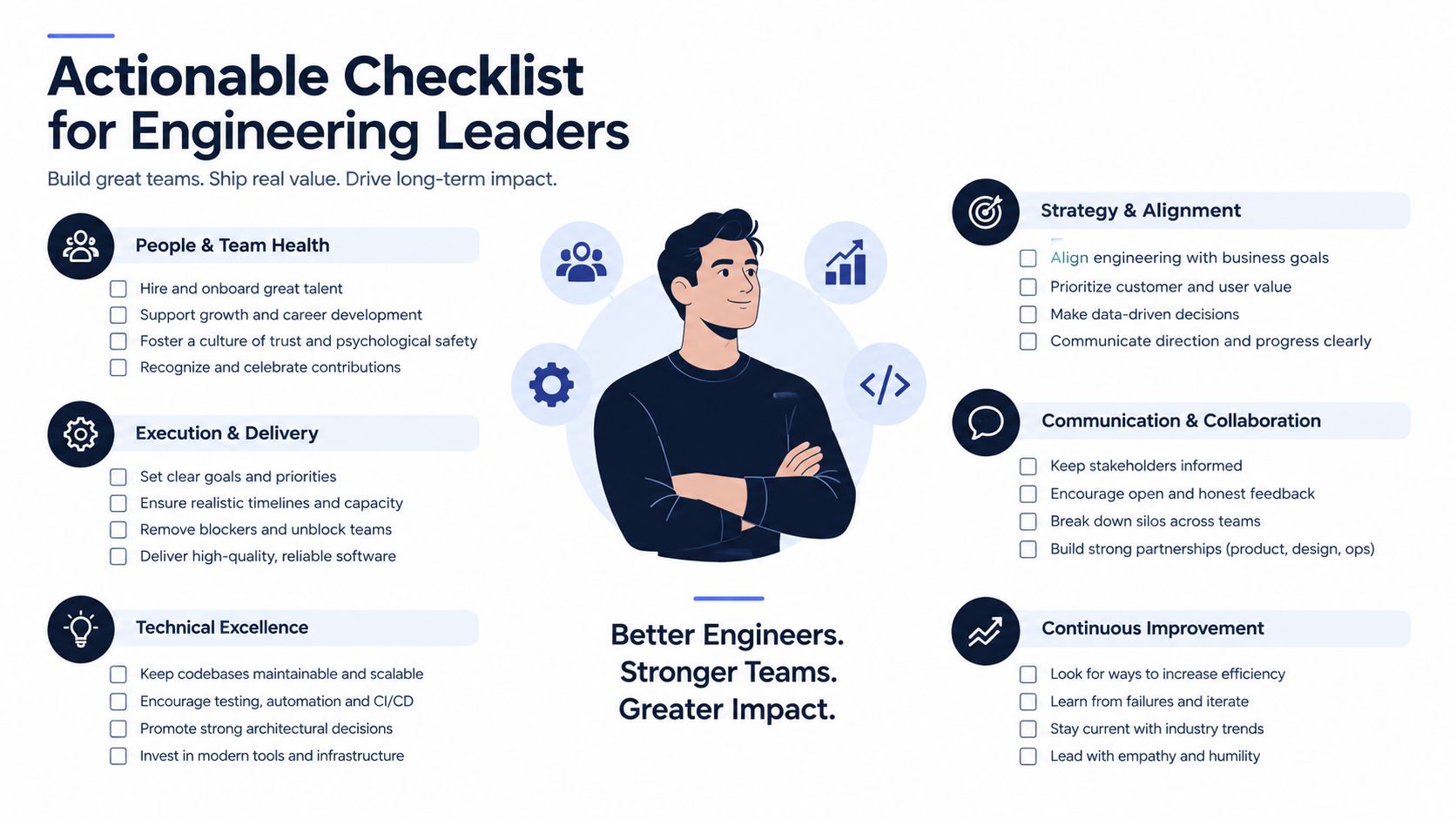
Use this checklist to turn QA test automation into an operating system for quality:
- Define signal: Identify the customer journeys and failure modes that must block release.
- Measure maturity broadly: Track coverage alongside flakiness, diagnostic time, maintenance effort, and escaped defects.
- Choose the right layer: Push logic into unit and API checks, reserving end-to-end automation for critical cross-system journeys.
- Design for scale: Isolate data, separate domain intent from interface mechanics, and make execution safe for parallel workers.
- Control retries: Preserve first failures, classify outcomes, and quarantine only with ownership and expiry.
- Govern AI output: Review high-risk generated tests, validate assertions with mutation or fault injection, and record traceability.
- Integrate continuously: Place fast checks on pull requests, broader validation on merges, and risk-based suites before release.
- Align with delivery: Monitor deployment frequency, lead time, change-failure rate, and recovery time alongside test results.
Start by removing the tests your team doesn't trust, then invest in the journeys that determine whether customers can use the product. Quality improves when every failure leads to a confident decision.
AskYourQA designs and implements end-to-end automation across frontend, backend, APIs, and mobile, then integrates smoke and regression suites into CI/CD pipelines. If you need a maintainable, high-signal automation system with functional, AI, security, or performance coverage, visit AskYourQA to discuss your release risks and framework requirements.