
Functional test automation is often sold as a numbers game. Add more scripts, increase coverage, run everything in parallel, and trust the green dashboard. That advice misses the hard part of quality engineering: a large suite can still provide weak evidence when it tests low-risk behavior, repeats the same checks, or fails for reasons unrelated to product defects.
The stronger objective is release confidence. A useful suite protects the journeys that matter to customers and the business, produces failures people can understand, and stays healthy as the product changes. That means selecting fewer, higher-signal tests across web, mobile, APIs, backend services, and AI-driven workflows, then treating the suite as a production system with owners, observability, and maintenance rules.
Table of Contents
- Why Bigger Test Suites Usually Make Releases Worse
- What Functional Test Automation Actually Covers
- Designing High-Signal End-to-End Tests
- Building a Maintainable Framework Architecture
- Integrating Functional Tests Into CI/CD Pipelines
- Test Data and Environment Strategy
- Metrics and ROI That Actually Matter
- Migration and Scale Patterns
Why Bigger Test Suites Usually Make Releases Worse
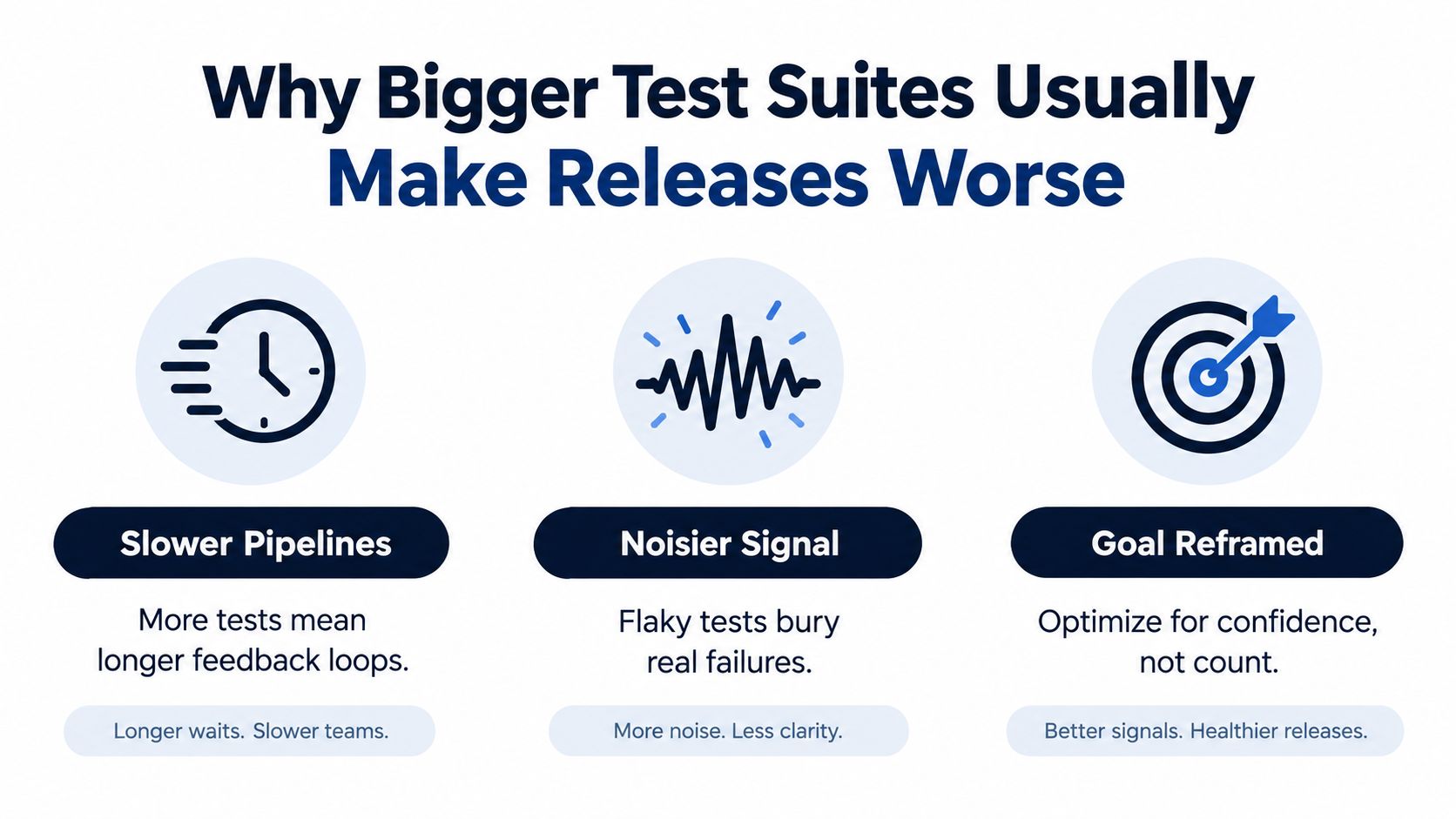
A test suite can become a release liability when its size outgrows the team's ability to interpret and maintain it. More scripts increase execution time, repair work, and triage queues. Under delivery pressure, engineers start rerunning failures until the pipeline turns green. That habit can hide a product defect behind apparent stability.
The problem is not only speed. It is evidence quality. A checkout test that fails after a pricing regression should change the release decision. A test that breaks because another scenario changed a shared account, then passes on rerun, adds investigation work without clarifying product risk. Repeated noise trains people to discount the failures that deserve attention.
The reasons releases feel risky often point to this gap between test activity and usable evidence. Teams may run many checks and still lack a clear answer about whether customers can complete the journeys that matter.
The metric that matters
Raw test count is a capacity measure, not a quality outcome. A growing inventory can reflect duplicated checks, low-risk paths, or assertions that no longer match the product. It can also make feedback arrive too late for engineers to act on it during a release.
Ask a more useful question: what business decision does this test support? If the answer is unclear, move the check to a lower-frequency suite, combine it with stronger coverage, or retire it. A focused set of deterministic tests for login, account recovery, payment, permissions, and core transactions can protect more customer value than hundreds of shallow screen validations.
Practical rule: Optimize for reliable evidence, not an impressive test inventory.
Separate three measures that teams often treat as interchangeable:
- Execution volume: How many tests run.
- Feature coverage: Which product capabilities and rules are exercised.
- Release signal: Whether results support a confident ship, hold, or investigate decision.
Only the third describes release usefulness. High-signal automation connects failures to business risk, keeps diagnosis affordable, and gives teams a defensible reason to ship or stop. That standard applies across web, mobile, APIs, and AI-driven flows, where a larger suite can still miss the journey customers depend on.
What Functional Test Automation Actually Covers
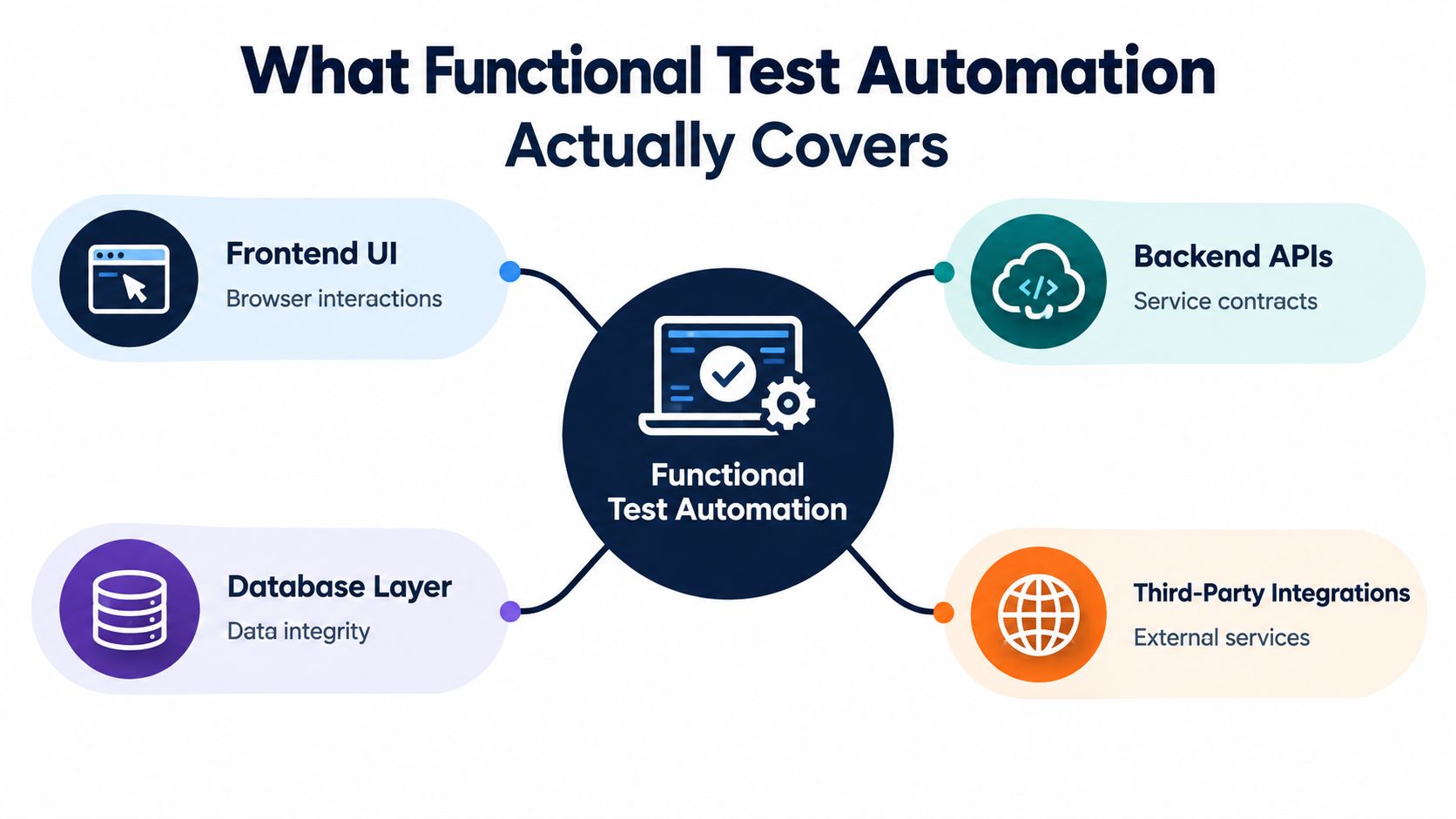
Functional test automation verifies that a product behaves according to its requirements. It checks inputs, business rules, system interactions, and observable outputs. Its scope extends beyond browser clicks. A single customer journey may cross the frontend, APIs, backend services, databases, mobile operating systems, and external providers before the user sees a result.
The useful question is not how many surfaces the suite touches. It is whether a small number of high-signal tests prove that the right business outcome survives those boundaries.
Take a checkout flow. A customer selects a product in the web UI, adds it to a cart, applies a discount, submits payment, and receives confirmation. The browser test verifies the visible path, while API checks confirm pricing and authentication rules. Database validation confirms that the order is stored correctly, and the payment integration returns a controlled result for both success and failure.
Match each layer to its job
Frontend UI tests should prove that a customer can complete a high-value task through the interface. They cover navigation, form behavior, permissions presented in the UI, and the connections between visible steps. Rendering changes, asynchronous timing, and unstable selectors can make them expensive to maintain, so they should remain focused.
API and service tests validate business logic with less overhead. They check request validation, response schemas, authorization, error states, and data transformations without repeatedly driving a browser. REST, GraphQL, gRPC, and WebSocket interactions may each require distinct contract and behavior checks.
Database validation confirms that important state changes are correct. A successful confirmation page is weak evidence if the order is missing, duplicated, assigned to the wrong customer, or saved with an incorrect status.
Third-party integration tests need controlled boundaries. Payment, messaging, identity, analytics, and delivery services should receive realistic requests and responses. Mocks or service virtualization can make provider failures deterministic without turning every run into a dependency outage exercise.
Mobile requires separate coverage. Device fragmentation, permission prompts, operating-system interruptions, backgrounding, and network transitions expose failures that a desktop browser suite cannot see. AI features introduce further functional surfaces, including prompt handling, tool calls, agent state transitions, output constraints, and safety behavior. These checks should verify observable outcomes and failure handling, not only fixed page assertions.
Before selecting a framework, inventory every surface each priority journey touches and assign each layer a distinct verification job.
Designing High-Signal End-to-End Tests
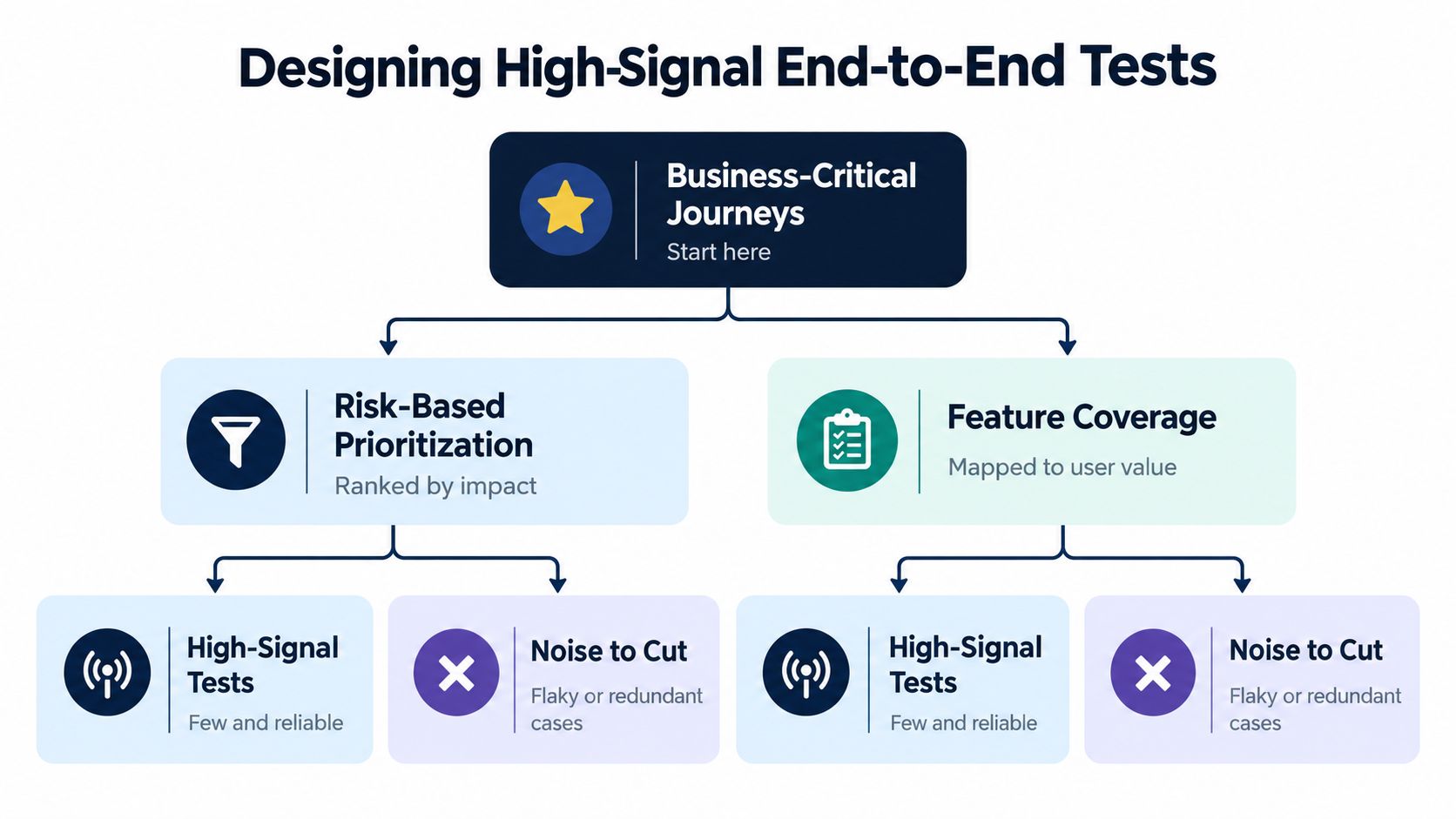
Start with journeys, not screens. A screen list tells you what the product contains. A journey tells you what the customer must accomplish and what the company cannot afford to break.
Build a journey map with product, engineering, support, and QA input. Include actions such as registration, authentication, checkout, subscription changes, file upload, administration, and recovery from failure. Then rank each journey by business impact, usage frequency, regulatory exposure, and failure cost. A low-frequency internal report may need less end-to-end depth than the payment path used by most customers.
From risk to coverage
For each high-priority journey, define the smallest test that proves the complete outcome. A checkout test should not stop at “the payment button is enabled.” It should establish that the right item and price reach the backend, the payment result is handled correctly, the order is stored, and the customer receives the expected confirmation.
Use different test layers for different risks:
- End-to-end tests: Protect the complete user outcome and the integration points that make it possible.
- API tests: Exercise business rules, validation, permissions, and error handling quickly.
- Component or integration tests: Isolate boundaries where defects can be diagnosed more precisely.
- Exploratory testing: Investigate ambiguous behavior, new interactions, and situations that are difficult to express as stable assertions.
Happy paths belong in the release signal because they represent the basic promise of the product. Edge cases belong where their risk justifies the maintenance cost. A financial rule, permission boundary, or destructive action may deserve dedicated negative coverage. A minor visual variation may be better handled through exploratory or visual review rather than another brittle functional script.
The E2EBench research benchmark evaluates whether test suites cover application features across 8 open-source web applications. Its useful implication for practitioners is straightforward: measure whether your suite reaches meaningful product features and journeys, not merely how many test cases it contains.
Remove duplication deliberately
Two tests that reach the same business outcome through slightly different selectors may not provide twice the protection. Tag each test to a journey, feature, rule, and risk. When several cases exercise the same path without adding a distinct assertion or state, consolidate them.
A practical test inventory should answer:
| Question | Useful answer |
|---|---|
| What does this test protect? | A named user journey or business rule |
| Why does it run at this tier? | A clear risk and feedback requirement |
| What does failure mean? | A defect, environment issue, or test problem |
| Who owns it? | A team responsible for keeping it reliable |
For templates and concrete test-case structure, use this sample test case guidance as a starting point, then adapt the fields to your product risks.
Building a Maintainable Framework Architecture
Framework architecture determines whether automation gets cheaper or more expensive every time the product changes. A suite with clean boundaries can absorb a redesigned page or changed API without forcing engineers to edit dozens of unrelated tests. A suite built from duplicated selectors and hidden dependencies turns every feature change into a repair exercise.
Keep test intent separate from implementation details. The test should describe the customer action and expected result. Page objects, screen objects, API clients, or service adapters should own selectors and protocol details. This separation lets a team update a locator or request helper in one place instead of searching through scattered scripts.

Give shared concerns one home
Authentication, test data creation, cleanup, waiting behavior, logging, screenshots, network tracing, and environment configuration should be handled through deliberate utilities. Shared code isn't automatically good code, though. A giant helper that hides every action makes failures difficult to interpret and encourages tests to depend on undocumented behavior.
Prefer small, explicit abstractions:
- Configuration: Keep base URLs, credentials references, feature flags, and browser or device settings outside test logic.
- Selectors: Use stable attributes or accessible roles rather than brittle positional selectors.
- Data builders: Create valid objects with controlled overrides, instead of copying large static fixtures.
- Waits: Wait for observable application state, not arbitrary pauses.
- Diagnostics: Capture logs, network details, screenshots, and video when they help a developer reproduce the failure.
Plain structured code is often easier to maintain than a heavy keyword layer. Keyword-driven frameworks can help non-programmers contribute to repetitive flows, while BDD can clarify shared business behavior when product and engineering actively use the scenarios. Neither style fixes weak isolation or unclear ownership.
Avoid the common traps
Hard-coded URLs, duplicated locators, test-order dependence, global mutable state, and “god files” all create hidden coupling. A test that passes only after another test creates a record isn't independent, even if the framework reports both as green.
Name tests by outcome and risk. Keep setup close enough to the test that a failure is understandable, but move repeated mechanics into focused helpers. Review test code like production code, with pull requests, refactoring, and deletion treated as normal engineering work.
The framework should make the reliable path easy and the fragile path visible. If adding a test requires copying a long script, manually editing environment details, and guessing where failures are logged, the architecture is already charging interest.
Integrating Functional Tests Into CI/CD Pipelines
Automation that runs only on a tester's machine can't consistently influence release decisions. CI/CD integration gives each test a defined place in the delivery process, but the pipeline should be tiered rather than indiscriminate.
A practical arrangement looks like this:
- Pull request smoke suite: Run a small set of fast checks for authentication, application startup, core navigation, and the most important transaction. These tests should answer whether the proposed change is safe enough for review.
- Merge regression suite: Run broader API, integration, and end-to-end coverage after code reaches the main branch. This tier can use parallel workers and test sharding where the infrastructure supports it.
- Release gate: Run a curated set of high-risk journeys against the release candidate before deployment. A failure should block or trigger an explicit investigation, not disappear into a dashboard.
- Scheduled depth checks: Run less frequent scenarios, device combinations, and extended integrations on a schedule that matches their diagnostic value.
The CI/CD pipeline guide provides useful context for placing these checks around build, integration, and deployment stages.
Protect the feedback loop
The pull request tier needs a strict runtime budget, but speed shouldn't come from removing the only tests that protect critical behavior. Instead, select a compact smoke set, parallelize independent cases, reuse safe setup where it doesn't compromise isolation, and move broad combinations to later tiers.
Secrets belong in the CI platform's protected storage, not in test files or logs. Environment promotion should be explicit. A test passing against one environment doesn't prove that a different deployment has the same configuration, data, feature flags, or third-party behavior.
Each test needs three owners:
- A technical owner who maintains the implementation.
- A trigger that explains when it runs.
- A consequence that defines what the team does when it fails.
A pipeline becomes useful when failure routes people to action. Classify failures as product defects, test defects, or environment problems, then make that classification visible in the job output. Automatic reruns can help investigate nondeterminism, but they shouldn't silently turn a failed release gate into a pass.
Test Data and Environment Strategy
Flaky tests often expose a systems problem rather than a weak assertion. A test may be perfectly reasonable and still fail because another job changed its account, a shared environment deployed halfway through execution, or a third-party response arrived outside the assumed timing window.
The TeamCity guidance on flaky tests identifies environment inconsistency, stale or shared data, execution-order dependence, and timing issues as common causes. It also recommends explicit waits, isolated data, repeated execution under identical conditions, and quarantine when an unstable result would contaminate release signals.
Choose realism by layer
There isn't one correct data model for every test. The right choice balances isolation, speed, and realism.
Synthetic data works well for unit, API, and integration checks. Builders can create a known customer, order, permission set, or subscription state for each test. The data remains predictable, and the test can assert exact outcomes.
Production-like snapshots offer realism for complex relationships and migration checks, but they need careful anonymization, version control, and reset procedures. A snapshot that changes without notice creates the same uncertainty as a shared mutable database.
Service virtualization is useful when a payment provider, identity service, shipping carrier, or AI dependency must return controlled success and failure responses. Keep a smaller number of real integration checks for the boundary itself, while using deterministic responses for most functional scenarios.
Ephemeral environments provide strong isolation by creating a short-lived stack for a branch or test run. They require infrastructure investment, but they remove cross-branch contamination and make failures easier to reproduce.
Make every test independent
Each test should create or claim the data it needs, use unique identifiers where possible, and clean up without relying on execution order. Database seeding should be deterministic. Time, randomness, queues, and external responses should be controllable when they affect the expected result.
Avoid arbitrary sleeps. Wait for a specific condition such as a status transition, network response, visible state, or queue completion. If the application is eventually consistent, the test should express that behavior with a bounded, observable wait rather than assuming a fixed delay will always be sufficient.
Quarantine is a safety valve, not a storage area for neglected tests. Record why a test was quarantined, assign an owner, and review it regularly. A quarantined test that never returns to service is a deleted test with extra paperwork.
Metrics and ROI That Actually Matter
A pass rate can look healthy while the team reruns failures, ignores quarantined cases, and discovers defects after deployment. Code coverage can rise without proving that customers can complete the journeys that generate value. Metrics should explain whether automation improves decisions, not whether the team has produced more artifacts.
Track a small operational set:
- Flake rate: Count nondeterministic failures separately from genuine product failures. Compare initial outcomes with controlled reruns and investigate recurring patterns.
- Mean time to detection: Measure how quickly the pipeline identifies a regression after it enters the delivery flow.
- Escaped defects: Link production functional defects to the journey, rule, or test gap that allowed them through.
- Tier runtime: Track the duration of smoke, regression, and release suites independently so slow stages have an identifiable owner.
- Cost per release: Combine CI consumption and the engineering time spent investigating, repairing, and rerunning tests.
A useful dashboard shows trends by journey and service, not just one global percentage. If checkout failures rise while the overall pass rate remains stable, leadership needs to see that concentration of risk.
Measure noise as a business cost
Bitrise's mobile CI analysis examined more than 10 million mobile CI builds and found that the share of teams experiencing test flakiness rose from 10% in 2022 to 26% in 2025. The same analysis reported that teams using monitoring and observability tools had 25% fewer flaky-test reruns, as described in this mobile CI test automation analysis.
That finding supports a practical investment case. Better logs, traces, failure classification, and environment visibility can reduce wasted engineering time even when they don't add another test. Report one outcome per release, such as faster detection, fewer escaped defects, or lower rerun effort, and connect it to a decision the team made.
Migration and Scale Patterns
Most automation programs don't begin with a clean repository. They inherit duplicated scripts, partial frameworks, unstable environments, and a team that has learned not to trust the results. A successful migration starts by reducing uncertainty, not by rewriting every test immediately.
A representative first week is mostly discovery. Inventory the existing suite, identify which tests run, map each case to a business journey, and label failures by likely cause. Mark tests that duplicate coverage, depend on shared state, or protect behavior nobody can explain. The point isn't to judge the previous team. It's to establish what the current system tells you.
The first 90 days
During the next phase, build a thin pilot around a small number of high-risk journeys. Use the product's real architecture, not an artificial demo, and include the framework conventions that the wider suite will need. A pilot should prove data setup, diagnostics, environment handling, and CI execution as well as the assertions themselves.
The following sequence works well:
- Days 1 to 7: Map critical journeys, inventory existing tests, and record baseline runtime and failure categories.
- Days 8 to 30: Rebuild a focused pilot with separated test logic, stable selectors, deterministic data, and useful diagnostics.
- Days 31 to 60: Connect smoke and regression tiers to pull requests, merges, and release candidates. Add ownership and failure routing.
- Days 61 to 90: Expand into the next risk area, remove redundant legacy cases, and review flake trends before adding more volume.
Rewrite when the existing framework prevents isolation, diagnostics, or reliable execution. Refactor when the underlying structure is sound and the main problem is duplicated setup, outdated selectors, or poor data handling. A rewrite can create a cleaner foundation, but it also delays coverage if the team treats architecture as a reason to postpone useful tests.
Expand across product surfaces
Web coverage often provides the first visible improvement, but it shouldn't become the permanent boundary of the program. Add API and backend checks where they offer faster diagnosis of business rules. Introduce mobile scenarios for device, permission, interruption, and network risks that web automation can't represent.
AI features need a distinct validation approach. Test prompt construction, input boundaries, tool invocation, state transitions, refusal behavior, output structure, and safety constraints. Exact text matching is often too brittle for generative output, so assertions should focus on required properties, prohibited behavior, grounded results, and workflow outcomes. For autonomous agents, test recovery from failed tools and ambiguous instructions, not just successful completion.
The functional testing category has become a substantial software market. A 2026 market analysis projected that functional testing would generate USD 20.76 billion in 2025, representing 58.6% of automation-testing revenue, and forecast growth to USD 69.41 billion by 2035 at a 12.8% CAGR, according to that market analysis. Market size doesn't tell a team which tests to write, but it reinforces that automation is now an engineering capability requiring architecture, operations, and investment.
A Monday morning checklist
-
Map five critical journeys. Choose the paths whose failure would cause the greatest customer, revenue, compliance, or operational harm. Write the expected outcome and the systems each journey touches.
-
Retire low-signal tests. Review the bottom quartile of the existing suite by failure usefulness, duplication, and maintenance cost. Delete or consolidate cases that don't protect a distinct risk.
-
Measure flakiness before changing tools. Record initial failures, reruns, environment causes, and test ownership. Without a baseline, a framework migration can hide noise rather than remove it.
-
Wire tiers into CI with explicit triggers. Put a compact smoke suite on pull requests, broader regression on merges, and a curated release gate before deployment. Define what each failure means.
-
Report one outcome metric per release. Show a change in detection time, escaped defects, runtime, rerun effort, or another measure tied to release confidence. Keep the report small enough that leadership can act on it.
When choosing between another easy script and a harder test that protects a real customer outcome, choose the journey. Functional test automation creates value when it earns trust, not when it fills a repository.
AskYourQA designs and implements maintainable functional automation across frontend, backend, APIs, mobile platforms, and AI workflows, then connects the suites to CI/CD release gates. If your current tests are slow, brittle, or disconnected from business risk, visit AskYourQA to discuss a higher-signal automation system.