
How do you know your LLM works when a convincing answer can hide a broken retrieval step, an unauthorized tool call, or a failed customer journey?
Shipping without systematic evaluation makes every prompt tweak, model swap, and retrieval change a gamble. A successful demo proves that your application can work on selected inputs. It doesn't establish whether the next release preserves business rules, handles missing information, or refuses an unsafe action.
LLM evaluation tools should match the gap in your testing workflow, not just your preferred dashboard. Tracing tools help explain failures. CI regression tools compare changes before merge. RAG metrics separate retrieval problems from generation problems. Red-teaming tools probe behavior that ordinary acceptance tests miss.
That distinction matters because quality isn't a single score. Stanford's HELM framework established a multidimensional approach covering accuracy, calibration, reliability, fairness, bias, toxicity, and efficiency. For product teams, the practical lesson is to keep functional success, safety, and operating constraints visible separately.
Selection rule: Start with the failure you need to detect, then choose the smallest toolset that can detect it and explain the result.
The tools below serve different parts of that workflow. None removes the work of building representative test cases, calibrating evaluators, or deciding which failures should block a release.
Table of Contents
- 1. LangSmith
- 2. Braintrust
- 3. Langfuse
- 4. W&B Weave
- 5. Arize Phoenix
- 6. DeepEval and Confident AI
- 7. Ragas
- 8. Promptfoo
- 9. Giskard
- 10. LangWatch
- LLM Evaluation Tools at a Glance
- Choosing Your Evaluation Stack and Making It Stick
1. LangSmith
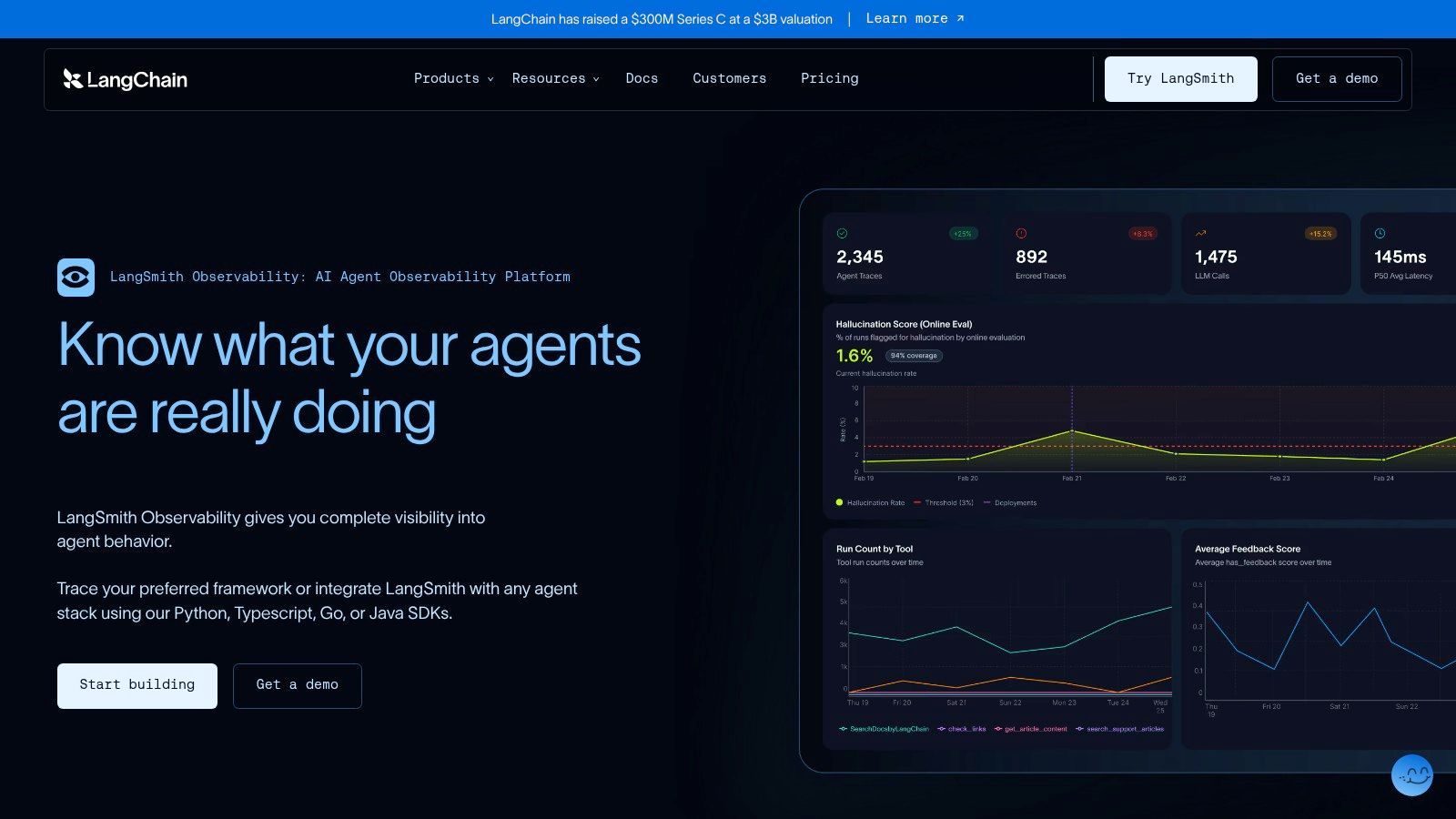
Best fit: tracing and production-connected evaluation. LangSmith combines traces, datasets, prompt iteration, monitoring, and evaluation. It's particularly convenient when your application already uses LangChain or LangGraph, although those frameworks aren't a prerequisite.
Its strongest use case is investigating a result that looks acceptable until you inspect how the agent produced it. An account-support agent might give the correct final response after querying the wrong customer record. Trajectory evaluation lets you examine the sequence of steps and tool calls rather than grading only the final text.
Where It Earns Its Place
LangSmith supports offline dataset evaluations and online evaluation of production interactions, with heuristic, human, model-based, and pairwise evaluators. Conversation and multimodal evaluation extend that workflow beyond isolated text responses.
For CI, preserve the prompt version, application revision, dataset version, and evaluator configuration with each run. Then use traces to investigate regressions rather than treating the aggregate score as the diagnosis.
- Main advantage: Production failures and pre-release experiments can share a trace-to-dataset investigation workflow.
- Setup trade-off: Teams outside the LangChain ecosystem should test instrumentation effort against their actual agent framework.
- Cost trap: Estimate trace volume and retention alongside evaluation-model usage, not just platform access.
LangSmith can be more platform than a small local test harness needs. It earns its place when developers need shared investigation and review workflows.
An AI testing framework should still connect these evaluations to application assertions, permissions, and end-to-end outcomes. A useful trace explains behavior; it doesn't automatically prove the surrounding product worked.
2. Braintrust
A developer changes a support prompt to make answers shorter. Before merging, the team needs to know whether concision improved without losing refund-policy exceptions. That's a regression comparison problem, and Braintrust is built around the relevant objects: datasets, scorers, experiments, and comparisons.
Best fit: CI regression and collaborative experiments. Developers can run evaluations through code or command-line workflows, while other reviewers can inspect results through the UI. Pull-request score summaries make evaluation results available where engineers already review changes.
Make Comparisons Reproducible
Run the baseline and candidate against the same dataset and scorer configuration. Preserve per-example results so reviewers can distinguish a genuine policy regression from a harmless wording change.
A practical scorer mix includes deterministic checks for required fields, reference-based checks for policy facts, and a rubric-based judge for helpfulness. Keep those results separate instead of averaging an unauthorized action into a broadly positive quality score.
Braintrust's advantage is the experiment workflow, not a substitute for test design. Teams still have to define representative inputs, expected behavior, and release thresholds.
The commercial trade-off needs attention, too. Processed data, scores, and retention can matter alongside seats, and starter-plan limits may not support the historical comparisons your team wants.
Before adopting it, run an ordinary pull-request evaluation and a deliberately failing change. Confirm that reviewers can find the failing examples, understand the score differences, and retrieve the baseline later. If the workflow stops at a summary score nobody investigates, the integration hasn't delivered a useful release gate.
3. Langfuse
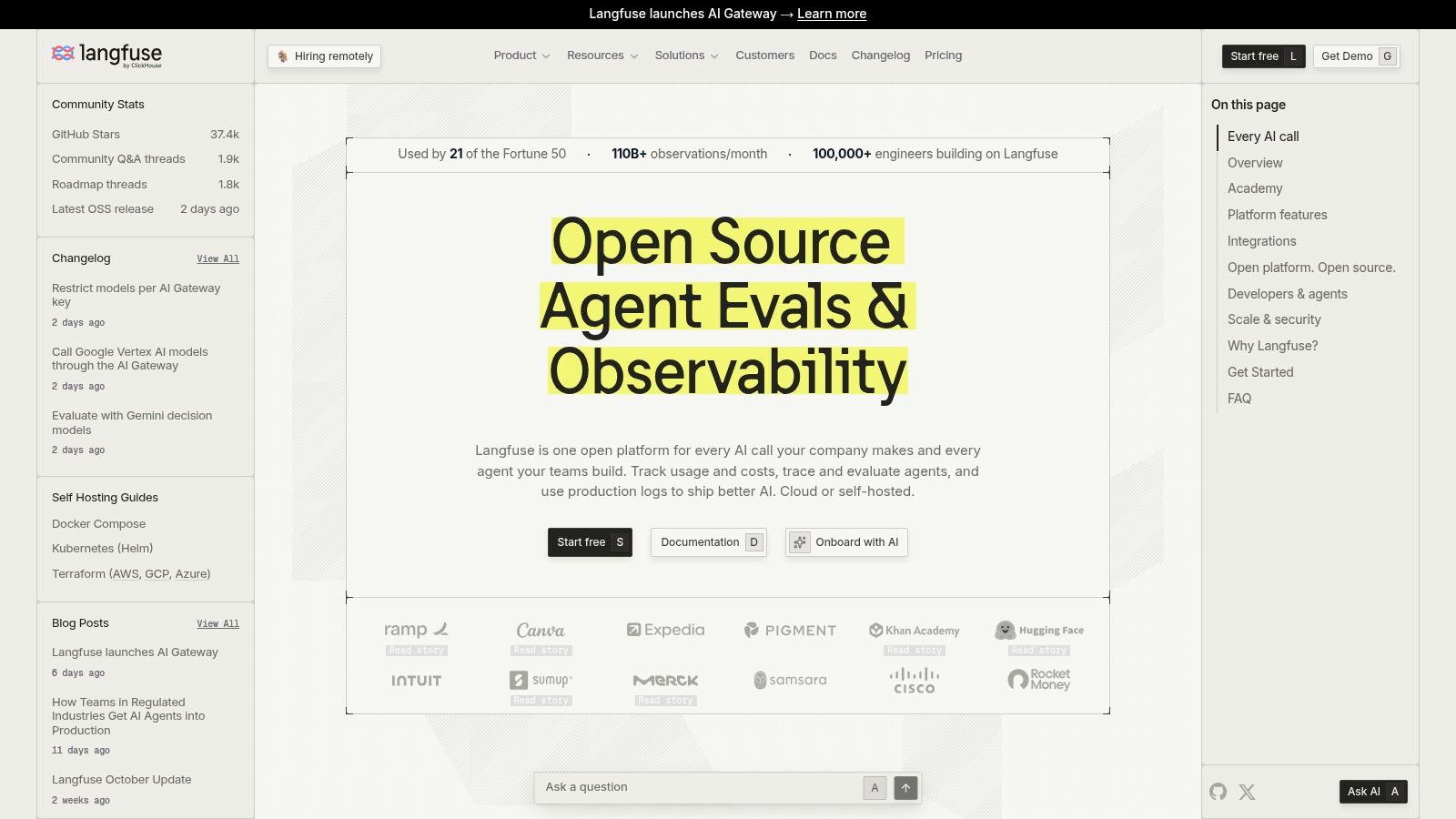
Choose Langfuse when deployment control matters alongside observability. Langfuse combines tracing, prompt management, dataset-based experiments, and evaluation, with hosted and open-source self-hosting options.
Its practical strength is the loop between production behavior and repeatable tests. Capture a problematic interaction, remove sensitive information, define the expected behavior, and promote it into a versioned dataset. Compare application changes against that dataset before releasing them.
That workflow is more useful than accumulating traces without assigning anyone to review them. A trace becomes a regression asset only after someone identifies what should have happened.
Control Comes With Ownership
- Useful capabilities: Prompt versioning, offline experiments, live-trace evaluation, and score-threshold checks in CI.
- Engineering requirement: Your team must define or integrate evaluators that represent its own acceptance criteria.
- Operational trade-off: Self-hosting requires ownership of infrastructure, upgrades, access controls, backups, and retention.
Judge calibration deserves explicit attention. In controlled evaluator experiments, removing scoring criteria reduced GPT-4o's correlation with human judgments from 0.666 to 0.591. Configure rubrics with clear score descriptions and reference outputs where they're available.
Langfuse provides the infrastructure for recording scores and comparing runs. Your team remains responsible for proving that those scores mean something.
I'd favor it when engineers want production-to-test feedback with deployment flexibility. I wouldn't choose self-hosting just to avoid a subscription without first assigning operational ownership. The software may be open source, but maintaining an evaluation service still consumes engineering time.
4. W&B Weave
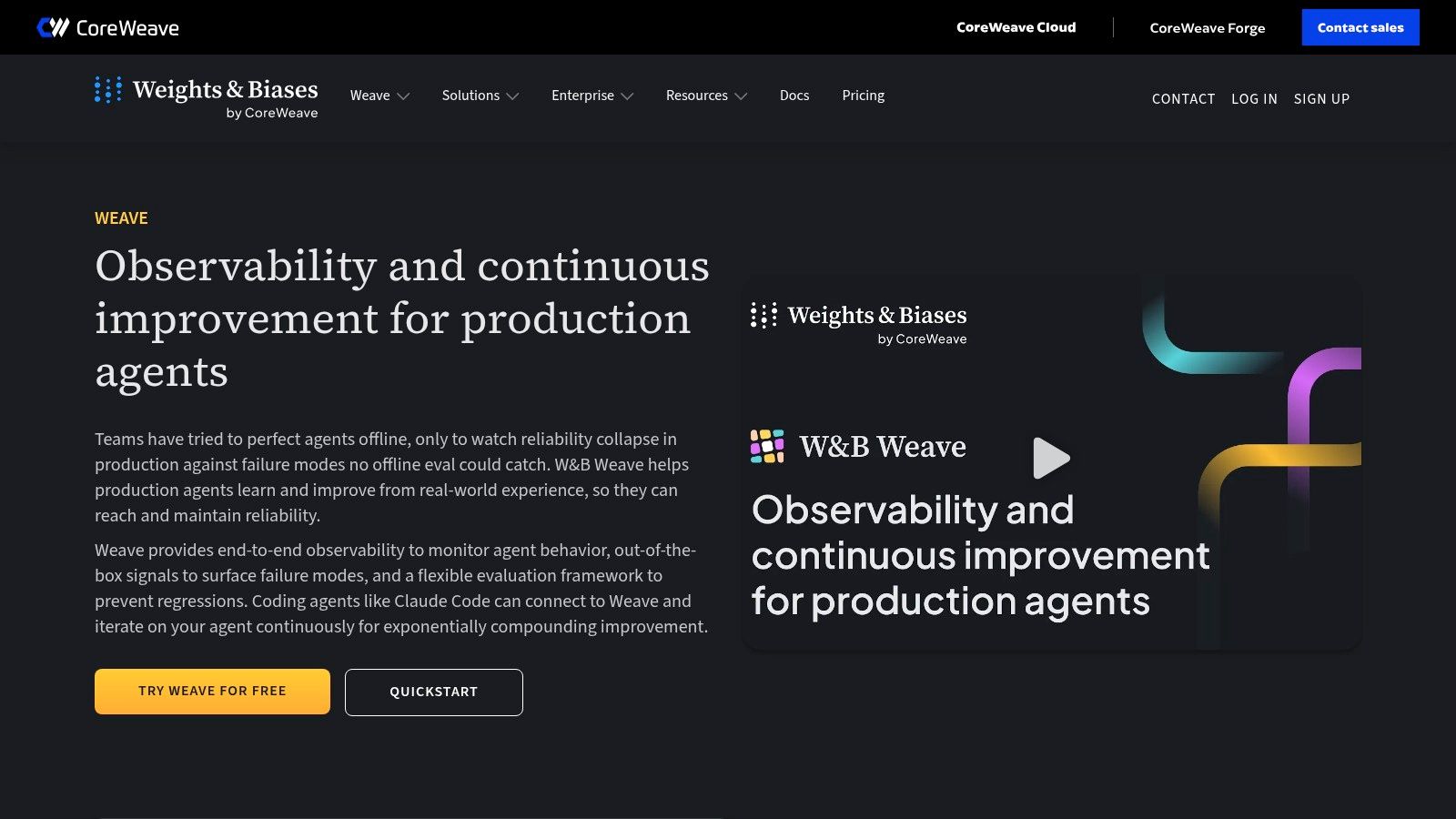
Best fit: experiment comparison backed by trace inspection. W&B Weave provides evaluation datasets, reusable scorers, tracing, and side-by-side results for generative applications and agents. It's a natural candidate for organizations already using Weights & Biases.
The important capability isn't just comparing aggregate accuracy. It's opening the examples behind a change and inspecting the associated behavior, latency, and cost.
Say a candidate prompt improves answer quality but causes an agent to make redundant searches. The quality score alone makes the candidate look attractive. Per-example inspection lets engineers identify the extra work and decide whether the improvement justifies it.
Use Separate Decision Signals
Build reusable scorers around distinct questions: Did the task succeed? Was the answer supported? Did the agent violate policy? Did execution stay within the application's operating limits?
Don't let an improvement in writing style compensate for a failed permission check.
Weave's combination of experiment tracking and application traces supports that investigation. Production signals and guardrail scorers can contribute safety and quality evidence, but scores shouldn't be mistaken for enforcement.
The trade-off is platform scope. A small team that only needs a local regression command may not need the broader environment, while teams already managing experiments there can avoid another disconnected reporting system.
There's a free entry plan for personal development, but production budgeting should include ingestion and storage. Confirm the collaboration and CI capabilities available on the intended plan, then test whether a reviewer can move from a failed score to the responsible execution step without manually assembling evidence.
5. Arize Phoenix
When a RAG answer is wrong, start by identifying which stage failed. Did retrieval miss the relevant policy, did the context contain conflicting versions, or did generation ignore adequate evidence?
Arize Phoenix combines tracing, experimentation, and evaluation to support that investigation. Its OpenTelemetry- and OpenInference-based tracing is relevant when teams need visibility across application components rather than only the final model response.
Best fit: RAG and agent troubleshooting with evaluation attached. Phoenix supports code-based and model-based evaluators across datasets, experiment results, and production traces, with Python and TypeScript SDKs.
Keep Retrieval and Answer Checks Separate
- Retrieval checks: Inspect whether the necessary evidence reached the generator and whether irrelevant context crowded it out.
- Generation checks: Assess whether the answer follows that evidence and resolves the user's request.
- Application checks: Verify authorization, tool parameters, and downstream outcomes with deterministic assertions.
That separation makes a failed evaluation actionable. Changing the generation prompt won't repair a missing document, and changing the embedding configuration won't fix an unsupported claim produced from sufficient context.
Phoenix offers source-level deployment control, but instrumentation and maintenance require engineering effort. Domain-specific validation also remains necessary, especially when a judge must interpret technical policies or specialized terminology.
I'd choose Phoenix when the team needs to connect RAG scores to the spans that explain them. I wouldn't assume that evaluation replaces runtime controls or every managed-monitoring requirement. Decide separately who will enforce permissions, respond to alerts, and maintain the deployment.
6. DeepEval and Confident AI
Best fit: code-first LLM regression testing. DeepEval is an open-source framework with pytest-style test cases and evaluation metrics for RAG applications, agents, multi-turn chatbots, and voice applications.
The appeal is familiar delivery mechanics. Engineers keep tests next to application code, run them before release, and return failures through the existing CI workflow. Configurable judge models let the team choose evaluators independently of the model under test, which matters when the same provider supplies both.
Separate the Framework From the Platform
Confident AI is a separate hosted product, adding centralized monitoring and collaboration. Local DeepEval tests run without making hosted monitoring a prerequisite, so a team can start in CI and decide later whether shared dashboards are worth the subscription.
A useful starting suite combines deterministic application assertions with selected quality metrics. For a support assistant, assert the escalation action and required fields directly. Reserve the judge for whether the explanation accurately communicates the policy.
Judge-based failures need reliability checks of their own. A study of LLM-as-a-judge reliability found inconsistent agreement across models and evaluation runs, which supports repeating critical tests and explicitly reviewing unstable scores. Resist the urge to rerun a flaky judge until the build turns green. Preserve the original result, inspect the evidence, and separate application instability from evaluator instability.
DeepEval's real cost is test maintenance plus inference spend on judge calls. A framework supplies execution mechanics; representative cases and rubrics that reflect your business still come from the team. Discovery listings such as the Deepval entry on AI Tool Seekers can help survey the category, but adoption should rest on whether the framework expresses your actual release criteria cleanly.
7. Ragas
Ragas earns its place when retrieval drives product quality. Ragas is an open-source evaluation library with metrics for retrieval and generation, including faithfulness, factual correctness, and context recall.
Unlike a broad observability platform, it focuses on expressing evaluation criteria within your own scripts and pipelines. That makes it useful for comparing chunking strategies, retrieval configurations, prompts, and model changes against a stable dataset.
Diagnose the Right Failure
A faithful answer isn't necessarily a correct answer. It may accurately repeat an outdated policy from the retrieved context. Conversely, a factually correct answer may still ignore the application's approved evidence.
- Faithfulness: Check whether the generated claims are supported by the supplied context.
- Context recall: Check whether retrieval supplied the information needed for the expected answer.
- Factual correctness: Compare answer claims with the appropriate reference information.
Keep the corpus snapshot and expected answers versioned with the evaluation. Otherwise, a changed score may reflect changed source material rather than a better or worse retriever.
Ragas supports custom metrics and experiments, but it isn't a complete hosted test-management system. Your team must decide where results live, how CI reports failures, and who reviews disputed judgments.
Some metrics also require evaluator-model calls, so a broad configuration sweep can increase evaluation usage before the team has learned anything actionable. Start with changes tied to a specific failure hypothesis.
I'd use Ragas for specialized RAG measurements and pair it with tracing when diagnosis requires execution details. Don't add another platform merely to display scores your existing pipeline can already report.
8. Promptfoo
Best fit: local-first regression testing and adversarial checks. Promptfoo combines a CLI and library with prompt and provider comparisons, assertions, browser-based result inspection, and automated red teaming.
It suits teams that want test definitions in the repository and a command that CI can execute. Compare prompts or model providers against the same cases, then inspect where behavior changed rather than relying on an overall winner.
For structured output, begin with schema and field assertions. For an agent, connect the test to the application endpoint and inspect tool behavior. Use model-based scoring where semantic judgment is necessary.
Keep Routine Tests and Attack Tests Distinct
A practical setup separates ordinary acceptance cases from adversarial cases. Both can run in CI, but failures need different interpretation and ownership.
Routine regression asks whether supported requests still work. Red teaming asks whether an attacker can induce prohibited behavior, expose information, or misuse a tool.
A prompt regression testing workflow should preserve prompt configuration, test inputs, and baseline results together. Make failures visible in the pull request, with enough evidence for a developer to reproduce them.
Promptfoo's local-first design doesn't eliminate model costs. Both the application under test and judge-based assertions can generate inference usage.
Its self-hosted web UI also shouldn't be treated as a production-scale collaboration platform without evaluating the enterprise offering. Choose it for its repository-friendly execution model, then assess shared reporting and access-control requirements separately.
9. Giskard
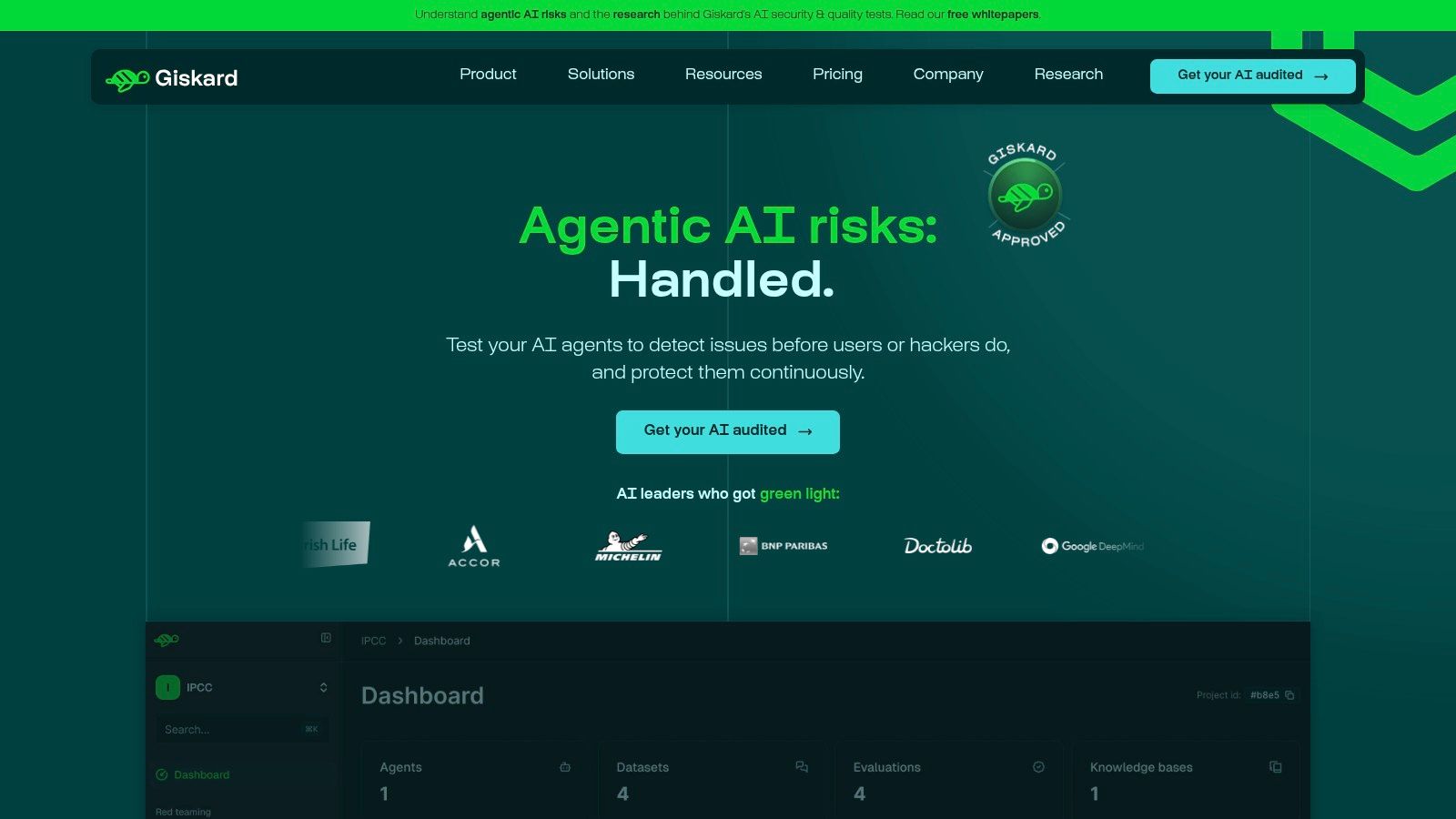
A vulnerability scanner is useful only if engineers can reproduce and resolve its findings. Giskard's relevant workflow is discovery followed by regression coverage, not generating a long issue list.
Giskard offers open-source Python testing and evaluation tools alongside a hosted Hub for datasets and team workflows. Its scope includes quality checks, vulnerability scans, and generating test suites from detected issues.
Best fit: security-focused evaluation with reusable failure cases. The hosted Hub's documented agent scope is conversational text-to-text through an API endpoint, so teams testing other modalities should evaluate fit carefully.
Turn Findings Into Release Evidence
For each finding, preserve the input, relevant context, observed behavior, and expected boundary. Reproduce the issue against the actual application permissions before assigning severity.
- Useful finding: An injected document causes the agent to call a restricted tool with attacker-controlled arguments.
- Different severity: The agent repeats an instruction but cannot access the requested data or execute the action.
- Regression target: After remediation, verify both the refusal behavior and the absence of unauthorized side effects.
A prompt injection testing program should cover retrieved documents, tool responses, and conversation history, not just malicious user prompts.
Giskard's trade-off is review effort. Automated findings need human assessment, and hosted capabilities differ from the open-source tooling.
Use scans to discover candidate failures, then keep confirmed cases in the release suite. A clean scan isn't proof that every attack path is closed, particularly when the tested configuration differs from production.
10. LangWatch
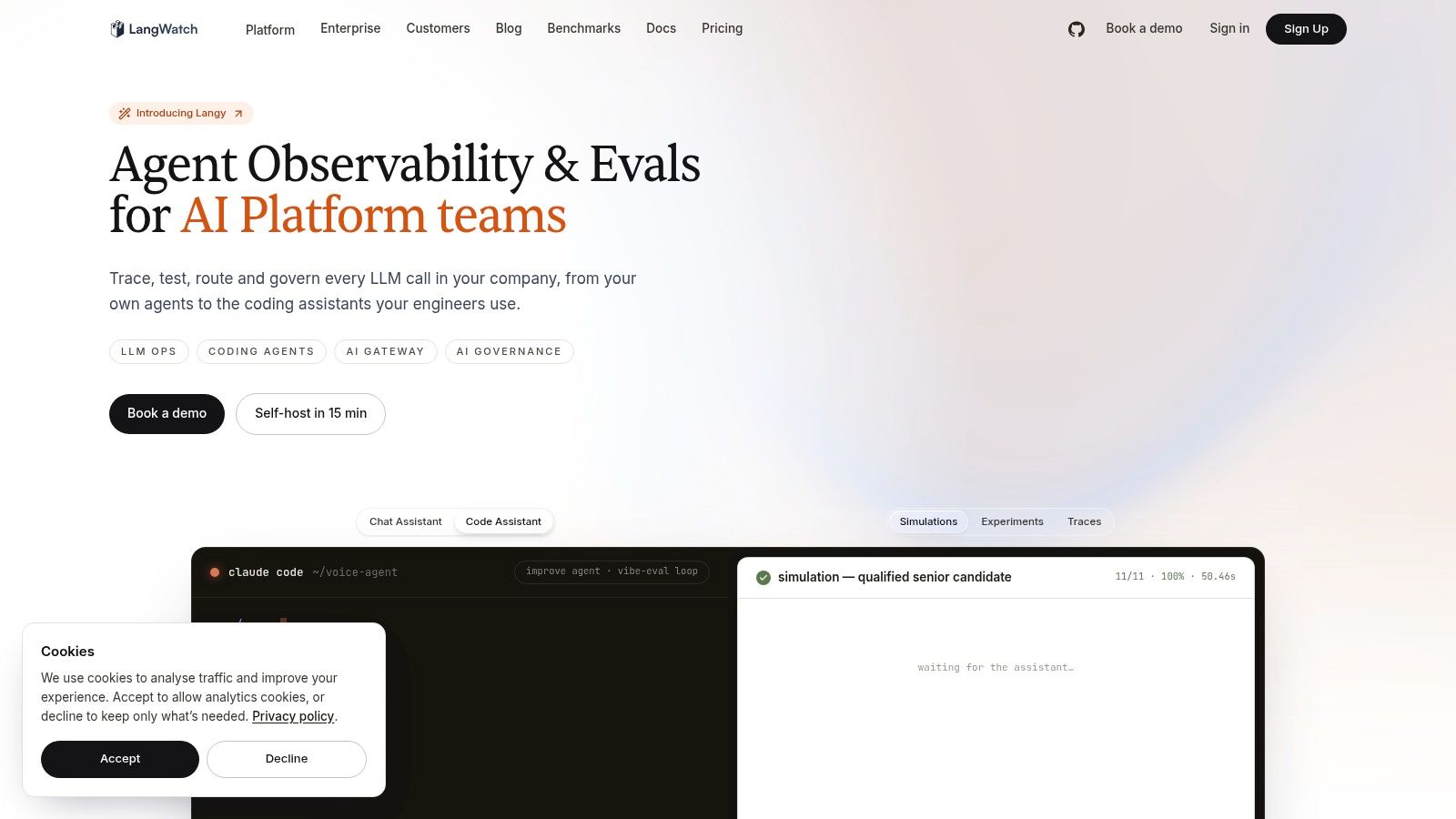
Best fit: multi-turn journeys and agent simulation. LangWatch combines evaluation, observability, and scenario-based testing, including success criteria, evaluator judgments, tool-call verification, and a visual run inspector.
Consider a customer changing a delivery address. The agent must identify the order, check whether modification is allowed, request missing information, submit the correct update, and explain the outcome. An isolated answer-quality test can't establish whether that journey succeeded.
Test Outcomes and Boundaries
Define the scenario's initial state, simulated user behavior, permitted tools, and success conditions. Include recovery paths such as an unavailable service or an ambiguous account match.
Check the resulting state directly where possible. A conversational claim that an address changed isn't equivalent to a successful authorized update.
A simulation should verify what the agent did, not merely whether its final message sounds successful.
Deployment-specific testing matters: the Stanford AI Index analysis reports that safety-optimized language-model agents failed 23.9% of 144 critical tool-use scenarios. That finding concerns those evaluated scenarios, not a universal failure rate for production agents.
LangWatch supports offline evaluation, production monitoring, CI/CD, and self-hosted options. Its trade-offs include usage-based event billing and enterprise requirements for custom SSO/RBAC and SLAs.
Budget for the full simulated journey, including tool calls, evaluation, and traces. Keep real user cases alongside simulated ones, because a simulator's assumptions can exclude the confusion and unexpected behavior that users introduce.
LLM Evaluation Tools at a Glance
| Tool | Deployment Model | Best For | Stands Out For |
|---|---|---|---|
| LangSmith | Hosted platform | Teams connecting LLM evaluations with production monitoring | Tracing agent steps and tool calls |
| Braintrust | Hosted platform with code and UI workflows | Regression testing and comparing AI changes in CI | Pull-request score summaries |
| Langfuse | Hosted or self-hosted, open source | Teams building evaluation workflows from production traces | Flexible deployment and trace-based datasets |
| W&B Weave | Hosted platform | Teams evaluating generative AI applications and agents | Per-example inspection alongside experiment tracking |
| Arize Phoenix | Open source and self-hostable | Teams troubleshooting RAG and agent workflows | Tracing combined with code-based and model-based evaluation |
| DeepEval and Confident AI | Local open-source framework with optional hosted platform | Code-first LLM testing in development and CI | Pytest-style test cases across RAG, agents, chat, and voice |
| Ragas | Open-source library | Evaluating RAG retrieval and answer quality | Specialized retrieval and generation metrics |
| Promptfoo | Local-first open-source CLI and library, with enterprise options | Prompt regression testing and AI red teaming | Quality checks and adversarial testing in CI/CD |
| Giskard | Open-source Python tools and hosted Hub | AI quality and security testing | Turning detected issues into regression tests |
| LangWatch | Hosted platform with self-hosted option | Testing multi-turn conversations and agent journeys | Scenario simulation with tool-call verification |
Choosing Your Evaluation Stack and Making It Stick
Start with the workflow you're missing, not the longest feature list. The useful categories are tracing and observability, CI regression, RAG-specific evaluation, and adversarial red teaming. Scenario testing connects these categories when an agent must complete a journey across multiple turns and tools.
For most application teams, begin with Promptfoo, DeepEval, or Braintrust as the CI-integrated evaluation layer. Choose Promptfoo for repository-friendly comparisons and adversarial checks, DeepEval for pytest-style evaluation, or Braintrust for shared experiments and pull-request review. Prove the release workflow before expanding the stack.
Add Ragas or Phoenix when retrieval materially determines answer quality. Layer in LangSmith or Langfuse when production diagnosis becomes a bottleneck, and Giskard when you need systematic vulnerability discovery. Weave and LangWatch deserve consideration when experiment tracking or simulated agent journeys are the main gap.
Build a Suite People Will Maintain
Start with business-critical journeys: policy-grounded support, account changes, escalation, and consequential tool actions. Include successful requests, missing information, denied permissions, and recoverable downstream failures. Define expected outcomes before choosing the scorer.
Use deterministic assertions for schemas, factual fields, permissions, tool arguments, and resulting application state. Use judges for nuanced qualities such as relevance or explanation quality. Reserve human review for ambiguous, high-impact, novel, or unstable cases.
- Version the evidence: Preserve datasets, prompts, corpus snapshots, evaluator configurations, and application revisions.
- Separate release signals: Keep safety violations distinct from answer quality, latency, and cost.
- Budget the full workflow: Include tested-model inference, judge inference, trace ingestion, retention, and review effort.
Human review also needs calibration rather than automatic trust. A review of annotation reporting found 79.2% human–human exact-match agreement, reinforcing the need for clear rubrics and adjudication of disputed cases.
Generic benchmarks remain useful context, but they don't certify your product's deployment readiness. The discussion of benchmark limits for compliance teams is relevant when stakeholders need to distinguish capability evidence from application-specific assurance.
Assign an owner to every blocking metric and every recurring failure category. If nobody can explain a failed score or authorize a justified exception, the gate will become noise.
Teams without in-house capacity can bring in QA automation specialists such as AskYourQA. We map critical user journeys and build automated coverage around LLM output validation, safety checks, and CI/CD integration, keeping evaluation connected to the software customers use.
AskYourQA designs and implements AI testing and automation systems that connect LLM quality checks, safety validation, and end-to-end workflows to your delivery pipeline. Visit AskYourQA to discuss your critical AI journeys and identify the evaluation gates your next release needs.