
Friday afternoon, someone adds two words to a support assistant's system prompt. The replies get warmer, the change ships, and the application code stays untouched.
Monday morning the parser starts throwing. The assistant's answers still read well to a human, but they now arrive wrapped in markdown fences, and the service that consumes them chokes on a third of requests. Nothing in the repository changed. Every unit test in the pipeline is green.
That's the gap prompt regression testing closes. The practice is easy to describe: replay a fixed corpus of real inputs against stored baseline outputs and scores whenever the prompt text, the model revision, the retrieval snapshot or the sampling settings change, then block the release when previously working behavior drops. Running the prompts isn't the hard part. Proving which component moved is.
Table of Contents
- What Prompt Regression Testing Catches That Code Tests Miss
- How to Capture a Trustworthy Prompt Baseline
- Metrics and Drift Thresholds That Separate Real Regressions From Noise
- Managing Test Data and Calibrating Your Judges
- How to Gate Prompt Changes in CI/CD
- Diagnosing and Fixing a Failed Prompt Regression
- Set Up Your First Prompt Regression Gate
What Prompt Regression Testing Catches That Code Tests Miss
Unit tests verify code that someone committed. Prompt regressions often live outside the repository entirely. A prompt regression suite closes that gap by holding three things under version control: a fixed corpus of inputs, a pinned baseline of outputs and scores, and a comparison that runs before every merge. It answers one question code tests cannot. Does the system still behave as it did on the cases that matter?
That question exists because model behavior moves without a commit. Providers update models or retire versions, which is why a 2024 ACM study of evolving LLM APIs re-evaluated prompts that had already been designed and validated, and saw its toxicity-detection prompt regress after the API underneath it changed. No repository diff would have flagged that.

The payoff shows up in review depth. The 2024 RETAIN study from the Association for Computational Linguistics reported that its regression-testing tool let participants identify twice as many errors as manual evaluation (ACL Anthology). That multiple matters because manual spot-checking is precisely where quality leaks out of a release.
Three properties break the exact-assertion model. The same ACM study names them: correctness depends on the task and its evaluation context, prompts are brittle to small wording changes, and outputs vary between runs. Prompt shape alone moves scores hard. On MMLU evaluations, few-shot chain-of-thought prompting scored well above the zero-shot version of the same questions, with the task, the model and the inputs unchanged.
Here's the failure that usually lands first. A claims-triage prompt has routed every ticket into exactly one of four categories for six months. Someone adds an instruction to be more nuanced, and it now returns two categories and a hedge. Every human-readable answer looks better than before. The routing automation breaks.
That break is why every element in the chain carries a version: prompt text, model revision, retrieval snapshot, parser contract, evaluator version. Miss one and you'll spend a week blaming the prompt for a retriever change. A score drop never answers a failure on its own. It only tells you which component to interrogate first.
| Aspect | Code regression testing | Prompt regression testing |
|---|---|---|
| Typical trigger | Code commit or merge | Prompt edit, model update, provider change, retrieval change or new sampling setting |
| Same input gives | Same output every run | Varying output across runs, so repeated trials are needed |
| Pass criteria | Exact assertion on the result | Task scores, schema validity and safety checks with an agreed tolerance |
| Baseline | Previous passing test run | Pinned outputs or scores stored with prompt, model and evaluator metadata |
Tooling carries more weight than commonly expected, because the runner must store baselines, per-slice reports and raw outputs rather than just fire requests, so it pays to browse testing tool reviews before you pick one. The AI testing framework underneath it decides how much of that you get out of the box.
How to Capture a Trustworthy Prompt Baseline
Baselines fail for a boring reason. A team captures outputs, forgets the settings, and six weeks later nobody can say whether a score moved because the prompt changed or because the provider rolled a new revision underneath them.
Start with the journeys, not the test cases. The first step is mapping the user journeys the business depends on, not only the flows that are easy to test. A refund path with three prompts behind it earns more attention than a toy endpoint with a clean assertion.
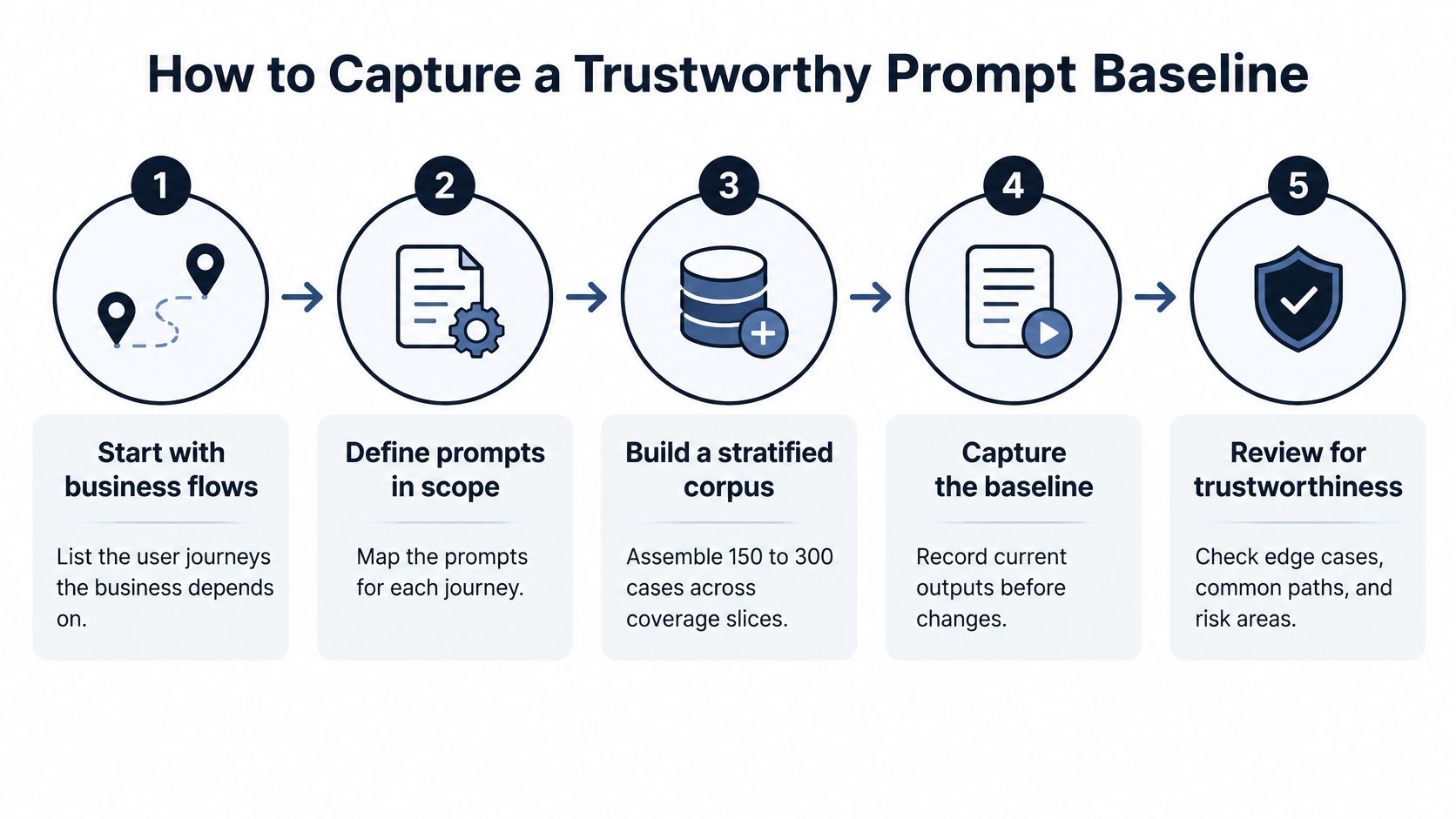
Build a stratified corpus of 150 to 300 cases across five slices: normal traffic sampled from logs, boundary inputs, multilingual variants, adversarial attempts, and every previously fixed failure. A slice below its floor can't decide a gate, because a handful of cases produces noise you'll mistake for signal.
Then run the capture routine in order.
- Name the flows. Pick three to five business-critical journeys and list every prompt in scope for each one.
- Assemble the cases. Attach an expected behavior or a validator to every case, not a golden string.
- Pin the settings. Prompt version, provider model revision, temperature, seed where supported, retrieval snapshot, evaluator version.
- Replay. Run each case, repeating nondeterministic tasks three to five times so you learn the actual spread.
- Score. Use task-specific validators, not a generic similarity metric.
- Store. Keep raw outputs, scores and metadata per slice in version control, tagged to the release.
A billing assistant with 200 cases, 40 per slice, gets saved as billing-prompt-v12 before anyone touches the wording. When v13 arrives, the comparison is arithmetic instead of an argument.
| Slice | What to include | Minimum cases |
|---|---|---|
| Normal traffic | Typical requests sampled from production logs | 60 |
| Boundary | Empty, very short and very long inputs | 30 |
| Multilingual | Each supported language with native-speaker phrasing | 20 per language |
| Adversarial | Prompt injection, jailbreak attempts and off-topic requests | 30 |
| Historical failures | Every previously fixed bug, kept permanently | All of them |
The last check is reproducibility. Rerun the corpus with nothing changed. If the scores don't land inside the noise band you measured, the baseline isn't trustworthy yet and no gate built on it will be either.
Metrics and Drift Thresholds That Separate Real Regressions From Noise
The order is fixed. Run deterministic checks first, score meaning second, and never let one average become the gate.
Deterministic checks are binary. JSON schema validity, required fields, exact identifiers, citation presence, latency ceilings and token budgets either hold or they don't. One failure on a critical slice blocks the change, and reviewer discretion doesn't override it.
Semantic quality needs a distribution. Helpfulness, grounding and concision get rubric scores reported as mean, standard deviation and worst case per slice. Safety gets the strictest rule in the suite: zero new violations against the baseline.
Deciding whether a drop is real
The evidence for taking this seriously is blunt. An analysis of prompt and model combinations across API updates found accuracy declined for 58.8% of combinations after the update, and 70.2% of those declines exceeded five percent. The same work found one update lifting a dataset by 11.8% on average while cutting another by 16.8%, which is exactly how an aggregate score conceals a release-blocking regression.
Repeat runs, pair the results on identical cases, and require a confidence interval or paired test before you call a drop meaningful. Then read the slices.
Say a rubric mean falls 0.2 on a five-point scale across 60 cases. That's probably noise on an open-ended task, and I'd rerun before acting on it. Now say the refund-policy slice falls 0.5 while the overall mean rose, because the model got chattier on general questions. That blocks the release.
Gate rule: a noncritical improvement never cancels a critical failure.
| Metric type | Examples | Gate rule |
|---|---|---|
| Deterministic | JSON schema validity, required fields, exact IDs, citation presence | Must pass on every case in critical slices |
| Rubric score | Helpfulness, grounding, concision scored by a judge | Mean and worst case per slice inside the agreed tolerance, with critical slices never below the baseline |
| Safety | Policy classifier flags, refusal behavior | Zero new violations compared with baseline |
| Operational | Latency, token count, cost per request | No rise beyond the budget set for that slice |
Managing Test Data and Calibrating Your Judges
Two parts of a suite get forgotten between releases: the data and the judge. Both drift, and both can make a healthy system look broken or a broken one look healthy.
Refresh the corpus monthly from anonymized production logs, strip personal data, and add every new bug as a permanent case. Version the dataset with a hash, such as a SHA-256 over the sorted case IDs and expected labels, so any result traces back to the exact cases that produced it.
Then test the paraphrases. A study of meaning-preserving prompt variants found that, across 150 queries, closed-form outputs preserved the expected answer label only about 22% of the time once wording, separators or ordering changed. A prompt that passes its canonical examples may still fail under these changes, which is why critical cases need reworded twins that assert on meaning rather than text.
Calibrating the judge
Treat automated judge labels as a hypothesis, never as ground truth. Human reviewers label 50 to 100 examples per task type, and you measure how often the judge agrees with them. Audit false positives and false negatives at each release, and send ambiguous outputs to a person.
The misalignment is measurable. An audit of 496 tool-calling benchmark tasks found 92 disagreements between official labels and expert judgments, an 18.5% label-misalignment rate (arXiv). That's the error you inherit if you never check the checker.
Run repeated trials on nondeterministic cases and quarantine flaky ones instead of averaging them into oblivion. Record judge version, rubric version, temperature, seed, provider model revision and dataset hash with every failure, so a colleague can reproduce it without asking you what you did. The floors stay fixed as the corpus refreshes, and a slice that drops below them stops deciding gates until it's refilled.
| Slice | What to include | Minimum cases |
|---|---|---|
| Normal traffic | Typical requests sampled from production logs | 60 |
| Boundary | Empty, very short and very long inputs | 30 |
| Multilingual | Each supported language with native-speaker phrasing | 20 per language |
| Adversarial | Prompt injection, jailbreak attempts and off-topic requests | 30 |
| Historical failures | Every previously fixed bug, kept permanently | All of them |
For the surrounding data plumbing, this guide to building a test data strategy for automation covers the parts that aren't specific to LLMs.
How to Gate Prompt Changes in CI/CD
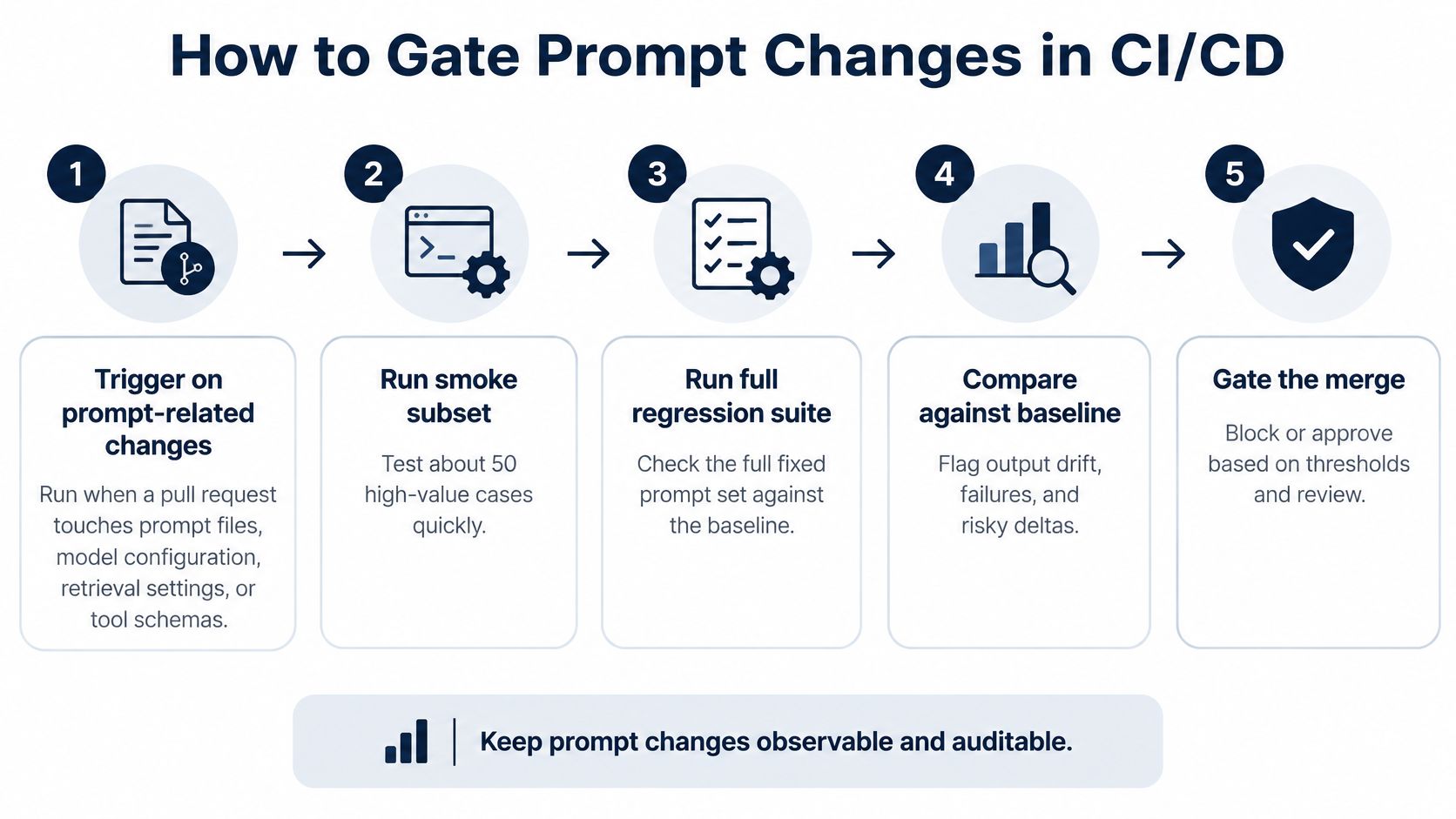
A gate that runs but never blocks anything is a dashboard. Wire it to the merge button or don't build it.
- Trigger on the right changes. Run the job on any pull request touching prompt files, model configuration, retrieval settings or tool schemas.
- Smoke first. A subset of about 50 high-value cases should finish in minutes, which is the only way developers keep the check enabled.
- Run the full suite nightly and on every release candidate.
- Compare per slice. Every result goes against the pinned baseline and produces a report by slice, not one overall number.
- Apply the gate rules. Deterministic checks must pass, rubric drops stay inside tolerance, no new safety violation appears.
- Block and attach evidence. On failure the merge stays closed, with failing examples and raw outputs in the comment.
- Promote deliberately. A passing change becomes a candidate baseline and needs human approval before it replaces the old one.
- Log everything. Every run keeps its metadata so a later drop is traceable to a version, a date and a case set.
The nightly run earns its keep on drift nobody triggered. A provider ships a new model revision on a Thursday and no pull request exists to catch it. The nightly comparison finds the shift in a boundary slice before a customer does.
Say a pull request edits a system prompt to handle partial refunds. The smoke run fails four of the 50 boundary cases with a schema error, the merge is blocked, and those four raw outputs sit in the thread. The author sees the markdown fence in the payload within a minute of opening the page.
Merge rule: if a critical slice fails in the smoke subset, the pull request stays open. "It's just wording" is not an exemption.
If your team is still wiring the pipeline itself, the guide to CI/CD integration testing covers the job structure and reporting that make this kind of gate visible.
Diagnosing and Fixing a Failed Prompt Regression
The instinct when a score drops is to rewrite the prompt. That's the last step, not the first. A drop can come from the prompt edit, a provider model update, a retrieval or embedding change, a tool contract shift, or plain sampling noise, and rewriting on instinct destroys the evidence you need.
Attribution comes first. Operational research into 156 high-severity AI inference incidents between April and June 2025 noted that variable prompt lengths, concurrency and streaming give these systems reliability characteristics traditional workloads don't have, which is why a single quality score can't identify a cause.
Change one factor at a time
Hold the model, retrieval snapshot, tool responses, temperature and evaluator constant, then move one variable: the old prompt on the new model, then the new prompt on the old model. The difference between those two runs tells you whether you shipped the problem or inherited it.
Retrieval moves matter more than often assumed. An empirical study of retrieval-augmented code generation found that removing the retrieved document caused 11.67% of previously passing tasks to regress, and substituting a mismatched document caused 9.17%. The authors were careful to note that much of the signal traced to a copy-the-document template habit rather than deployment risk, which is itself the point: the input moved, and the prompt took the blame.
Once you know what changed, repair it in this order.
- Revert or constrain. Roll back the change, or add a targeted instruction that addresses the specific failure.
- Make it permanent. Add the failing input to the corpus so it can never regress again.
- Rerun the affected slice only. Fast confirmation beats a full suite for a single fix.
- Update the baseline last, and only when the change was intended and a human approved it.
Decide in advance who may roll back a prompt when a provider update tanks production. A named owner with authority beats a meeting.
| Symptom | Likely cause | First check |
|---|---|---|
| Parser breaks while answers read fine | Formatting drift in the prompt or after a model update | Run schema validity on the failing outputs |
| Drop only in one slice | A prompt weakness specific to that input type | Compare per-slice scores with the baseline |
| Failure with an unchanged prompt | Provider model revision changed | Rerun with the pinned revision to confirm |
| Results differ between runs | Nondeterministic sampling or a flaky case | Repeat trials and check the quarantine list |
| Gate disagrees with reviewer | Judge drift or rubric ambiguity | Audit against the calibration set |
Set Up Your First Prompt Regression Gate
Keep week one small enough to finish. Day one, pick three to five flows that would hurt most if they regressed. Day two, build a starter corpus of about 50 cases from those flows, including every known failure. Day three, capture the baseline with pinned metadata and confirm a rerun reproduces the scores. Day four, add one CI job that runs the deterministic checks and blocks merges on any schema failure.
In week two, add rubric scoring and slice-level gates once you've seen how noisy your own data is, and grow the corpus toward the slice floors. Assign one owner for the baseline and another for the judge calibration set, so every approval and audit has a name attached.
Start here: protect one flow this week, not the whole product. The refund path or the login-adjacent assistant, whichever produces the angriest tickets today.
That ownership point is why we build these systems with a specialized team working in parallel rather than assigning a single engineer, since baseline upkeep, judge auditing and CI wiring are three jobs that don't queue well behind one person.
If your product includes a conversational agent, the AI support agent blog covers conversation design patterns that make refusal and escalation cases easier to specify as assertions instead of opinions.
Name the first flow now. Not the one that's easiest to test, the one that would page you on a Sunday.
AskYourQA builds this gate end to end: we map the business-critical flows first, then build the regression suite, the pinned baselines and the CI checks that run on every pull request, with nightly evaluations against the stored baseline and re-baselining only after a human approves the change. Our team works in parallel across frontend, backend and CI/CD, so the first working suite arrives in weeks rather than quarters. Book a free 20-minute call where we map your critical flows and show how fast the framework can be up, or visit AskYourQA to start.