
Your suite was green on Friday. On Monday it fails on checkout, login, and refunds, yet nobody changed those flows over the weekend. You rerun it, half the failures vanish, and now you don't know whether you're looking at a product bug or at test data that drifted, was shared between tests, or never contained the state the test assumed.
That's the failure mode a test data strategy for automation is meant to prevent. NIST describes test-data generators as tools that produce data specifically to expose execution-time errors, and its NIST guidance on test data makes a point teams often skip, a valid dataset includes both the input and the correct expected output. Without that input and oracle pair, you have records, not evidence. I would treat test data as a versioned operating asset with owners, contracts, and refresh rules, not as fixture files someone copies when a run breaks.
Table of Contents
- Which Data Source Fits Each Test Type
- Build the Strategy in Five Steps
- Keeping Data Stable So Failures Mean Something
- Masking and Synthetic Data Without Broken Relationships
- Provision and Version Environments and Datasets
- Covering Risk Without Bloating the Suite
- Assign Ownership and Start with One Journey
Which Data Source Fits Each Test Type
Use this table as your default. If a test needs a specific state, build it. If it needs a realistic shape, mask a real one.
| Test type | Data source | Masking | Refresh |
|---|---|---|---|
| Unit and component tests | Inline fixtures or factories | Not needed | Every run |
| API and contract tests | Seeded synthetic records created through the API | Not needed | Every pipeline run |
| End-to-end regression | Masked subset with production shape | Static masking | Weekly or each release |
| Performance tests | Volume-scaled synthetic profile | Synthetic only | Before each load test |
| Exploratory and UAT | Dynamically masked production snapshot | Dynamic masking | Monthly |
| Negative and edge-case tests | Hand-built synthetic records | Not needed | With each new feature |
Why the rows differ
Unit tests don't need realism, they need speed and control, so a factory that creates a user with balance zero or status suspended on demand beats a database restore every time. API tests need predictable IDs and states more than production-like names, which is why creating records through the API itself works well. It also proves your setup path works, a point worth carrying into your test strategy for API testing.
End-to-end regression is different. Those tests pass through pricing, inventory, permissions, and payment rules that interact in ways hand-written fixtures rarely capture, so a masked subset with production shape earns its slower refresh. Performance tests need volume and distribution, not personal data, so synthetic profiles scaled to production give you the load without the compliance risk.
Practical rule: Production rarely contains the invalid states you need most, so write negative and edge-case records by hand alongside each new feature.
Say a checkout team is fixing a payment regression. They find the end-to-end row, take the masked subset as their source, confirm static masking is the rule for card and email fields, and check the subset was refreshed for the current release before they run anything. That lookup takes seconds, and it stops the common waste of debugging a failure caused by a stale dataset.
No single technique covers every row. Teams that force masked production data into unit tests get slow pipelines, and teams that force synthetic data into regression miss the odd real-world combinations that break releases. The mix is the point.
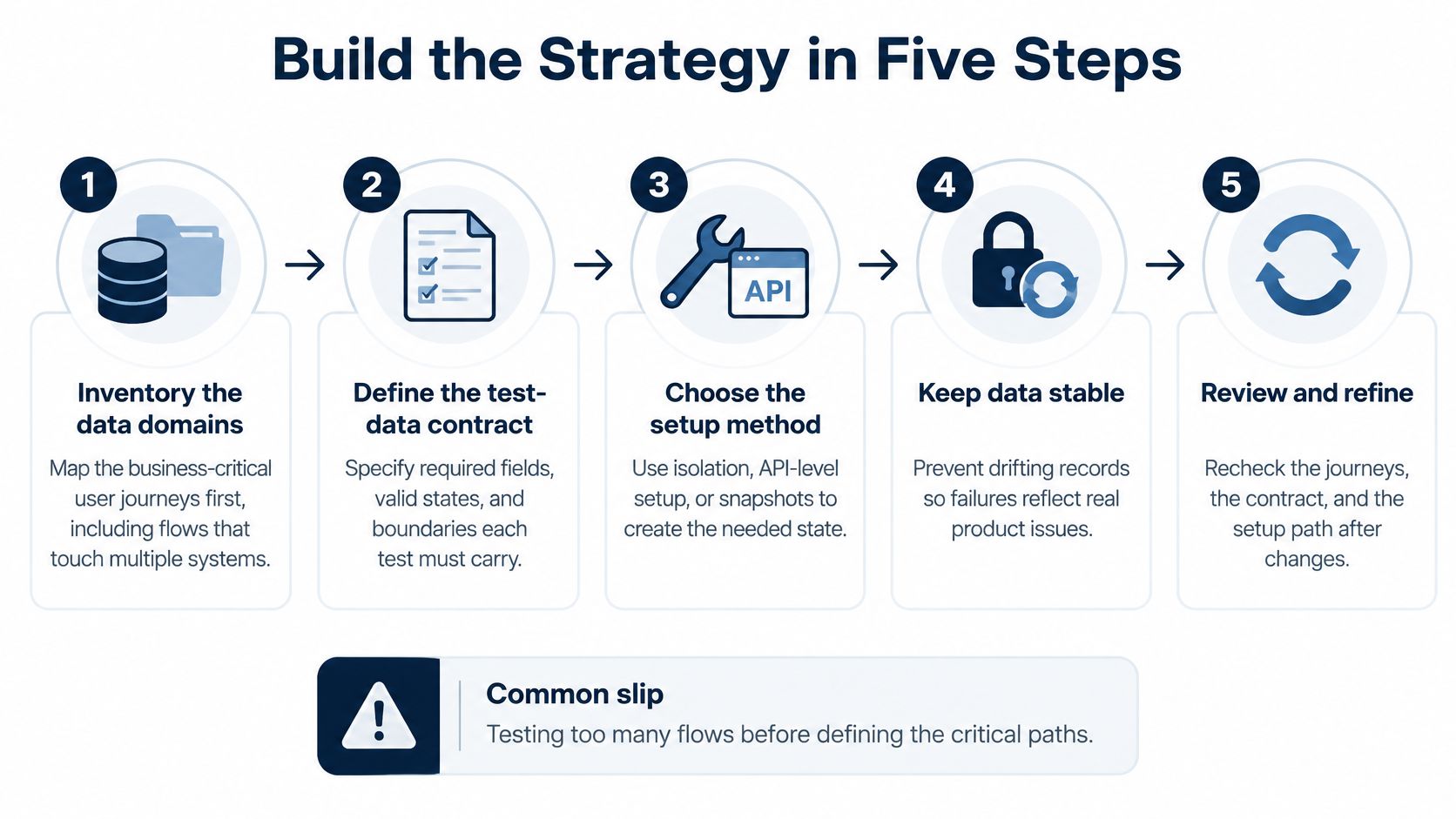
Build the Strategy in Five Steps
Build this as a pipeline, not as a one-off data dump. The Perforce State of Test Data Management report found an enterprise survey reporting adoption of static masking at 86%, dynamic masking at 60%, synthetic data at 51%, tokenization at 33%, and subsetting at 29%, which tells you mature programs run a portfolio, not one method.
-
Inventory the data domains: Map the business-critical user journeys first, including flows that cross systems and are hard to test, not only the easy ones. That's also our first step when we start work with a client. The common slip is skipping the inventory and building polished data for flows nobody depends on.
-
Classify each field: Tag fields by sensitivity and test purpose, such as personal identifiers, financial values, or free text, so every field has a known handling rule before any data moves. The slip here is masking one table but not its foreign keys, which leaves the same customer identifiable through a related record.
-
Select the control per use case: Pick static masking for reusable lower environments, dynamic masking for controlled access, subsetting for smaller CI datasets, and synthetic generation for new features and negative tests. Record the choice beside each journey so the next engineer doesn't relitigate it. Masking must preserve referential integrity, format constraints, uniqueness, and distributions, or your privacy step becomes a defect generator.
-
Define a data contract per test: Write down the required entities, valid-state constraints, authorization context, time-zone assumptions, cleanup behavior, and expected invariants. A scalable framework, built clean from day one, pays off because contracts sit naturally beside the tests they support. Without a contract, a failure can't be traced to data or code.
-
Validate and monitor in the pipeline: Check each dataset before the suite runs, version it as code, and record provisioning lead time, refresh success, and the share of critical journeys with ready fixtures. Manual data acquisition is the trap to avoid, it makes even small datasets slow to obtain, so automate scope identification and generate on demand where you can.
The five-question check
Run these against your current suite today:
- Journeys mapped: Is every critical journey in the inventory?
- Fields classified: Does every sensitive field have a handling rule?
- Contracts written: Does every test carry a data contract?
- Owners named: Does every dataset have an owner and a refresh date?
- Runs traceable: Does every CI run record its dataset identifier?
The first no is your first gap. Close that one before you buy any tooling.
Keeping Data Stable So Failures Mean Something
Unstable data is worse than missing data because it produces failures that look exactly like product defects. Engineers investigate, find nothing, rerun, and slowly stop trusting the suite. Once that trust goes, real regressions get ignored too.

What a data contract actually does
A contract makes a test's assumptions inspectable. It names the required entities, the states they must be in, the authorization context, clock and time-zone assumptions, external dependencies, cleanup behavior, and the invariants that must hold at the end. Provision isolated data per test or namespace, set it up through the API where you can, reset with snapshots or transactional cleanup, and attach the dataset identifier to CI artifacts. That identifier is what turns a vague red build into a reproducible case, and it's a natural fit for how you already handle continuous integration and testing.
| Cause | Symptom | Fix |
|---|---|---|
| Shared mutable records | Passes alone, fails in parallel runs | Provision isolated data per test or namespace |
| Order-dependent fixtures | Fails only after a specific test runs first | Make each fixture self-contained |
| Non-deterministic timestamps | Fails near midnight or across time zones | Pin clock and time zone in the data contract |
| Reused identities | Duplicate key errors in CI | Generate unique IDs per run from a seed |
| Incomplete teardown | Failure rate grows over days | Reset with snapshots or transactional cleanup |
| Asynchronous propagation | Intermittent not-found errors | Wait on the data event, not a fixed sleep |
Reruns are a signal, not a cure
Research reported in a large-scale flaky test study found 9,568 flaky tests across almost 1.2 million tests executed, with developer-written tests showing roughly 0.5% to 1% flakiness. The same source notes automated rerunning detected only 40% of developer-repaired flaky-test commits, so a test that passes on rerun is weak evidence that anything is fixed.
A rerun that turns green tells you the test is unstable. It doesn't tell you the product is fine.
Quarantine a test only with an owner, an expiry date, and a root-cause ticket, and track your data-induced flake rate separately from product failures so you can see which problem you're solving. I'd also hold a hard promotion rule, a fixture is trusted only after it passes repeated parallel runs across your supported browsers, services, and database versions, and any failure must reproduce from a clean environment before someone files it as a product bug.
Masking and Synthetic Data Without Broken Relationships
The masking mistake that breaks the most tests is masking values in isolation. You scramble the email in the customers table, leave the original in the orders table, and now every account history test fails because the join no longer resolves. The data is private. It's also useless.
Pick the masking method by access pattern
Static masking rewrites values once when you build a reusable lower environment, so the masked copy is what everyone works against. Dynamic masking leaves the source intact and hides values at query time, which suits controlled access to a snapshot that different roles see differently. Tokenization fits when a value must match across systems, such as a customer reference shared between billing and support, because the same input produces the same token everywhere.
Whichever you choose, the masked output has to keep referential integrity, valid formats, uniqueness, distributions, and cross-field rules. A masked card number should still pass format checks. A masked birth date shouldn't produce a customer who is younger than their own account. A masked region code shouldn't point at a tax rule that doesn't exist. Test those properties directly, because a suite failing on structurally impossible data wastes everyone's morning.
Use synthetic data for what production can't give you
Production data is biased toward the happy path. It rarely holds expired cards, suspended accounts with pending orders, zero-balance wallets, or the invalid inputs that trigger your worst failures. Synthetic records let you build those states deliberately and oversample them.
The need is real. The Applause 2025 State of Digital Quality release reports a 2025 survey in which 84% of software professionals find defects difficult to reproduce with available test data, and separate research cited there identifies edge-case testing as the leading use case for tabular synthetic data, cited by 53% of respondents overall and 70% in financial services. Availability isn't the same as diagnostic value.
Build synthetic sets from production-derived distributions, then add risk-based mutation, domain constraints, metamorphic checks, and fixed seeds so any failure replays exactly. If you're generating evaluation cases for an AI feature, check them against real user behavior, because generated cases can inherit the omissions and biases of the model that wrote them and skip the hard prompts.
Measure state-transition coverage, boundary and negative-case coverage, defect-reproduction rate, and drift between test and production behavior. Counting records created tells you nothing about whether the data can catch a bug.
Provision and Version Environments and Datasets
Good data in the wrong environment, or at an unknown version, still leaves you unable to reproduce a failure. Provisioning and versioning close that gap.
-
Decide per environment: Create ephemeral environments per branch or pull request and seed them from code, so they can be thrown away without ceremony. Refresh shared lower environments from a masked snapshot on a schedule. Never send raw production copies to a production-facing environment, however urgent the request sounds.
-
Subset for CI: Pull only the rows your critical journeys need, then follow foreign keys so the subset stays referentially complete. Cap the size against a provisioning target, because a subset that takes longer to load than the suite takes to run will be bypassed.
-
Version the data as code: Keep seed scripts, masking rules, subset definitions, and scenario fixtures in the same repository as the tests. Tag each dataset version and attach that tag to CI artifacts, so a failing run points to an exact, recoverable dataset.
-
Refresh from the pipeline: Run refreshes automatically, never by hand from someone's laptop. If a refresh fails, keep the previous version available so the team isn't blocked on a broken data job.
-
Validate after provisioning: Check row counts, foreign keys, and uniqueness, then run a smoke pass over the critical journeys before the full suite starts. Catching a bad dataset here costs minutes, catching it through two hundred red tests costs a day.
Reproducibility rule: If you can't name the data version an environment is running, you can't use that environment to reproduce a failure.
The slip I would watch for is subsetting tables independently. It looks faster, and it breaks foreign keys in ways that surface as confusing not-found errors far from the actual cause.
Covering Risk Without Bloating the Suite
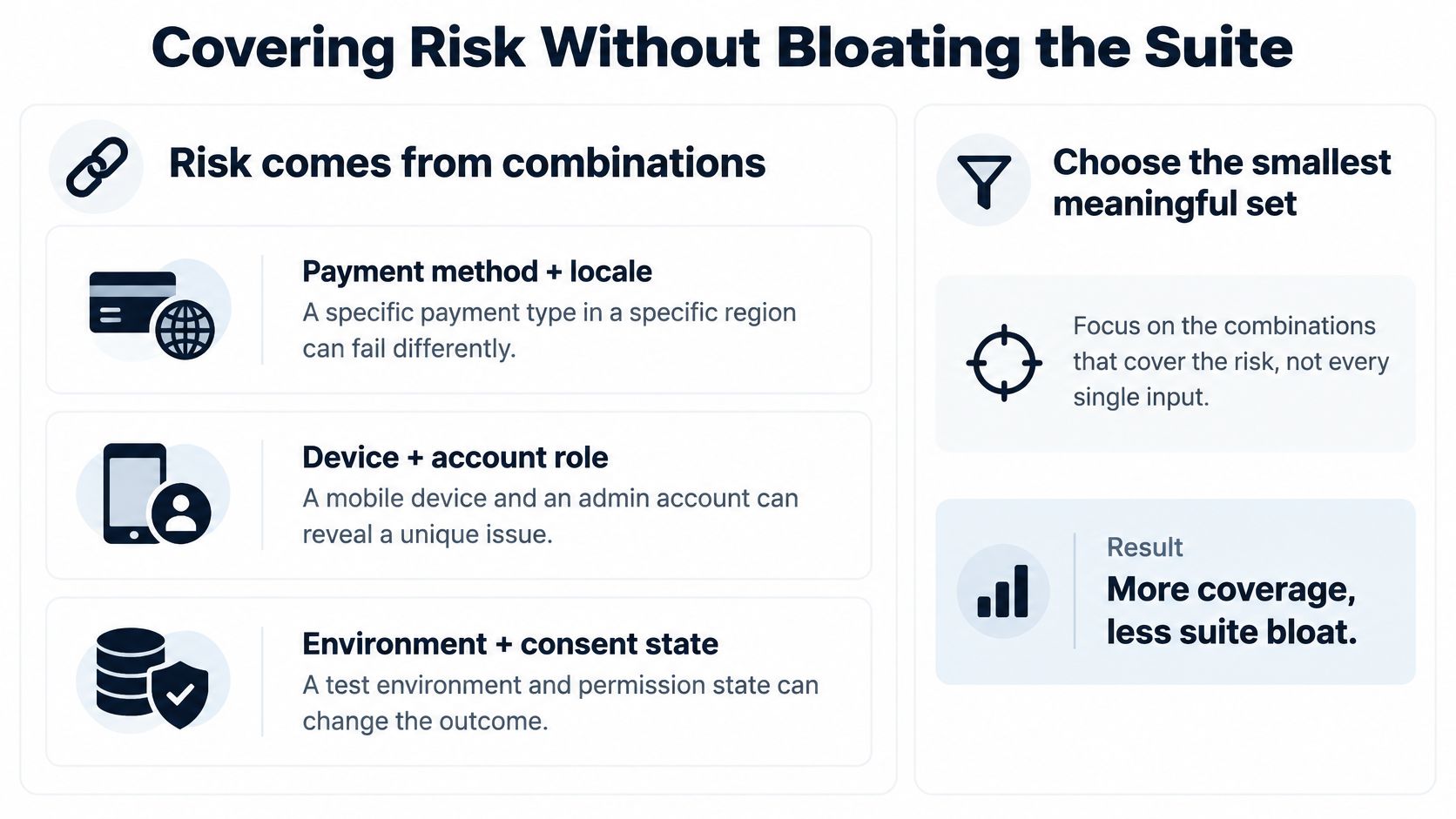
Most field failures come from combinations, not single inputs. A payment method that's fine in one locale fails in another. An admin role on a mobile device hits a path nobody else does. Testing every combination exhaustively isn't an option, and guessing leaves holes.
| Strength | Typical use | Example |
|---|---|---|
| 1-way | Smoke checks on every parameter value | Each browser and each locale appears at least once |
| 2-way | Routine regression across configuration | Every pair of locale and payment method appears together once |
| 3-way | Permissions and workflow state | Role, account status and region appear together |
| 4-way to 6-way | Safety-critical or failure-prone areas | Reserved for payment and security flows |
How covering arrays keep the set small
NIST's Automated Combinatorial Testing for Software supports t-way generation from 1-way through 6-way, and the NIST ACTS user guide describes a covering array where each row is one test and the full set of rows covers every selected combination of t parameter values. The pipeline is mechanical, generate the array, convert rows into executable test definitions, run them through a harness, and check each result against its expected outcome.
Take a checkout flow with four currencies, four device types, four locales, and four account types. That's 256 exhaustive combinations in a worked example. A 2-way covering array for those four parameters needs 16 rows, and every pair of values from any two parameters still appears in at least one test. That's about 94% fewer runs for defined pair coverage, which is the trade I'd take for routine regression.
This is how you get a high-signal suite, fewer and better tests that show whether the product works instead of thousands of noisy checks. Start by ranking parameters by business and technical risk, then choose the strength that matches that risk, which is the same discipline behind risk-based software testing. Reserve 4-way to 6-way strengths for safety-critical or historically failure-prone areas, because higher strengths buy interaction depth at real runtime cost.
Assign Ownership and Start with One Journey
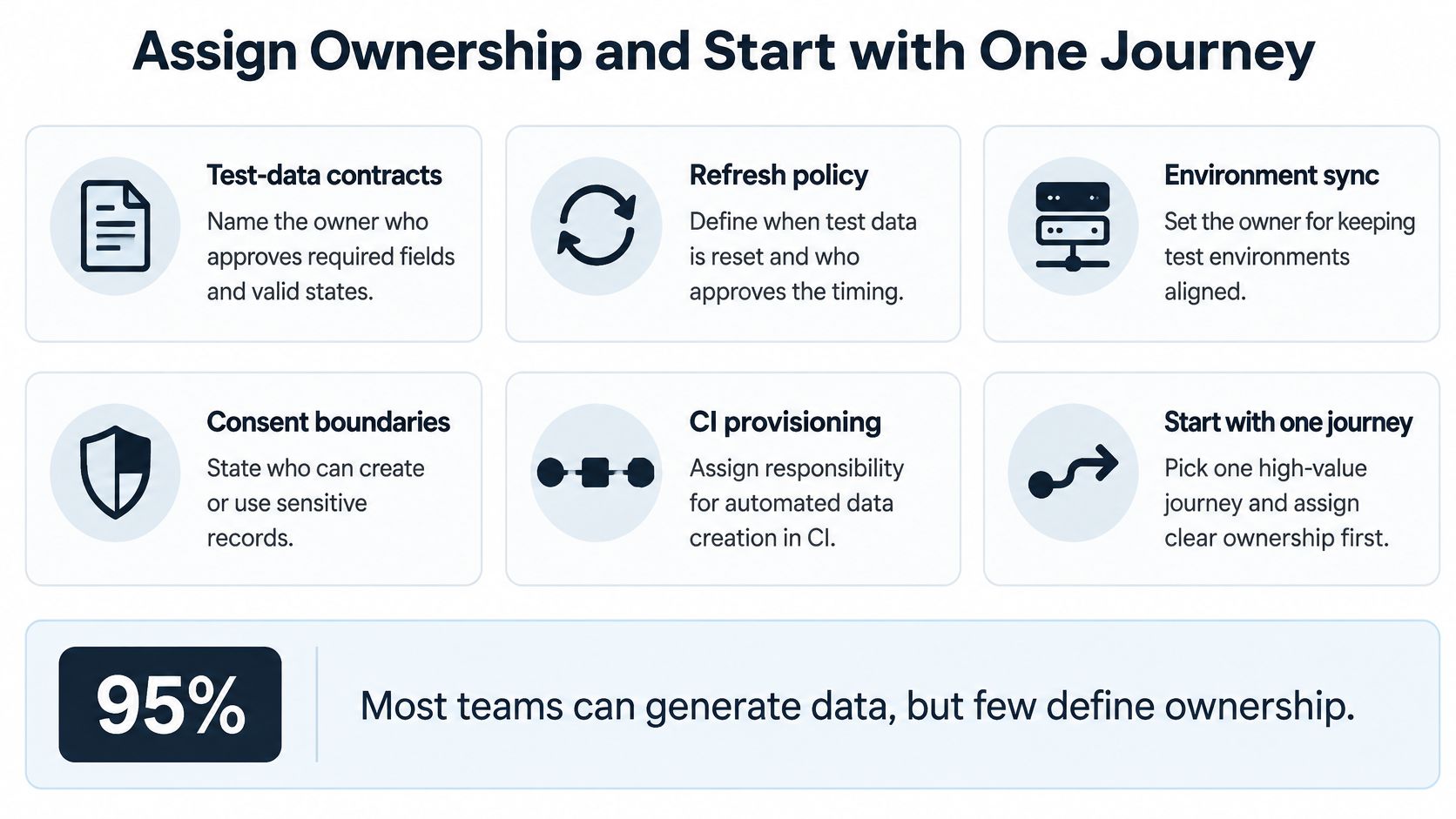
Teams can generate data. Far fewer can tell you who owns the test-data contract, the refresh policy, environment synchronization, consent boundaries, or CI provisioning. That gap, not generation capacity, is why automation stalls.
The Sogeti World Quality Report public sector edition reports industry research finding that 95% of organizations use AI to generate test data in TDM or ERP testing, yet only 10% have fully embedded that capability into development lifecycles, nearly 50% lack centralized TDM ownership, and 62% identify realistic, privacy-compliant data as their biggest automation challenge.
Split the responsibilities clearly
- QA owns the contracts: Required fields, valid states, and teardown rules for each test.
- Engineering owns provisioning: Pipeline jobs, seeding, and environment synchronization.
- Security owns access and masking rules: Who can see what, and which fields never leave production unmasked.
- Compliance signs off consent boundaries: Retention, expiration, and exception handling.
We don't assign a single QA engineer to this kind of work. We build the automation system with a specialized team working in parallel, because data, framework, and pipeline problems have to move together.
Your two-week starting plan
- Pick one business-critical journey, the one whose failure hurts most.
- Write its data contract in full.
- Seed it deterministically, with fixed seeds and isolated records.
- Set a provisioning-time target and measure against it.
- Track freshness and whether failures reproduce from a clean environment.
One journey done properly gives you the contract template, the seeding pattern, and the measurements every other journey will reuse. Expanding from a working example is much easier than designing the whole estate up front.
If your failures can't be reproduced and nobody can name who owns the data behind them, we can help you fix the operating model behind your test data strategy for automation, starting with the contracts, seeding, and refresh rules for your most critical journey. Book a free 20-minute call and we'll map your critical flows and show how fast the automation framework can be up and running. Start at AskYourQA.