
The most popular advice about software testing is also some of the least useful: aim for 100% code coverage, then treat the resulting green pipeline as release confidence. Coverage can show that execution reached a line. It can't tell you whether the payment flow is protected, whether an authorization change exposes customer data, or whether an obscure helper function matters more than a business-critical API.
Risk based software testing starts with a harder question: what could fail, how likely is that failure, and what would the business lose if it happened? The answer should determine test depth, execution order, and CI/CD gates. This doesn't mean abandoning broad coverage. It means spending deeper testing effort where failure has consequences, while using lighter checks where the risk is lower.
The practical shift is from a static manual matrix to a dynamic risk signal that changes with code, dependencies, incidents, and production behavior. That model also needs to evolve for AI features, where outputs can be variable and a functionally passing test may still hide unsafe or biased behavior.
Table of Contents
- The Problem with Uniform Test Coverage
- The Evidence Behind Risk Based Software Testing
- Building a Practical Risk Scoring Framework
- Integrating Risk Scores into CI/CD Pipelines
- Adapting Risk Models for AI and LLM Features
- Measuring Success Beyond Vanity Metrics
- Transforming Your Release Confidence
The Problem with Uniform Test Coverage
Uniform coverage sounds responsible because it produces an easy dashboard: more tests, more covered lines, more green checks. But software doesn't distribute business risk evenly. A defect in a checkout authorization rule isn't equivalent to a defect in an account avatar preview, even if both sit behind similar amounts of code.
The obsession with raw percentages encourages teams to optimize the measure instead of the outcome. Developers add tests that execute unimportant branches, QA engineers maintain brittle end-to-end scenarios, and release pipelines spend time producing evidence that doesn't answer the questions leaders need answered. A high coverage figure can coexist with weak validation of authentication, payments, data integrity, or failure recovery.
A useful review of coverage tooling should distinguish visibility from protection. The SonarQube test coverage guide can help teams understand what coverage measures, but the metric still needs business context before it becomes a release decision.
Why large suites lose signal
Large suites create their own operational risks. UI tests fail because of timing, shared data, unstable environments, or changed selectors rather than product defects. Engineers then rerun jobs, quarantine failures, and learn to distrust red builds. The suite may be extensive, but its feedback arrives late and requires too much diagnosis.
Uniform execution also treats all changes as if they deserve the same response. A copy change and a modification to payment settlement shouldn't trigger identical test policies. Code ownership, dependency exposure, historical failures, and the affected user journey provide better signals for deciding what to run first.
Practical rule: A test suite earns its place by reducing uncertainty about a meaningful failure, not by increasing a coverage percentage.
What curated coverage looks like
A risk-oriented suite usually has a small, fast layer for critical journeys, a broader change-impact layer, and deeper suites for release or risk-triggered events. The critical layer might validate login, authorization, checkout, and order confirmation across API and user-interface boundaries. Lower-risk features can still receive functional checks, but they don't automatically consume the same execution budget.
This approach accepts a trade-off that uniform testing tries to hide: not every scenario receives equal depth. The trade is deliberate, visible, and reviewable. Leaders can see which risks are covered, which are accepted, and which require more evidence before release.
The Evidence Behind Risk Based Software Testing
Risk based software testing predates modern automation programs. In the early 1980s, Barry Boehm's risk-driven spiral development organized work around identifying and reducing the highest risks before making later commitments. Boris Beizer advanced risk-driven integration and integration testing, while Beizer and Bill Hetzel argued during the mid-1980s that risk should shape both testing effort and execution order.
During the 1990s, practitioners including Rick Craig, Paul Gerrard, and Felix Redmill developed more systematic methods for quality-risk analysis and risk-based testing. A notable industry milestone arrived in 1999, when Ståle Amland's paper and presentation, “Risk Based Testing and Metrics,” received the EuroSTAR Best Paper Award in Barcelona. The approach later entered professional guidance, including the ISTQB definition and guidance summarized in testing literature, and its principles are reflected in ISO/IEC/IEEE 29119.
That history matters because RBT is more than a method for reducing regression-suite size. It provides a governance model for assigning limited test time according to failure likelihood, business impact, and stakeholder concern. A modern implementation can extend that model beyond a static workshop: code changes, ownership, dependency exposure, incident history, and production signals can continuously adjust the score that determines CI/CD test depth.
What the empirical evidence actually says
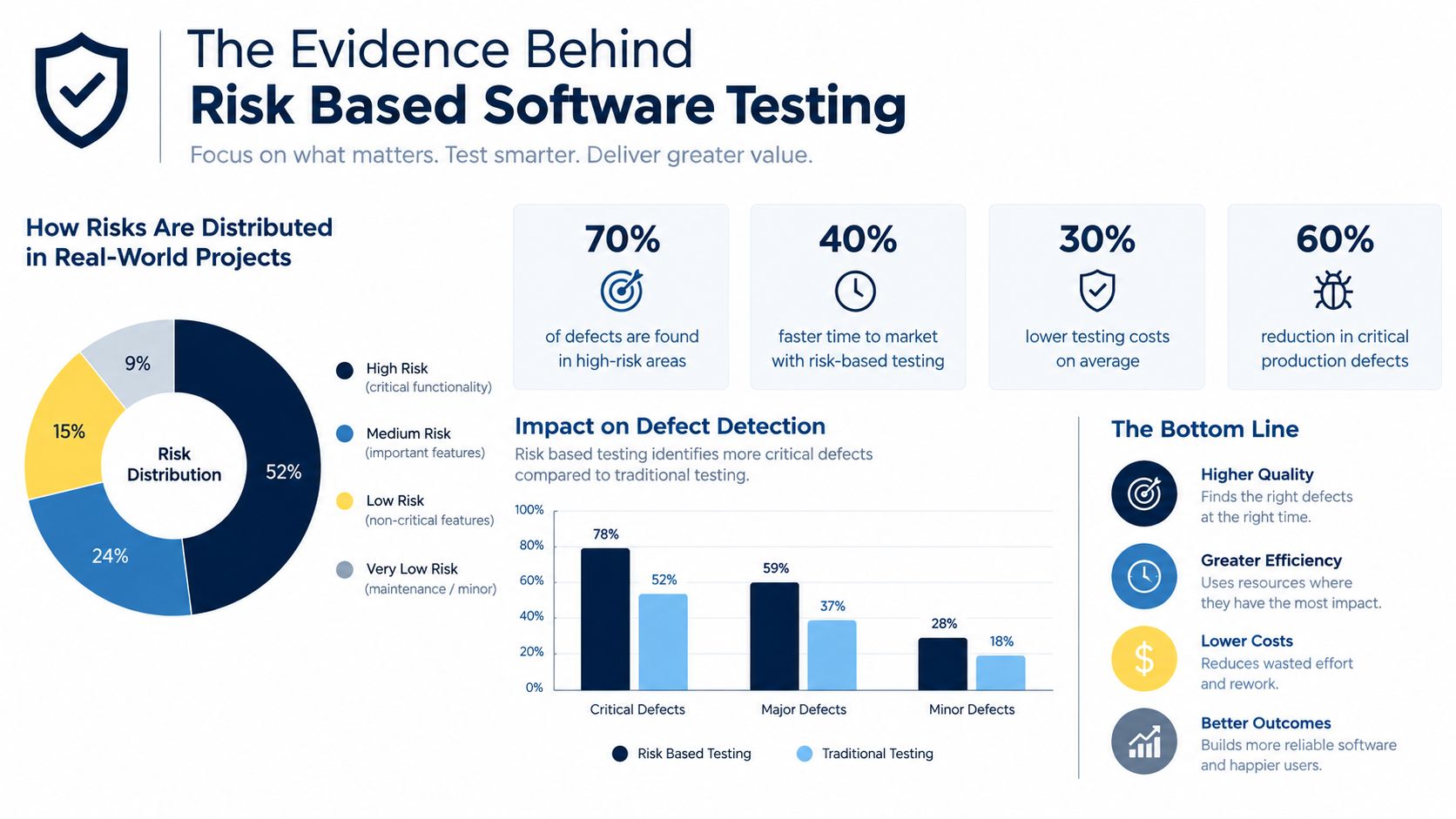
A five-product empirical study in the Software Quality Journal compared risk indicators with a conventional lines-of-code strategy. Risk-based prioritization detected 83% of observed defects by testing 13% of classes, according to this peer-reviewed study. The result requires context. At that particular concentration threshold, the lines-of-code strategy reached the same 83% defect detection after testing 6% of classes, so risk-based prioritization did not outperform the alternative at every cutoff.
The broader finding was more useful for test planning. To identify all observed defects, risk-based testing required an average of 51.6% of classes, compared with 61.8% for the lines-of-code strategy. That represents a reduction of 10.2 percentage points, or roughly 16.5% fewer classes tested. Across all five products, the study also found a statistically significant positive relationship between a class's risk coefficient and its defect count.
For teams with limited execution time, the conclusion is not to discard technical metrics. Lines of code can still provide a useful signal. Combine it with change scope, dependency exposure, defect history, and business consequence, then use the resulting score to decide which tests run first and which require fuller evidence.
Why prioritization changes release feedback
Risk ordering brings high-value evidence earlier in the pipeline. A failure in a payment, identity, or data-integrity path reaches the developer before many lower-consequence checks finish. The team can investigate while the change remains fresh, rather than waiting for a full regression run to reveal the same problem.
A risk coefficient also has practical value outside planning workshops. It can determine test selection, validation depth, and the evidence required by a release gate. In AI-enabled features, the same principle supports adaptive validation for non-deterministic outputs, where fixed pass or fail checks alone cannot represent the full risk.
Building a Practical Risk Scoring Framework
A workable risk model doesn't need elaborate mathematics. It needs consistent definitions, traceability, and enough detail to drive test decisions. Under ISO/IEC/IEEE 29119, teams estimate the probability and impact of each risk element, calculate a risk value, and use that value to refine test strategy, as described in this overview of risk-based test planning.
Start with business-critical journeys rather than isolated screens. For an e-commerce system, map browsing to cart creation, checkout authorization, payment capture, order confirmation, refund processing, and account access. Then connect each journey to components, integrations, data stores, and operational dependencies.
A simple scoring method
Use a consistent scale for probability and impact, then multiply them to create a relative risk value. The scale itself matters less than the team applying it consistently and recording why a feature received its rating.
Probability should reflect signals such as recent architectural change, complexity, historical defect density, dependency exposure, and instability in test or production environments. Impact should reflect consequences such as financial loss, security exposure, data corruption, regulatory concern, customer disruption, or damage to a core user journey.
| Feature | Probability of Failure | Business Impact | Risk Score | Test Strategy |
|---|---|---|---|---|
| Payment gateway authorization | High | High | High | API and end-to-end functional tests, failure-path validation, security checks, regression on every relevant change |
| User authentication and session management | Medium to high | High | High | Functional, integration, security, session-expiry, privilege-boundary, and change-impact regression testing |
| Order confirmation and inventory update | Medium | High | High | Contract tests, integration tests, retry and idempotency checks, end-to-end purchase validation |
| Product search filters | Medium | Medium | Medium | API and UI functional coverage, representative regression checks, performance review after search changes |
| Profile avatar upload | Low to medium | Low to medium | Low to medium | Validation, file-type checks, basic UI regression, deeper testing after storage or security changes |
The table isn't a substitute for engineering judgment. A low-risk avatar upload can become high risk if it introduces an untrusted file-processing path or connects to a new storage service.
Turn scores into test depth
High-probability, high-impact scenarios deserve layered coverage. Test the happy path, invalid input, retries, timeouts, authorization boundaries, dependency failures, and data consistency. Lower-risk areas may receive a smaller functional set, but they shouldn't disappear from the test portfolio.
Keep the reasoning traceable. Link each risk to the affected journey, implementation area, executable tests, owner, and current mitigation. Recalculate when requirements, architecture, incidents, or code-change patterns shift. A score that never changes is documentation, not risk control.
Risk scoring is valuable only when a changed score changes what the pipeline executes or what the release owner must review.
Integrating Risk Scores into CI/CD Pipelines
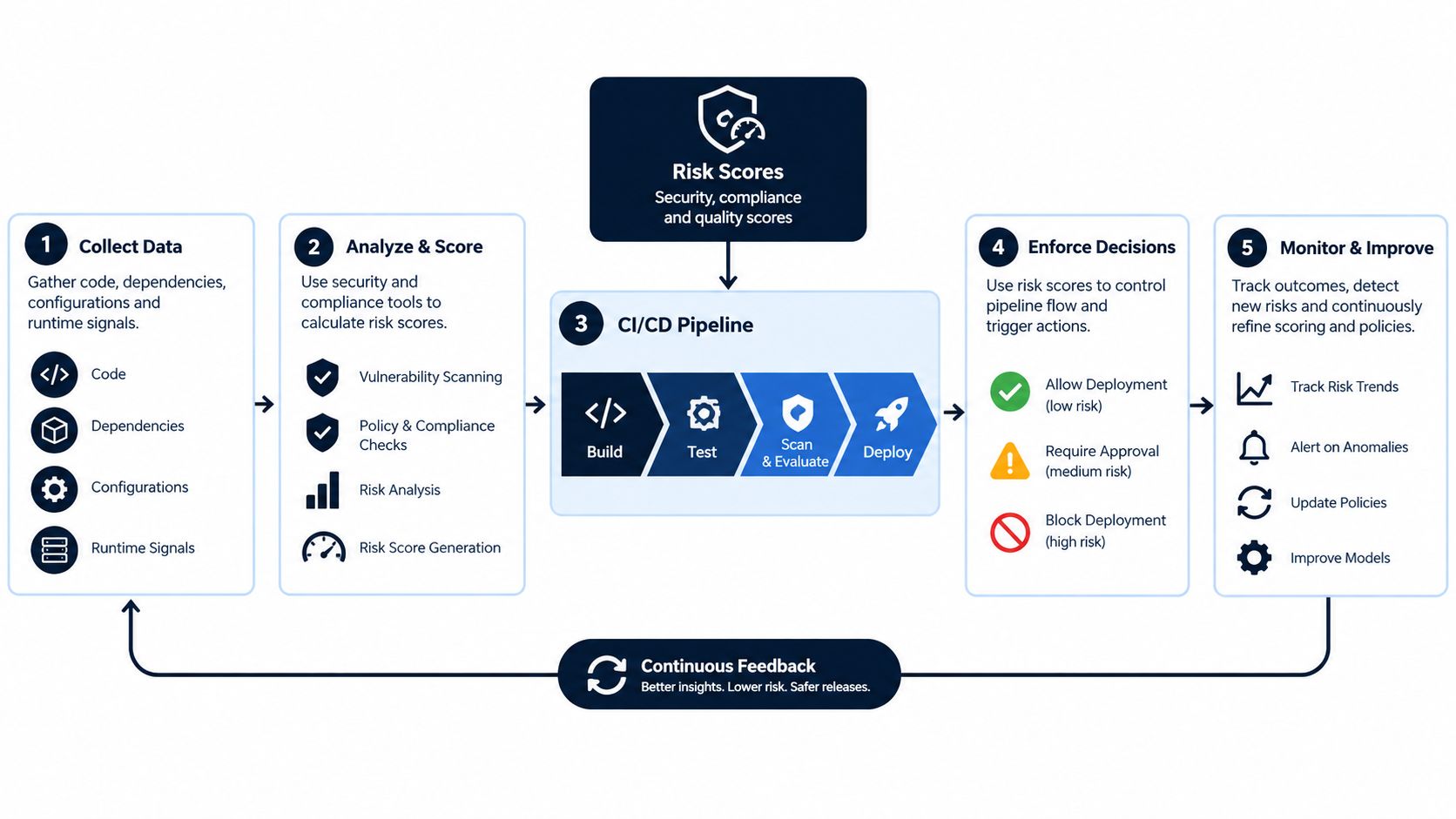
A spreadsheet-based risk matrix becomes stale as soon as the codebase changes. CI/CD integration turns it into a control loop. The pipeline should inspect the change, identify affected journeys and dependencies, update the relevant risk signals, and select tests according to both baseline criticality and current change impact.
The execution policy should be layered rather than binary. Every pull request doesn't need the full performance and end-to-end estate, but every pull request touching a critical path should receive immediate high-signal evidence.
A dynamic execution policy
A practical pipeline can use these layers:
-
Pull request checks: Run fast unit, API, contract, and high-risk smoke tests when changed code maps to critical journeys. Fail quickly on authentication, payment, authorization, or data-integrity regressions.
-
Post-merge validation: Run broader change-impact regression after the merge. Include dependent services and integration boundaries that the pull request diff may affect indirectly.
-
Risk-triggered deep testing: Schedule load, security, mobile, and extensive end-to-end scenarios when the change touches sensitive interfaces, alters architecture, follows an incident, or increases dependency exposure.
-
Release-candidate evidence: Require the deepest relevant suites and a review of unresolved risks before shipping. The gate should explain which high-risk scenarios passed, failed, or remain untested.
Prioritization should use more than file paths. Combine business criticality with change size, ownership, dependency graphs, recent defects, runtime failures, and the severity of escaped issues. A framework review such as test automation framework architecture guidance is useful when these signals need to operate across UI, API, mobile, and service layers.
Measure the feedback loop
Empirical evidence reported in a systematic review of test prioritization found that risk-based prioritization improved fault detection by approximately 30% over random ordering. A separate result in the same verified evidence reported an average 9.48% reduction in the number of test cases needed to find a fault versus coverage-based strategies.
Those figures don't justify blindly ranking tests by a single score. They support an operational principle: run tests associated with risky or defect-prone components earlier, then measure whether the ordering produces faster, more actionable feedback. If it doesn't, adjust the signals, test tags, or dependency mapping.
Adapting Risk Models for AI and LLM Features
Traditional software testing assumes that the same input should produce a stable, expected result. AI features break that assumption. An LLM can return a valid answer that varies in wording, omit an important safeguard, misuse a tool, expose private information, or produce biased or toxic content while still passing a superficial functional assertion.
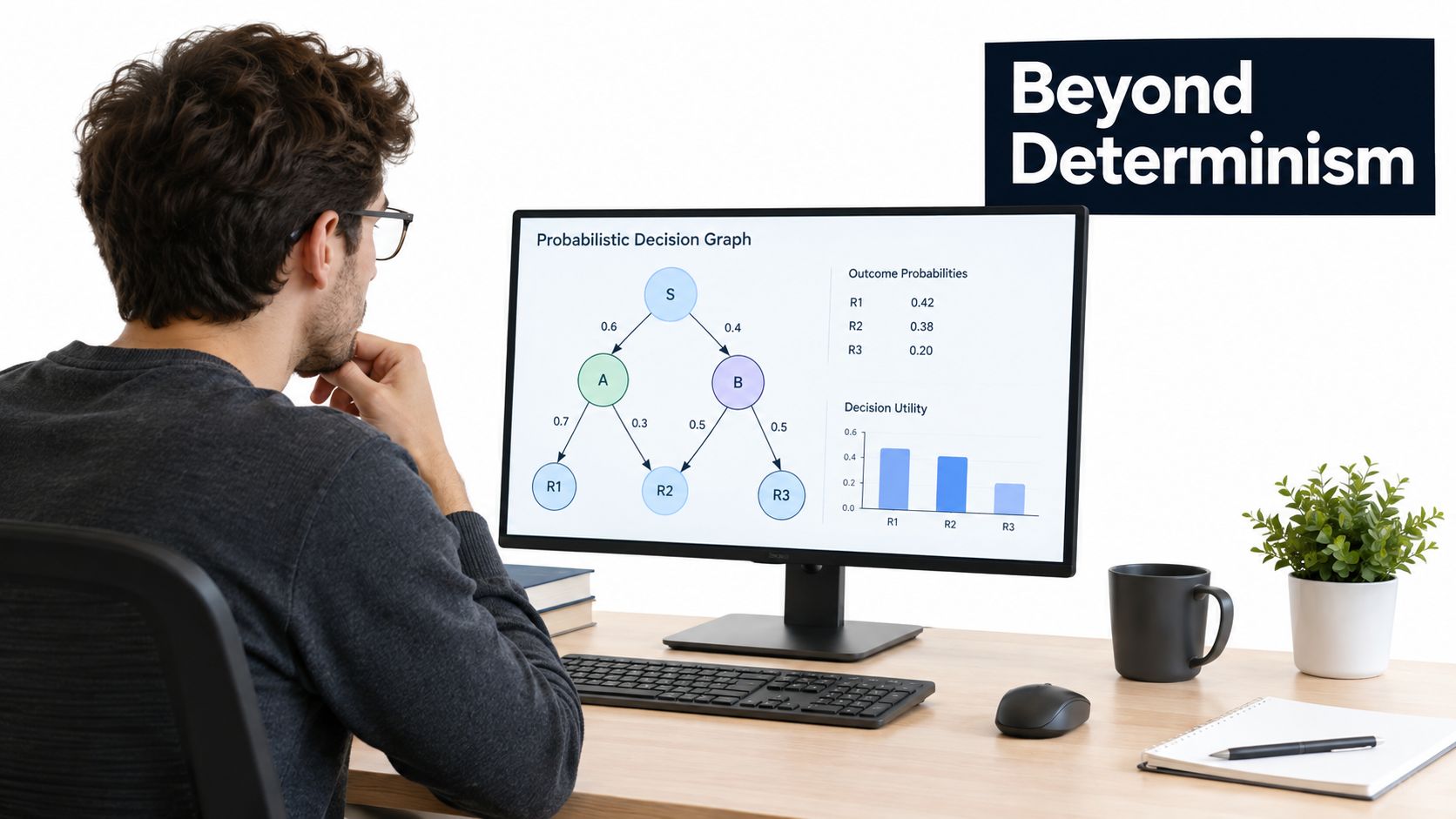
A conventional risk score based on failure probability multiplied by business impact still helps, but it needs additional dimensions. Include nondeterminism, prompt and model changes, adversarial misuse, privacy leakage, bias, unsafe tool invocation, human-review requirements, latency, cost, and the severity of an incorrect decision.
Deterministic checks versus judgment
Deterministic automation remains valuable for AI systems. Validate response schemas, access control, required fields, prohibited content patterns, tool permissions, latency, cost limits, citation requirements, and regression benchmarks. These checks are repeatable and suitable for pull-request or deployment gates.
They can't judge every meaningful quality dimension. Human reviewers may need to assess factual usefulness, tone, ambiguity, cultural context, domain suitability, and whether an agent took an acceptable path to a result. LLM-as-judge evaluation can help scale review, but it shouldn't become the only authority for high-impact workflows.
A recent global survey reported that only 33% of respondents used red teaming to detect inaccuracy, bias, toxicity, and related harms in generative AI models, as reported in this AI testing survey coverage. That gap shows why teams need explicit adversarial scenarios rather than relying on happy-path prompt tests.
The AI testing approach used by AskYourQA is one example of a broader category of practice that combines output validation with safety-oriented evaluation. The important design choice is not the brand. It's the separation of deterministic gates, adversarial risk scenarios, human grading, and production monitoring.
A mature AI release policy asks different questions for different risks:
- Can the system return a valid, authorized response?
- Does it remain safe under adversarial prompts?
- Does it protect private data across retrieval and tool calls?
- Is the output acceptable for the domain and user journey?
- What evidence requires human approval before release?
Measuring Success Beyond Vanity Metrics
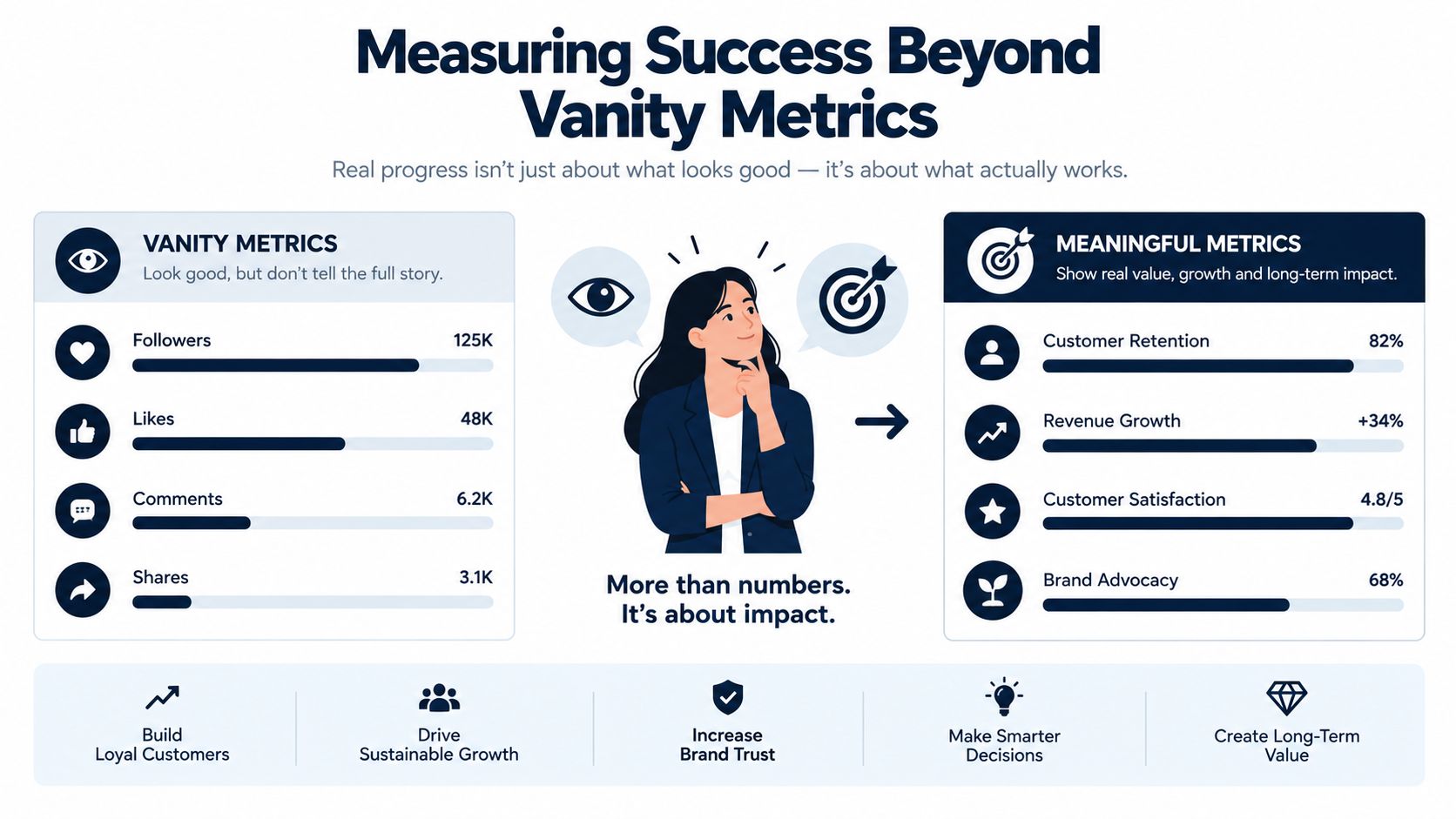
A test count is an inventory number, not a quality outcome. Raw code coverage is useful for identifying unexecuted areas, but it doesn't weight a low-consequence utility function against an authorization boundary. If leadership rewards only those figures, teams will naturally optimize test volume and coverage instead of reducing release risk.
Risk-weighted reporting gives engineering leaders a more honest view. It connects test activity to the failures the organization most needs to prevent and makes accepted gaps visible.
Metrics that guide action
Track faults detected in the first N tests to see whether prioritization produces early evidence. Track mean time to actionable feedback, not merely total pipeline duration. A short run that finds irrelevant failures is less valuable than a slightly longer run that identifies a release-blocking regression with a clear diagnostic trail.
Segment escaped defects by risk tier. A low-risk presentation issue and a high-risk authorization defect shouldn't appear as equivalent points in a defect total. Review whether high-risk journeys have executable tests, whether those tests ran for the relevant changes, and whether the failures were understandable enough for engineers to act quickly.
Risk-weighted coverage can combine journey importance with the depth of validation. A critical checkout flow covered only by a shallow happy-path test should not receive the same coverage credit as a flow tested across authorization, retries, dependency failures, and data consistency.
A green dashboard is evidence only when the dashboard shows which business risks the tests addressed.
Metrics also need a feedback cycle. When a production incident occurs, update the affected risk, add or strengthen the relevant test, and confirm that future changes will trigger it. When a test repeatedly fails for environmental reasons, fix the test or reduce its gate authority. Otherwise, the reporting system will reward noise and gradually weaken trust in automation.
Transforming Your Release Confidence
The shift to risk based software testing usually starts with an uncomfortable audit. Take the current suite and ask which tests protect a named business journey, which tests merely exercise implementation detail, and which failures regularly consume investigation time without exposing product defects. Quarantine isn't a strategy, but a failure history can reveal where the suite has lost signal.
Next, identify the journeys that would make a release unacceptable if they failed. For an online commerce product, that may include sign-in, checkout authorization, payment capture, order creation, inventory consistency, and refund handling. Map each journey to services, dependencies, test layers, owners, and current evidence.
Then establish a baseline model and let it evolve:
- Remove noise: Retire duplicates, stabilize valuable flaky tests, and separate environmental failures from product failures.
- Map critical journeys: Link business outcomes to API, UI, mobile, integration, security, and performance checks.
- Score current risk: Record probability, impact, change exposure, historical defects, and dependency concerns.
- Tag executable tests: Make risk and journey metadata available to CI/CD selection logic.
- Create release rules: Define which risk tiers require pull-request, merge, release-candidate, or human review evidence.
- Review incidents: Update scores and tests whenever production or staging reveals a missed failure mode.
The outcome isn't a promise that software will never fail. It is a more defensible release decision, based on whether the most consequential risks have current evidence. Smaller suites can be safer than larger ones when they are curated, layered, diagnosable, and connected to how the system changes.
Risk based software testing is therefore a business strategy expressed through engineering controls. It helps teams ship with less ceremony because the pipeline spends its limited time on evidence that matters.
AskYourQA designs and implements automation systems for functional, API, mobile, AI, security, and performance testing, with CI/CD integration for high-signal feedback on critical user journeys. If your current suite is noisy or your AI and release risks aren't mapped to executable checks, visit AskYourQA to discuss a practical risk-driven testing system.