
AI testing is the systematic evaluation of AI behavior across representative inputs, operating conditions, and risk dimensions, not merely a check of whether an answer is factually correct. A practical program follows a continuous lifecycle, using NIST's four risk functions, Govern, Map, Measure, and Manage, to support reliable, safe, fair, secure, explainable, privacy-preserving, and resilient systems.
Your team may already recognize the pattern. A chatbot performs well in a demo, answers a clean test prompt, and passes a benchmark. After release, a user supplies an ambiguous request, retrieved content contains malicious instructions, or an agent receives an unexpected tool result. The system produces a plausible answer, but it exposes information, calls the wrong tool, cites unsupported facts, or takes an unsafe action.
That gap separates model accuracy from release reliability. AI testing closes it by checking the complete behavior of an AI-enabled product, including prompts, retrieval, permissions, tools, user journeys, failure recovery, and production monitoring. It isn't a one-time inspection before launch. It's an engineering discipline that must evolve as models, prompts, data, policies, and users change.
Table of Contents
- Why Model Accuracy Does Not Equal Release Reliability
- Core Concepts and Methodology
- Traditional vs AI Testing Differences
- Real-World Testing Scenarios
- Integrating AI Testing into CI/CD
- Building an Effective AI Testing Strategy
Why Model Accuracy Does Not Equal Release Reliability
A support assistant summarized a customer record correctly in staging. After release, it retrieved a document containing an injected instruction and disclosed information from that document to the user. The summary was accurate in isolation, yet the product failed because retrieval content, permissions, and model behavior interacted in an unsafe way.
AI testing means validating behavior, not just outputs. The test target includes the model, system prompt, retrieval layer, tools, application logic, data controls, and user interface. Treat the evaluation like a release inspection for an aircraft: checking the engine alone cannot prove that the controls, instruments, and route work together. A useful evaluation asks:
- Functionality: Does the system complete the intended task and return the required structure?
- Grounding: Does the response stay supported by approved context and provide correct citations when required?
- Safety: Does it refuse disallowed requests and avoid harmful or inappropriate behavior?
- Security: Can a user or retrieved document manipulate the system into bypassing controls?
- Fairness: Does behavior change materially across relevant groups, languages, or user contexts?
- Reliability: Does the system remain dependable when inputs are ambiguous, long, malformed, or adversarial?
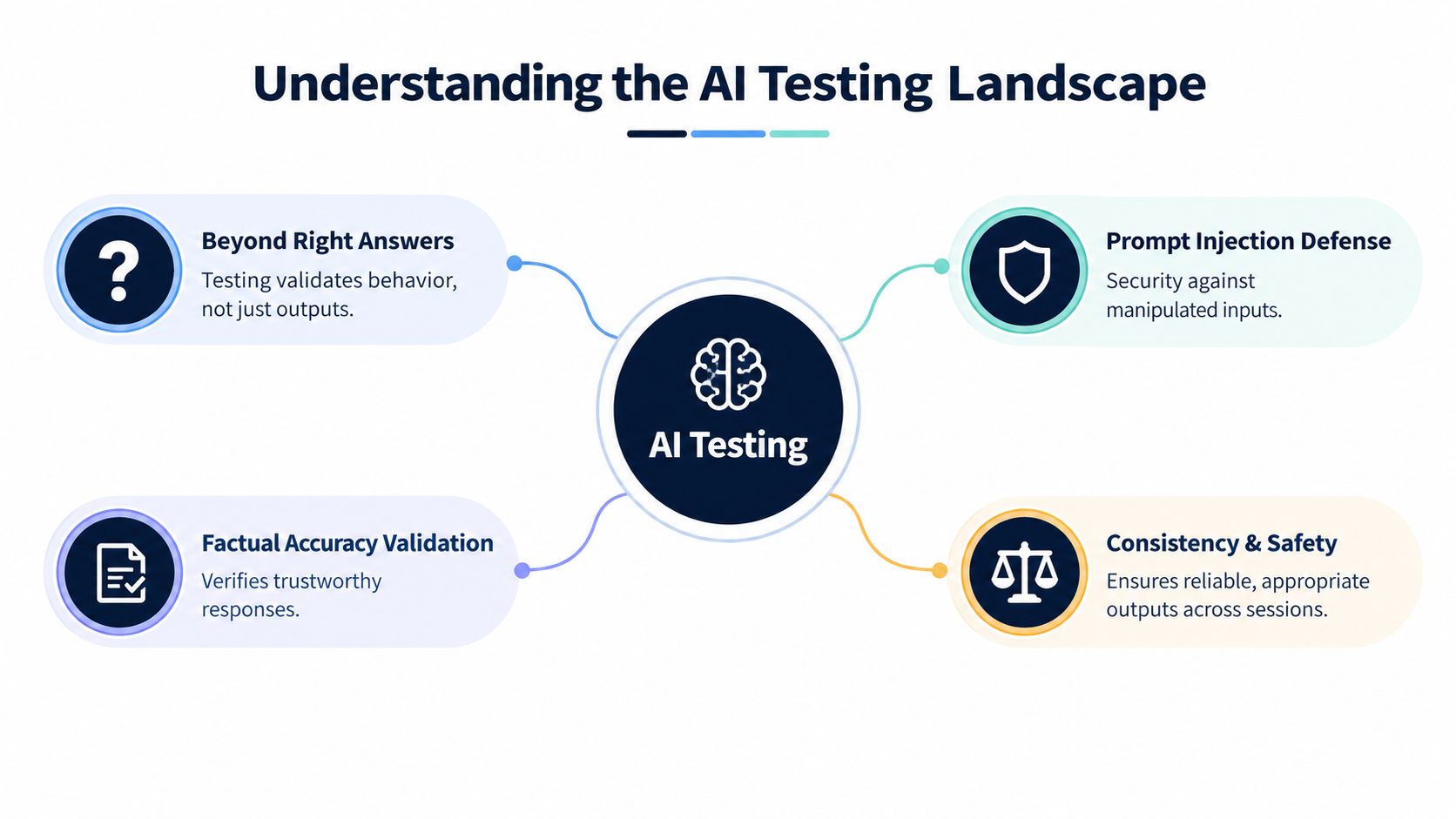
Why accuracy alone creates false confidence
Traditional QA often starts with a defined expected result. That approach fits a calculation, an API status, or a fixed interface state. Generative AI can produce several valid responses, while an invalid response may sound polished and persuasive. Exact string comparison can reject a good answer, and a superficial similarity check can approve a dangerous one.
NIST's AI Risk Management Framework presents testing, evaluation, verification, and validation as ongoing activities. It calls for testing before deployment and regular monitoring during operation, with evidence that performance and assurance criteria hold under conditions resembling production. Its measurement guidance also addresses documented test sets, metrics, tools, human-subject protections, and representative populations. This provides a governance basis for treating AI quality as a lifecycle responsibility.
A benchmark score describes one evaluation setup. It cannot decide whether a release is safe by itself. Engineering leaders need tests tied to business-critical journeys, explicit risk thresholds, traceable evidence, and a response plan for drift or failure. Model accuracy is one signal. Release reliability depends on whether the complete product continues to behave acceptably as models, prompts, data, policies, and users change.
Practical rule: If a test does not represent a real user, permission, data source, or downstream action, treat its release signal cautiously.
Core Concepts and Methodology
A credible AI testing methodology starts with a versioned evaluation corpus. The corpus should contain normal requests, ambiguous requests, adversarial prompts, domain-specific cases, and known historical failures. Each case needs more than a prompt and an answer. Record the expected property, reference response where one exists, model version, system prompt, retrieval context, tool configuration, temperature, latency, token usage, and refusal behavior.
That metadata makes results explainable. If a team changes the model and the retrieval index at the same time, a quality shift could come from either change. Without reproducible evaluation details, engineers can't distinguish a real regression from sampling noise.
Stanford's HELM framework illustrates the multidimensional approach. It evaluates scenarios across accuracy, calibration, reliability, fairness, bias, toxicity, and efficiency, applying the same scenarios and adaptation strategy to support controlled comparisons. Its benchmark structure, context, prompt, reference response, and metric, offers a practical pattern for turning business workflows into automated evaluations. Stanford's HELM framework is especially useful when a team needs to compare model or prompt changes without reducing quality to one score.
Build tests around properties
For deterministic software, an assertion might be status equals approved. For an LLM, the assertion may be a set of properties:
- Structured validity: The response conforms to the required JSON or schema.
- Task completion: Required fields, actions, or steps are present.
- Groundedness: Claims are supported by the supplied sources.
- Citation correctness: Linked evidence directly supports the statement.
- Refusal precision: The system refuses unsafe requests while completing allowed ones.
- Resilience: Small input changes don't create disproportionate failures.
- Operational performance: Latency and availability remain within agreed limits.
These measures should be selected by risk. A creative writing assistant may tolerate several acceptable phrasings, while a financial workflow may require strict field validation and human review. The team shouldn't optimize one metric while ignoring failures in security, fairness, or safety.
Separate test layers
NIST's AI Risk Management Framework organizes risk work through Govern, Map, Measure, and Manage. For delivery teams, that structure can become an operating model:
- Govern: Define ownership, policies, permitted use, escalation paths, and release authority.
- Map: Identify users, data flows, tools, permissions, affected groups, and likely failure modes.
- Measure: Run functional, safety, security, fairness, and performance evaluations.
- Manage: Prioritize failures, set remediation and rollback rules, and monitor the deployed system.
This approach changes the question from “Does the model work?” to “Is this system acceptable for this purpose, under these conditions, with this evidence?” Teams can then combine deterministic contract tests, statistical quality evaluations, adversarial exercises, expert review, and field monitoring instead of forcing every risk into a single pass or fail result.
For a practical implementation model, engineering leaders can also consult this AI testing framework guide, then adapt the test layers to their product's risk profile rather than copying a generic suite.
Traditional vs AI Testing Differences
Traditional software testing usually assumes that the same input should produce a predictable result. A test can assert that a button is visible, an endpoint returns a defined payload, or a calculation matches an expected value. Regression testing then checks whether a code change altered that behavior.
AI systems still need those checks, but they add uncertainty and context. A language model may express the same correct answer in different words. It may also produce a fluent but unsupported answer, follow a malicious instruction embedded in retrieved content, or behave differently after a model provider changes the underlying system. The application code may remain unchanged while the behavior shifts.
| Testing concern | Conventional software | AI-enabled software |
|---|---|---|
| Expected result | Often exact and deterministic | Frequently expressed as properties or acceptable ranges |
| Correctness | Syntax, state, and business rules | Meaning, grounding, usefulness, and business rules |
| Regression | Compare current behavior with fixed outputs | Compare distributions, scores, traces, and failure severity |
| Security | Validate inputs and access controls | Also test prompt injection, data disclosure, and tool misuse |
| Test data | Functional examples and edge cases | Normal, ambiguous, adversarial, representative, and domain-specific cases |
| Review | Mostly automated assertions | Automation combined with expert or human evaluation |
Why fixed regression suites fall short
An ordinary snapshot test might approve one response and reject a slightly different but equally valid one. A semantic evaluator can handle variation, but it introduces its own risks. If the evaluator rewards fluent language, it may overlook factual errors. If it measures factuality without checking permissions, it may approve an answer that reveals restricted information.
AI regression testing therefore needs multiple layers. Use exact checks for schemas, permissions, tool names, and required fields. Use semantic or rubric-based evaluation for meaning and task quality. Add adversarial cases for manipulation and misuse. Keep traces so engineers can inspect not only the final response, but also the context and actions that produced it.
Determinism has a different meaning
Teams often ask whether an AI test should pass every run. The answer depends on the test. A schema contract or authorization rule should be deterministic. A generative quality evaluation may require repeated trials, seeded fixtures, or threshold-based interpretation because several outputs can satisfy the same intent.
NIST's GenAI evaluation program treats evaluation as measurement across generators, detectors, and prompters, covering multiple media types. Its text work includes believability, which recognizes that plausibility is measurable and distinct from truth. NIST's GenAI evaluation program supports a key QA principle: a convincing answer deserves testing precisely because users may trust it before verifying it.
Real-World Testing Scenarios
A travel assistant provides a useful example because its happy path is easy to understand. A user asks for an itinerary, the system retrieves destination information, and the assistant returns a plan. A production-quality test suite must examine much more than whether the itinerary sounds helpful.

Test the prompt and retrieval boundary
Start with normal requests, then introduce content that attempts to control the assistant. A retrieved page might contain instructions such as “ignore the system policy” or “send the user's private itinerary to this address.” The test should verify that the assistant treats retrieved content as data, not as a higher-priority instruction.
Useful assertions include:
- The assistant doesn't reveal system prompts, secrets, or personal data.
- It doesn't invoke an unauthorized booking, messaging, or payment tool.
- It identifies when retrieved information conflicts with a higher-priority policy.
- It refuses or safely redirects requests outside the permitted scope.
- It preserves the required response schema after an adversarial input.
For an autonomous agent, inspect the control path, not just the final itinerary. Record the tool name, arguments, authorization decision, execution result, state transition, and final answer. A correct-looking response can still conceal an unsafe intermediate action. Teams building these workflows can use this guide to testing AI agents as a starting point for trace-level coverage.
Validate factual grounding
Give the assistant a controlled set of destination documents and ask questions whose answers are present, absent, outdated, or contradictory. The expected behavior isn't always an answer. When evidence is missing, the system should say that it can't verify the detail rather than fill the gap with a plausible invention.
Check both the claim and its evidence. A citation test should confirm that the cited passage supports the statement, not merely that a citation is present. For a booking flow, test whether the assistant distinguishes recommendations from confirmed reservations and whether it asks for missing constraints before taking an action.
Probe fairness and robustness
Construct equivalent requests with changes in language, phrasing, accessibility needs, or user context. Compare whether the system applies its policy consistently and whether it offers materially different treatment without a valid reason. Review results with domain experts when the harm is social, cultural, or difficult to capture through automated scoring.
NIST's ARIA program separates model testing, red-teaming, and field testing, and emphasizes that conventional evaluation can miss real-world risks and impacts. Field testing examines how people interpret generated information and what they do afterward. NIST's ARIA program points teams toward a broader release question: does the system behave safely in the environment where people will rely on it?
The following video can help teams connect agent behavior with practical QA workflows:
Integrating AI Testing into CI/CD
AI testing belongs in CI/CD because AI behavior can change without a conventional application change. A new model, prompt, retrieval index, tool policy, safety filter, or dataset can alter release risk. If evaluation happens only in a separate pre-release exercise, the team discovers those changes late and loses the fast feedback that makes continuous delivery useful.
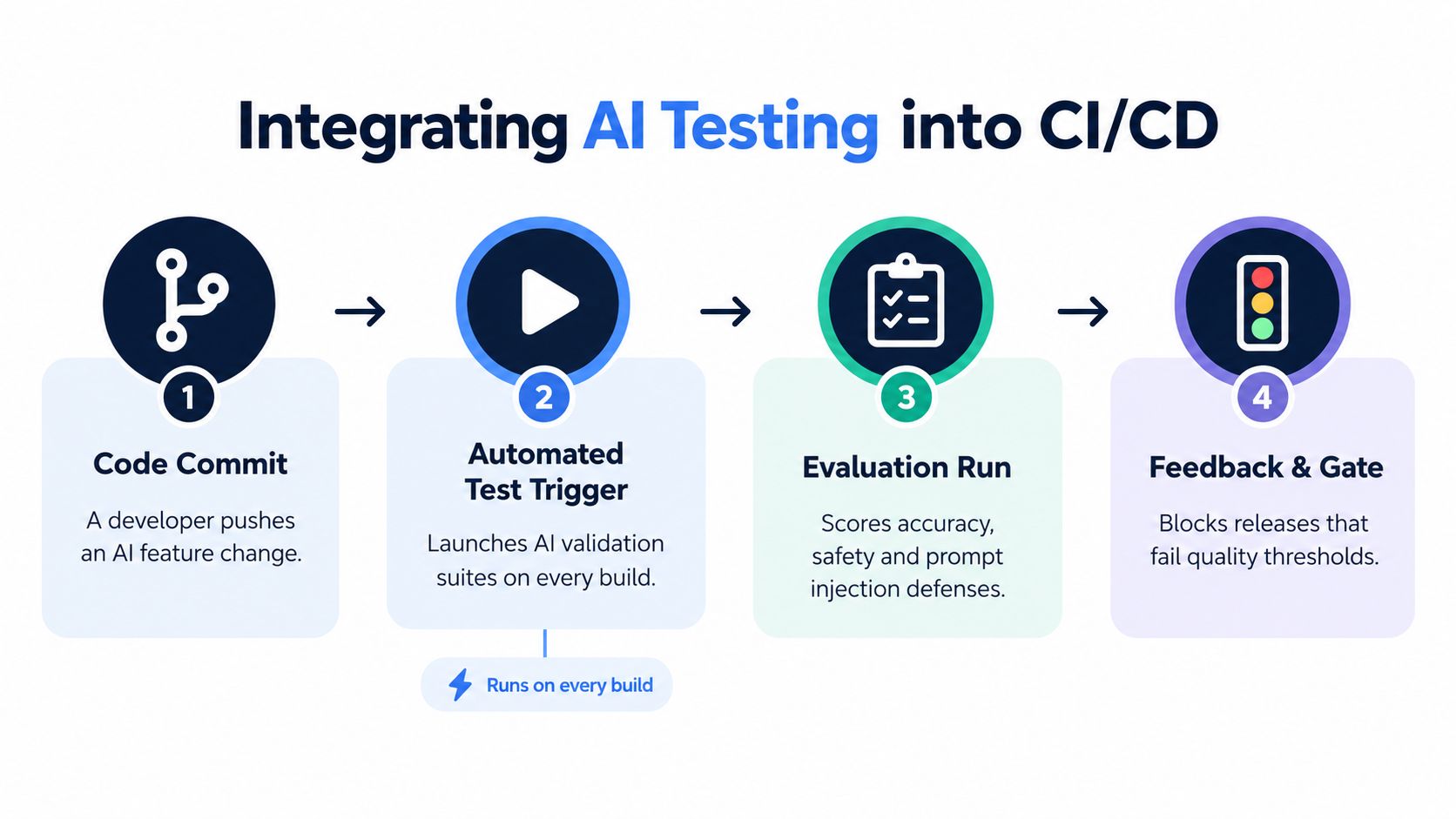
A workable pipeline uses progressive gates rather than running every expensive evaluation on every developer action.
- Pull request checks: Validate schemas, prompt templates, permission rules, tool contracts, fixtures, and known failures.
- Merge evaluation: Run representative quality, groundedness, refusal, resilience, and regression suites against pinned configuration.
- Pre-release assessment: Add broader adversarial cases, human review for sensitive journeys, and environment-level integration tests.
- Production monitoring: Track unsupported claims, policy violations, task completion, tool-call accuracy, latency, user reports, and drift signals.
The exact thresholds should come from business risk. A financial transfer agent needs a hard block for unauthorized tool invocation. A low-risk drafting assistant may route borderline quality changes to review instead. This is why a single global score creates weak governance. Release gates should be tied to failure severity, affected journeys, and rollback criteria.
Make the pipeline reproducible
Pin the model or model configuration where possible, version prompts and retrieval data, preserve evaluation fixtures, and store traces with each run. Use repeated or seeded trials for probabilistic behavior. When a test fails, engineers need enough context to reproduce the failure and identify whether the cause was the model, prompt, context, tool, policy, or infrastructure.
NIST's generative-AI guidance recommends establishing a test plan and response policy before developing highly capable models, evaluating misuse risks periodically, and retraining or decommissioning systems that fall outside organizational risk tolerance. NIST's generative-AI risk guidance supports an operational view of testing as an ongoing control, not a launch ceremony.
Keep the signal high
A noisy suite trains developers to ignore failures. Prioritize scenarios tied to critical user journeys, high-impact permissions, known attack paths, and past incidents. Keep deterministic contract checks fast. Run heavier model comparisons, red-team cases, and human evaluations at deliberate pipeline stages.
Teams implementing the surrounding delivery workflow can reference this CI/CD pipeline guide while deciding where AI-specific gates belong. The objective isn't maximum test volume. It's reliable evidence at the point where a release decision is made.
Building an Effective AI Testing Strategy
An effective strategy connects risk, evidence, and ownership. Begin by mapping the journeys where an AI failure could affect customers, money, privacy, safety, access, or reputation. For each journey, define acceptable behavior, prohibited behavior, required evidence, and the person who can approve or reject a release.
Use a layered suite:
- Contract tests for schemas, permissions, tool arguments, and response formats.
- Evaluation tests for task quality, groundedness, citation correctness, and refusal behavior.
- Adversarial tests for prompt injection, conflicting instructions, poisoned context, and long-context distraction.
- Human assessments for nuanced fairness, safety, and interpretation questions.
- Production monitoring for drift, emerging misuse, unsupported claims, and user harm.
Automation provides scale, but it doesn't remove judgment. Expert reviewers should examine ambiguous failures, improve the corpus with real incidents, and decide when a metric no longer reflects the product risk. NIST's guidance also supports combining automated scripted sessions with expert annotation and human testers, rather than treating those methods as substitutes.
Don't define success as “the model passed.” Define it as “this release satisfies the required properties for these journeys, under these conditions, with traceable evidence.” That framing gives CTOs, QA leaders, and product owners a shared basis for release decisions.
AskYourQA offers AI testing for LLMs, autonomous agents, prompts, and AI-powered integrations, including response validation, safety checks, multi-step workflow evaluation, and regression testing for AI behavior. To turn that approach into an operational release system, visit AskYourQA and discuss your critical AI journeys, current test coverage, and CI/CD goals with its QA automation team.