
An AI agent with 75% per-trial reliability has only a 42% chance of passing all three trials. To test AI agents properly, run repeated, multi-step evaluations that score both the final outcome and the trajectory of tool calls, decisions, and state changes.
A successful demo proves very little about an autonomous system. Agents don't just generate text. They interpret a request, choose an action, call a tool, inspect the result, update their working state, and decide what to do next. A single incorrect parameter or unsafe assumption can send the rest of the workflow down the wrong path.
That's why agent testing needs to resemble systems testing, not only language-model grading. The reliable approach combines representative tasks, repeated trials, trajectory checks, failure injection, security testing, regression suites, and production monitoring. The question isn't just whether the agent produced a plausible answer. It's whether it completed the user's goal safely, consistently, and with valid changes to external systems.
Table of Contents
- Why AI Agent Testing Demands a Different Approach
- Building a Test Harness for Autonomous Agents
- Validating Agent Trajectories and Tool Usage
- Addressing the Testing Coverage Gap
- Integrating Agent Tests into CI/CD Pipelines
- Putting It All Together - A Testing Strategy Checklist
Why AI Agent Testing Demands a Different Approach
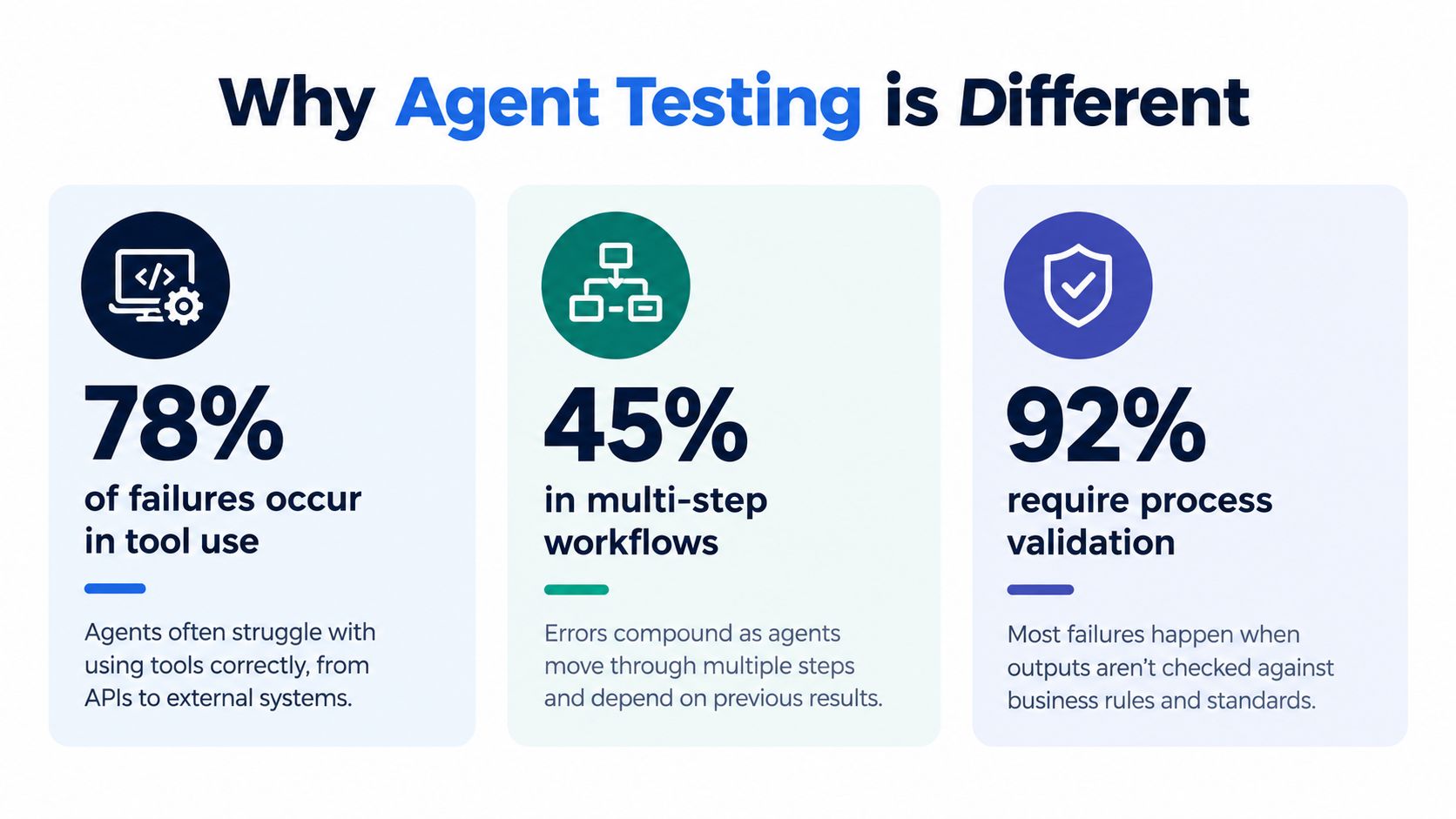
A 75% reliable agent reaches only 42% under pass^3, according to Tricentis guidance on testing AI agents. That metric captures a problem that one successful demo hides: users depend on repeated, complete workflows, not isolated wins.
Traditional software usually follows rules engineers define in advance. An AI agent interprets natural-language intent, selects tools, reacts to observations, updates its state, and may choose a different route on each run. The system therefore requires validation of its entire trajectory, not just a grade for the final answer.
A response can look correct even when the agent called the wrong tool, skipped an authorization check, passed an unsafe parameter, or changed the wrong record. The reverse also happens. An agent may reach the right result through a valid sequence that does not match a rigid, prewritten path. Tests must distinguish unsafe behavior from acceptable variation.
Repeated trials expose the gap between capability and reliability. Pass^k measures the probability that every trial succeeds, rather than whether at least one attempt works. A one-shot evaluation gives the optimistic view. Repeated execution shows whether the agent can complete the same class of task dependably.
Reliability falls as workflows get longer
Long-horizon tasks introduce more opportunities for state drift, prompt decay, tool misuse, and recovery errors. In one benchmark suite, mean pass@1 declined from 76.3% on short tasks to 52.1% on very-long tasks, a 24.3 percentage-point drop across 396 tasks, 3 domains, 4 duration buckets, and 23,392 episodes, as reported in research on long-running agent reliability.
A short-prompt test set can make an agent appear ready while revealing little about invoice reconciliation, multi-step research, browser automation, or software changes that run for much longer.
Practical rule: Test the shortest useful interaction, the normal workflow, and the longest realistic workflow separately. One average score hides where reliability breaks.
The same research reports that the task-length frontier agents can complete with 50% reliability has roughly doubled every seven months since 2019, reaching about 110 minutes for OpenAI's o3 in a March 2025 study. Longer tasks are becoming feasible, but teams still need reliability measurements at both 50% and 80% thresholds. They should know what an agent can sometimes complete and what it can complete consistently.
Building a Test Harness for Autonomous Agents
A useful harness turns agent behavior into repeatable evidence. Start with a task record that includes the user input, environment state, available tools, expected outcome, safety constraints, and grading rules. Keep the task independent from the implementation so you can test a prompt change, model change, tool change, or orchestration change against the same requirement.
Build the task set from reality
Begin with production incidents, support tickets, manual QA scenarios, and high-value user journeys. Add normal cases, boundary conditions, incomplete records, conflicting instructions, and adversarial inputs. A customer-support agent, for example, shouldn't be tested only on successful refunds. It also needs cases involving failed identity verification, unavailable order data, duplicate requests, and a user asking it to bypass policy.
Define success in observable terms:
- Outcome: The intended record, file, ticket, or transaction exists in the correct final state.
- Communication: The agent gives a clear response grounded in available evidence.
- Tool behavior: The agent selects permitted tools and supplies valid parameters.
- Safety: The agent refuses, escalates, or requests confirmation when policy requires it.
- Operational quality: The run stays within acceptable latency, cost, and iteration limits.
Use a clean environment for each trial. Shared files, cached responses, leftover database records, or exhausted resources can create failures that have nothing to do with the agent. They can also inflate results when a later run benefits from an earlier run's state.
For teams formalizing this setup, an AI testing framework for repeatable evaluation can help connect task data, execution, assertions, and reporting. The framework matters less than the discipline of making every test reproducible and every failure diagnosable.

Score repeated runs, not isolated wins
Run each important task across multiple trials and report both first-run success and repeated-run consistency. The harness should preserve the complete transcript, tool calls, intermediate observations, errors, final response, and resulting environment state.
Use benchmark suites when they match your agent type. GAIA, tau-bench, OSWorld, WebArena, and SWE-bench cover different combinations of reasoning, tool use, browsing, operating-system control, and software engineering. They're useful reference points, but domain-specific tasks still matter because a public benchmark rarely captures your authorization model, data quality, or business rules.
A practical harness separates capability tests from regression tests. Capability tests probe new or difficult behaviors. Regression tests protect workflows that already work. When an evaluation fails, inspect the transcript before changing the agent. A broken assertion, ambiguous task, or unstable environment can look exactly like model failure.
Validating Agent Trajectories and Tool Usage
Final-answer checks are necessary, but they aren't enough. An agent can say “the refund has been processed” while the transaction remains pending. It can provide the right answer after querying an unauthorized system. It can update a customer record correctly while using a tool with parameters that would be dangerous for another account.
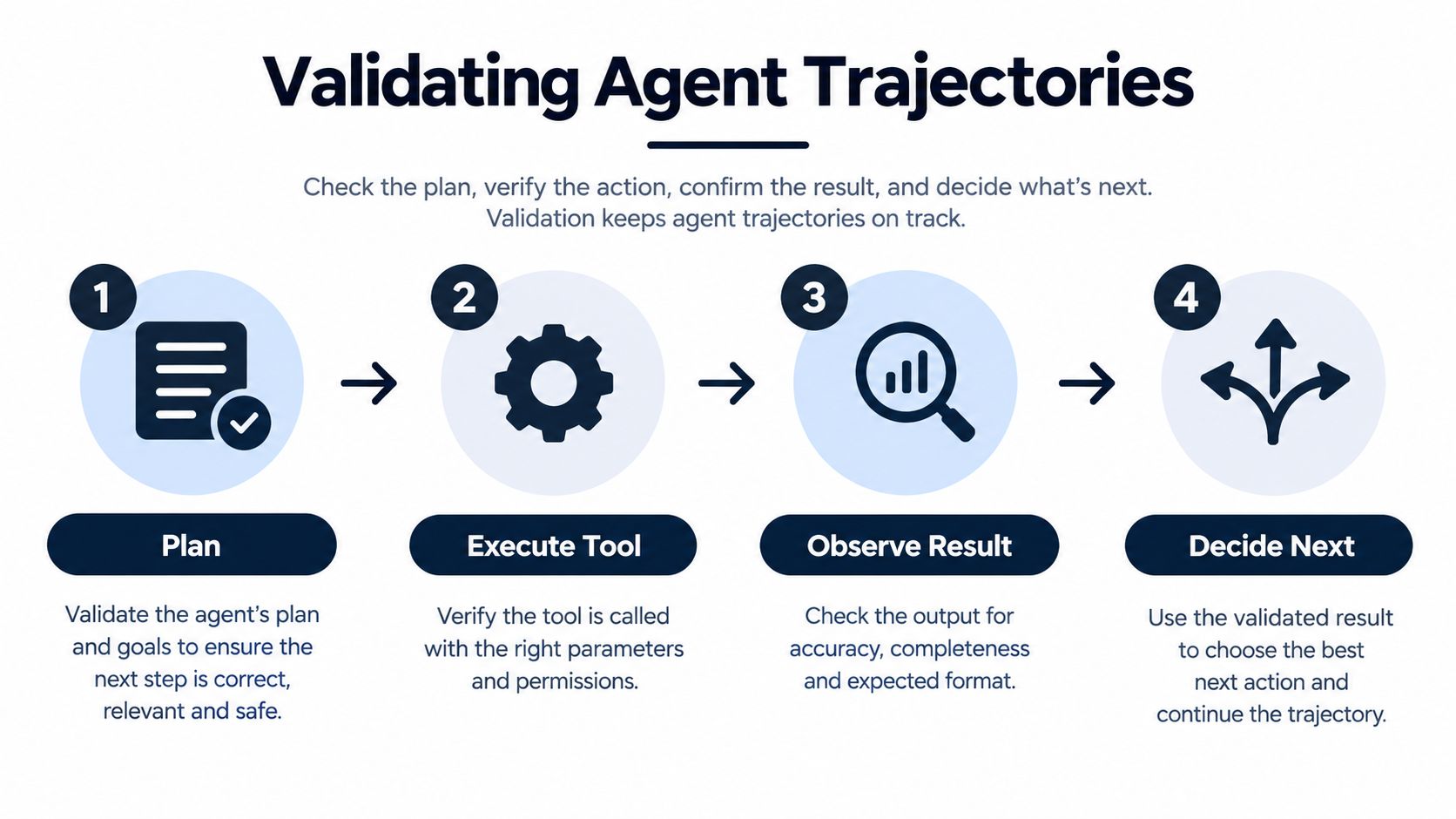
Trajectory validation examines what happened between the request and the outcome. Capture each planning step, tool invocation, parameter set, returned observation, error, retry, and state transition. Then grade the sequence according to the behavior your system requires.
Check the path without making it brittle
Validate the important invariants rather than demanding one exact chain of actions. If two tools can safely retrieve the same information, don't fail a test because the agent selected the second valid option. Do fail it if the agent used a write operation when a read operation was sufficient, omitted required identity verification, or sent a parameter outside the allowed range.
Useful trajectory assertions include:
- Tool selection: The agent uses an appropriate tool for the task and doesn't call prohibited tools.
- Parameter integrity: IDs, filters, amounts, destinations, and permissions match the task context.
- Dependency order: The agent completes required checks before sensitive actions.
- Error recovery: A failed tool call leads to a safe retry, clarification, or escalation.
- State awareness: The next decision reflects the actual tool result, not an assumed result.
- Termination: The agent stops after success or escalates instead of looping indefinitely.
The right balance is important. A test that requires an exact tool order can reject valid creativity. A test that checks only the final text can miss unsafe execution. Score the required invariants, then allow multiple valid paths.
Verify the environment, not the claim
For actions that change external systems, grade the resulting state directly. Check the database, ticket status, file contents, permissions, or transaction record rather than trusting the agent's message. This distinction is central to reliable testing because the assistant's statement is an output, while the external state is the actual result.
Use several grader types together. Code-based assertions are fast and reproducible for state checks, schemas, tool parameters, and security rules. Model-based graders can assess open-ended communication, but they need clear rubrics and periodic comparison with human judgment. Human review remains useful for ambiguous failures, new behaviors, and grader calibration.
Addressing the Testing Coverage Gap
Many teams have tests for individual prompts, tools, or agents but few tests for the interactions that determine whether the complete workflow works. A unit check might confirm that a search tool returns data. It won't reveal that the orchestrator selects that tool too often, ignores an empty result, or passes stale context into the next action.
Evidence from LLM-based agent applications shows this imbalance clearly. 61.8% of tests exercised individual tools or agents in isolation, about one-third targeted interaction behavior, and only 7.5% covered non-functional requirements such as security and performance, according to the study of testing practices for LLM-based agent applications.
![Do not add an image here.]
The gap matters because users experience the whole system. They don't care whether the parser passed its unit tests if the agent misroutes a request. They don't care whether the API wrapper works in isolation if an intermediate result causes the agent to update the wrong account.
Prioritize interaction risk
Map each business-critical journey from user intent to final state. Mark every boundary where the agent hands control to another component:
| Test layer | What it should answer |
|---|---|
| Tool or component | Does this operation validate inputs and return predictable results? |
| Orchestration | Does the agent select and combine tools appropriately? |
| End to end | Did the user's request reach the correct final state? |
| Non-functional | Does the workflow remain safe, performant, and affordable under stress? |
| Production monitoring | Can the team detect drift and unexpected failures after release? |
Use coverage analysis to identify missing journeys, not just the percentage of executed code. A test coverage strategy for SonarQube can help teams inspect code-level gaps, but agent teams also need behavioral coverage across intents, tool combinations, permissions, error paths, and state transitions.
Security and performance deserve explicit tests rather than an assumption that functional success implies safety. Enterprise environments contain missing records, access restrictions, unusual transactions, rate limits, prompt injection attempts, and tool misuse opportunities. Research on enterprise AI-agent security and reliability describes why curated datasets alone miss failures found in realistic production conditions.
Integrating Agent Tests into CI/CD Pipelines
Agent tests belong in the delivery pipeline, but running every expensive scenario on every code change isn't practical. A layered pipeline gives developers fast feedback while reserving deep evaluation for merges, releases, model changes, and orchestration changes.
Separate fast checks from deep evaluations
Run deterministic checks first. Validate tool schemas, authorization rules, prompt assembly, state cleanup, and known safety constraints before invoking the model. These tests are cheap and should block a change immediately when a contract breaks.
Run a small smoke set on pull requests. Include representative happy paths, one failure-recovery case, one permission boundary, and one trajectory assertion. Keep the environment isolated and record the model version, prompt version, tool definitions, configuration, and grader version with every result.
On merges and release candidates, run the broader regression suite with repeated trials. Include long-horizon workflows, adversarial prompts, external-service failures, and non-functional measurements. A pipeline can report pass@1 for quick diagnosis, then pass^k for workflows where consistency matters.
A CI/CD pipeline implementation guide provides the general delivery structure. For agents, add evaluation artifacts to the same process: traces, failed assertions, environment snapshots, model settings, and comparison against the last accepted baseline.
Handle non-determinism deliberately
Flaky results aren't automatically noise. A changed result may indicate genuine behavioral instability. Classify failures into agent failure, grader failure, infrastructure failure, and expected variation. Rerun infrastructure failures separately, but don't hide agent failures by retrying until they pass.
Track more than a single quality score:
- Task completion: Did the workflow reach the intended final state?
- Trajectory validity: Did the agent use safe tools and parameters?
- Consistency: Do repeated trials produce dependable results?
- Latency and cost: Does the workflow remain operationally viable?
- Safety events: Did the agent trigger unauthorized actions, leakage, or unsafe recovery?
- Regression status: Did an existing capability deteriorate after the change?
The pipeline should block release when a critical safety or state invariant fails, even if the aggregate score looks healthy. For less critical quality changes, route the result for review and retain the trace for diagnosis.
Place the video after the pipeline design discussion so it adds context rather than interrupting the visual sequence.
Continuous monitoring completes the loop after deployment. Sample real trajectories, watch for new tool combinations, inspect user-reported failures, and convert confirmed incidents into regression tasks. Offline evaluation coverage remains incomplete across the industry, with a 2026 summary citing LangChain data reporting that 52.4% of teams run offline evaluations and 37.3% run online evaluations, as described in practical guidance on testing AI agents.
Putting It All Together - A Testing Strategy Checklist
A reliable agent test program starts with clear release boundaries. It does not need every possible test immediately. It needs checks that expose unsafe decisions, incorrect state changes, and failures that a polished final answer could conceal.
Use the checklist below to assess your setup:
-
Define the actual outcome. Specify the final system state that proves the user's goal was completed. Treat the agent's final message as context, not proof.
-
Build representative tasks. Cover routine requests, edge cases, missing data, conflicting instructions, permission boundaries, adversarial prompts, and failures observed in production.
-
Isolate every trial. Reset data, files, sessions, credentials, caches, and external dependencies. A test result is unreliable when one run can affect the next.
-
Record the full trajectory. Store tool calls, parameters, observations, retries, errors, intermediate decisions, final output, and environment changes. These details show whether the agent reached the result safely.
-
Grade multiple dimensions. Pair deterministic state checks with trajectory assertions. Use model-based rubrics where fixed rules are insufficient, and send ambiguous or high-risk behavior to human reviewers.
-
Measure repeated reliability. Report single-run success and consistency across repeated trials. For long workflows, evaluate reliability at both 50% and 80% completion thresholds, following the long-running agent reliability research cited earlier.
-
Automate regression protection. Run fast smoke tests on pull requests and broader suites after merges, releases, model changes, and tool changes. Keep release gates tied to failures that can affect users.
-
Test the messy production environment. Include rate limits, unavailable services, incomplete records, injection attempts, unexpected formats, and unauthorized requests. Controlled tests should reproduce the conditions that cause real incidents.
-
Review failures manually. Read the transcript and inspect the grader's reasoning. Confirm that the test rejected unsafe behavior rather than a valid solution or a defective test.
-
Feed incidents back into the suite. Convert every meaningful production failure into a reproducible test with an owner and a defined release threshold.
A useful suite explains what the agent did, why it failed, and whether the failure can reach a user. Begin with the highest-risk journey and a small set of high-signal tasks. Add coverage when traces reveal uncertain decisions, unsafe tool use, inconsistent state changes, or weak recovery.
AskYourQA designs and implements AI testing for LLMs, autonomous agents, prompts, and AI-powered integrations, including multi-step workflows, edge cases, injection attempts, output validation, and safety checks. Teams seeking trajectory-aware automation integrated with CI/CD can visit AskYourQA to discuss a testing system built around critical user journeys.