
More automated tests don't automatically create better software. A large UI suite can slow delivery, obscure failures, and consume engineering time while leaving important risks untested. The question is not how many scripts a team can run, but whether its test automation framework architecture places reliable, high-signal checks where they can prevent expensive rework.
A scalable framework behaves like part of the delivery system. It connects business risk to test layers, test execution to CI/CD gates, and failures to diagnostic evidence. That shift changes automation from a QA checkbox into an economic-control mechanism for engineering leaders who need faster releases without accepting more production risk.
Table of Contents
- The Economic Reality of Automation Architecture
- Bridging the Continuous Delivery Gap
- Designing Layered Components and Pipeline Gates
- Allocating Coverage Across Test Layers
- Engineering Reliability and Eliminating Flakiness
- Measuring Framework Impact on Delivery Metrics
The Economic Reality of Automation Architecture
The assumption that more automated tests equal better quality is attractive because test counts are easy to report. They don't show whether the suite catches important defects early, whether failures are actionable, or whether developers trust the result enough to fix problems before release.
The economic case for architecture starts with defect timing. A U.S. National Institute of Standards and Technology study estimated that inadequate software testing infrastructure cost the U.S. economy approximately $59.5 billion annually, with more than one-third of that loss potentially avoidable through improved testing practices, as summarized in this software testing statistics analysis. The same evidence describes a relative defect-fix cost of roughly 1 unit during requirements work, 5 units during coding, 10 units during testing, and 15 to 100 units after production release, depending on system complexity and downstream impact.
Those figures make a narrow UI-only strategy difficult to defend. A UI test that runs late in the pipeline may confirm a user journey, but it can't replace fast unit checks, API validation, integration coverage, security testing, performance checks, or contract verification. By the time a defect reaches a broad end-to-end regression run, the team may already have built more code around the wrong behavior.
Practical rule: Put the cheapest reliable check as close as possible to the change that could introduce the defect.
From test inventory to economic control
A framework should help teams answer four operational questions:
- What matters most: Which customer journeys, business rules, integrations, and failure modes carry the greatest risk?
- Where should validation happen: Is the defect best detected through a unit, API, contract, integration, end-to-end, security, or performance test?
- When should the check run: Should it block a pull request, run after a merge, or execute only at a release gate?
- What evidence is needed: Will a failed test provide a trace, request and response data, logs, screenshots, or environment details that allow rapid diagnosis?
This is why a test automation framework shouldn't be designed as a collection of browser scripts. It needs controlled environments, dependable test data, repeatable fixtures, clear diagnostics, and CI/CD integration. It must also support the way software is delivered, including parallel execution and selective test runs.
A consultancy may describe this broader operating model as test automation as a service, but the architectural principle is the same whether the work is delivered internally or by a specialist team. Automation creates value when it prevents compounding rework, not when it increases the number displayed on a dashboard.
What fails in practice
A flat suite often hides three economic problems. First, it pushes too much validation toward the slowest layer. Second, it makes failures difficult to localize because several technical components are exercised at once. Third, it turns every application change into a maintenance event across many scripts.
The better design starts with critical journeys and risk categories. A payment authorization rule might need unit and API checks, a contract test for the payment provider, and a smaller number of end-to-end checks for the customer-facing path. A UI script alone may confirm that a button can be clicked, but it offers weak protection if the underlying authorization logic, message contract, or retry behavior is wrong.
The framework's purpose is therefore economic discipline. It reduces the chance that defects escape into increasingly expensive validation stages, while giving engineers feedback early enough to change the code without destabilizing the release plan.
Bridging the Continuous Delivery Gap
Continuous delivery depends on an automation framework that controls feedback speed, diagnostic signal, and pipeline health. A larger UI suite can increase execution time and obscure failures, while the framework must connect source control, pull requests, build agents, deployment environments, service dependencies, test data, and the CI/CD pipeline that governs release approvals.
Survey evidence shows the scale of this operating gap. A survey of 500 IT executives reported that 58% of enterprises deployed a new build daily and 26% deployed at least hourly, while only 32% said their organizations had fully embraced continuous testing, according to ZDNET's coverage of continuous testing. The same survey reported automation coverage of 24% of test cases, 24% of end-to-end business scenarios, and 25% of required test-data generation. It also found that 36% of respondents spent most testing time searching for, managing, maintaining, or generating test data.
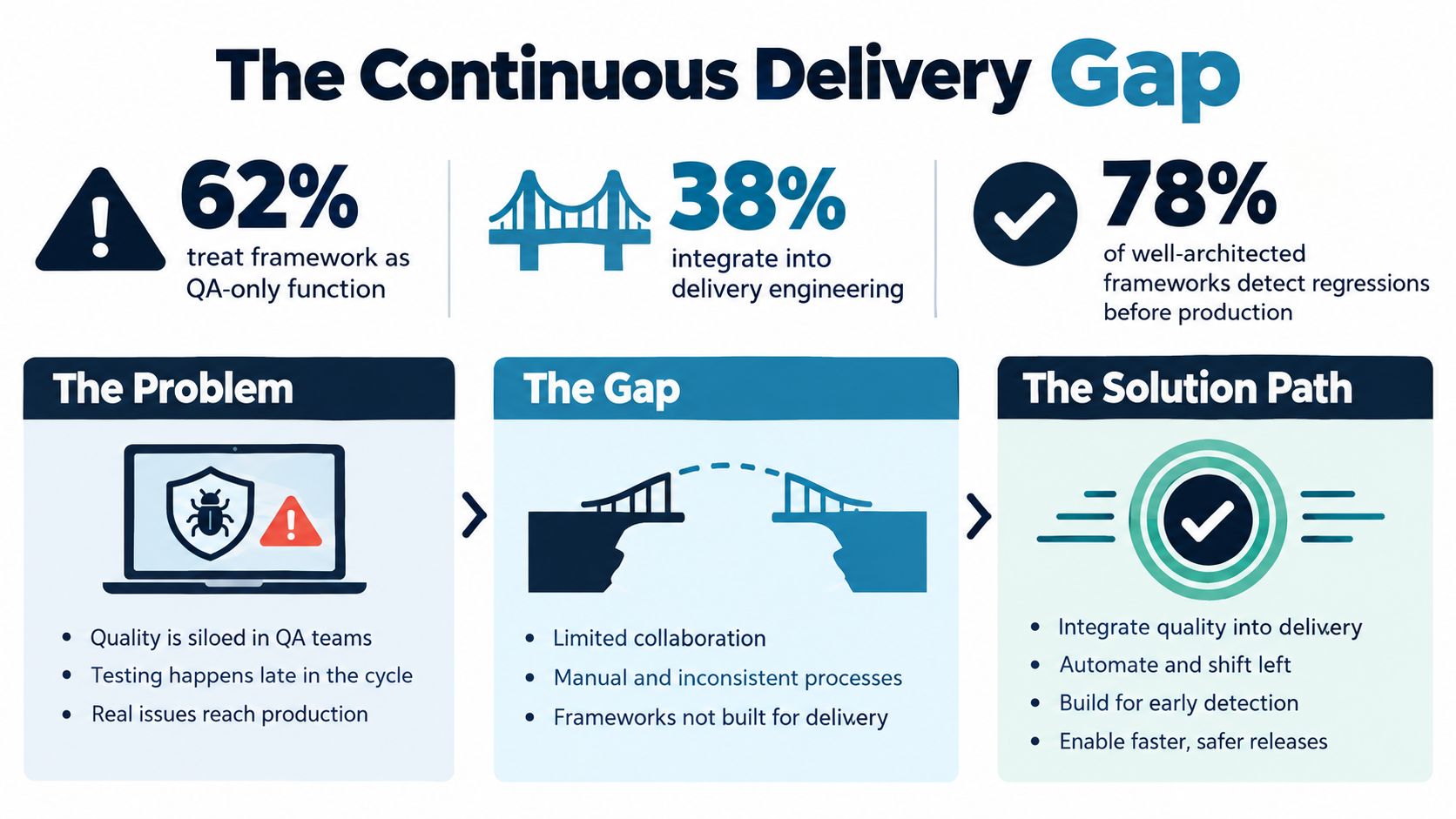
Those findings describe a systems problem rather than a tool-selection problem. Installing Playwright or Cypress will not create continuous testing if a flaky staging database makes every merge gate report false failures. The framework must provision reliable data, select tests by risk and event, publish usable evidence, and return a status that the pipeline can act on. Selenium, Appium, and an API client become useful components only when they support that operating model.
Connect the framework to delivery events
A practical pipeline assigns tests to events according to the decision each event must support:
- Pull requests: Run deterministic unit, contract, API smoke, and focused integration checks. They should complete quickly enough for developers to decide whether a change is safe to merge.
- After merge: Run broader API, integration, and service-level suites against a controlled environment. Each failure should include logs, traces, request details, and dependency context so an engineer can diagnose it without rerunning the entire suite.
- Release gates: Run selected end-to-end, mobile, security, performance, and cross-environment checks. These suites may take longer, but every check should protect a defined release risk. A gate that runs indiscriminately becomes a queue, not a quality control.
Pipeline configuration should reach the framework without placing environment-specific values in test logic. Store credentials in secure secret management. Control URLs, feature flags, browser settings, and service endpoints externally. The same test intent should run against the appropriate environment without a rewritten test or a hidden configuration branch.
Treat test data as infrastructure
Test data requires the same design discipline as execution. Pipeline time disappears when each test searches for an account, creates inconsistent records, or depends on state left by an earlier run. Parallel workers expose the problem quickly. Shared mutable data creates collisions, order-dependent failures, and results that cannot be reproduced locally.
Use isolated fixtures wherever possible. Generate records through APIs when that is faster and more deterministic than navigating the UI. Give each worker its own data namespace, then define cleanup or reset behavior explicitly. For third-party services, use stable test doubles or service virtualization when the external dependency makes feedback slow or nondeterministic.
Separate test selection from test implementation. Tags or metadata can identify smoke, contract, integration, mobile, security, and performance checks, provided each category maps to a real pipeline decision. Running every category at every stage adds ceremony and increases queue time without improving release flow.
A framework earns its place in release engineering when developers can see why a check ran, what it validated, where it failed, and whether that failure blocks the next delivery event. That connection turns automation into an economic control mechanism instead of a growing count of scripts.
Designing Layered Components and Pipeline Gates
A solid framework begins with business-critical journeys, not folders or test runners. Map the journey, identify the risk at each step, assign an owner, define the required environment and data contract, then choose the least expensive layer that can provide trustworthy evidence.
Layering keeps stable business intent separate from volatile implementation details. It also gives teams a place to change a browser adapter, API client, or environment fixture without rewriting every test that uses it.
A practical four-layer structure
-
Test intent layer: Expresses the behavior being validated, such as a customer submitting an order or an administrator changing an access policy. This layer should describe risk and expected outcomes rather than locator details.
-
Workflow and component layer: Models reusable journeys, page components, service objects, and domain actions. A checkout workflow can call a cart component, an address service, and a payment adapter without exposing how each technical interaction works.
-
Transport and browser adapter layer: Encapsulates Playwright or Selenium browser actions, REST or GraphQL requests, mobile driver operations, and protocol-specific behavior. Volatile selectors, headers, retries for transport errors, and client configuration belong here.
-
Fixture and environment layer: Creates isolated data, provisions accounts, controls feature flags, configures browsers and devices, and manages environment-independent setup and cleanup.
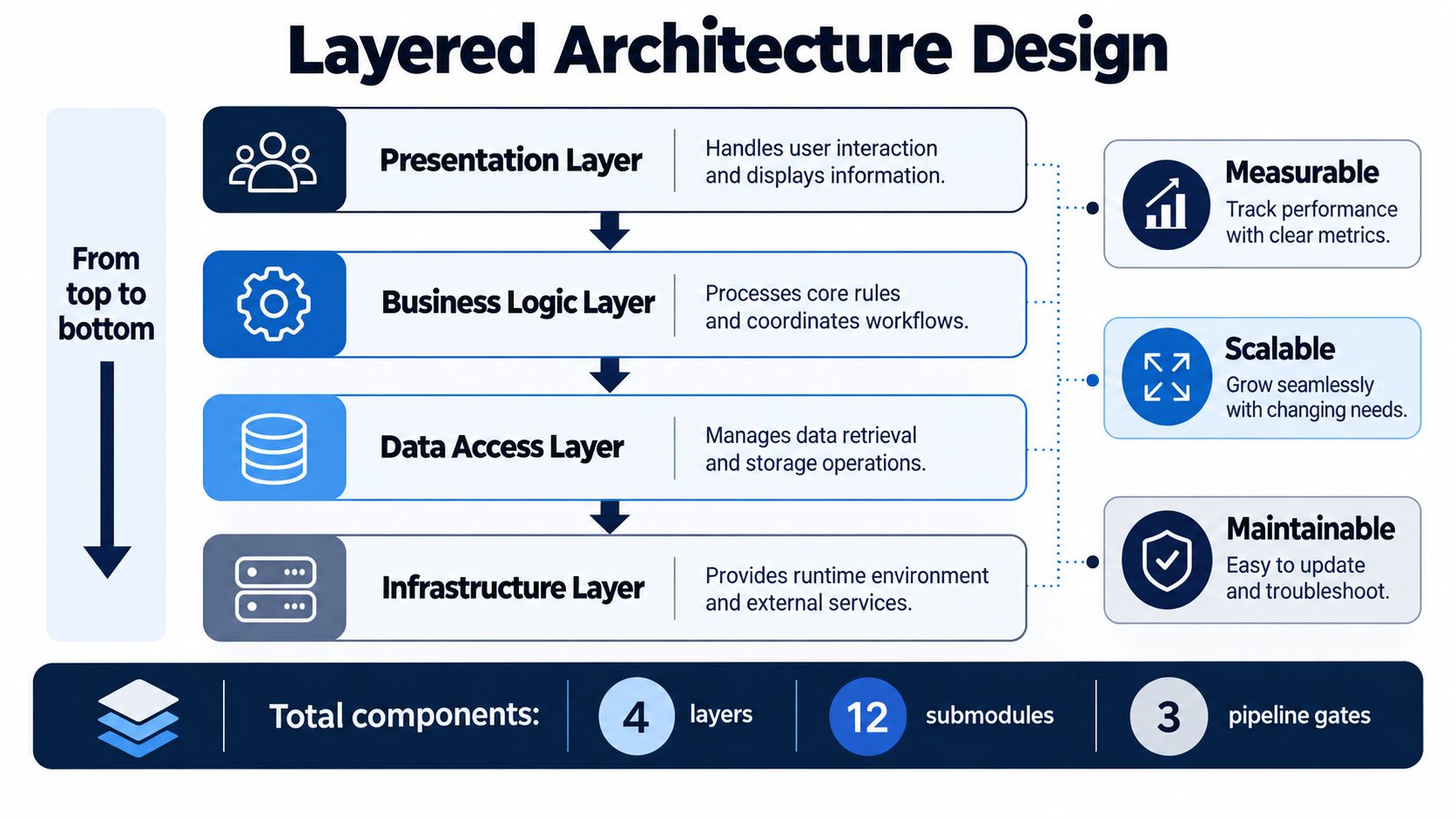
Assertions should remain close to the test intent or a dedicated validation component, not inside reusable page objects. A page object should expose actions and state, while the test decides what outcome matters. Putting assertions inside a shared object makes reuse harder and can cause one workflow to impose an inappropriate expectation on another.
Map tests to gates and outcomes
The framework should make pipeline behavior explicit. A pull request gate might require a small, deterministic set of checks. A merge gate can expand into service and integration coverage. A release gate can include the longer scenarios that validate real user journeys across supported browsers, devices, or external systems.
Use artifacts as part of the architecture, not as optional reporting decoration. A failed browser test may need a screenshot, video, DOM snapshot, console output, network log, and trace. An API failure may need the request metadata, response body, correlation identifier, and service logs. Failure evidence should be consistent enough that engineers can distinguish a product defect from an environment problem.
Parallel execution requires isolation from the beginning. Tests shouldn't share mutable accounts, static files, browser sessions, or database records unless the shared resource is deliberately controlled. Fixed sleeps are another architectural smell. Replace them with conditions based on application state, events, network responses, or visible readiness signals.
A framework also needs ownership. Every critical journey should have a business or engineering owner, every reusable component should have a maintainer, and every quarantined test should have a removal condition. Otherwise, abstraction becomes a shared area that nobody feels responsible for repairing.
The final connection is measurement. DORA defines delivery outcomes such as change lead time, the time from commit to production, and change-fail rate, the proportion of deployments requiring intervention, in its DORA metrics guidance. The framework should help teams examine whether faster feedback improves these outcomes, rather than treating execution volume as success.
Allocating Coverage Across Test Layers
There is no universal test pyramid that tells every organization how much coverage belongs in each layer. The right allocation depends on business risk, change frequency, diagnostic value, execution cost, and the reliability of the test environment.
A useful decision starts with the failure mode. If a rule can be evaluated without infrastructure, a unit test usually gives the fastest and clearest signal. If compatibility between services is the risk, a contract test may be more valuable than a browser journey. If the concern is whether a real customer can complete a critical flow across multiple systems, end-to-end coverage earns its place despite higher cost.
| Test Layer | Execution Speed | Diagnostic Value | Pipeline Gate |
|---|---|---|---|
| Unit | Fast | High for isolated business logic | Pull request |
| Contract | Fast to moderate | High for interface compatibility | Pull request or merge |
| API | Moderate | High for service behavior and data rules | Pull request or merge |
| Integration | Moderate to slow | High for component interaction | Merge |
| End-to-end UI | Slowest among routine functional layers | Broad journey signal, weaker fault isolation | Release or focused merge gate |
| Mobile | Moderate to slow | High for device and platform behavior | Merge or release |
| Performance | Scenario-dependent | High for capacity and response risks | Release or scheduled gate |
| Security | Scenario-dependent | High for exploit and control validation | Release or risk-based gate |
The table is a decision aid, not a coverage quota. Duplicating a critical authorization check at the API and UI layers can be sensible when the layers protect different risks. The API check gives fast feedback on the rule, while the UI check confirms that the user-facing flow connects correctly. Duplicating every low-risk check across both layers creates maintenance without equivalent protection.
Decide what blocks the pipeline
Pull request checks should be deterministic and tightly related to the code change. A flaky browser scenario that touches several external systems is usually a poor blocking test unless the change directly affects that journey and the environment is controlled.
Merge checks can validate broader interactions, especially where a service contract or integration boundary is involved. Release gates should focus on risks that the organization has agreed cannot pass unnoticed, such as a high-value customer journey, a critical security control, or a performance threshold tied to a known operational requirement.
The comparison of functional tests and unit tests is useful as a starting point, but leaders should avoid turning layer selection into a slogan. The best test is the one that detects the relevant failure with enough evidence to support a decision.
When slower tests are justified
A slower end-to-end test earns its cost when the risk exists only across real boundaries. Examples include authentication handoffs, payment confirmation, entitlement propagation, or a mobile workflow that depends on device behavior. Keep the scenario narrow, use stable data, and avoid turning one journey into a long script that validates unrelated features.
Performance and security checks need their own execution strategy because they often require controlled environments and specialized evidence. They can run at release gates or scheduled points, while targeted security and performance checks can still run earlier when they are deterministic.
The economic model is simple: prioritize tests that reduce meaningful uncertainty. A smaller portfolio with clear ownership and useful diagnostics can provide more release confidence than a large suite dominated by repetitive, slow, or low-signal checks.
Engineering Reliability and Eliminating Flakiness
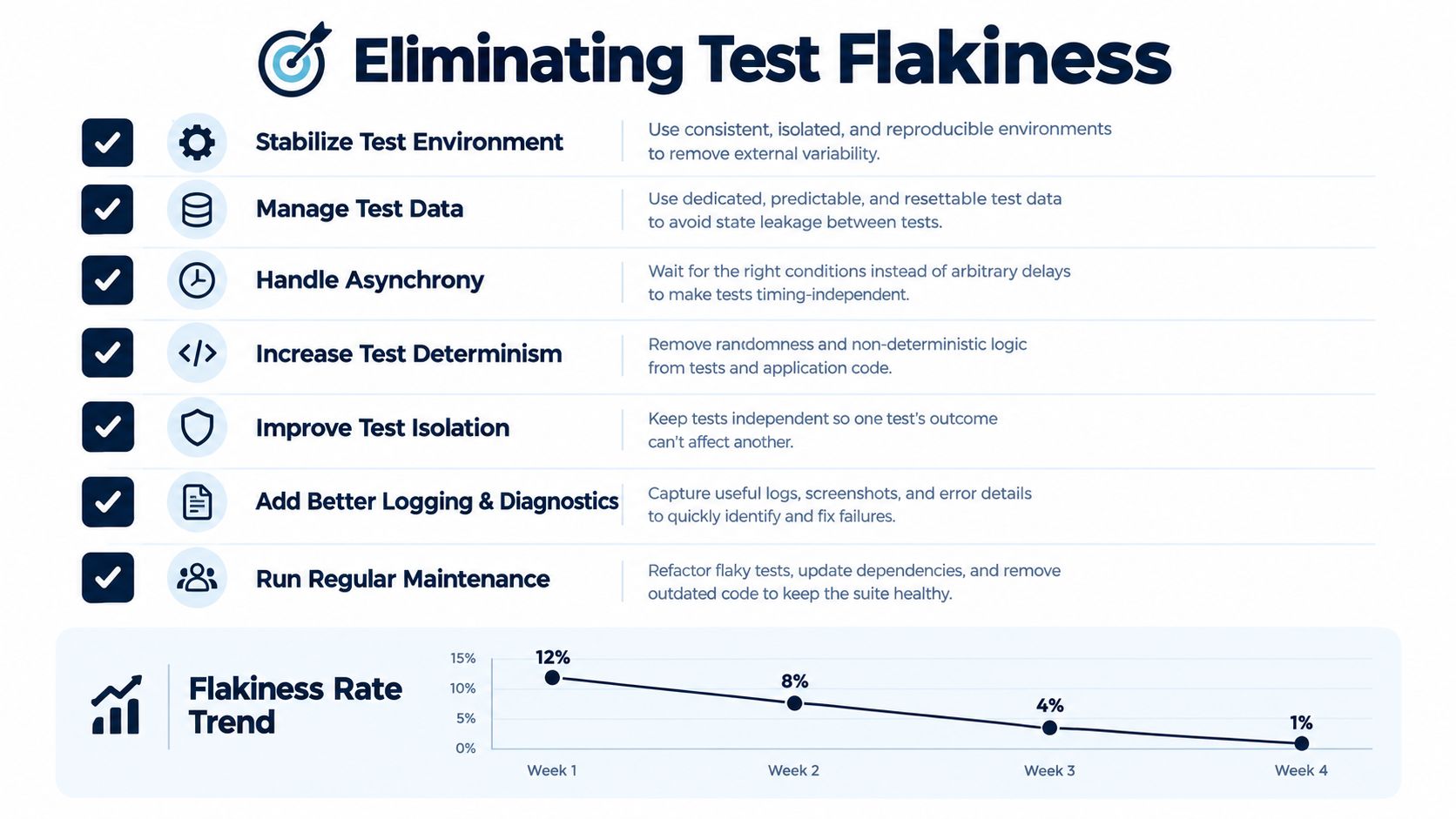
Flakiness is an architecture defect because it changes the meaning of a test result. When a passing test can fail without a product change, engineers stop treating the suite as evidence and start treating it as background noise.
Industrial evidence shows the scale of the problem. A study of 4.2 million Google tests reported approximately 16% exhibiting flakiness, while flaky tests accounted for about 84% of pass-to-fail transitions and reruns consumed roughly 2% to 16% of compute capacity, as summarized in this test maintenance automation guide. A separate industrial study estimated that flaky-test investigation and repair consumed at least 2.5% of developer time.
Make nondeterminism measurable
Every run should record a stable test identifier, commit, environment, browser or device, duration, retry count, and failure signature. Categorize failures as product defects, infrastructure failures, test defects, or nondeterministic behavior. Without these fields, teams can't tell whether the framework is finding more product problems or just producing more infrastructure noise.
Quarantine can protect a pipeline, but it must be temporary and ownership-based. A quarantined test should have an owner, a reason, a date for review, and a visible impact on the flakiness backlog. It shouldn't become a hidden skip list that lets unreliable checks remain indefinitely.
Track practical indicators such as flaky-test rate, retry-pass rate, mean time to repair, quarantine age, and compute consumed by retries. A test that passes only after an automatic retry should remain visible and count against the flakiness measure. Retries can collect evidence, but they shouldn't convert an unreliable result into an accepted result.
Repair causes, not symptoms
Use a controlled remediation sequence:
- Reproduce repeatedly: Run the test under the same commit and environment until the failure pattern is understood.
- Replace time waits: Use condition or event-based synchronization instead of fixed sleeps.
- Remove shared state: Isolate accounts, records, files, queues, clocks, and random values between workers.
- Control dependencies: Stub or virtualize external services when their behavior isn't the subject of the test.
- Validate the repair: Run the test repeatedly and across multiple workers before removing quarantine.
Common failures have recognizable architectural causes. A test that depends on execution order probably shares state. A test that fails only under parallel load may use unsafe fixtures or static resources. A test that fails after a UI animation may be waiting for time rather than application readiness.
The framework should also preserve enough trace detail to explain a failure. Screenshots alone rarely identify a race condition. Combine traces, network evidence, logs, browser or device information, and fixture identifiers so engineers can reproduce the same conditions.
A reliable suite doesn't mean every run is perfect. It means failures become increasingly attributable, repairable, and rare enough that teams trust the signal. The operational target is downward nondeterminism alongside better parallel throughput and more complete diagnostics.
Measuring Framework Impact on Delivery Metrics
A framework succeeds when delivery decisions improve; execution counts are a vanity metric. Engineering leaders should measure whether developers receive feedback sooner, failures take less time to diagnose, and releases move faster without increasing deployment risk.
DORA's outcome model provides a useful measurement boundary. Track deployment frequency, change lead time, failed-deployment recovery time, change-fail rate, and deployment rework rate alongside test results. The framework cannot claim credit for every movement in these outcomes, but its contribution should remain visible through test duration, gate outcomes, failure categories, and time to resolution.
Build an evidence chain
Connect each change to the checks it triggered and the release decision that followed. Retain these records for every gate:
- Scope: The commit, pull request, services, journeys, and risk categories covered.
- Signal: Pass, fail, blocked, skipped, or quarantined status, including the reason.
- Diagnosis: Logs, traces, screenshots, API evidence, environment information, and failure classification.
- Action: The owner, remediation decision, and whether deployment proceeded or stopped.
- Outcome: The relationship between the gate result and later delivery or recovery work.
This chain separates valuable control from pipeline friction. A gate that blocks a release because of a confirmed authorization defect protects delivery quality. A gate that blocks the same release because another worker modified a shared staging account exposes framework debt.
Use a health checklist
Review the framework regularly against these questions:
- Can the team identify which business risks each important test covers?
- Do pull request checks finish within a useful development feedback window?
- Can engineers diagnose failures without rerunning the entire suite?
- Are test data and environments isolated enough for parallel execution?
- Does every retry, quarantine, and skip remain visible?
- Do end-to-end tests validate critical cross-system behavior instead of repeating lower-layer checks?
- Are security, performance, API, mobile, and AI-specific risks assigned to appropriate gates?
- Can the organization compare framework changes with lead time, deployment frequency, recovery, and change-fail outcomes?
A healthy framework may contain fewer tests after rationalization. Removing redundant or low-signal checks can improve confidence when the remaining portfolio covers the right risks and produces clearer evidence. Raw volume becomes harmful when it lengthens feedback and makes triage less certain.
AskYourQA builds automation systems around critical journeys and CI/CD release feedback, applying the layered architecture and flakiness controls described above. Its work covers frontend, backend, APIs, mobile platforms, functional and AI testing, security, performance, reporting, and pipeline integration.
The strategic standard is straightforward: increase deployment frequency and shorten change lead time while keeping change-fail and recovery measures from deteriorating. The framework therefore needs owners, architectural standards, measurable reliability, and a coverage portfolio that evolves with the product.
If your suite is slow, brittle, or disconnected from release decisions, map critical user journeys and assign each risk to the appropriate test layer. AskYourQA can design and implement a scalable framework, integrate smoke and regression coverage into your CI/CD pipeline, and provide release visibility. Visit AskYourQA to discuss an automation architecture built for dependable delivery.