
A release goes out cleanly, the deployment dashboard stays green, and the first customer report arrives hours later. A partner endpoint has been returning malformed responses, but your UI tests never noticed because the affected path runs through an external integration and isn't part of the browser suite. The API technically deployed, yet the business flow failed.
That incident usually isn't a tooling problem. It points to a missing test strategy for API testing, one that connects endpoints to revenue, dependencies, consumer expectations, security exposure, and production behavior. A large practitioner survey already showed the discipline moving beyond basic checks: in the 2018 State of Testing survey, 80% of respondents tested APIs, compared with 71% in 2017, while 54% automated API tests and fewer than half performed API load testing (historical API testing survey summary). The lesson is still relevant. Functional checks are a starting point, not a complete release safety net.
Table of Contents
- Why API Tests Still Slip Through Releases
- The Scope of API Testing Explained Simply
- Prioritizing the Business-Critical Flows First
- Contract, Functional, and End-to-End Approaches Compared
- Test Data and Environment Strategy That Holds Up
- Wiring API Tests Into CI/CD the Right Way
- Metrics That Show Real Release Readiness
- A Practical Roadmap to Scale API Test Automation
Why API Tests Still Slip Through Releases
The payments API in the opening scenario probably had tests. It may have had unit coverage for request validation, a Postman collection for the happy path, and a UI test that completed checkout with a mocked partner response. All three could pass while the production integration failed.
That happens because teams often test what they own locally instead of testing the agreement and business flow across service boundaries. A provider changes a response field, a consumer interprets an empty value incorrectly, or a third-party system returns a valid HTTP response with an unusable body. If no test observes the actual boundary, the release pipeline has no reason to stop.
The familiar gaps
UI-heavy coverage creates a misleading sense of confidence. Browser tests prove that selected user journeys work through the interface, but they're slow, expensive to diagnose, and often insulated from the full range of API responses. They also rarely cover every consumer of a shared service.
Unit tests isolate logic effectively, but they can't prove that a deployed service still communicates correctly with another service. A unit test can confirm that a handler creates the right object while missing a renamed field that breaks a downstream consumer.
Postman collections are useful for exploration and repeatable functional checks. They become weak strategy when they exist as manually maintained scripts, run only before a release, or assert status codes without checking business meaning, authorization, and response contracts.
Practical rule: If an API change can break another team, a partner, or a revenue flow, the test must observe that boundary directly.
Production adds another class of failure. Expired certificates, rotated credentials, DNS problems, third-party outages, shadow APIs, deprecated endpoints, authorization chaining, and identity propagation can all escape pre-release suites. Recent API strategy guidance on production blind spots makes the important point that no amount of pre-deployment testing can reproduce every runtime condition.
The right response isn't to add random tests after every incident. Map the risk first, then choose the cheapest test layer that can detect it early. A contract test may catch an incompatible schema before merge. A functional test may verify a rule against a deployed service. A synthetic production check may reveal an expired credential that no staging test could see.
The Scope of API Testing Explained Simply
An API platform works like a restaurant. Unit tests check the recipe, integration tests confirm that the kitchen hands work together, contract tests define what the menu promises, security tests protect the back door, and performance tests show what happens during the dinner rush.
The comparison matters because these layers solve different risks. Each has a different owner, feedback speed, and failure pattern. Treating them as interchangeable creates blind spots, especially at service boundaries and in production.
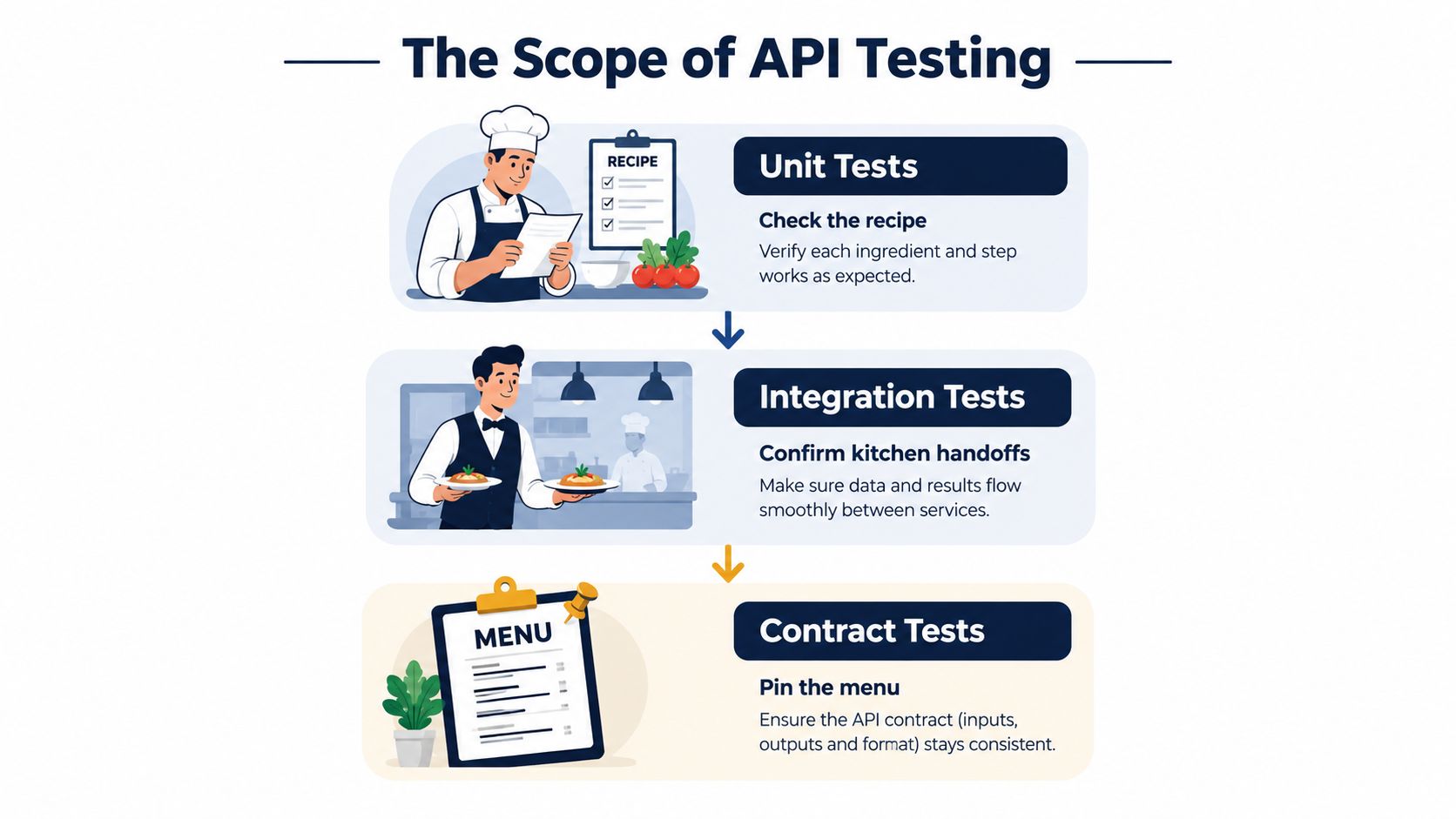
A practical scope pyramid
-
Unit testing checks isolated behavior. Does the route handler reject invalid input? Does transformation logic return the correct object? These tests are fast and precise, but mocks can conceal failures in databases, queues, authentication services, and network serialization.
-
Functional testing checks an endpoint as a behavior. Send valid, invalid, and unauthorized requests, along with boundary values. Assert the status, headers, body, error shape, and business result. This layer is a common starting point because it verifies whether the service follows its specification.
-
Integration testing checks real handoffs. Create an order, reserve inventory, publish an event, and confirm that the notification service receives the expected data. Integration tests expose configuration, persistence, serialization, and dependency failures that isolated tests miss.
-
Contract testing checks the menu promise. A consumer defines the fields, types, and behaviors it depends on. The provider verifies that it still satisfies those expectations. Pact, OpenAPI validation, and JSON Schema support this boundary-focused approach. For services with many consumers, automate contract checks before merge rather than relying on broad end-to-end coverage.
-
Security testing checks whether the wrong person can perform an allowed action. Test authentication, authorization, token expiry, tenant isolation, input handling, rate limits, and sensitive-data exposure. More than 90% of developers in the RapidAPI survey identified security and data privacy as key considerations (RapidAPI State of Software Quality findings).
-
Performance testing checks behavior under pressure. Use realistic traffic patterns to examine latency, throughput, resource exhaustion, queue behavior, and error rates. A fast endpoint that returns incorrect data remains broken, so load tests cannot replace functional checks.
Scope should follow the failure you need to prevent. Use a unit test for a calculation, a contract test for a shared response schema, and an end-to-end test when several services must complete one customer outcome. Add production-observability checks for failures staging cannot reproduce, such as expired credentials, dependency outages, or unexpected traffic patterns.
The video below provides a visual introduction to API testing layers and their place in a broader quality approach.
Prioritizing the Business-Critical Flows First
An endpoint inventory tells you what exists. It doesn't tell you what matters.
Start by mapping each endpoint to a customer, operational, or revenue flow. A checkout completion endpoint has a large blast radius because failure blocks a purchase and may leave payment, inventory, and order state inconsistent. An internal admin export endpoint may matter to a small group of employees and can often tolerate a slower recovery path.
Rank each flow using three questions:
- What is the business impact if it fails?
- How likely is the flow to fail after a change?
- How many services, consumers, or partners depend on it?
The third question is easy to miss. A seemingly minor profile API may feed mobile clients, billing, analytics, and partner integrations. Its direct revenue impact may be moderate, but its dependency fan-out makes a contract check valuable.
Endpoint Risk Scoring Matrix
| Endpoint | Revenue Impact | Failure Likelihood | Test Depth |
|---|---|---|---|
| Checkout completion | High | Medium to high | Contract, functional, integration, security, failure paths, concurrency, targeted end-to-end |
| Payment authorization callback | High | Medium | Contract, functional, replay, timeout, duplicate-event, authorization and observability checks |
| Account login and token refresh | High | Medium | Functional, security, negative, rate-limit, identity propagation, integration |
| Product search | Medium | Medium | Functional, contract, representative data, latency and dependency failure checks |
| Internal admin export | Low | Low to medium | Functional happy path, authorization, malformed input, basic regression |
Don't turn this matrix into a fake precision exercise. Its purpose is to make trade-offs visible to engineering and product leaders. A high-risk flow deserves broader data variation, negative scenarios, dependency failures, and concurrency checks. A low-risk endpoint may need only a small functional suite and a contract check.
Coverage percentages can also distort priorities. Hundreds of shallow tests across low-impact endpoints won't protect a broken checkout flow. Ten critical flows tested in depth may provide more release confidence than a large collection that never validates the actual customer outcome.
For every new test, ask one question:
Which business failure does this test detect earlier than the current suite?
If the answer is unclear, don't add it yet. Improve an existing assertion, replace a brittle end-to-end test with a contract check, or invest in observability instead.
Contract, Functional, and End-to-End Approaches Compared
These approaches answer different risk questions. Treating them as interchangeable creates unclear ownership, slow pipelines, and gaps between interface compatibility and customer outcomes.
Contract tests verify the agreement between a consumer and provider. They check request fields, response fields, data types, status codes, and compatibility expectations without exercising every business rule. They provide fast feedback at public API and internal service boundaries, especially when separate teams release on different schedules. A passing contract does not prove that the provider handles every runtime scenario correctly.
Functional tests call a running service and verify its behavior. Use them for business rules, validation, authorization, error handling, and response semantics within that service. The assertion should establish the correct business result, not merely confirm an HTTP 200 response.
End-to-end API tests connect multiple services to validate a complete flow, such as checkout, onboarding, provisioning, or account recovery. They expose integration failures that isolated tests cannot see. They also cost more to maintain and diagnose. A failure may come from authentication, test data, a downstream timeout, or the final assertion, so the suite needs clear logging and production-like observability.
| Dimension | Contract | Functional | End-to-End |
|---|---|---|---|
| Primary question | Did the interface remain compatible? | Does this service behave correctly? | Does the complete business flow work? |
| Best target | Public and inter-team boundaries | Critical endpoint behavior | Highest-value customer journeys |
| Feedback speed | Fast | Moderate | Slowest |
| Main failure found | Breaking schema or interface change | Rule, validation, security, or response defect | Cross-service workflow failure |
| Main trade-off | Does not prove every runtime business rule | Does not prove all consumer interactions | Flakiness, setup cost, and diagnosis time |
| Typical owner | Consumer and provider teams | Service team with QA support | Product or platform quality ownership |
A practical pipeline uses contracts broadly at service boundaries, functional tests for critical endpoint behavior, and a limited number of end-to-end tests for high-value customer journeys. Allocate coverage according to blast radius, change frequency, and consumer count, rather than a universal coverage target.
The testing mix reported by RapidAPI included functional testing at 29.5%, integration testing at 26.8%, and acceptance testing at 16.3% (RapidAPI testing mix findings). Those categories help describe common practice, but they do not establish the right allocation for your product. Postman reported functional and integration testing at 67%, performance testing at 57%, and contract testing at 17% among respondents (Postman State of the API report). The gap makes contract coverage worth examining, not copying a benchmark.
For practical guidance on selecting and organizing workflow coverage, review these end-to-end testing frameworks.
Test Data and Environment Strategy That Holds Up
Most unstable API suites don't fail because assertions are badly written. They fail because one test changes shared data, a dependency returns a different response, or the environment starts in an unknown state.
Separate reference data from mutable data before writing the suite. Countries, currencies, tax rules, and plan tiers usually behave like reference data. Users, sessions, orders, payment attempts, and transactions change during a test and need isolated lifecycle management.
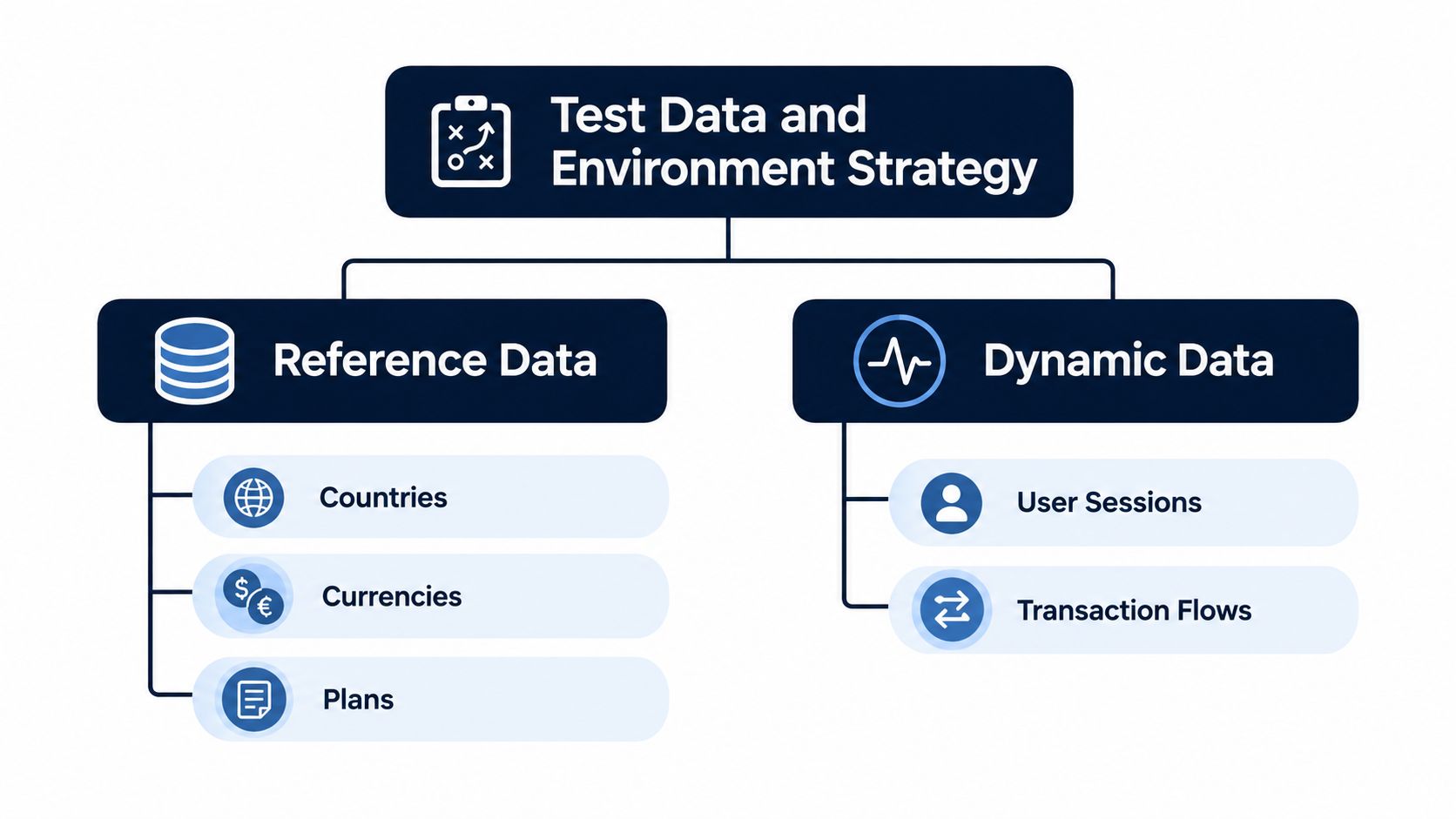
Make each test responsible for its state
A reliable test should create the dynamic records it needs, use unique identifiers, and clean up or expire those records without depending on execution order. Shared fixtures look convenient until parallel runs mutate the same account or one failed test leaves an unexpected status behind.
Prefer synthetic data factories seeded for each run over production snapshots. Snapshots can contain personal information, conceal environmental drift, and make failures difficult to reproduce. If production-like patterns matter, generate representative values without copying identity data.
Use stable reference data deliberately. Version it, load it consistently, and fail the environment health check if a required plan or currency is missing. This keeps a bad seed from appearing as an application defect.
Control dependencies and environments
External or unstable dependencies need a controlled boundary. Service virtualization can simulate stateful behavior, latency, timeouts, malformed payloads, and 4xx or 5xx responses, so the suite can exercise failure paths without depending on partner availability or rate limits. Guidance on service virtualization for microservices is particularly relevant for partner APIs that your team can't control.
Use environments with distinct purposes:
- Pull request environments provide isolated feedback for changed services.
- Integration environments support repeatable cross-service validation.
- Production-like staging validates release candidates with representative topology and configuration.
Pin dependency versions, reset schemas predictably, and prohibit shared mutable state across suites. If a test passes only after another test runs first, the suite isn't providing evidence. It's depending on an accident.
For practical templates that help teams standardize repeatable checks, use these software testing scripts and templates.
Wiring API Tests Into CI/CD the Right Way
Putting every API test on every commit sounds rigorous until developers wait for irrelevant checks, ignore red builds, and eventually disable the suite. Execution should be tiered by speed, intent, and failure ownership.
A useful pipeline arrangement looks like this:
- Pull request gate: Run smoke tests for changed services, schema validation, and consumer-driven contract checks. These tests should provide rapid feedback and avoid unnecessary external calls.
- Merge validation: Run broader functional and integration coverage against the shared integration environment.
- Nightly or release-candidate runs: Execute deeper regression, cross-service workflows, security checks, and dependency failure scenarios.
- Scheduled performance runs: Use controlled load and stress scenarios when the environment and traffic model are ready, rather than mixing them with ordinary correctness checks.
Neutral API automation guidance recommends running contract suites on every change and reserving deeper regression for nightly or release-candidate execution (CI-oriented API test automation guidance). That separation keeps the pull request signal focused while still giving the organization a place to run expensive confidence checks.
Keep failures actionable
Assign ownership through service tags and repository rules such as CODEOWNERS. If a provider changes a response consumed by another team, the relevant owners should receive the failure with the request, expected contract, actual response, and suspected change. A red pipeline without an owner becomes background noise.
Parallelize independent tests and shard by service or risk tag. Cache only safe, immutable setup artifacts, and never reuse mutable authentication or transaction state across parallel workers. Before running assertions, check authentication, service health, DNS resolution, and required dependencies. A failed environment check should report infrastructure noise clearly instead of producing a page of misleading endpoint failures.
A deployment gate should evaluate both pass status and freshness. A suite that passes but hasn't run recently can't support a confident release decision. The team should know which critical flows ran against which version, with which dependencies, and whether the result still reflects the current system.
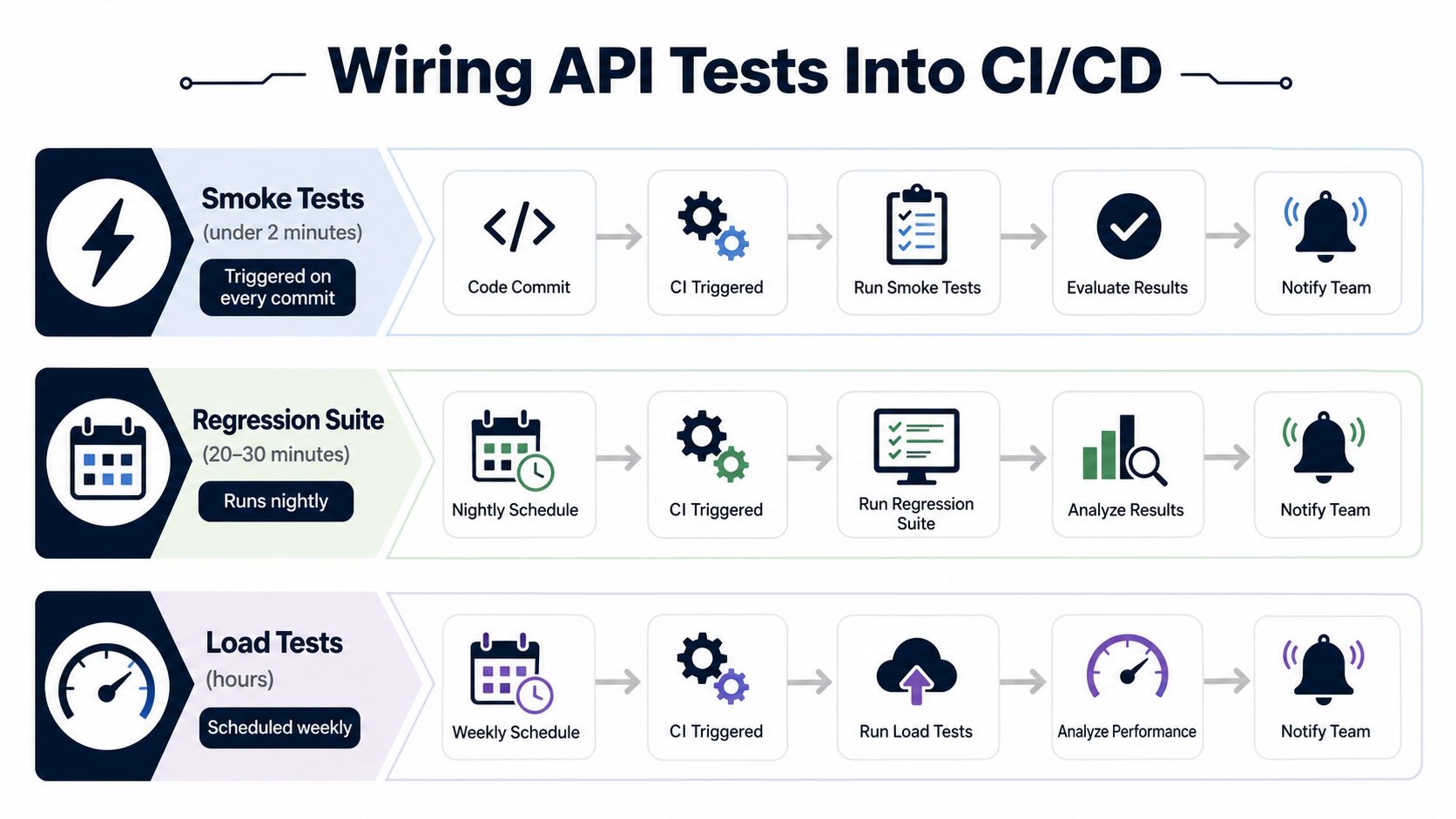
The pipeline is part of the test strategy, not merely the place where scripts happen to run. If the right test runs at the wrong time, its value falls sharply.
For teams aligning test execution with delivery stages, this explanation of what a CI/CD pipeline is provides useful operational context.
Metrics That Show Real Release Readiness
A dashboard full of test counts can look healthy while customer risk increases. Release readiness requires signals that connect test behavior to escaped defects, interface stability, and feedback quality.
Track change failure rate to understand how often releases create remediation work or customer impact. Track mean time to detect API defects to see whether monitoring and test gates identify failures quickly. Track production defect escape rate per release to expose gaps that pass-rate reporting hides.
Contract metrics add a boundary view:
- Contract pass rate: Shows whether consumer and provider expectations remain compatible.
- Schema drift incidents: Reveals changes that bypassed agreed interface management.
- Contract-related merge blocks: Shows whether the gate is catching meaningful incompatibilities or generating noise.
- Consumer coverage: Identifies important clients that have no explicit agreement represented in the suite.
Pipeline health matters too. Monitor the p95 execution time for each test tier, flaky-test rate, rerun frequency, and the proportion of merges blocked by each failure category. A suite that runs quickly but flakes often is not fast feedback. It's unreliable feedback.
Leading vs. Lagging API Test Metrics
| Metric | Category | What It Tells You | Owner |
|---|---|---|---|
| Production defect escape rate | Leading risk signal | Whether release controls miss customer-impacting failures | Engineering and QA leadership |
| Contract pass rate | Leading interface signal | Whether service boundaries remain compatible | Provider and consumer teams |
| Mean time to detect | Leading operational signal | How quickly the organization notices API defects | SRE and platform teams |
| Schema drift incidents | Leading boundary signal | Whether interface changes bypass governance | Service owners |
| Total automated tests | Lagging activity signal | How much the team has written, not whether it matters | QA or quality engineering |
| Raw code coverage | Lagging implementation signal | Which code paths execute, without proving business risk is covered | Engineering teams |
| Assertion count | Lagging volume signal | Test size, with no direct evidence of release safety | Test owners |
Set an owner and an action for each metric. For example, a contract failure may block a release, while a rising flaky-test rate may trigger maintenance work without blocking unrelated services. Without a defined response, measurement becomes reporting theater.
The strongest question for a release dashboard is simple: what evidence would make us hold this release? If a metric can't influence that decision, it may still be useful for planning, but it shouldn't be presented as proof of readiness.
A Practical Roadmap to Scale API Test Automation
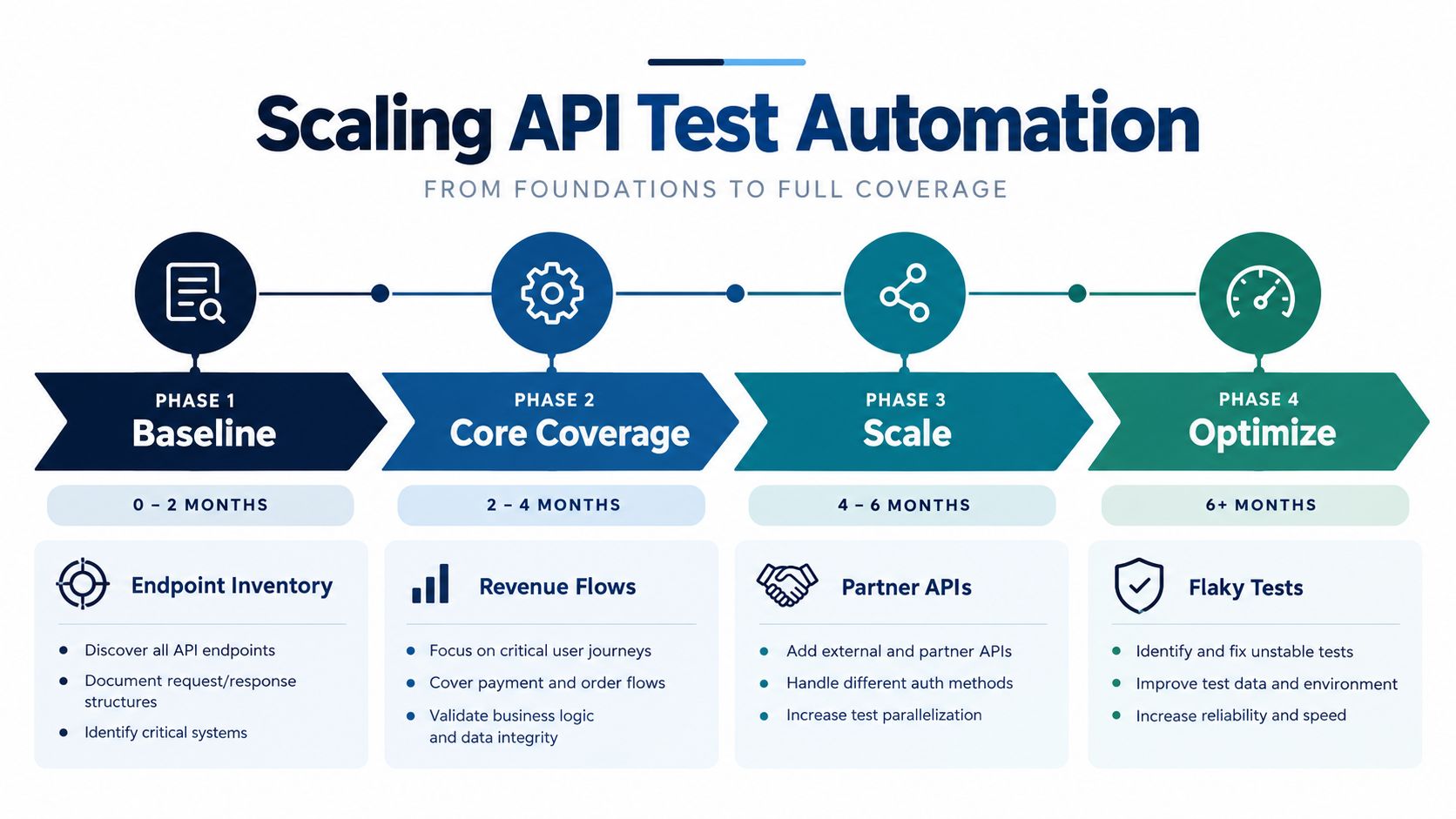
A scalable API automation program grows in stages. The sequence matters because teams that start with broad end-to-end coverage often create a slow, brittle suite before they understand which flows deserve protection.
Establish the baseline
Begin with an endpoint inventory, service ownership map, consumer list, and business-critical flow catalogue. Tag endpoints by impact, dependency fan-out, data sensitivity, and change frequency. Automate smoke coverage for the most important revenue and access paths, then verify that failures reach the right owners.
This first stage should produce visibility, not an impressive test count. The deliverable is a risk map that engineering, product, and QA can use in release discussions.
Build the foundations
Introduce contract tests between producers and their most important consumers. Define the response fields and behaviors that consumers rely on, then run those checks as part of change validation.
At the same time, create deterministic data factories, establish a stable integration environment, and separate fast pull request checks from deeper regression. The team should be able to reproduce a failure without guessing which shared record or dependency caused it.
Expand where risk justifies it
Add security tests for authentication, authorization, identity propagation, tenant isolation, and sensitive data handling. Add performance scenarios for APIs whose latency or capacity affects a critical flow. Use virtualization for unstable partner dependencies and make teams responsible for maintaining their own contracts.
Prune tests that duplicate stronger checks. Automation scale isn't measured by how many scripts remain in the repository. It's measured by how much meaningful risk the system detects with acceptable maintenance effort.
Connect test priorities to production
A mature program feeds runtime evidence back into planning. Synthetic monitoring can exercise critical flows continuously, while real-user telemetry can reveal which endpoints fail under conditions staging never reproduces. Watch for expired certificates, credential rotation errors, third-party outages, DNS failures, shadow APIs, and deprecated consumers.
The production feedback loop is essential because pre-release suites test controlled conditions. They don't prove that every live dependency, identity path, or client implementation will behave correctly in the wild.
AskYourQA designs and implements test automation systems across backend APIs, frontend journeys, mobile products, security, performance, and CI/CD workflows. If your team needs to map critical API flows, introduce contract and functional coverage, or connect automated checks to release readiness, visit AskYourQA to discuss a practical automation plan.