
Your pull request is ready, but the integration job is red again. Someone reruns it, someone else asks whether staging is broken, and the release owner has to decide whether a green retry means the change is safe. Meanwhile, developers keep pushing changes into the queue.
CI/CD integration testing should produce a delivery decision, not just a test report. That requires more than connecting a growing suite to a CI runner. Each test layer needs a useful trigger, a clear blocking rule, and someone responsible when its feedback becomes unreliable.
Table of Contents
- Where Each Test Type Runs in Your Pipeline
- Choosing Test Environments and Data Safely
- How to Wire Tests Into Your Pipeline, Step by Step
- Gate Rules That Decide What Blocks a Release
- Keeping Flaky Tests From Blocking Good Releases
- Confirm Your First Pipeline Gate This Sprint
Where Each Test Type Runs in Your Pipeline
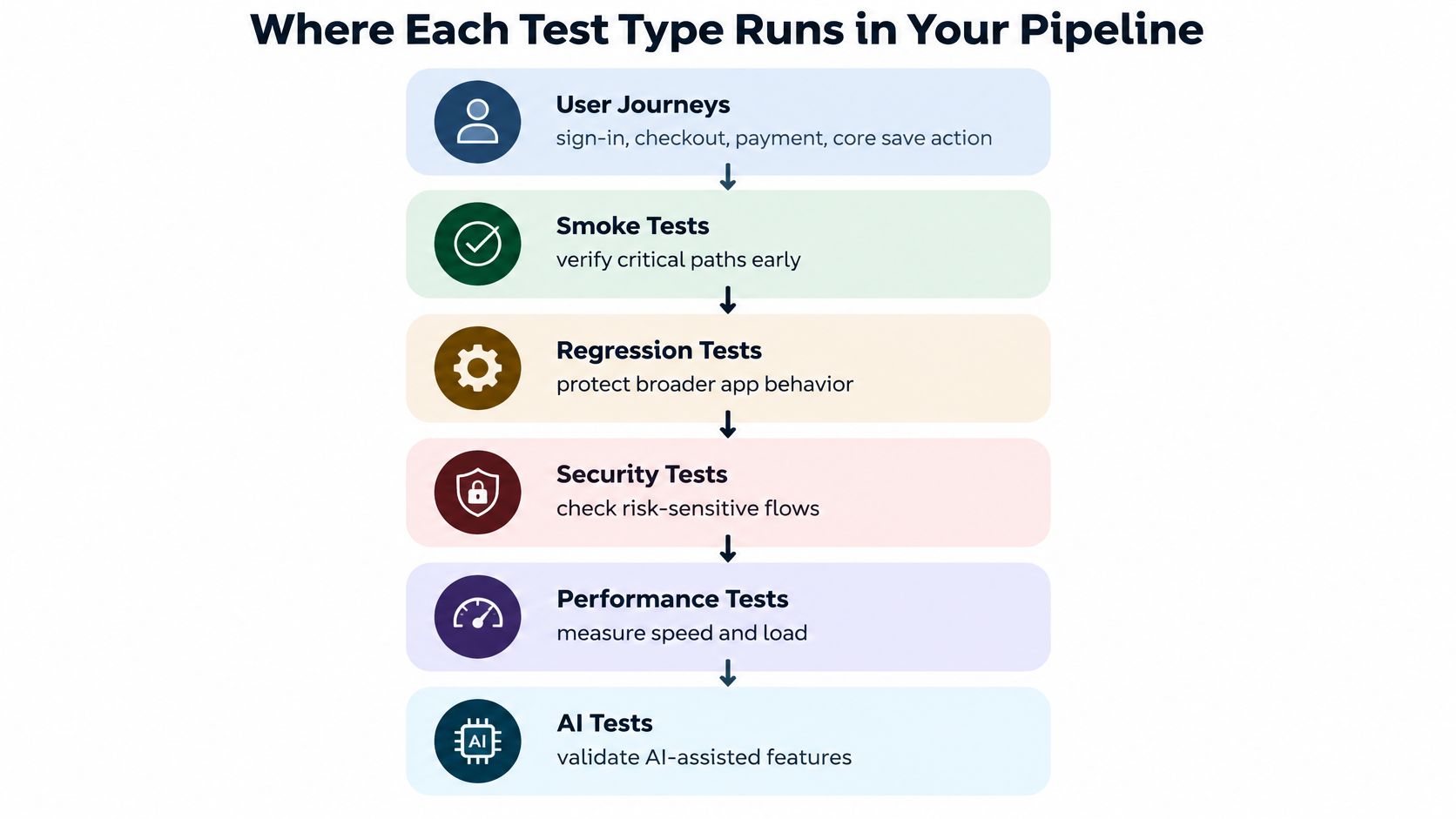
Start with a map of business-critical user journeys, not the tests that are easiest to automate. For a commerce product, that could mean sign-in, checkout, payment confirmation, and order retrieval. For a document tool, the core save action matters more than whether every settings panel opens.
At AskYourQA, our first step is mapping the journeys the client's business depends on. For each journey, identify the services, database writes, asynchronous messages, and external providers involved. Those boundaries tell you where integration checks belong.
Match the check to the decision
Unit tests verify local logic. Contract checks verify expectations at service boundaries. API integration tests exercise real interactions, such as an endpoint writing an order and publishing an event. Browser smoke tests confirm that users can complete the critical journey through the deployed application.
DORA's continuous integration guidance recommends checking whether commits automatically trigger tests, whether builds and tests succeed daily, and whether acceptance and performance feedback reaches developers within one day. Treat that as a feedback requirement, not permission to make developers wait for a nightly result.
The following table is an illustrative starting configuration, not a measured industry benchmark. Its numerical budgets are hypothetical planning targets to replace with your own measured build times.
Test types by pipeline trigger and time budget
| Test type | Runs on | Typical scope | Target time |
|---|---|---|---|
| Unit and contract checks | Every commit | Single module, mocked boundaries, contract expectations | Example budget of under 5 minutes |
| API integration tests | Pull request | Service and database interactions | Example budget of 5–15 minutes |
| Smoke suite | Pull request and merge | Example selection of five to ten critical user flows | Example budget of under 10 minutes |
| Regression suite | Merge to main and nightly | Full functional coverage in parallel shards | Example budget of 20–40 minutes |
| Security scans | Pull request for SAST and dependencies, nightly for DAST | Code, dependencies, running app | Example SAST budget of under 5 minutes |
| Performance tests | Release candidate and nightly | Load and stress on key endpoints | Set from your agreed baseline run |
| AI output validation | Prompt, model configuration, or agent tool change, plus nightly | Fixed evaluation set with safety checks | Set from evaluation set size and runtime |
A useful pipeline map connects those checks to the journeys they protect.
Keep expensive evidence off the fastest path
Don't put every integration scenario behind a browser. Test authorization, database persistence, and message handling through APIs where possible. An API testing strategy helps separate service-level evidence from the smaller set of interactions that need a UI.
Use nightly execution for broader combinations, destructive scenarios, and longer load profiles. AI evaluations need their own selection rules because prompt changes and tool permissions can alter behavior without a conventional application-code change.
Placement rule: Move expensive breadth to a later trigger, but keep critical-path evidence where developers can still act on it.
Before expanding coverage, use the PushOps resource to plan a sustainable testing approach around maintenance as well as execution. Then inspect a pull request: can its author identify each failing layer, the affected journey, and the responsible team without opening the pipeline configuration?
Choosing Test Environments and Data Safely
An ephemeral preview environment per pull request gives a change its own application instance and data. It proves that the branch works with its deployed dependencies without another team changing the same records. It doesn't prove production equivalence, and provisioning can take longer than the tests themselves.
Keep previews small: the application, its database, and the services required by the selected checks. Use the same deployment definitions as production where practical, with explicit overrides for capacity and external integrations. Otherwise, you're validating a separate configuration that nobody intends to ship.
Compare what each environment proves
Apply the same questions to every option: What does it prove? What does it hide? What does it cost to maintain?
Test environments compared by use, risk and cost
| Environment | Best for | Main risk | Cost profile |
|---|---|---|---|
| Ephemeral preview environment per pull request | Isolated API and UI integration tests | Slow provisioning and differences from production | Compute per pull request |
| Shared staging | Regression and end-to-end journeys | Data collisions between teams | Fixed monthly environment cost, with usage overhead |
| Mocks or service virtualization | Third-party APIs and payment providers | Hidden real-world contract changes | Low runtime cost, ongoing maintenance |
| Masked production-like data snapshot | Performance and data-heavy checks | Sensitive data exposure if masking fails | Storage and masking effort |
| Live production monitoring | Post-release checks and change failure tracking | Defects reach users first | Ongoing monitoring and response |
Shared staging is useful for cross-service journeys, but isolation still matters. Give each run a tenant or namespace, generate unique accounts, and delete only the records that run created. A cleanup script that clears the whole database can invalidate another pipeline's results.
Mocks offer control over payment failures, rate limits, and unavailable providers. They don't establish that the provider still accepts your request. Schedule contract checks against the actual sandbox, and keep sandbox credentials separate from production credentials.
Protect data and configuration
Prefer synthetic fixtures for routine functional checks. Use masked production-like snapshots when data shape, cardinality, or distribution materially affects the behavior under test. Mask before copying data into a less trusted environment, restrict access, and log who retrieves it.
Keep deployment configuration in version control, but keep secret values in a secrets manager. Compare deployed service versions, feature flags, schema revisions, and secret references against the intended configuration. Don't print credentials into drift reports.
A mock-backed pass and a staging failure are conflicting evidence. Inspect the mock's assumptions first, rather than dismissing staging as unreliable.
That inspection may uncover a stale response schema, missing authentication behavior, or an error the mock never returns. Fix the representation before using it to approve another change.
How to Wire Tests Into Your Pipeline, Step by Step
Build the pipeline so developers can reproduce its behavior locally. A job that depends on undocumented runner settings or manually prepared staging records will be difficult to diagnose when it fails.
Use GitHub Actions, GitLab CI, or Jenkins for orchestration, and keep test commands in the repository. The CI configuration should select and run checks, not contain application-specific fixture logic.
Connect selection, setup, and execution
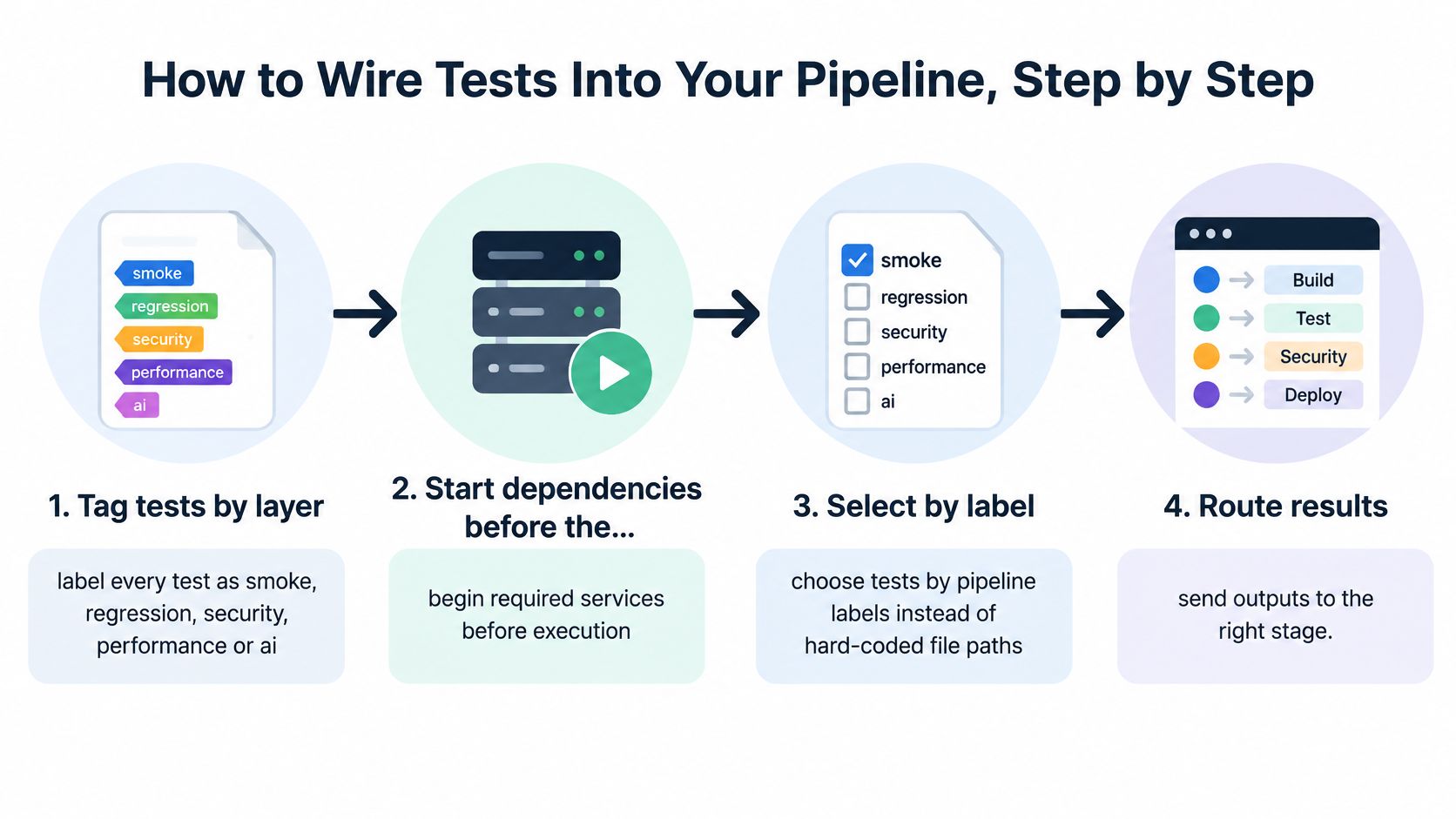
The wiring starts with labels and dependency setup, then ends with results routed to the right decision.
-
Tag tests by layer and purpose. Use labels such as
smoke,regression,security,performance, andai, alongside service ownership metadata. Select through those labels rather than hard-coded file paths, so reorganizing the repository doesn't remove coverage. -
Start dependencies before running checks. Use Docker Compose, Testcontainers, or CI service containers for the database, queue, and virtualized providers. Wait for readiness probes that verify usable connections and completed migrations, not merely running processes.
-
Attach smoke execution to pull requests. Deploy the branch artifact, seed isolated fixtures, and run the selected critical journeys against that build. Configure an explicit job timeout and capture diagnostics on failure, including browser traces, service logs, and correlation identifiers.
-
Add regression after merge. Reuse the same setup entry point and distribute tests across parallel workers. Balance shards using historical duration rather than file count, because a shard full of slow browser scenarios can determine the whole job's finish time.
-
Connect security checks to the right build. Run static application security testing and dependency scanning during change validation, then run dynamic application security testing against a deployed staging artifact. Record the artifact identifier so a finding can be traced to the code scanned.
-
Run performance against a fixed profile. Define endpoints, data volume, concurrency, warm-up behavior, and runner capacity before comparing results. Store the profile alongside the result, because a faster response under lighter load isn't evidence of an improvement.
-
Trigger AI evaluations through change filters. Include prompt files, model configuration, retrieval settings, and agent tool definitions in the filter. Store evaluation cases, scoring rules, and configuration versions together so reviewers can understand why a score changed.
-
Publish a status for each stage. Report pass, fail, or warn with a short summary and links to detailed artifacts. A skipped required check must remain visibly skipped, not appear as a successful validation.
Make the workflow observable
A practical pull-request workflow checks out the repository, restores dependencies from a lockfile-aware cache, and starts the test services. Once readiness succeeds, run the smoke selection while static security and dependency checks execute independently.
Upload JUnit reports, traces, and setup logs even when tests fail. Otherwise, the failure that needs the most evidence is the run least likely to retain it. Add cancellation handling so abandoned branches don't leave preview environments and database volumes running.
For merge execution, reuse the setup and artifact conventions, then add the regression matrix. Keep fixture namespaces unique across workers, and ensure a failed worker prevents the aggregate required check from reporting success.
- Cache safely. Cache downloaded dependencies or build outputs keyed to their inputs, not mutable test databases.
- Separate setup failures. Report a database startup failure as infrastructure trouble rather than failed application assertions.
- Clean up reliably. Run teardown on success, failure, and cancellation, with a scheduled sweep for abandoned resources.
Finally, run the complete workflow on a throwaway branch. Measure provisioning, build, execution, and artifact-upload time separately. If the stage misses its budget, identify the expensive part before moving tests: slow provisioning calls for an environment fix, not less coverage.
Gate Rules That Decide What Blocks a Release
An unresolved smoke failure blocks the release. If the team can't establish that a critical journey works, the release owner doesn't have enough evidence to proceed. A confirmed infrastructure outage is a different diagnosis, but it still leaves required validation incomplete.
Decide that policy before a release deadline. The Continuous Delivery Foundation's 2023 State of Continuous Delivery report found that 49% of developers used either CI or CD, but only 22% used both to automate building, testing, and production deployment. Installing CI tooling isn't the same as making automated evidence part of the release decision.
Make blocking conditions explicit
Use this as a starting policy, then adapt it to your risk model. Critical-path failures block; other findings need an explicit disposition, not automatic dismissal.
Gate rules: when each check blocks and when it only warns
| Check | Block the release when | Warn only when |
|---|---|---|
| Smoke suite | Any required critical-path test fails or remains unvalidated | Never for an unresolved smoke result |
| Regression suite | A deterministic failure affects a critical journey | A confirmed flaky test has an owner, expiry date, and accepted coverage gap |
| API contract tests | A change breaks a consumer contract | An additive change has no consumer impact |
| Performance tests | p95 latency exceeds the agreed endpoint budget under comparable load | Latency worsens but remains within the budget |
| Security scan | A high or critical finding affects changed code or a dependency | A medium finding has a tracked fix date |
| AI output checks | A required safety or policy evaluation fails | Quality falls below baseline without a safety issue |
API compatibility needs particular care. Adding an optional field may be harmless, while changing an enum can break a consumer that rejects unknown values. Let consumer expectations, not the producer's description of the change, determine the outcome.
Performance gates need controlled comparisons. Don't block because a shared runner had a noisy interval, but don't waive a budget breach without investigating either. Security findings likewise need reachability and context assessed through a documented exception process, not an informal message.
Release owners should agree on these conditions together.

Give exceptions an audit trail
An exception should record the affected artifact, risk, approver, mitigation, and expiry. It must not turn a failed result green. For AI features, keep safety requirements separate from subjective quality scoring so an average score can't conceal a prohibited action.
Connect the policy to broader quality assurance best practices, including release ownership and incident review. Evaluate gates using change failure rate and time to restore service, not test pass rate alone.
A gate is useful when its result changes a decision for a defensible reason. A warning nobody owns is just another log message.
Review escaped defects against the gate policy. Ask which missing check or mistaken exception allowed the failure, rather than responding by making every test mandatory.
Keeping Flaky Tests From Blocking Good Releases
A 99% pass rate can look reassuring while developers spend their day investigating false alarms. In Google's account of flaky tests at scale, about 99% of executions passed, yet 84% of pass-to-fail transitions were attributed to flaky tests. The aggregate pass rate didn't describe how trustworthy a red result was.
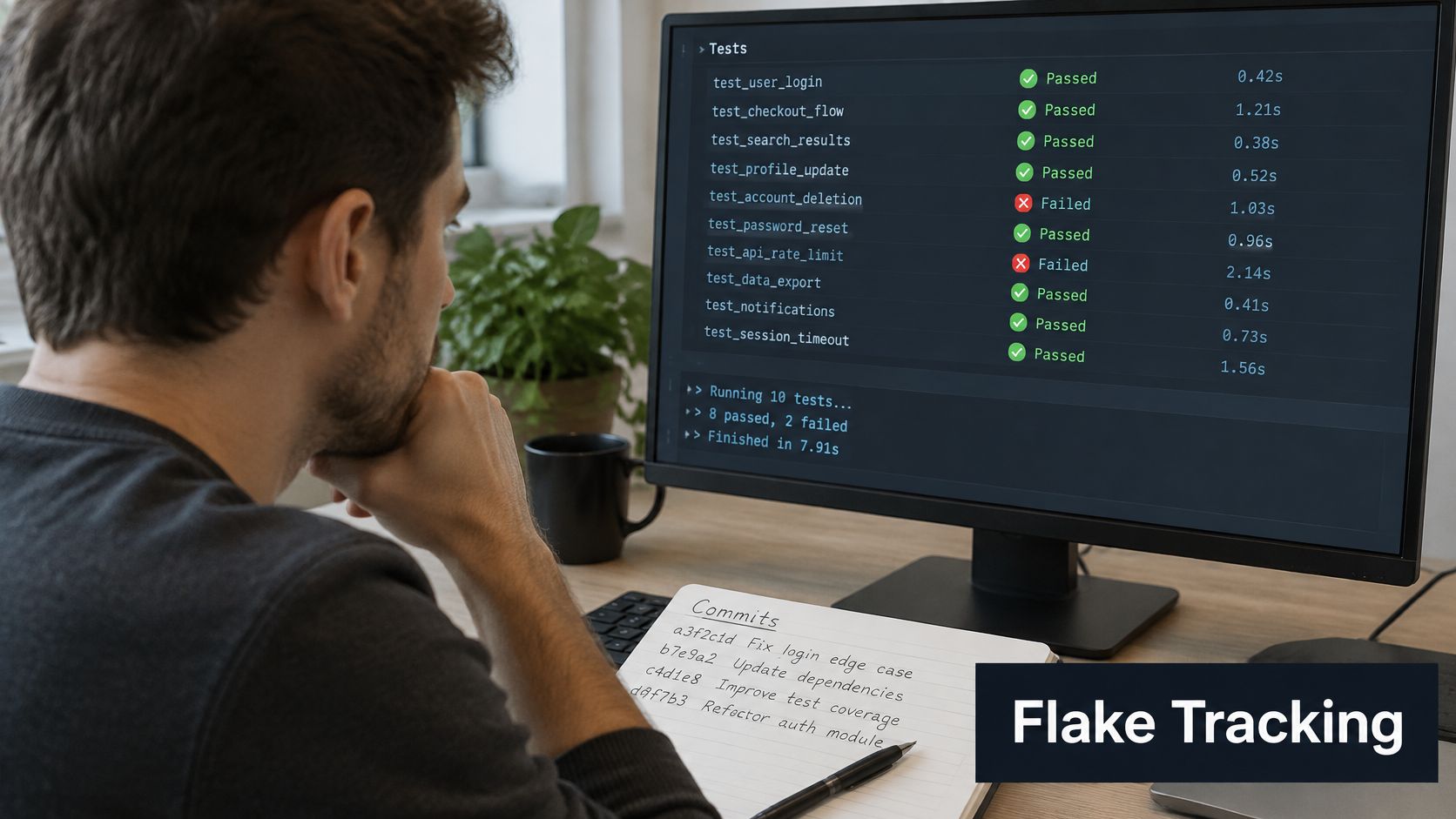
Keep the failure's evidence visible while deciding what broke.
Classify before retrying
Assign failures to product defect, infrastructure failure, or test flake. An intermittent application race is still a product defect, even if a rerun passes. “Couldn't reproduce” isn't enough evidence to blame the test.
Retain history by test identifier, commit, environment, and worker. Calculate a per-test flake rate from outcomes classified as nondeterministic, rather than counting every failed execution as flakiness. Quarantine only when reproduction supports that classification, with an accountable owner, expiry, and visible coverage gap.
Fix root causes in a deliberate order:
- Time and asynchronous waits. Replace fixed sleeps with condition-based waits; control clocks where business rules depend on time.
- Shared state and ordering. Use isolated fixtures and unique data namespaces, and remove assumptions about execution order.
- External instability. Virtualize unavailable dependencies while preserving realistic error behavior and contract validation.
- Nondeterminism and cleanup. Fix random seeds where appropriate, capture generated inputs, and make teardown safe to repeat.
For browser-level implementation work, Clearcote Labs' Playwright automation guide is a useful companion while reviewing how the suite is structured. Apply framework techniques to the actual failure mechanism rather than replacing every timeout with a longer timeout.
Use the video as supplementary viewing while reviewing your failure-triage workflow.
Report the signal developers received
Limit retries to identified transient infrastructure conditions. Publish first-attempt and final outcomes together, so recovery doesn't erase the original failure.
Choose test automation reporting tools that preserve history and ownership, not just screenshots of green builds. Track first-pass pass rate, mean time to diagnose, and escaped defects on a regular review cadence.
Also record the share of red builds that reveal genuine product defects. If that share falls, investigate noisy tests and environment failures before adding more cases. Developers need fewer ambiguous failures, not more opportunities to press rerun.
Confirm Your First Pipeline Gate This Sprint
Keep the first implementation narrow enough that the team can explain it without opening a dashboard. Write down the journeys whose failure would stop customers from receiving the product's core value. For each, name the owner, required dependencies, and observable success condition.
Agree on the decision before expanding
Choose a small smoke selection and attach it to pull requests. Make merge protection require its result, and confirm that cancellation, setup failure, and skipped execution can't accidentally satisfy the check.
- Measure elapsed feedback time. Include queueing and provisioning, not just test execution, because developers experience the whole wait.
- Measure useful failures. Record which red builds exposed product defects and which required test or infrastructure repair.
Use those measurements to decide what to add next. Stabilize the initial gate before expanding regression execution or making more findings release-blocking. Keep existing security controls in place while you improve the rest of the workflow.
If the release owners can't agree on the blocking rule, settle that disagreement before writing more tests. Otherwise, you'll automate execution while leaving the release decision just as uncertain.
Your first action this week is to put the critical journeys and smoke-gate rule on a shared page, then get agreement from engineering, QA, and whoever signs off releases.
AskYourQA offers a free 20-minute call to map your critical flows, review your current testing process, and show how quickly an automation framework can be up and running. Visit AskYourQA to discuss CI/CD integration that builds automated test execution into your delivery pipeline, giving each release fast, reliable feedback.