
Your API suite passes, but the release still feels risky. The checkout endpoint returns a success code, yet nobody has verified that it charged the right amount. A mobile client depends on a response field no one remembers changing, and an authorization bug could expose another customer's order. The problem isn't a lack of tests. It's that the tests aren't organized around the risks that should decide whether you ship.
A practical API testing strategy treats each release as a decision supported by evidence. It names the interfaces and user journeys that matter, assigns owners to the contracts between services, and sets clear rules for which failures block a merge, deployment, or release. It also connects pre-release checks to production signals, so the team can spot risks that automated tests didn't model.
Table of Contents
- The Four API Test Types and What Each One Proves
- How to Rank Endpoints and Flows by Risk
- Test Design Patterns That Catch Real Bugs
- Test Data and Environment Strategy
- Choosing Tools and Frameworks Without Lock-In
- Wiring Tests Into CI/CD Pipelines
- Metrics and Reporting That Show Real Coverage
- Confirm Your Top Endpoints and Start the Rollout
The Four API Test Types and What Each One Proves
A building inspector checks wiring, fire exits, structure, and load capacity because each can fail in a different way. API testing works the same way. Four test types answer four separate questions, and passing one doesn't prove the others are safe.
- Functional testing: Does the endpoint or workflow do what the business expects? A checkout endpoint might return
201 Createdwhile charging the wrong amount. The status code passes; the business behavior doesn't. - Contract testing: Does the response still match what consumers rely on? Renaming a response field can break a mobile app even if the provider continues to work correctly for other clients.
- Security testing: Can someone reach data or perform an action they shouldn't? A user changing an order ID in a request must not reveal another customer's order.
- Performance testing: Does the API stay fast and stable under expected and peak load? If latency climbs from 200 ms to 2 s at 500 requests per second, the endpoint may be functionally correct but still unusable.
These checks need owners, scope, and pass conditions. A functional test might assert the order total and resulting state, not just the response code. A contract test should name the consumer expectation it protects. Security tests need identities and permissions that expose access-control failures. Performance tests need an agreed workload and latency target.
Security belongs throughout the lifecycle, not just in a final pre-release scan. Akamai's 2024 API Security Impact Report recorded 108 billion API attacks between January 2023 and June 2024. The report also found that among respondents in the United States and United Kingdom, real-time testing fell from 18% in 2023 to 13% in 2024, while testing at least once per day declined from 37% to 13%.
That's why the run schedule matters. Put quick checks on pull requests, verify provider compatibility before merging, run deeper security and regression suites on a schedule, and monitor production where risk warrants it. For a closer look at the security layer, see security testing for APIs.
How to Rank Endpoints and Flows by Risk
When an API estate contains thousands of interfaces, testing a handful of visible endpoints won't establish dependable coverage. Akamai's 2026 API Security Study reported that the global median enterprise API inventory exceeded 5,900 APIs, while the top quartile exceeded 29,400. In the same study, 87% of respondents experienced at least one API-related security incident during the preceding 12 months.
Use a repeatable ranking process rather than relying on whoever knows which endpoint seems important.
- Build the inventory. Record each endpoint's owner, environment, authentication model, data sensitivity, dependencies, and business purpose. Include APIs the system consumes as well as those it exposes.
- Find what the specification misses. Compare documented interfaces with live traffic and deployed services. Investigate undocumented, changed, shadow, and retired endpoints instead of assuming the published specification is complete.
- Score the risk. Rate each endpoint from 1 to 3 for exposure, data sensitivity, business impact, and change frequency. Add the scores for a total from 4 to 12.
- Set the tier and test depth. Use the score to decide which checks run, how often they run, and which failures block release.
- Rank the journeys too. Sign-up to first purchase, password reset, and refund flows can fail because of interactions between endpoints. A sequence such as add to cart, apply discount, then pay needs its own risk review.
Here's a workable score mapping. The High tier covers scores 7–9, filling the gap between Standard and Critical.
| Risk tier | Score (4 to 12) | Example endpoints | Test depth | Run frequency |
|---|---|---|---|---|
| Critical | 10–12 | Payment authorization, login, token refresh | Full contract checks, authorization matrix, injection and regression tests | Every merge and nightly |
| High | 7–9 | Order creation, profile update, webhook receivers | Contract checks, positive and negative tests, authorization checks | Every merge |
| Standard | 4–6 | Product search, internal admin reads, health checks | Contract checks and core positive and negative tests | Daily or per release |
A payment authorization endpoint with a score of 12 belongs in Critical. An internal reporting export scoring 4 can receive the Standard test set. Assign a named owner to each tier and require that owner to approve changes to the score or test depth. For teams planning how to stage validation around releases, GoReplay's guide to software test strategy offers a useful reference point. A more detailed approach to ranking scope is available in risk-based software testing.
Test Design Patterns That Catch Real Bugs
An invoice endpoint returns 200 OK for any invoice ID. The bug only becomes clear when a tester signs in as a second user and tries the first user's ID. A scanner can check whether the endpoint responds, but it usually can't know which invoice belongs to which person.
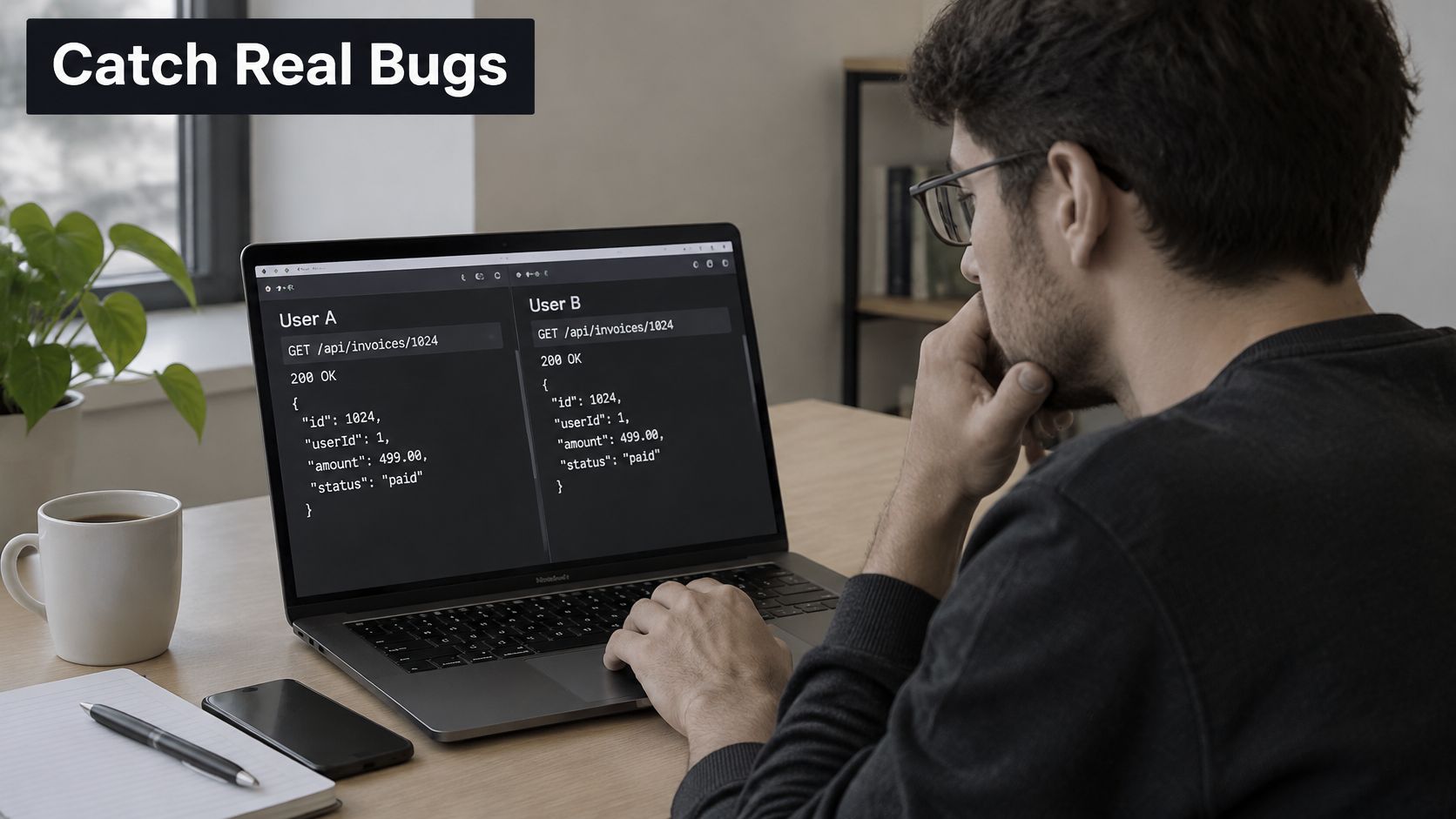
Build test cases around the behavior the API must protect, not just the response shape it usually returns. The OWASP API Security testing guidance recommends explicit authorization testing and calls out broken object-level authorization, broken function-level authorization, and unrestricted resource consumption as distinct risks.
Turn the specification into executable tests
For each endpoint, create valid-request tests and negative tests for missing fields, malformed values, wrong types, empty strings, long inputs, and numeric limits. Assert both the status code and the response properties. Bad input should produce a controlled 4xx response, not a 5xx error, stack trace, or exposed data.
Use two identities for authorization
Have User A create a resource. Then use User B's credentials to try reading, updating, and deleting it with A's resource ID. Expect a 403 or 404, and verify that B neither sees nor changes the resource. Extend the matrix across roles, tenants, HTTP methods, nested resources, and attempts to update individual properties. See these API testing examples for practical ways to turn common scenarios into checks.
Test contracts, state changes, and abuse
Each consumer should declare the request and response behavior it relies on, and the provider should verify those expectations in CI. Contracts catch interface drift, but they don't replace workflow tests. Chain operations such as create, pay, cancel, and refund, then assert the correct state after each step.
A short video can help the team align on API test design before building out the suite.
Add explicit abuse cases: exceeded rate limits should return 429, oversized payloads should be rejected, and retrying a payment should not charge twice. These tests catch behavior that ordinary positive requests won't reveal.
Test Data and Environment Strategy
Treat environments like a flight simulator and a real aircraft. Practise risky manoeuvres where mistakes cost nothing, then use realistic conditions for the checks that need them.
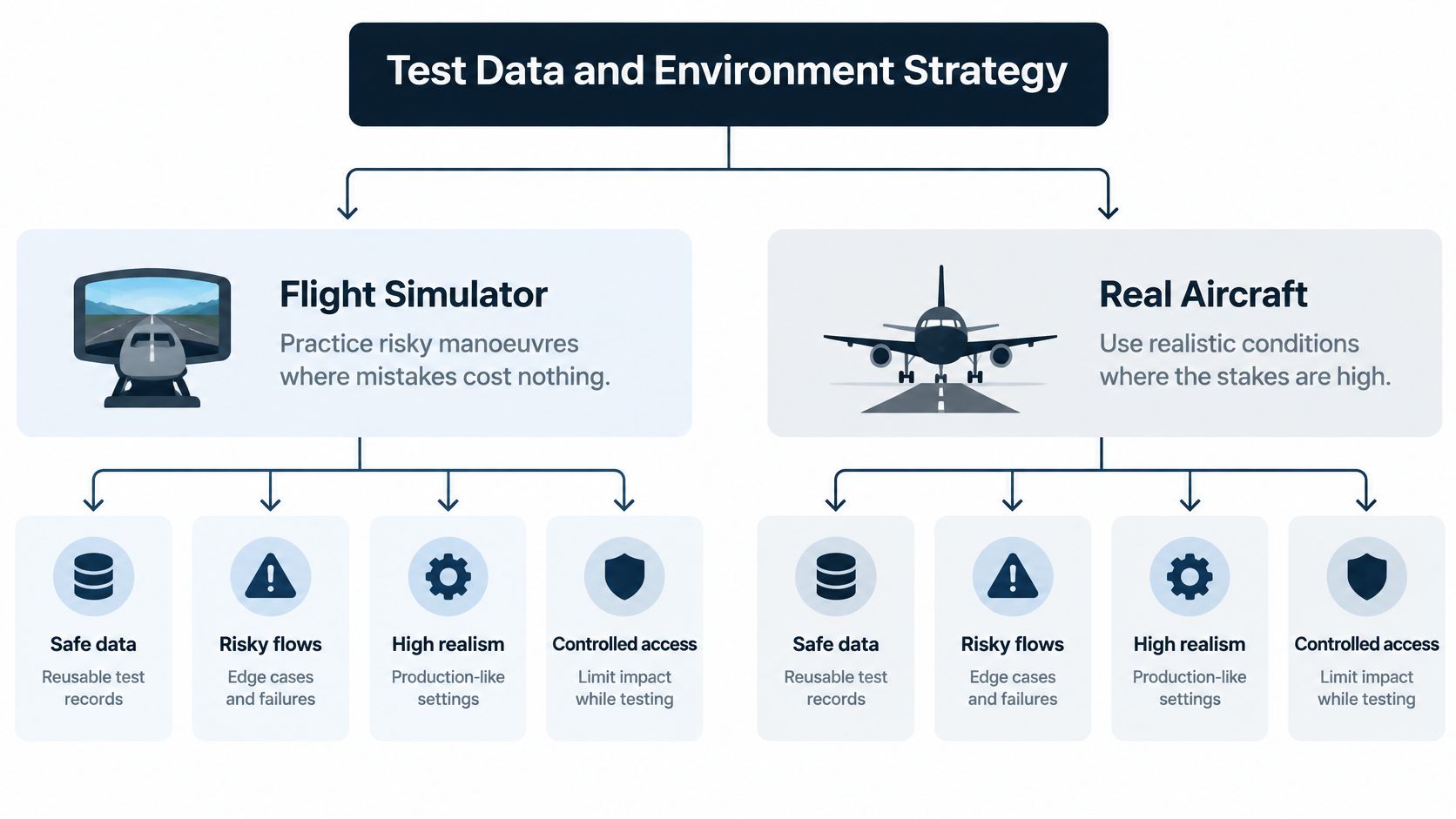
| Environment | Best use | Data and access rules |
|---|---|---|
| Pull-request environment | Fast functional and contract checks in containers, with mocked services | Use generated records; isolate each run |
| Shared staging | Integration tests, authorization matrices, and multi-step flows | Match production configuration; reset state between runs |
| Performance environment | Load, stress, and soak testing | Use production-like capacity, never customer data |
| Production monitoring | Read-only health, latency, and authentication signals | Avoid write tests against live customer data |
Generate synthetic accounts with realistic shapes, including long text, Unicode names, and multiple currencies. Keep at least two isolated identities for each role and tenant so authorization tests can compare access without sharing credentials. Reset state between test runs, and mask any production data that has to be copied into a non-production environment.
Stub third-party services such as payment and email providers with recorded responses for most automated runs. Provider sandboxes can add a small set of realistic integration checks, but they shouldn't be a dependency for every commit. Their limits and availability make them a poor foundation for a fast, reliable merge gate.
For performance work, build the workload from observed traffic shares and compare each run with the same baseline build. Ramp to 1.5 times expected peak, hold steady for at least an hour, and run a soak test for four hours or longer when memory growth is a concern. Those are practical starting conditions, not universal thresholds. Adjust them to the service's risk and agreed performance targets.
Choosing Tools and Frameworks Without Lock-In
Choose tools by the checks your strategy needs and the skills your team already has. No single tool category covers functional behavior, consumer compatibility, authorization, schema quality, and load.
| Tool category | Best for | Watch out for | Choose it when |
|---|---|---|---|
| API client and collection tools | Exploration and simple functional checks | Collections that drift away from code and CI | The team needs quick coverage and shared collections |
| Code-level test frameworks | Complex flows, data setup, authorization matrices | Maintenance cost if tests are poorly structured | The team already writes application tests in one language |
| Contract testing tools | Consumer and provider compatibility | Needs clear ownership and versioning discipline | Several services deploy independently |
| Specification validators | Schema and lint checks on OpenAPI or GraphQL | Schema alone misses behavior | Specifications exist and are kept current |
| Security scanners | Static code checks and dynamic API tests | False positives that need triage | Public or partner APIs handle sensitive data |
| Load testing tools | Percentile latency and throughput under load | Unrealistic traffic models give false comfort | Critical endpoints have latency targets |
Judge each option by CI integration, report quality, fit with the team's language, licensing, cost at your expected volume, and whether you can export your tests. Tools should make results portable, not trap test logic in a format the team can't review or maintain.
Contract testing deserves particular attention. Postman's 2025 State of the API reported functional and integration testing at 67% adoption each, while contract testing reached 17%. Start with a revenue-critical or fast-changing integration, assign contract ownership, and expand only when the tests produce reliable results. An OpenAPI validator can confirm that a response matches a schema, but it won't by itself prove authorization, error meaning, pagination, idempotency, or rate-limit behavior.
Wiring Tests Into CI/CD Pipelines
Contract checks belong at the merge gate because that's where a provider can catch an incompatible change before it reaches deployment. Each consumer publishes executable expectations for the request shape, headers, status codes, response schema, and important field semantics. The provider verifies those contracts independently in CI.
A 2025 systematic literature review and action-research study from Friedrich-Alexander-Universität found that consumer-driven contract testing can ensure syntactic interoperability, complement broader testing strategies, and support higher-quality API and code design. Contracts don't prove business correctness, though. Component, integration, and end-to-end tests still need to verify persistence, authorization, and workflows.
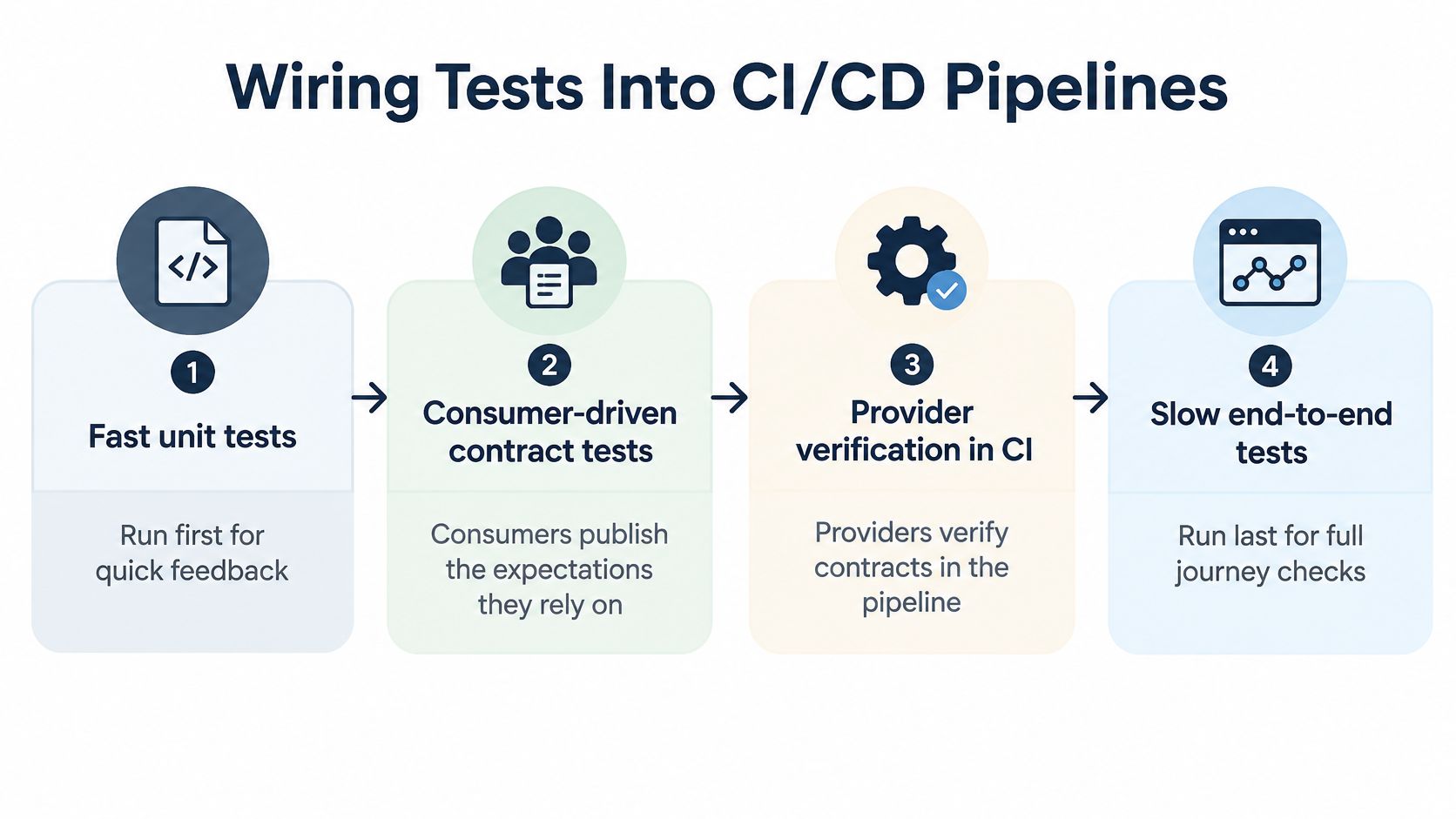
Consider a provider that renames customerId to customer_id. If a consumer contract depends on the old field, provider verification should fail on the pull request and block the merge. That's a useful gate: it catches the break while the author still has the change context.
| Stage | Trigger | Tests run | Gate behavior |
|---|---|---|---|
| Pull request | Every commit to a branch | Unit tests, schema lint, contract checks for changed providers, smoke tests | Blocks merge on any failure |
| Main branch merge | Merge to main | Functional suite for Critical and High tiers, authorization matrix | Blocks deploy to staging |
| Nightly | Scheduled run | Full regression, static and dynamic security scans, abuse cases | Opens tickets; blocks only on critical findings |
| Pre-release | Release candidate | Load tests on changed critical endpoints, contract evidence review | Blocks release if p95 exceeds the agreed threshold |
| Post-deploy | Each production deploy | Synthetic journey checks, read-only health checks | Alerts; rolls back on critical journey failure |
Keep the policy explicit. The provider team owns each contract it exposes; each consumer team owns its published expectations. Version contracts per consumer and test representative cases for optional fields, nullability, enum changes, pagination, error payloads, and additive changes. A removed field, changed type, or narrowed enum blocks the merge. An additive optional field can warn and be logged for review.
Record any consumer-approved break in writing with an expiry date. Quarantine flaky tests rather than weakening the gate, and track them until the team fixes them. Otherwise, unreliable failures train people to ignore the pipeline.
Metrics and Reporting That Show Real Coverage
A thousand passing tests can still miss checkout. Count alone tells you how much ran, not whether the release is protected. In a 2025 survey cited in the Thales Data Threat Report, 34% of businesses used more than 500 APIs. That scale makes it important to measure risk coverage and watch production for behavior tests couldn't model.
Track the measures that help someone decide whether to ship:
- Risk-weighted endpoint coverage: Share of Critical and High endpoints with the full test set. Set a target that closes identified gaps in those tiers before release.
- Contract breaks caught before merge: Track incompatible changes stopped before deployment. The aim is an upward trend in early catches, with no known break reaching production.
- Escaped defects by tier: Group production bugs by risk tier. Aim for zero Critical escapes per release.
- Flaky test rate: Measure runs that fail without a real product defect. Use below 2% as a starting target for gate trust.
- p95 latency for critical endpoints: Compare each endpoint with its agreed target. Block release when a regression exceeds the team's chosen threshold, such as 20%.
- Production authentication failures and schema violations: Establish a baseline, then alert on a sustained spike rather than a single anomalous request.
Release rule: An alert needs an owner and a response threshold. Don't block every change in traffic, because legitimate client behavior can shift and noisy alerts make important signals easier to miss.
| Metric | What it tells you | Starting target |
|---|---|---|
| Risk-weighted endpoint coverage | Share of Critical and High endpoints with the full test set | Close identified gaps in Critical and High tiers before release |
| Contract breaks caught before merge | Interface drift stopped before deploy | Trend upward; no breaks reach production |
| Escaped defects by tier | Bugs that reached production | Zero Critical escapes per release |
| Flaky test rate | How much the team can trust gate results | Below 2% of runs |
| p95 latency, critical endpoints | Performance against the agreed target | Within each endpoint's agreed target; block on regression above 20% |
| Production auth failures and schema violations | Live drift and abuse signals | Baseline set first; alert on a sustained spike |
Keep a one-page release report with coverage by tier, open Critical risks, key production signals, and a decision: ship, ship with conditions, or hold. For a useful way to structure the evidence, find testing report examples. The report should make gaps visible, not hide them behind a large test count.
Confirm Your Top Endpoints and Start the Rollout
This week, confirm your top ten endpoints and name an owner for each. That small decision gives the team a real starting point and prevents a test plan from becoming a list of unowned work.
For a team of four to six engineers, the following phases provide a practical rollout. Treat the timing as a working plan, and don't start the next phase until the current checkpoint passes.
| Phase | Typical timing | Main work | Checkpoint to pass |
|---|---|---|---|
| 1. Inventory and tiering | Weeks 1–2 | List endpoints, score risk, name owners | Every Critical endpoint has an owner and a tier |
| 2. Critical coverage | Weeks 3–6 | Authorization matrix and contract tests for the Critical tier | Critical endpoints pass two-identity tests |
| 3. Pipeline gates | Weeks 7–10 | Stage gates, environments, and High-tier coverage | Gates block a trial merge with a real contract break |
| 4. Measurement | Weeks 11–14 | Performance baselines, nightly security scans, and release report | Engineering and product review the first release report |
| 5. Ongoing review | Each quarter | Expand tiers, tune thresholds, retire flaky tests | Metric trends are reviewed against targets |
If a phase slips, finish its checkpoint before building on top of it. Pipeline gates around unowned endpoints create the appearance of assurance without a clear person accountable for the result.
AskYourQA helps teams design and implement test automation across APIs, critical user journeys, security, performance, and CI/CD. If you want support turning your endpoint priorities into a release-ready testing system, visit AskYourQA to discuss the work.