
A release is scheduled for late evening. The API change is small, the unit tests are green, and the deployment passes its standard checks. A few hours later, an engineer discovers that an authenticated user can modify another user's account by changing the identifier in a PATCH /users/{id} request. The endpoint checks whether the caller has a valid token, but not whether that caller owns the object.
That incident usually doesn't come from a missing scanner signature. It comes from a gap between what the API is supposed to do and what it permits at runtime. Effective security testing for API systems must therefore examine authenticated abuse, business workflows, authorization boundaries, input handling, and deployment drift, not just whether a request returns a valid response.
Table of Contents
- Why API Security Testing Matters More Than Ever
- Map the Attack Surface Before You Test a Single Endpoint
- Test Authentication and Authorization the Right Way
- Fuzz Inputs, Probe Rate Limits, and Simulate Abuse
- Choosing Between Automated Scans and Manual Pentests
- Wiring Security Testing Into Your CI/CD Pipeline
- Your 90-Day API Security Testing Roadmap
Why API Security Testing Matters More Than Ever
APIs expose application logic directly. A browser may hide a forbidden button, but an API client can still send the underlying request. Internal services also call one another through APIs, often outside the traffic patterns a traditional web scanner or perimeter control can observe.
The risk has become operational rather than theoretical. Akamai's 2026 API security report records an average of 258 API attacks per day against enterprises in 2025, compared with 121 in 2024, a 113% year-over-year increase. The same report says 61.18% of API attacks in 2025 involved unauthorized workflows or abnormal activity, up from 30.01% in 2024, and 87% of survey respondents experienced an API-related security incident in 2025.
Those figures change the testing question. It isn't enough to ask whether /orders/{id} rejects malformed JSON. You also need to ask whether a legitimate user can read another customer's order, repeat a completed payment workflow, alter a protected field, or use a low-privilege token against an administrative route.
Practical rule: Test the behavior an authenticated attacker can reach, not only the behavior an anonymous scanner can discover.
API security testing has moved from functional validation toward adversarial validation. Salt Security's 2024 State of API Security report found that only 7.5% of organizations were implementing dedicated API testing and threat modeling, while about 80% of attack attempts used one or more OWASP API Top 10 methods. The report also found that about 58% of respondents focused on the OWASP list.
A strong program combines threat modeling, endpoint discovery, authentication and authorization tests, schema-aware fuzzing, abuse simulations, and continuous retesting. It catches a broken permission before release, while the cost of finding that same flaw through a customer report includes investigation, containment, remediation, and trust repair.
Map the Attack Surface Before You Test a Single Endpoint
A scanner cannot test an endpoint it has never discovered. API inventory is therefore part of security testing, not an administrative task. The goal is to map runtime behavior, including authenticated routes, undocumented workflows, and interfaces that no longer match the approved design.
Collect endpoint definitions from OpenAPI or Swagger files, gateway configuration, service repositories, mobile and web client traces, and representative production traffic. Compare these sources instead of trusting one. Specifications describe intended behavior. Traffic shows what clients invoke. Code and gateway data can reveal routes that documentation and front-end crawling miss.
Build an inventory that reflects reality
Use a repeatable discovery sequence:
- Enumerate passively. Capture routes, methods, parameters, authentication schemes, response codes, and content types from logs and client traffic.
- Fingerprint endpoints. Identify REST, GraphQL, gRPC, webhook, administrative, and service-to-service interfaces.
- Reconcile against the contract. Compare discovered routes with the OpenAPI or Swagger specification.
- Diff the inventory over time. Flag new endpoints, changed methods, altered authentication requirements, and routes missing from approved documentation.
- Classify business impact. Mark endpoints handling personal information, financial operations, account changes, privileged administration, or public data.
The practical workflow in this API security testing sequence combines passive discovery, endpoint fingerprinting, inventory baselining, authentication probing, object-level authorization checks, and retesting. It also recognizes that specifications do not capture every live route. Shadow endpoints and deprecated versions can remain reachable after teams believe they have been removed.
A forgotten /internal/admin route may still accept requests from a network segment whose access has widened. A supposedly retired /v1/orders endpoint may still validate tokens and return sensitive records. These mismatches deserve priority because they expose a gap between the documented security model and the behavior an attacker can reach.
Use the OWASP list as a test map
The OWASP API Security Top 10 provides useful categories, but it cannot replace application-specific threat modeling. Map each risk to the endpoint patterns, identities, and business workflows in your product. An inventory should tell you where to test. Runtime abuse paths should determine how thoroughly you test.
| OWASP API Risk | Example Endpoint Pattern | First Test to Run |
|---|---|---|
| Broken Object Level Authorization | GET /orders/{id} | Replay the request with another user's object identifier |
| Broken Authentication | POST /auth/token | Test missing, expired, tampered, and replayed credentials |
| Broken Function Level Authorization | POST /admin/users | Call the route with a low-privilege account |
| Unrestricted Resource Consumption | GET /reports/export | Test pagination, export size, and burst behavior |
| Broken Object Property Level Authorization | PATCH /users/{id} | Attempt to modify protected fields such as role or status |
| Unrestricted Access to Sensitive Business Flows | POST /password-reset | Repeat or reorder requests across multiple sessions |
| Server-Side Request Forgery | POST /integrations/import | Submit controlled external references and inspect outbound behavior |
| Security Misconfiguration | GET /debug/config | Check exposed diagnostics, verbose errors, and unsafe defaults |
| Improper Inventory Management | /v1/*, /v2/*, undocumented routes | Compare live traffic with approved versions |
| Unsafe Consumption of APIs | POST /partner/sync | Validate third-party responses, redirects, and untrusted fields |
Do not apply identical scan depth to every route. A public health-check endpoint and a payment authorization workflow may both appear in the inventory, but they carry different abuse paths. Fast automated discovery can cover breadth in CI/CD. Authenticated, multi-user tests and manual workflow checks are slower, yet they are the checks most likely to expose authorization failures and business-logic defects before production.
Test Authentication and Authorization the Right Way
Authentication answers, “Who are you?” Authorization answers, “What are you allowed to do here?” Treating them as one control produces incomplete tests and false confidence.
Begin with credential failure behavior. Send requests with no token, an invalid token, an expired token, and a token whose signature or claims have been altered. Test replay with a previously accepted token where the application should require freshness. For JWT-based systems, inspect how the API handles missing or incorrect issuer, audience, scope, and subject claims. A valid signature doesn't prove that the token belongs in the current context.
The response code matters. A request with missing or invalid authentication should fail with 401. A request from an authenticated user who lacks permission should fail with 403. Returning 200 with partial data, or returning 404 to conceal authorization failures inconsistently, can make monitoring and client behavior harder to reason about. The expected response should be defined per endpoint and tested as part of the contract.
Make BOLA and BFLA tests multi-user
Broken object-level authorization, often called BOLA, appears when the server trusts an object identifier supplied by the client. Create two controlled users, obtain valid sessions for both, and replay the same request while crossing their object identifiers.
For example:
- User A creates an order and records the resulting identifier.
- User B requests
GET /orders/{user A order id}. - User B attempts
PUT,PATCH, andDELETEagainst that same object. - The test verifies both the response code and the absence of leaked data.
- User A confirms that permitted operations still work.
The same method applies to invoices, documents, support tickets, team memberships, and files. Don't test only one HTTP verb. Authorization middleware may protect GET while leaving PATCH or DELETE exposed, or it may apply a different policy to nested routes.
Broken function-level authorization, or BFLA, requires a role comparison. Call administrative operations using a standard user, a tenant administrator, and a service account. Attempt method substitution against the same route, change path casing where routing permits it, and test alternate content types if the application supports them.
Negative tests carry more security value here than happy-path tests. A successful request proves the feature works. A correctly denied request proves the boundary exists.
Keep the two sessions separate in your test harness. Never infer authorization from a UI role or from a token's visible claims alone. The server must enforce ownership, tenant membership, action permission, and object state on every relevant request.
Fuzz Inputs, Probe Rate Limits, and Simulate Abuse
Input validation and abuse resistance appear during execution. Static analysis can flag suspicious code, and an API schema can define acceptable fields, but only a running service shows how unexpected values behave inside an authenticated workflow. Test runtime behavior first, then use the results to refine the checklist.
Use schema-aware fuzzing instead of sending random noise to every route. Schemathesis and RESTler can generate requests from an API contract, while ffuf can explore parameter and route behavior. Seed payloads with real OpenAPI examples, application-specific identifiers, and serializer edge cases. Exercise JSON bodies, query parameters, path values, headers, multipart fields, and webhook inputs.
Authenticated injection testing matters because sensitive routes are often unavailable to anonymous scanners. In an approved test account, probe parameters for SQL, NoSQL, template, command, and header injection. Check the direct response and the side effects. Unexpected records, changed filters, delayed processing, and overly detailed errors can reveal a production issue even when the endpoint returns a normal status code.
Move beyond signature matching
Business-logic abuse often looks valid at the HTTP layer. A scanner may accept a normal POST /export request, while a tester asks whether the caller can export another tenant's records or request an unbounded dataset. These cases require state, identity, and sequence context that signature matching does not provide.
Useful scenarios include:
- Reusing an idempotency key after a successful payment or account action.
- Replaying a webhook after the receiver has processed it.
- Changing a quantity, discount, status, or ownership field that the client should not control.
- Calling a bulk operation repeatedly with different filters.
- Reordering workflow steps, such as confirming before verifying.
- Using a valid low-privilege token against a route intended for a higher role.
For rate-limit testing, establish a normal baseline per token, IP address, and tenant. Run controlled bursts at 5 to 10 times the normal request level and record how the service responds under pressure. Verify whether it returns 429, includes a useful Retry-After value, resets the counter at the expected boundary, and keeps one tenant's limit from affecting another. Test authentication routes early because they often need stronger throttling and lockout controls.
Run denial-of-service simulations only in an isolated environment with agreed limits. Capture recovery behavior, queue growth, dependency impact, and error handling. A crash is one signal, not the complete result. For wider context on load and response behavior, see this guide to performance testing in software.
Fast checks can run in pull requests, while authenticated abuse sequences and heavier bursts belong in scheduled pipeline jobs or a controlled staging environment. Preserve request sequences and failure evidence so a fix can be reproduced rather than reduced to a scanner finding.
| Attack Category | Sample Payload | Expected Signal |
|---|---|---|
| Object access abuse | Replace /orders/123 with another controlled user's identifier | 403, no sensitive response body, and no state change |
| Injection | Use quoted, nested, oversized, and type-conflicting values in a filter | Safe validation error, no stack trace, no unexpected query behavior |
| Token replay | Resubmit a previously accepted token or workflow request | Rejection where freshness is required, with a stable failure response |
| Bulk abuse | Increase page size, export scope, or batch count | Enforced bounds, predictable errors, and protected resource usage |
| Rate-limit evasion | Rotate request attributes while retaining the same tenant or token | Limits remain effective across the intended identity boundary |
| Webhook replay | Resend a valid signed event with the same event identifier | Idempotent handling, no duplicate side effect |
| Privilege escalation | Add protected role or status fields to a normal update request | Protected fields ignored or request denied |
The useful finding is not just that an endpoint accepted unusual input. It is that a realistic authenticated user could use that behavior to cross a data, role, workflow, or resource boundary.
Choosing Between Automated Scans and Manual Pentests
Automated scanning and manual testing answer different questions. Choosing one as a substitute for the other usually creates either shallow coverage or slow, expensive testing.
Automated DAST tools such as StackHawk, Burp Suite DAST, Akto, and 42Crunch are strong at breadth. They can import API definitions, replay requests, apply known signatures, inspect responses, and run repeatedly against changing builds. That makes them valuable for regression detection and for catching common injection, configuration, and contract problems.
They struggle when the expected result depends on business context. A scanner usually can't infer that User A must not access User B's object, that a refund must follow a completed transaction, or that two individually valid requests become dangerous when sent in a particular sequence. It may also miss a race condition or a permission problem that appears only after crossing tenants.
Manual pentests provide depth. An internal red team or a PTaaS provider such as Cobalt or HackerOne can reason across object graphs, roles, workflow state, trust boundaries, and chained requests. The trade-off is time, specialist availability, environment preparation, and the need to retest findings after fixes.
| Method | Best For | Pipeline Cadence |
|---|---|---|
| Contract and schema tests | Response shape, required controls, unsafe field changes | Every pull request or merge |
| Automated DAST | Broad endpoint and parameter coverage | Gated staging runs and scheduled deep scans |
| Authenticated custom tests | BOLA, BFLA, token behavior, tenant isolation | Every critical-flow change |
| Manual security review | Workflow abuse, race conditions, chained authorization flaws | After major architecture changes and at a regular review interval |
| PTaaS or external pentest | Independent validation and adversarial depth | After significant releases or planned security assessments |
The OWASP API Security Testing Framework describes a benchmark in which every discovered endpoint is exercised by 16 active test cases, representing 100% coverage of the OWASP API Security Top 10 2023, with additional checks for GraphQL, gRPC, mTLS, LLM, and general injection. The value of that approach isn't the endpoint count alone. It gives the team a way to measure whether each endpoint receives systematic discovery, authentication, authorization, fuzzing, and contract validation.
Track time to detection, OWASP category coverage, and the percentage of high-severity findings caught before production. Those measures reveal whether automation is reducing risk or only generating reports.
Wiring Security Testing Into Your CI/CD Pipeline
Security tests should run beside unit, integration, and contract tests, with a clear purpose at each stage. A single large scan before production creates slow feedback and encourages teams to ignore noisy results.
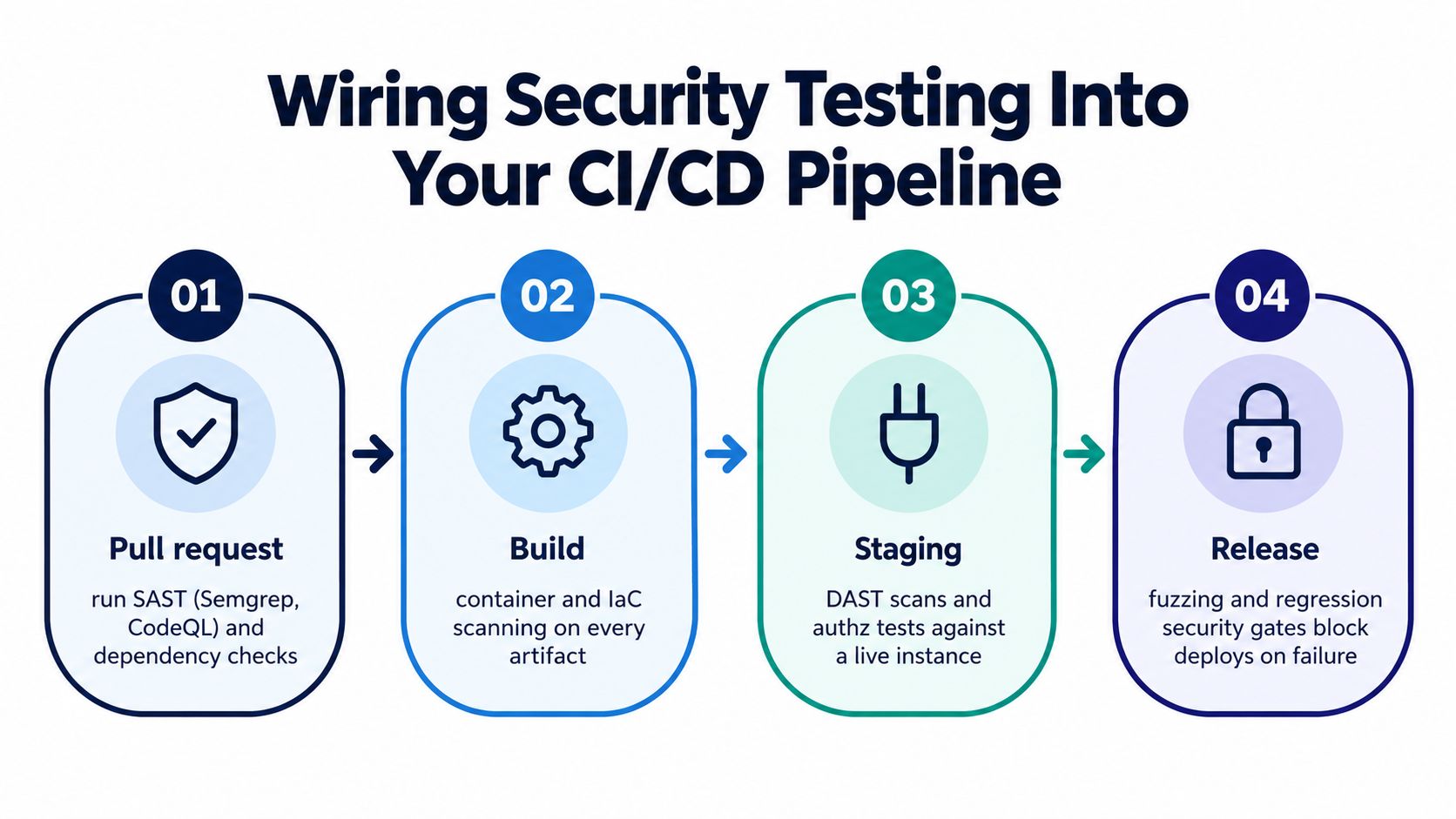
A practical pipeline has four layers:
- Pull request. Run SAST with tools such as Semgrep or CodeQL, plus dependency checks using Trivy or Snyk. Reject newly introduced critical issues when the finding is actionable and reproducible.
- Build. Scan containers and infrastructure definitions before publishing artifacts. Keep secrets, unsafe permissions, and vulnerable dependencies out of shared environments.
- Staging. Import the current API contract and run authenticated DAST against a live instance. Use at least two test personas, anonymous and low privilege, so the suite can exercise both unauthenticated exposure and object-level authorization.
- Release. Run fuzzing, workflow regression tests, and release gates. Block promotion when critical or high-impact issues remain unresolved, unless an owner records a time-bound risk acceptance.
Make the gates reflect real risk
On merge to the main branch, contract tests should verify authentication headers, required scopes, protected response fields, and failure behavior. Before staging deployment, compare the generated route inventory with the approved specification. A new route that has no security test should create a visible warning or block, depending on its sensitivity.
The CI/CD pipeline model for software teams provides the delivery context for these checks. Security feedback works best when developers receive it in the same pull request or deployment view they already use, rather than in a separate dashboard they rarely open.
Measure drift as carefully as vulnerability counts. Useful indicators include:
- Endpoint test coverage: The share of known production endpoints covered by active security tests.
- Authorization matrix coverage: Which role and tenant combinations have been replayed against critical objects.
- Spec gaps: The number of documented routes missing from the test suite, and discovered routes missing from the specification.
- Remediation time: How long teams take to resolve findings by severity.
- Release blocks: Which failures stopped deployment, and whether accepted risks have expired.
Place these metrics beside delivery indicators such as deployment frequency and change failure rate. That makes security posture part of release readiness, not a late-stage approval ritual.
The pipeline should also support authenticated secrets safely. Use short-lived test credentials, isolated data, automatic cleanup, and audit logs. Never solve authentication coverage by placing a production token in a repository or a long-lived shared variable.
After staging tests run, a deeper scheduled scan can cover less frequently changed routes and integrations.
Your 90-Day API Security Testing Roadmap
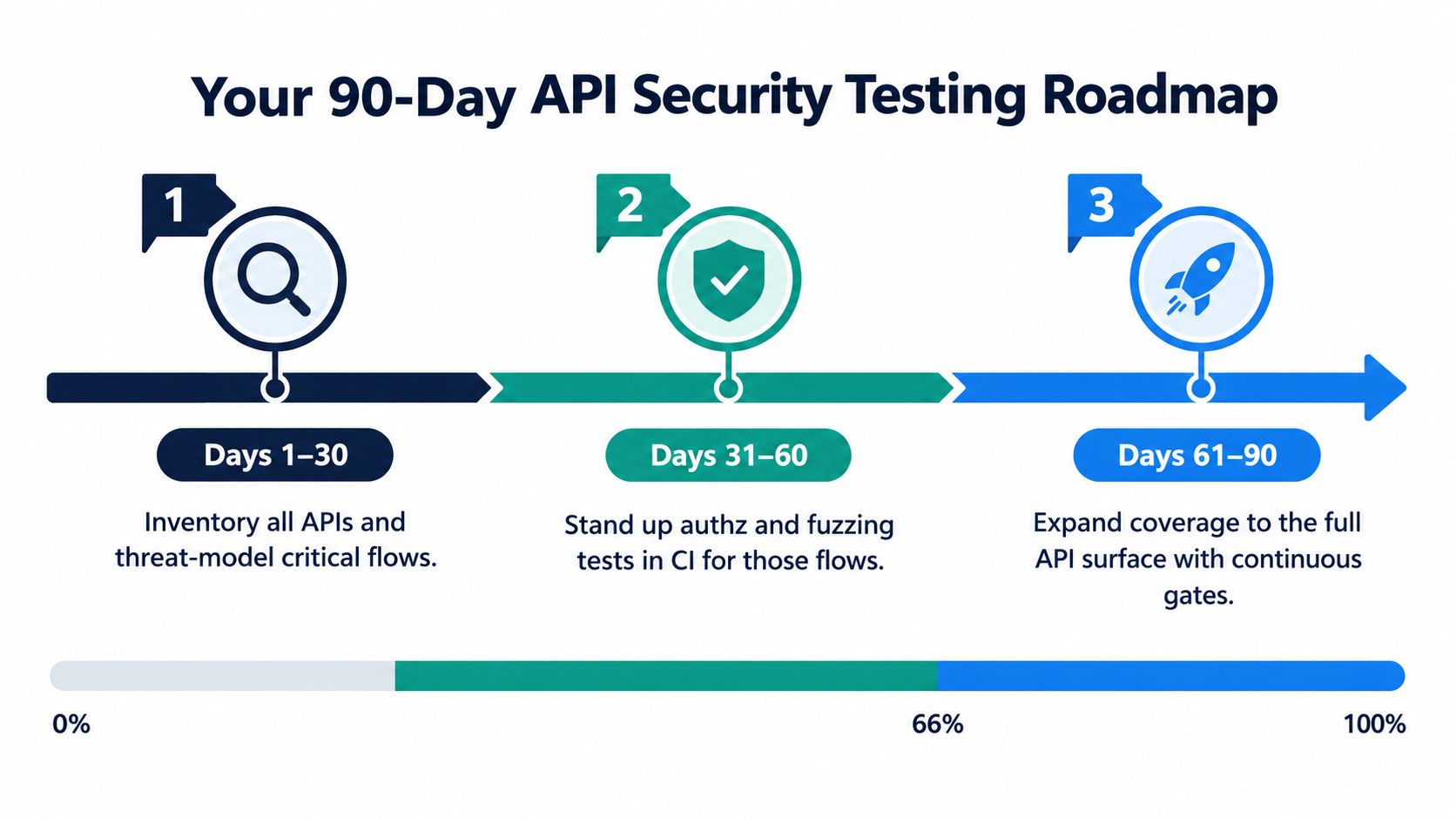
A useful rollout starts with critical flows, not with an attempt to automate every endpoint immediately. The first objective is to make high-value behavior visible and testable.
Days 1 to 30
Create the inventory from specifications, traffic, gateway data, and code traces. Diff it against the production route set, identify shadow and deprecated APIs, and classify endpoints by data and business impact. Build a threat model for login, account changes, payments, exports, administration, and third-party integrations.
Deliverables should include an approved inventory, an ownership record for critical routes, and a BOLA and BFLA test matrix. Establish a baseline for production endpoint coverage and record which routes currently lack authenticated tests.
Days 31 to 60
Add two or more controlled user personas to the CI environment. Implement authorization replay across users, roles, tenants, and HTTP methods. Add schema-aware fuzzing for critical request bodies, query parameters, headers, and webhook fields.
Run these checks against staging on pull requests or merges where the affected services change. Track false positives, mean time to remediate, and the number of releases blocked by reproducible security failures. Tune the suite toward high-signal results instead of disabling broad categories because the first scan is noisy.
Days 61 to 90
Expand coverage to rate limits, token replay, workflow sequencing, idempotency, bulk operations, and controlled denial-of-service behavior. Add scheduled deep scans for the broader API surface and arrange a manual assessment of changed critical flows.
The API testing strategy guidance can help teams connect these checks to broader functional and regression planning. By the end of the rollout, the security dashboard should show endpoint coverage, authorization coverage, unresolved risk by severity, false-positive rate, remediation time, and release-block history.
Avoid five common traps: testing only anonymous paths, trusting a single scanner, ignoring business-logic abuse, prioritizing severity labels without exploitability, and omitting the authentication context. Runtime behavior changes when users, roles, state, and sequence change. Your suite should reflect those conditions on every relevant commit, so critical weaknesses surface during development rather than after a customer finds them.
AskYourQA designs and implements API security, functional, performance, and CI/CD automation that exercises business-critical flows with high-signal checks. Visit AskYourQA to discuss authenticated authorization testing, API abuse scenarios, and release gates for your product.