
A service can pass its smoke test and still be unsafe to release. The basic request returns the expected success code, but a consumer breaks when a response field changes, one account can retrieve another customer's data, a GraphQL query consumes too many resources, or a performance regression slows a business-critical operation. A happy-path check confirms that one request worked. It doesn't tell you whether the API will behave correctly for other users, inputs, protocols, or traffic patterns.
Useful API testing examples cover those release risks directly. They combine functional and negative cases with contract checks, authorization tests, schema validation, performance measurements, and protocol-specific behavior. The right automated check should make failure reproducible, explain what broke, and run at the point in your pipeline where the team can still act on it.
The eight examples below pair a concrete test objective with sample assertions, likely failure modes, and practical CI/CD placement. Start with the endpoints that matter most to customers and downstream teams, then expand coverage as you learn where releases are most vulnerable.
Table of Contents
- 1. Consumer-Driven Contract Testing
- 2. Schema-Based API Fuzzing and Property Testing
- 3. Multi-Step API Workflow Testing
- 4. API Authorization and Access Control Testing
- 5. GraphQL API Testing
- 6. gRPC Service Testing
- 7. WebSocket Real-Time API Testing
- 8. API Load, Stress, and Response-Time Testing
- 8 API Testing Examples Compared Side by Side
- Build a Risk-Based API Testing Stack
1. Consumer-Driven Contract Testing
A provider can return a valid response and still break the teams that depend on it. Consumer-driven contract testing catches that mismatch before independently deployed services meet in a shared environment.
A consumer records the interactions it relies on. For example, a checkout service may expect GET /orders/123 to return an order object with an id and a status. The provider then verifies that its implementation satisfies the recorded contract. Keep the contract focused on fields the consumer uses. Requiring every field in the provider's full response creates brittle tests that fail over harmless changes.
Test objective and assertion
Imagine a provider changes status from a string to a nested object. The provider's local tests may still pass, but an older consumer could fail while rendering the order. The contract assertion should check the agreed response shape and relevant values, not just that the endpoint returns a success code.
Use provider states to create the required order reliably. Don't depend on a shared database that may contain different data between runs. This makes a failure easier to reproduce and tells the provider team which consumer expectation it violated.
Release rule: A provider should not ship if it breaks a consumer that's already deployed.
Put it in CI
Run consumer contract tests when consumers change, and provider verification in the provider's CI pipeline. A Pact Broker can track published contracts and support a can-i-deploy gate, so release decisions account for the versions deployed. Contract checks reduce the need for large shared staging setups, but they don't replace a small number of end-to-end tests for critical journeys.
For broader service-level coverage, connect this practice with testing of microservices. The useful combination is focused contracts for compatibility and a few end-to-end checks for the behavior that matters across service boundaries.
2. Schema-Based API Fuzzing and Property Testing
Handwritten tests usually cover inputs the team thought to try. Schema-based fuzzing explores the inputs they didn't.
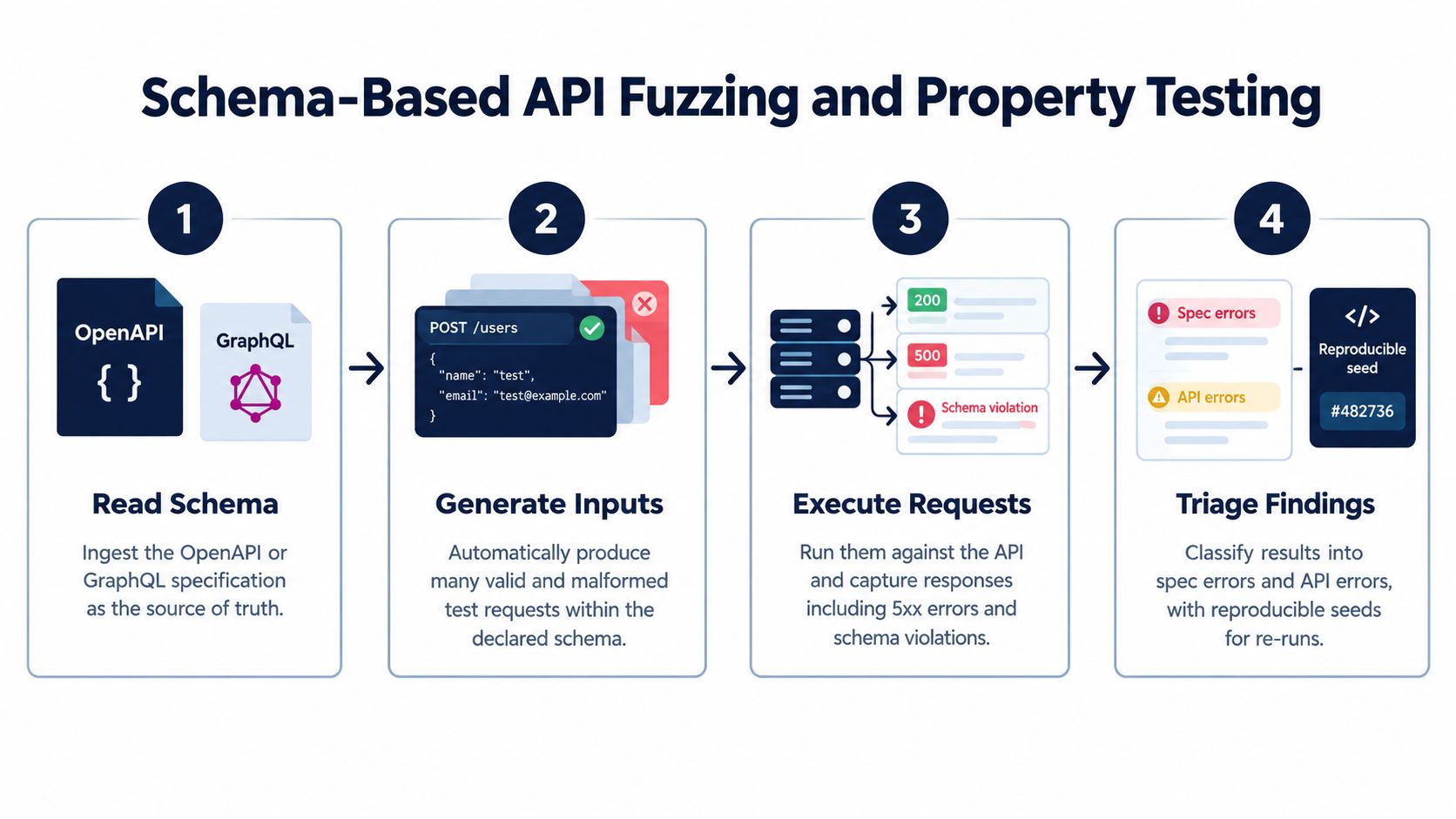
Start with an OpenAPI specification, then generate requests that fit its declared types as well as deliberately malformed values. A tool such as Schemathesis can generate property-based tests from OpenAPI and GraphQL schemas. The test looks for server errors, crashes, and responses that don't match the documented schema. It can expose problems with null, boundary values, unusual strings, or combinations of optional fields that a small set of fixed examples may miss.
What to assert
Suppose an endpoint accepts a search filter with an optional date. A normal test might confirm that a valid date returns results. Fuzzing can also try an empty value, an invalid date string, a missing field, or a value at a boundary. The API should either handle the request according to its documented behavior or return a controlled client error, not crash or leak internal details.
A failed test can mean the implementation is wrong, or the specification no longer describes the actual API. Triage those cases separately before filing defects. Otherwise, teams can spend time patching code that behaves correctly against an outdated contract.
Keep findings reproducible
Run fuzzing against a non-production environment first, especially before enabling write operations. Lock the random seed for CI runs so a reported failure can be replayed. Nightly execution against staging is a practical starting point; bring stable, high-value cases into pull-request checks once their runtime and signal are understood.
Fuzzers can check the schema, but they can't infer every business rule. Add explicit assertions for rules such as whether a customer can submit an order with an unavailable item. Use generated tests to broaden input coverage, not to replace tests for the decisions the business depends on.
3. Multi-Step API Workflow Testing
A customer submits payment, then opens their order history to find nothing there. Multi-step API tests target release risks like this by following state changes through a complete business process.
For an e-commerce checkout, authenticate a user, add an item to their cart, submit payment, and retrieve the resulting order. Pass identifiers and other required values from each response into the next request. This exercises the handoffs between actions, including whether the payment and order belong to the intended cart and account.
Example request and assertion
Capture the order identifier returned by checkout and use it to retrieve that order. Assert that the order exists, its status matches the expected payment outcome, and its items match the submitted cart. Check the account for the intended business change as well. A successful payment response alone provides little evidence that checkout completed correctly.
Make failures identify the broken handoff.
Record the step name and relevant identifiers in failure output so a missing order can be distinguished from an incorrect order status. Keep each chain focused on one outcome. Combining registration, profile editing, checkout, shipping, refunds, and account closure makes failures harder to diagnose. Create data during the run and clean it up afterward, including when an assertion fails.
Postman with Newman, REST Assured, and Karate can automate these sequences in CI. Run short, stable checkout journeys as smoke tests on pull requests or after deployment. Put longer regression chains in stages with suitable environments and controlled test data; their broader coverage comes with more setup and diagnosis cost.
Avoid brittle workflows
Shared accounts and hard-coded IDs cause interference between runs. Provision isolated data and capture identifiers from responses. For external payment services, use controlled success, decline, and timeout outcomes to test application behavior without making real charges.
Keep assertions tied to the business outcome. Repeating endpoint-level status checks adds little signal, while unpredictable data and uncontrolled dependencies can make a workflow fail for reasons unrelated to the release.
4. API Authorization and Access Control Testing
Authentication answers who is making a request. Authorization decides what that identity is allowed to do. Testing only that a user can log in leaves a major release risk unchecked.
For a typical object endpoint such as GET /accounts/{id}, create two users or tenants. Authenticate each, then have one request the other's account by changing the identifier. The expected result should be a rejection, such as 403 or 404, and the response must not include the other account's data. OWASP's API Security Top 10 identifies broken object-level authorization as a central risk, alongside broken authentication and unrestricted resource consumption. Its API security guidance provides a useful basis for prioritizing these checks.
Build a permission matrix
For each important endpoint, record the role, object ownership, operation, and expected outcome. Apply the same idea to function-level checks: a standard user should not be able to call an administrative operation just because they know its route. Test expired, malformed, or missing credentials as well as valid identities with insufficient permissions.
Also inspect the response body. An endpoint that returns a forbidden status but includes sensitive fields has still failed the security objective. Assert that protected data is absent, not just that the request was rejected.
Security check: Change the object ID, role, or HTTP method. The result must still respect the caller's permissions.
Put it in CI
Run high-risk authorization tests early, ideally as a required pull-request check when access-control code or affected endpoints change. To avoid a false sense of coverage, include IDs from another user and another tenant for every object endpoint where ownership matters. Don't treat the UI's hidden buttons as a security boundary. A caller can send the request directly.
A focused suite can protect the business-critical routes without trying to exhaustively test every role and operation on every build. Use security testing for APIs to help shape checks around authorization boundaries, data exposure, and the failure paths that generic happy-path tests miss.
5. GraphQL API Testing
GraphQL clients shape their own queries, so a test suite built only around fixed URLs won't cover the risks that matter most. Test the schema, resolver behavior, errors, pagination, and query complexity.
A representative operation might fetch an account with its recent orders. Assert the returned fields and types, but also check the GraphQL error array and how nullable fields behave when a resolver can't supply a value. A response can contain partial data alongside errors, so checking only the data field can miss a failed resolver or unexpected partial result.
Exercise query limits
Test a normal query, then deliberately expensive variants: deeper nesting, larger lists, or many aliases requesting similar data. Confirm that the API enforces the configured depth or cost limits instead of allowing a client to trigger excessive work. For paginated fields, verify that requesting the next page returns the right records without duplicates or gaps.
A useful test suite maintains representative operations that reflect real consumers. Run them in CI when the schema changes. This helps catch a resolver change that preserves the schema but returns incorrect data, as well as a schema change that breaks existing clients.
Check production settings
Review introspection behavior in the production configuration and test that it matches the team's security decision. Disabling or restricting introspection may be appropriate for an exposed API, but a configuration change shouldn't break internal tooling that relies on it. Keep test environments explicit so their settings don't accidentally mask production behavior.
GraphQL performance checks should reflect the operations customers send, rather than tiny sample queries. A query that looks compact can trigger expensive resolver work, while a large selection may be efficient if the service batches access well. Test observed behavior and enforce limits that match the service's design.
6. gRPC Service Testing
A .proto file defines the messages and RPC methods a gRPC service exposes. That gives teams a clear contract to test, but the contract alone doesn't prove that handlers return correct results or handle failures well.
For each RPC, test valid requests, boundary values, and expected gRPC status codes. A missing resource should produce the intended status, not a generic internal error. Set explicit deadlines in tests so a hung method fails clearly instead of leaving a CI job waiting without useful feedback.
Cover streaming behavior
Unary methods are only part of gRPC. For client, server, or bidirectional streaming calls, assert message ordering and behavior when a client cancels or stops reading. If the service applies backpressure, verify that it handles the slower consumer as designed. These cases are easy to miss if the test harness checks only the final response.
grpcurl can invoke methods and inspect responses from scripts or CI. For load checks, ghz can exercise gRPC methods and report latency and throughput. Treat these as ways to run tests, not as substitutes for defining what the service should do when a request is invalid or a stream ends unexpectedly.
Practical rule: A passing RPC call proves little if the test never checks its deadline, error status, or stream lifecycle.
Keep compatibility visible
Run backward-compatibility checks whenever .proto files change. A change that looks harmless to the service owner may still break a consumer that generates its client from an earlier contract. Use reflection in test environments when it helps inspection, but make sure the production configuration follows the team's intended exposure policy.
Where a business operation is available through more than one protocol, compare behavior as well as speed. The same operation should preserve field meaning, error handling, and idempotency across interfaces. Protocol-specific tests are most useful when they prove that each implementation meets its own contract and remains semantically consistent with the product.
7. WebSocket Real-Time API Testing
A WebSocket request doesn't end when the server sends its first response. The connection stays open, so the test must cover the lifecycle and the sequence of events that follow.
For a chat or live-update service, begin by checking the handshake and authentication. Then send a message and wait for the expected event from the server. Assert its shape, recipient, and ordering. Use explicit timeouts and wait-for-event helpers rather than fixed sleeps. A fixed delay can be too short on a busy runner and unnecessarily long when the event arrives quickly.
Test reconnects and duplicates
Drop the connection in the test harness, reconnect, and verify the service's resume behavior. If clients can receive a message again after reconnecting, check that the consumer can recognize and handle duplicates. If the service promises ordering, assert ordering under reconnect conditions rather than only on a clean connection.
Postman supports WebSocket requests for manual and scripted testing. For a live dashboard or chat feature, simulate multiple clients and check that messages reach the intended connections. Watch connection counts and memory during longer runs; a test that checks message content alone won't reveal a service that gradually exhausts resources.
Put async assertions to work
Model the expected conversation as events, not as a sequence of ordinary request-response calls. Include failed authentication, unexpected close frames, dropped connections, and timeouts. For every case, specify whether the client should reconnect, surface an error, or stop retrying.
Asynchronous tests can become flaky when they rely on timing guesses. Keep assertions tied to observable events and give failures enough context to identify which message was missing or out of order. That makes the test useful when it blocks a release, rather than another intermittent job the team learns to ignore.
8. API Load, Stress, and Response-Time Testing
During an evening traffic peak, checkout requests queue behind a saturated connection pool. Customers experience delays even though the dashboard's average latency looks healthy. Reproduce that release risk with a workload that matches the endpoint's traffic mix, payload sizes, and repeated requests.
Cache behavior deserves its own checks. A REST API performance study reported response-time improvements of up to 87% with a caching design pattern and approximately 1,029 ms post-optimization access time across tested data volumes. Treat those results as context for testing your endpoint's behavior as data volume and request repetition change. Check response correctness alongside speed.
Measure more than the average
Record p95 and p99 latency, throughput, error rate, and server-side saturation, including CPU, memory, and connection pools. Define acceptance thresholds from the service's release objectives and the environment users experience.
Make the assertions explicit: tail latency stays within the agreed limit, error rate remains within budget, and the service sustains the intended request rate. Check response content too, so fast error responses cannot make a run look successful. Keep workload settings and payload fixtures versioned with the test.
Separate profiles by intent. Steady load checks expected demand; spikes exercise sudden increases; stress runs locate degradation; soak runs expose resource pressure over time. k6 supports scripted checks and CI thresholds, while Apache JMeter supports HTTP and API workloads. Capture service metrics alongside client results to connect a threshold failure with a likely bottleneck.
Place performance gates carefully
Use a lightweight, repeatable performance gate for relevant releases. Schedule expensive stress and soak runs in a controlled environment, where competing workloads are less likely to distort results. Shared runners introduce noise, so investigate unexpected failures against service metrics before treating them as regressions.
For cached REST responses, warm the cache, update the underlying record, and assert that subsequent reads reflect the change. Repeat requests with separate user identities and verify that each receives only authorized data.
Document the workload, payloads, environment, and acceptance thresholds with each result. The broader approach to performance testing in software helps frame these checks. A useful release gate provides evidence about this service under its expected demand, with enough context to explain a failure.
8 API Testing Examples Compared Side by Side
| API Testing Approach | 🔄 Implementation Complexity | ⚡ Resource Requirements | 📊 Expected Outcome | 💡 Ideal Use Case | ⭐ Key Advantage |
|---|---|---|---|---|---|
| Consumer-Driven Contract Testing | Medium; requires maintained contracts and broker setup | Low; fast CI tests without dependent services | Detects consumer-provider compatibility breaks before release | Independently released microservices | Enables teams to release confidently without shared staging |
| Schema-Based API Fuzzing and Property Testing | Low–medium; depends on an accurate API schema and finding triage | Low–medium; often run in CI or scheduled staging jobs | Finds edge cases, crashes, and schema violations | APIs with maintained OpenAPI or GraphQL specifications | Automates broad input coverage with limited test authoring |
| Multi-Step API Workflow (Chained CRUD) Testing | Medium; requires sequencing, data handling, and cleanup | Medium; slower and more stateful than isolated tests | Validates end-to-end business flows across endpoints | Smoke and regression testing of critical user journeys | Confirms that connected API operations work together |
| API Authorization and Access Control Testing (OWASP BOLA) | Medium–high; requires role, account, and permission modeling | Medium; needs representative accounts and test data | Reveals unauthorized access and permission regressions | APIs handling user, tenant, or privileged data | Targets high-impact access-control vulnerabilities |
| GraphQL API Testing | Medium–high; covers schema, resolver behavior, and query limits | Medium; test load depends on query complexity and breadth | Verifies data, errors, schema behavior, and query safeguards | GraphQL services with flexible client-generated queries | Tests typed contracts and query-specific performance risks |
| gRPC Service Testing | Medium; streaming and lifecycle tests add complexity | Low–medium; generated clients support efficient testing | Verifies protobuf contracts, RPC behavior, and streaming | Internal service-to-service APIs using gRPC | Strong typing and generated clients simplify contract checks |
| WebSocket Real-Time API Testing | High; asynchronous events and persistent state complicate tests | Medium–high; concurrent clients may be needed | Checks message delivery, ordering, reconnection, and resilience | Chat, live updates, notifications, and collaborative features | Covers real-time behavior that request-response tests miss |
| API Load, Stress, and Response-Time Testing | Medium–high; requires realistic scenarios and thresholds | High; needs load generators and representative environments | Measures latency, throughput, errors, and capacity limits | Release readiness, capacity planning, and performance regression checks | Exposes bottlenecks before they affect users |
Build a Risk-Based API Testing Stack
A practical API testing stack doesn't run every test at every stage. It places high-signal checks where they can catch relevant failures early, then adds broader coverage as the release moves toward production.
On pull requests, run fast contract, authorization, and schema checks for the affected services. These tests can catch a breaking consumer change, a permissions regression, or a response that no longer matches its specification before the team merges it. Keep test data isolated and failures reproducible. A test that depends on a shared database or an untracked random input is harder to trust and slower to debug.
After deployment to a suitable test environment, run short, business-critical API workflows and protocol-specific checks. A checkout chain can verify that payment and order state agree. A GraphQL operation can check resolver behavior and query limits. A gRPC test can confirm the expected status code, while a WebSocket test can verify message delivery after connection and authentication. These checks should reflect how actual consumers use the API, not only how the endpoints look in documentation.
Schedule broader fuzzing, load, stress, and soak testing where the environment can support them. Bring stable, valuable cases into faster pipeline stages over time. If an overnight test finds a reproducible defect in a critical endpoint, reduce that scenario to a focused regression test and add it to the stage where it offers the most useful feedback.
Promote on agreement, not a single green check
A successful release needs more than a passing happy path. Correctness, security, and performance signals should agree. A service shouldn't ship because its response code looks right if another tenant's data is visible, the consumer contract is broken, or the operation slows under a realistic workload.
Keep the suite small enough that teams pay attention to it, and broad enough to cover the business journeys customers rely on. Prioritize endpoints by the impact of failure, the sensitivity of the data, and the number of consumers affected. Then choose a small group of checks you can automate immediately, such as a consumer contract, a cross-tenant access test, and one critical workflow.
AskYourQA works with teams on API and protocol testing, test automation frameworks, and CI/CD integration. For organizations that need help mapping critical journeys and turning the right checks into an operational release system, that kind of specialist support can help connect coverage to practical release decisions.
AskYourQA designs and implements test automation systems that cover APIs, functional flows, security, and performance, with checks integrated into CI/CD pipelines. Visit AskYourQA to discuss how to prioritize your highest-risk API journeys and build reliable, high-signal release checks.