
The most popular advice about testing of microservices is also the advice that creates the most fragile pipelines: write more end-to-end tests. That sounds logical until a failure leaves you investigating several services, a message broker, a database, and a test environment that may have changed underneath the run.
A distributed system needs a distributed testing strategy. Fast unit tests check local decisions, contract tests protect independently evolving interfaces, integration tests verify real dependencies, and a deliberately small end-to-end suite validates the journeys that matter to customers. The hard part isn't producing a large test count. It's producing high-signal evidence that tells a team what failed, why it failed, and whether the release is safe.
Table of Contents
- Building a Layered Microservices Testing Strategy
- Validating API Protocols and Service Contracts
- Testing Distributed Data Consistency and Transactions
- Designing Stable Test Environments and Data Patterns
- Integrating Observability and Performance Gates in CI/CD
- Scaling Automation with a System-Based Delivery Model
Building a Layered Microservices Testing Strategy
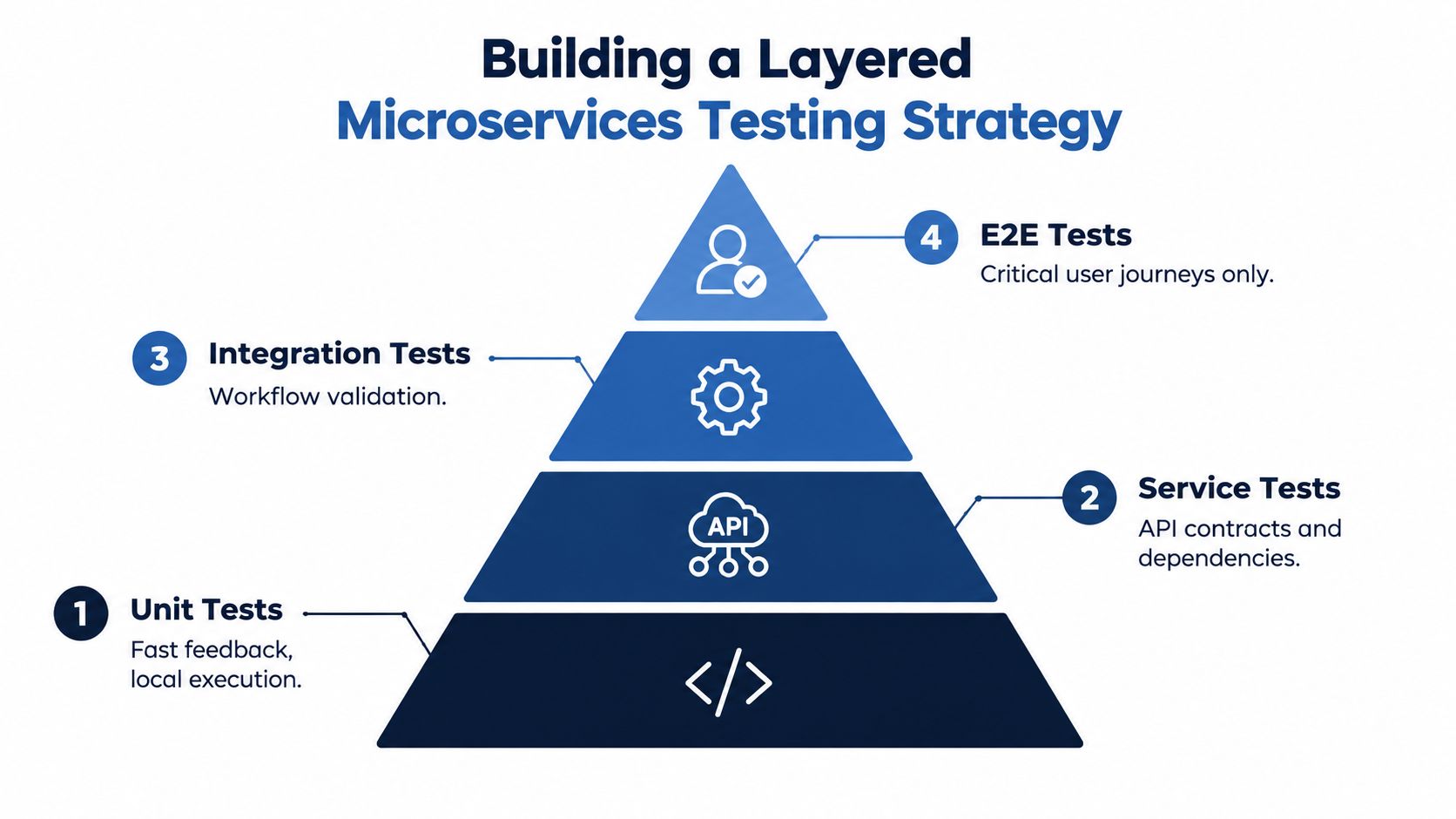
A microservices system turns one application boundary into many service boundaries. Applying a monolithic testing mindset usually produces a large E2E suite that runs slowly, depends on shared state, and reports failures without useful ownership. More E2E tests don't automatically create more coverage. They often duplicate scenarios while leaving service logic, message compatibility, failure handling, and unusual state transitions weakly tested.
A foundational empirical study surveyed 106 practitioners from 29 countries and conducted six additional interviews. It found that unit, end-to-end, and integration testing were the three most frequently used strategies, which confirms a practical reality: teams need several layers rather than a single dominant test type (the empirical study of microservice testing).
Start with local service behavior
Unit tests should isolate business rules, validation, error handling, retry decisions, timeout behavior, and persistence logic behind clear seams. They should run without a network, external database, or dependent service. This layer gives developers the quickest feedback and makes failures easy to assign to a code change.
Service-level tests then exercise the service through its API or message boundary while controlling dependencies. Use real serialization, authentication handling, database behavior, and error responses where those details matter. Use stubs or service virtualization when a dependency is expensive, rate-limited, unstable, or outside the team's control, but make the test double reflect meaningful success and failure behavior.
Protect boundaries before testing journeys
Contract tests belong between isolated service checks and broad workflow tests. A consumer should define what it needs from a provider, including fields, types, status behavior, headers, or message attributes. The provider verifies that it still satisfies those expectations before deployment.
Map the dependency graph for each important business flow. Mark synchronous calls, asynchronous events, queues, retries, and local transaction boundaries. That map tells you where contract tests are appropriate, where integration tests need real infrastructure, and where an E2E test is justified.
Practical rule: Use E2E tests as high-signal release gates for critical journeys, not as an exhaustive substitute for unit, contract, and integration coverage.
The practitioner evidence supports this balance. Unit testing was performed “very often” by 34.0% of respondents and “often” by 29.2%, while end-to-end testing was used “very often” by 26.4% and “often” by 29.2%. Integration testing was used “very often” by 23.6% and “often” by 35.8% (the practitioner testing study). These figures don't prescribe a universal ratio, but they do show that mature testing isn't an E2E-only activity.
Keep the E2E layer intentionally small. Select journeys such as account creation, checkout, payment confirmation, or a core operational action. For each one, assert business outcomes and important side effects, not just a successful page response. Track critical-flow coverage separately from the number of tests, because a green journey can still miss endpoints, failure states, or event consumers that the journey never exercises.
Validating API Protocols and Service Contracts
A successful transport response isn't proof that a service honored its contract. An HTTP response can have the expected status while returning an invalid schema, an unexpected nullable field, an incorrect error object, or a payload that breaks a downstream consumer.
Treat every service contract as an executable specification. Validate the request, response, headers, authentication behavior, error semantics, serialization, and compatibility rules. For REST, combine OpenAPI schema validation with consumer-driven expectations and negative cases. Check required fields, enum changes, pagination behavior, content types, and backward compatibility.
gRPC needs a different emphasis. Test protobuf compatibility, status codes, metadata, deadlines, and streaming behavior. For client and server streams, assert message order, completion, cancellation, retry behavior, and what happens when the stream ends unexpectedly. A mock that returns one successful message won't expose problems in flow control or partial delivery.
GraphQL contracts need more than checking that a query returns data. Validate the schema, nullability, field authorization, resolver errors, pagination, and query depth limits. Test representative queries and mutations from real consumers, including fragments and variables. A query can pass its shape check while triggering an expensive resolver chain or exposing a field that a role shouldn't access.
WebSockets require sequence-based assertions. Establish the connection, authenticate it, subscribe to the required channel, send an action, and verify the expected message sequence. Include reconnects, duplicate messages, out-of-order delivery, heartbeat failures, and server-side closure. The contract is temporal, not just structural.
| Protocol | Primary Testing Focus | Key Risk to Mitigate |
|---|---|---|
| REST | OpenAPI schemas, status codes, headers, errors, and compatibility | Breaking payload or error changes |
| gRPC | Protobuf compatibility, deadlines, metadata, and streams | Silent client failure or incorrect stream handling |
| GraphQL | Schema, resolver behavior, authorization, nullability, and query limits | Valid-looking queries with incorrect or unsafe results |
| WebSocket | Connection lifecycle and message sequences | Lost, duplicated, delayed, or unauthorized events |
Consumer-driven contracts are especially useful when teams deploy independently. The consumer publishes its actual expectations, while the provider runs those expectations in its pipeline. This catches field renames, type changes, missing required values, and incompatible error behavior before a provider release reaches dependent services.
For broader guidance on designing reliable API checks, use this practical resource on API testing strategy. The important distinction is that a contract test verifies compatibility, while an integration or workflow test verifies that the compatible interaction produces the right business result.
Testing Distributed Data Consistency and Transactions
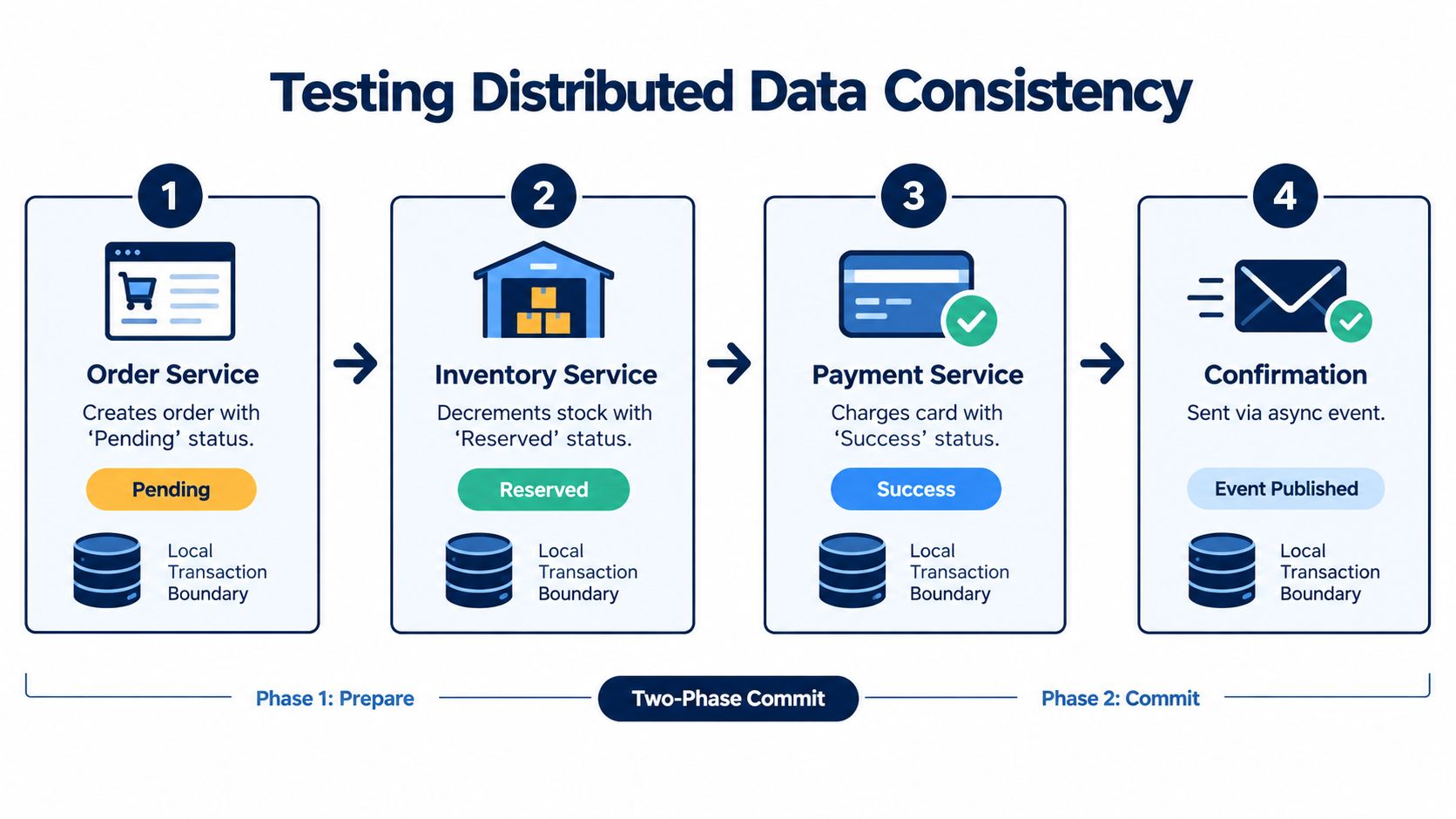
API contracts can prove that a message has the right shape. They can't prove that a business transaction reached the right final state across independently owned databases.
Consider an order flow. The order service may create a pending order, inventory may reserve stock, payment may approve a charge, and a notification service may consume a confirmation event. Each service can report success at its own boundary while the overall transaction remains incomplete, duplicated, or inconsistent.
A 2025 review found that 18.6% of organizations struggle with data consistency across services, while applications commonly require integration testing across 12–15 independent services (the review of quality assurance challenges). The figures describe the scale of the problem, but the testing response should focus on business invariants rather than test-count growth.
Define invariants and state transitions
Start by writing the states a critical workflow may enter and the rules that must always hold. For an order, examples include:
- Inventory safety: Reserved stock can't exceed available stock.
- Payment integrity: A retry must not create a second charge for the same idempotency key.
- Order truth: An order marked confirmed must have the required payment and inventory evidence.
- Notification behavior: A confirmation event may be retried, but consumers must process it idempotently.
- Reconciliation: The system must identify and repair records that remain inconsistent after an allowed consistency window.
Test each transition, not only the final HTTP response. Persist the correlation or transaction identifier, inspect the relevant service states, and assert that the event trail matches the intended path. For asynchronous flows, wait on a domain-specific condition instead of using arbitrary sleeps. A bounded polling assertion with a clear timeout is more reliable and more diagnostic than “sleep and hope.”
Exercise retries, replay, and partial failure
Idempotency tests should repeat the same command, replay the same event, and retry after a simulated timeout. The expected result is one business effect, not merely one response. Event replay should rebuild the expected projection or consumer state from a known history, exposing consumers that accidentally depend on delivery order or mutable external data.
Controlled fault injection reveals the cases that happy-path tests miss. Interrupt payment after inventory reservation, delay a confirmation event, make a downstream dependency unavailable, or deliver a duplicate message. Then verify compensation, retry limits, dead-letter handling, reconciliation, and operator visibility.
Avoid turning every transaction into a full production-topology E2E test. Use targeted workflow tests around the invariants that carry financial, operational, or customer risk. Contract tests protect message compatibility, component tests validate local handling, and a smaller number of consistency tests prove that the distributed state converges correctly.
The broader research on microservices problems analyzed 2,641 issues from 15 open-source microservices systems, supplemented the analysis with 15 practitioner interviews, and surveyed 150 practitioners from 42 countries across six continents. Testing-related problems represented 2.86% of recorded issues, including faulty tests, debugging difficulty, and missing essential functionality (the empirical analysis of microservices problems). That finding matters because test automation itself needs maintenance, observability, and ownership.
Designing Stable Test Environments and Data Patterns
A sound test strategy becomes unreliable when every test shares one database, one queue, and one mutable account. Data collisions then look like application defects, while timing differences turn passing tests into intermittent failures.
Give each test run an isolated identity and a cleanup strategy. Prefer unique tenant, order, user, and correlation identifiers over reusable records. Seed only the data needed for the scenario, and make the seed operation repeatable. Where privacy or compliance matters, use synthetic data rather than copying production records into a test environment.
Choose the right dependency boundary
Use a real dependency when the integration itself is the risk. A database transaction, message serializer, schema migration, or authentication provider often deserves direct testing. Use mocks for narrow unit behavior, and use service virtualization for unstable or costly downstream systems that would otherwise block parallel work.
The trade-off is fidelity. A mock that returns only successful responses creates false confidence. Model timeouts, malformed payloads, rate limits, partial failures, and stateful responses when those behaviors influence the service under test. Periodically compare the virtualized contract with the live dependency so the double doesn't drift.
Ephemeral environments can provide stronger isolation for integration and workflow tests. In Kubernetes, create a namespace or environment per change or test group, deploy the required service versions, run the checks, collect evidence, and destroy the environment. This catches service discovery, readiness, configuration, resource, and network-policy issues that a local process cannot reproduce.
Remove timing guesses
Distributed tests fail when they assert time instead of state. Replace fixed delays with conditions such as “the reservation event has been consumed” or “the order projection is confirmed.” Add a bounded timeout, expose the trace identifier, and record the last observed state when the condition fails.
Parallel execution only works when tests don't share mutable resources. Isolate databases, queues, object keys, ports, namespaces, and external identifiers. If a shared dependency is unavoidable, allocate controlled partitions and make ownership visible. A pipeline should fail because the system violated an assertion, not because another test happened to use the same customer record.
Integrating Observability and Performance Gates in CI/CD
A green functional suite can still hide duplicated events, excessive retries, tail-latency failures, or resource saturation. In a microservices system, logs, metrics, and distributed traces aren't post-release decoration. They are evidence used to decide whether a test produced the expected system behavior.
A 2025 review reported that security concerns affected 31.9% of studied implementations, testing complexity affected 26.7%, and monitoring difficulty affected 23.8%. It also found that 67% of projects needed significant changes to traditional testing strategies (the review of microservices testing and monitoring challenges). The useful lesson isn't to collect every possible signal. It's to define which signals answer a release question.
Turn traces into test oracles
Propagate a trace or correlation identifier through the user request, service calls, messages, retries, and database-facing operations. For a critical journey, assert more than the final response:
- Path correctness: Required service and consumer spans occurred.
- Failure discipline: A transient error triggered an allowed retry, not an uncontrolled retry storm.
- Business uniqueness: One command produced one intended business effect.
- Latency behavior: The critical path stayed within its defined service objective.
- Resource health: Queues, CPU, memory, and connection pools didn't saturate.
A trace-level assertion should identify the expected span, attribute, event, or absence of behavior. For example, a payment retry may be acceptable, but a second successful charge is not. This approach gives developers a failure location instead of a generic “checkout failed” message.
Make performance experiments reproducible
Define operating conditions before generating load. Specify request mixes, actor behavior, concurrency, payload size, dependency latency, failure rates, resource allocation, and autoscaling limits. Establish a baseline, then run steady-state, step-load, stress, and recovery scenarios.
Report p50, p95, and p99 latency, not only averages. The research on microservices performance recommends correlating latency percentiles with throughput, CPU, memory, network utilization, queue depth, error rate, and saturation (the microservices performance and reliability research platform). An average can remain healthy while a small but important group of requests experiences severe delay.
Use service-level objectives as explicit gates. Define the workload, the allowed p99 latency, the error budget, and the recovery expectation before the test starts. Repeat runs and use control charts or confidence intervals where necessary to separate regressions from normal variation. A performance result without matched conditions isn't a credible comparison.
For a broader explanation of performance testing in software, focus on the same principle: test the behavior customers experience, then connect that behavior to infrastructure evidence.
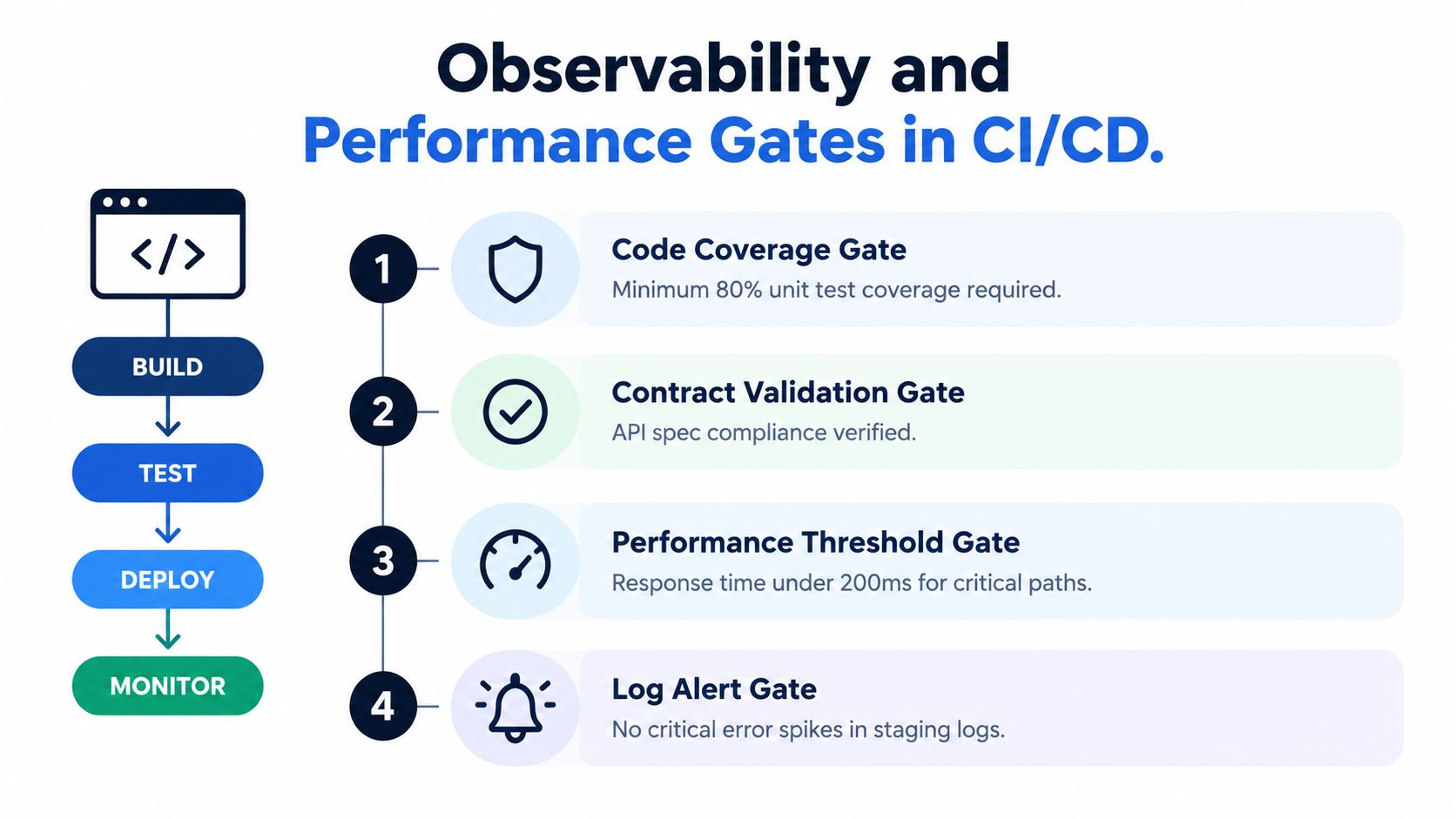
Put fast checks on pull requests, broader contract and integration validation before merge or deployment, and production-like performance and resilience tests at controlled release stages. Don't block releases on noisy signals that no team owns. Every gate needs a clear threshold, a diagnostic artifact, and an action when it fails.
Scaling Automation with a System-Based Delivery Model
Microservices automation fails to scale when QA adds isolated scripts after development. Distributed systems require a delivery model that connects architecture, test design, data, observability, and CI/CD execution. The objective is not maximum test volume. It is high-signal evidence about business journeys, service boundaries, data consistency, and release risk.
Assign parallel workstreams with shared readiness criteria. One maps services, dependencies, protocols, events, and critical journeys. Another builds unit, contract, integration, and workflow checks. A platform workstream provisions environments, isolated test data, trace collection, reporting, and release gates. These streams should converge on the same risk model, so a failing check leads to an owner and a diagnostic path.
Build around business risk
Start with journeys whose failure would create the greatest customer or operational impact. Map each participating service, event, database, invariant, and recovery path. Then match every risk to the least expensive test that can detect it reliably. Keep broad end-to-end coverage for business-critical behavior, while moving stable boundary checks into contracts and integration tests.
Use a test automation framework architecture that separates test intent from transport and environment details. Keep protocol clients, data factories, contract definitions, workflow actions, assertions, trace collectors, and reporting components modular. Clear ownership boundaries make failures easier to diagnose and let teams change infrastructure without rewriting business scenarios.
Review the suite as a product. Remove duplicate end-to-end scenarios, quarantine unstable tests only with an owner and expiry condition, and track time to diagnosis alongside pass rate. A test that fails often without explaining the fault is a delivery liability. A smaller suite that identifies a broken contract, missing event, or violated invariant provides stronger release evidence.
AskYourQA designs and implements automation across APIs, frontend and backend flows, performance, security, and CI/CD integration. Its team can map critical journeys, build high-signal coverage, and connect checks to release readiness, making AskYourQA a practical option for teams building a complete microservices testing system.