
Your team finished the feature on Monday. By Friday it still hasn't shipped, because QA is working through a manual regression pass, two builds have failed for reasons nobody can reproduce, and product is asking which flows are safe. That's not a people problem. It's a design problem in how testing is planned, automated, and gated.
Strong Quality Assurance Best Practices fix that design. They move the useful signal into pull requests and pipelines, protect the journeys that make money first, and stop risky builds before customers see them. The payoff isn't theoretical. In 2025, 86% of teams with strong test automation and CI/CD pipelines reported faster releases, according to Quality Magazine's coverage of TestRail's annual Software Testing and Quality Report.
Each practice below is a decision you can make this quarter. Which journeys get protected first. What blocks a merge. What you stop testing. For broader context, see practical QA guidance from devPulse, then apply the list to your own pipeline, starting with the decision that costs you the most today.
Table of Contents
- 1. Risk-Based Test Prioritization of Critical User Journeys
- 2. Shift-Left Testing
- 3. Test Pyramid with Balanced Automation Layers
- 4. Automated CI/CD Quality Gates and Release Readiness Metrics
- 5. Contract Testing for APIs and Service Interactions
- 6. Flaky Test Detection and Quarantine
- 7. Early and Continuous Security Testing
- 8. Realistic Performance and Load Testing Tied to Service Level Objectives
- 9. Guardrail Testing and Output Evaluation for LLMs and AI Agents
- 10. Maintainable, Scalable Test Automation Framework Architecture
- How the ten quality assurance best practices compare at a glance
- Start With One Practice and Build From There
1. Risk-Based Test Prioritization of Critical User Journeys
You can't test every path equally. Risk-based prioritization ranks journeys by business impact and likelihood of failure, then directs deeper automated coverage to the highest-risk paths.
For this quarter, decide which journeys deserve that coverage. Bring product, engineering, and support together to list the 10 to 15 journeys that matter most. Score each from 1 to 5 for impact and likelihood, multiply the scores, and rank the results. Tag automated tests with the journey they protect so the team can spot coverage gaps before release.

For an e-commerce pipeline, automate checkout, payment, and login journeys before wishlist flows. A SaaS team responding to an invoicing incident might rank billing and permissions ahead of settings, where a failure carries less business impact. The trade-off is deliberate: fewer, higher-value checks can give teams faster, more actionable feedback than a large suite that slows the pipeline.
More tests don't equal more confidence. A large suite can produce slow pipelines and low-value feedback, so weight automation toward the journeys that matter most. Review the ranking quarterly or after a major release, and remove tests that never catch an actionable regression. Use the research review of productivity, incentive metrics, quality review, and agentic AI as broader context, not as evidence for a specific test-prioritization method.
2. Shift-Left Testing
The cheapest defect is the one you never code. Shift-left testing means QA reviews acceptance criteria before sprint planning, test scenarios are written with the story, and automated checks run as soon as code is committed.
The economics are blunt. The U.S. National Institute of Standards and Technology study summarized by StickyMinds estimated inadequate software testing costs the U.S. economy approximately $59.5 billion annually, with a defect costing 1x in requirements and analysis, about 5x in coding and unit testing, and about 30x post-release.

What This Looks Like in Practice
Say a fintech team adds API contract and unit checks to every pull request. Fewer defects reach the slower end-to-end suite, and developers fix problems while the code is still fresh in their heads.
- Add a testability check: Block stories without clear, testable acceptance criteria at definition of ready.
- Automate low first: Unit and API tests are fast and stable, so build them before UI scripts.
- Track detection stage: Record where each defect was found so you can prove the shift is working.
Pair developers and QA engineers when writing acceptance tests. You will catch ambiguous requirements in a conversation that costs minutes, not in system testing that costs days.
3. Test Pyramid with Balanced Automation Layers
If most of your tests drive a browser, your pipeline will be slow and brittle. The test pyramid flips that. Many fast unit tests sit at the base, a moderate number of service and API tests sit in the middle, and a small number of end-to-end UI tests sit at the top.

Say a SaaS platform moves most regression checks from UI scripts to API tests. Pipeline time drops, failures point to a specific service, and the team keeps a small UI set for journeys like login and payment. A mobile team does the same, testing business rules at unit level and reserving device tests for critical flows.
Practical rule: If the UI isn't the behavior you're testing, don't test through the UI.
Audit your suite and count tests per layer. You'll usually find the imbalance in an afternoon. Set a budget for end-to-end tests and make each new one justify itself against a critical journey from your risk ranking. Treat the pyramid as a conversation tool, not a rigid ratio. The goal is fast, diagnosable feedback, not a perfect shape on a slide.
4. Automated CI/CD Quality Gates and Release Readiness Metrics
A quality gate is a checkpoint that must pass before code moves forward. Smoke tests run on pull requests, regression runs on merge, and broader suites run before deployment. If a critical check fails, promotion stops.
NIST Special Publication 800-204D on software supply chain security recommends maintainers run automated checks on all artifacts affected by a change, including unit tests, linters, integrity tests, and security checks, and run static and dynamic application security testing in CI/CD pipelines. Build your gate in that order, fast checks first.
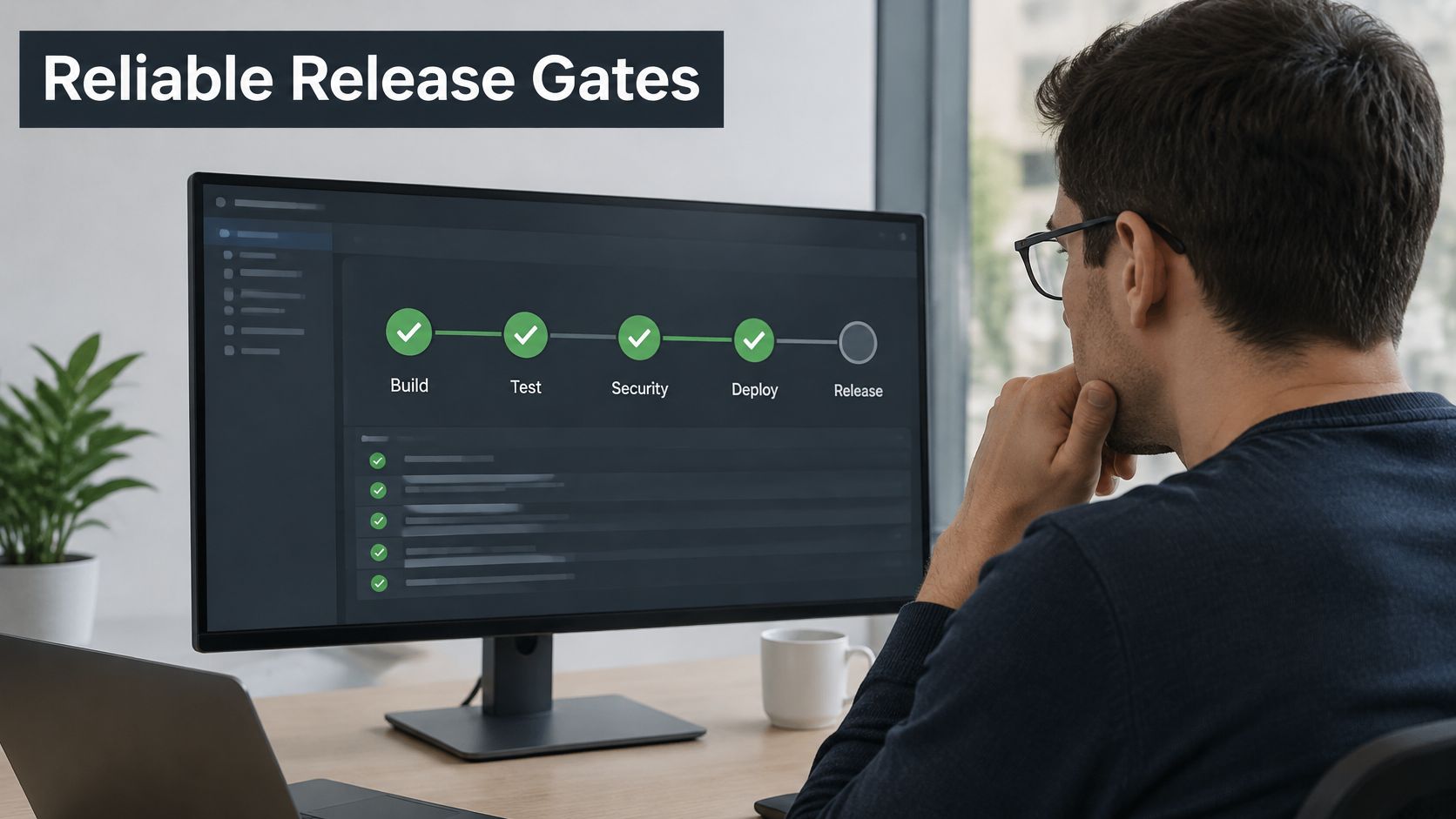
Say a scale-up runs a five-minute smoke suite on every pull request and full regression on merge to main. Developers get a clear answer quickly, and nobody argues about whether a build is ready.
Measure the gate, don't just install it. The DORA metrics history from Google Cloud's DORA program separates throughput, including change lead time, deployment frequency, and failed-deployment recovery time, from instability, including change-fail rate and deployment rework rate. Put those on one readiness dashboard with critical-journey coverage and defect escape rate. Keep pull-request gates under ten minutes, parallelize runners, and write the criteria down so a blocked build is never a surprise.
5. Contract Testing for APIs and Service Interactions
Integration failures often have a simple cause. One service changed a field, another service still expected the old shape, and nobody knew until both were deployed together. Contract testing catches that break in each service's own pipeline.
The consumer defines the expectations it relies on, for REST, GraphQL, gRPC, or WebSocket messages. The provider verifies its implementation meets them on every change. You get protection without spinning up every service in a shared environment.
A Worked Example
Say a microservices platform uses Pact. A consumer team publishes its expectations for an orders API. The provider pipeline verifies them before release, and a can-i-deploy check blocks any version that would break a consumer already in production.
- Start fragile: Pick the most-used or most breakage-prone integration first.
- Verify in the provider pipeline: Don't make verification a manual step someone forgets.
- Keep a few end-to-end journeys: Contracts prove services agree. They don't prove the full user flow works.
An API-first company can add schema validation for public GraphQL and REST endpoints the same way. I recommend contracts where teams deploy independently. If you ship one monolith, API tests may give you enough signal for less overhead.
6. Flaky Test Detection and Quarantine
A flaky test passes and fails with no code change. Once developers learn to hit re-run and ignore red builds, your whole suite loses authority, including the tests that are telling the truth.
Detect flakiness deliberately. Rerun newly failing tests automatically to classify intermittent failures, run suspect tests repeatedly in CI, and report flake rate per suite next to coverage. Good visibility depends on choosing the right test automation reporting tools so patterns are obvious instead of buried in build logs.
Say a product team quarantines UI tests with timing dependencies. They replace hard-coded waits with explicit element conditions, isolate the test data, and return the tests to the main suite only after repeated clean runs.
A quarantined test without an owner and a deadline is just a deleted test you haven't admitted to yet.
Set a maximum quarantine period, such as two sprints. After that, fix it or remove it. Track quarantined-test age as a quality metric, assign each one a named owner, and fix root causes like shared state and unstable data. Quarantine protects the pipeline today. It must not become a parking lot.
7. Early and Continuous Security Testing
Security testing six weeks before launch finds problems when they're most expensive to fix. Put it in the pipeline instead. Combine SAST on source code, DAST against a running app, dependency scanning, and automated checks for broken authentication and access control.
Use the OWASP Top 10 and OWASP ASVS as your checklist, and focus first on the critical flows from your risk ranking. It also helps to review guidance on testing CI/CD infrastructure for vulnerabilities, because the pipeline itself is an attack surface.
Say a payments platform runs dependency scanning on every build and blocks merges that introduce critical vulnerabilities. A healthcare team adds DAST scans on staging plus automated authorization tests for patient data endpoints, so one user can't read another user's records.
- Fail fast on critical findings: Block confirmed critical security or business-flow defects immediately.
- Triage everything else: Assign each finding an owner and track it to closure.
- Keep manual reviews: Schedule periodic human security reviews alongside automated scans.
Automated scans find known patterns quickly. They don't replace judgement about your specific threat model.
8. Realistic Performance and Load Testing Tied to Service Level Objectives
Averages hide pain. A page can average fine while one user in twenty waits ten seconds. Tie performance testing to service level objectives expressed as p95 or p99 response times, throughput, and error rates under realistic load.
Design load models from production analytics, not guesses. If you're new to the discipline, start by understanding what a load test is, then add stress tests to find breaking points and soak tests to expose slow leaks.
Two Patterns That Work
Say a ticketing platform runs spike tests before major sales events. It validates autoscaling and database connection pools before real buyers arrive. A SaaS company runs nightly soak tests instead, catching memory leaks that only appear after many hours.
- Run small in CI: A short performance smoke test on key endpoints catches obvious regressions early.
- Run full on a schedule: Larger load and soak runs belong in pre-production on a cadence.
- Correlate results: Read load results alongside application and infrastructure monitoring, or you won't know what saturated first.
I recommend blocking promotion when a critical endpoint breaches its objective. A slow checkout is a failed checkout for the user who leaves.
9. Guardrail Testing and Output Evaluation for LLMs and AI Agents
LLMs don't return the same answer twice, so exact-match assertions break immediately. You need evaluation datasets, rubric-based scoring, prompt regression tests, and safety checks for harmful content, data leakage, and unauthorized tool use.
The 2025 DORA year in review from Google Cloud's DORA program describes AI as an amplifier that can improve throughput yet weaken delivery stability when foundational practices are inadequate. Treat AI-generated tests and AI outputs the same way, as untrusted until evaluated. Our guide on how to test AI agents covers the operating model in depth.
The short video below walks through guardrail evaluation in practice.
Say a support assistant gates every prompt change on a regression suite checking factual accuracy, policy compliance, and refusal behavior. An agent platform validates every tool call against allowed actions and logs failures for review.
Start with 50 to 100 real user prompts from production logs. Combine deterministic checks for format, schema, and forbidden terms with rubric scoring, calibrate any LLM-as-judge against human ratings, and version prompts and evaluation sets together so results stay reproducible.
10. Maintainable, Scalable Test Automation Framework Architecture
Test code is production code for your pipeline. If it's copied, coupled to the UI, and owned by nobody, it will rot faster than the application it tests. Design the framework with clear layers and the same review standards you apply to product code.
Use proven patterns. Page objects or screen models for UI tests, service clients for APIs, centralized test data management, and one source of configuration for environments and secrets. Keep test data creation independent of the UI so a layout change doesn't break data setup for fifty tests.
Say a product company restructures its Selenium suite around page objects and shared API helpers. A UI change now means editing one component instead of hunting through every script. A platform team goes further and treats the framework as an internal product, with versioned releases and a backlog.
Refactoring rule: When a test change touches more than the feature that changed, your framework structure is the defect.
Document conventions where new engineers will find them, and review them when product architecture changes. I recommend a named framework owner, even in small teams. Shared ownership without a clear owner usually means nobody refactors, nobody upgrades dependencies, and the suite slowly becomes the bottleneck it was built to remove.
How the ten quality assurance best practices compare at a glance
| Item | Primary Benefit | Key Trade-off | Pipeline Stage |
|---|---|---|---|
| Risk-Based Test Prioritization of Critical User Journeys | Focuses testing on high-impact, high-risk journeys | Risk scoring can be subjective and needs regular review | Test planning and release prioritization |
| Shift-Left Testing | Finds defects earlier and reduces late-cycle bottlenecks | Requires collaboration and may need rework as designs change | Requirements, design, and development |
| Test Pyramid with Balanced Automation Layers | Delivers faster feedback with less UI-test flakiness | Lower-level tests may miss integration or usability issues | Unit, API, integration, and end-to-end testing |
| Automated CI/CD Quality Gates and Release Readiness Metrics | Blocks risky changes and supports consistent release decisions | Poorly designed gates can slow delivery or cause pipeline fatigue | Pull requests, integration, and release |
| Contract Testing for APIs and Service Interactions | Detects breaking service changes before deployment | Requires disciplined contract management and does not replace end-to-end tests | Service development and CI |
| Flaky Test Detection and Quarantine | Restores trust in test results and reduces false blockers | Quarantined tests can be neglected without ownership | CI test execution and suite maintenance |
| Early and Continuous Security Testing | Finds vulnerabilities before release and supports compliance | Scanners can produce false positives and slow pipelines | Development, CI, and pre-release |
| Realistic Performance and Load Testing Tied to Service Level Objectives | Identifies capacity limits before they affect users | Realistic environments and scenarios can be costly to maintain | CI, pre-production, and scheduled testing |
| Guardrail Testing and Output Evaluation for LLMs and AI Agents | Detects AI quality and safety regressions | Evaluation can be inconsistent, costly, and data-intensive | AI feature development and pre-release |
| Maintainable, Scalable Test Automation Framework Architecture | Reduces test maintenance and supports team growth | Upfront design and ongoing ownership are required | Framework setup and ongoing test development |
Start With One Practice and Build From There
No team needs all ten practices on day one. This quarter, choose the decision that addresses your costliest failure. If manual regression delays releases, prioritize critical journeys and add a pull-request smoke gate. If developers have stopped trusting red builds, fix flaky tests before adding more. If services keep breaking one another, start with contract tests at the most fragile boundary.
Then make the first step visible. Map your top five critical journeys this week. Set one quality gate in your pipeline next sprint. At the next retrospective, review what it caught, what it missed, and how long feedback took. That sequence turns Quality Assurance Best Practices into a system the team can assess and improve.
Measure outcomes, not activity. The 2023 DORA report from Google Cloud describes four measures: deployment frequency, change lead time, change failure rate, and failed deployment recovery time. It also reports that organizations emphasizing user needs achieved 40% higher organizational performance. Track those measures alongside defect escapes by journey, flake rate, time to diagnose, and pipeline feedback time. If test counts rise while lead time and change failure rate worsen, the suite is growing without improving delivery.
Be clear with leadership about the trade-off. A smaller, high-signal suite that protects revenue flows and runs in minutes can be more useful than broad coverage that blocks safe changes while missing customer-facing regressions. Remove tests that do not catch actionable failures, and put assertions at the earliest dependable layer. Use the maintenance time saved for security, performance, or AI evaluation when those risks apply to the product.
Start with one journey, not a perfect framework. Automate it end to end and gate it in CI/CD. That will expose practical constraints in the pipeline, test data, and environments. Add a second journey next, then use production incidents and escaped defects to update the risk ranking. Each defect should make its failure class harder to repeat.
Small, measurable steps compound. Protect the most important flows, keep pipeline feedback fast and trusted, and review delivery metrics. Together, the practices form one system: it finds defects early, blocks risky changes, and gives the team evidence about release quality.
AskYourQA designs and implements automation for functional, API, security, performance, and AI testing, integrated into CI/CD. To map your most important user journeys and scope an automation system around current release bottlenecks, visit AskYourQA and request a discussion.