
Your pull request is ready. The suite starts, runs for 90 minutes, and the checkout test that would've failed in minute two runs last. You didn't lack coverage. You lacked order.
That's the problem test case prioritization techniques solve. They decide which signal arrives first when you can't wait for everything. The right choice depends on the pipeline stage, not on theory alone. Use risk and change impact on pull requests for fast, relevant feedback. Use history and coverage at merge to catch what changed code touches. Use fault-based, search-based, and full regression runs nightly, where you have time to pay for depth.
I judge every technique below by three questions. Where does it fit, pull request, merge, or nightly? What data does it need before it works? And where does it break? If you also test AI agents or conversational flows, the same logic applies, and it's worth reviewing best practices for automated agent testing for how non-deterministic outputs change what "passing" means.
Start simple, measure time to first failure, and only add complexity when the data earns it.
Table of Contents
- 1. Risk-Based Test Prioritization
- 2. Coverage-Based Prioritization (Total and Additional Greedy)
- 3. Requirements and Business-Value Prioritization (MoSCoW)
- 4. Change-Based Prioritization and Test Impact Analysis
- 5. History-Based Prioritization (Failure History)
- 6. Fault-Based Prioritization (Mutation-Based)
- 7. Search-Based Prioritization (Genetic Algorithms)
- 8. Machine Learning-Based Prioritization
- How the 8 test case prioritization techniques compare at a glance
- Choosing Your First Prioritization Rule for Next Release
1. Risk-Based Test Prioritization
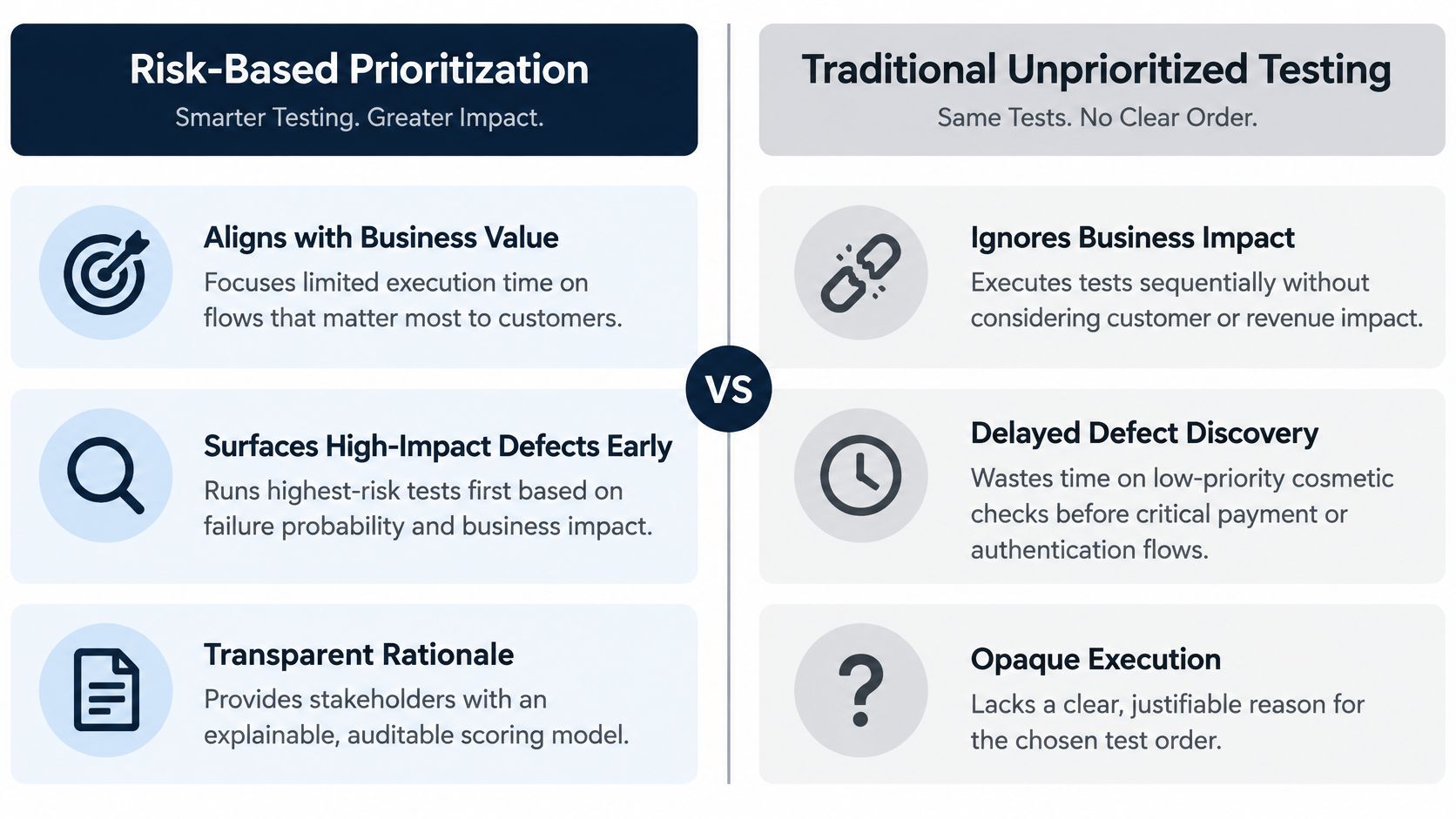
A payments checkout fails in production, and the refund path fails with it. The cosmetic UI tests passed first. Risk-based prioritization changes that order. Rank tests by a simple product: likelihood of failure multiplied by business impact if it fails. Checkout and refunds run before layout checks on every release candidate, because a break there costs revenue. A SaaS team does the same with authentication and billing.
Score each journey or component on complexity, recent change, defect history, and customer impact. Use a 1 to 5 scale for likelihood and impact, multiply, and sort. Keep the session short. Write down why each score landed where it did so leadership can audit the order later.
The sort is only as good as those four inputs. No defect history, and likelihood is a guess. No customer-impact call, and the formula collapses into "what changed last week."
Where It Fits and Where It Breaks
Put the highest scores on every pull request. Start with your top five business-critical journeys and mark them must always run. That is the stage where you still need a fast signal, not a full regression. Payments, authentication, privacy, and AI output controls belong there even when they fail rarely. Code proximity alone under-ranks those paths, because the diff can sit far from the screen that loses money or leaks data.
On the merge and the release candidate, sort the wider suite by the same scores so the next failure you learn about is the expensive one. Lower scores can wait for the nightly run.
The break point is staleness. Risk scores rot after a major release or an architecture change. Re-score after each major release, then split the list again: must-run on the pull request, deferrable overnight.
2. Coverage-Based Prioritization (Total and Additional Greedy)
Coverage-based prioritization orders tests by how much code they exercise. Total greedy sorts by the number of statements, branches, or methods each test covers. Additional greedy repeatedly picks the test that adds the most not-yet-covered elements. Additional greedy usually reaches full coverage in fewer tests.
The field got measurable in 1999, when Rothermel and collaborators introduced the Average Percentage of Faults Detected (APFD) in the research summarized by this arXiv survey of test case prioritization. A value closer to 1 means faults appear earlier. APFD ignores execution cost and fault severity, so don't treat it as a business score.
How to Run It Without Slowing CI
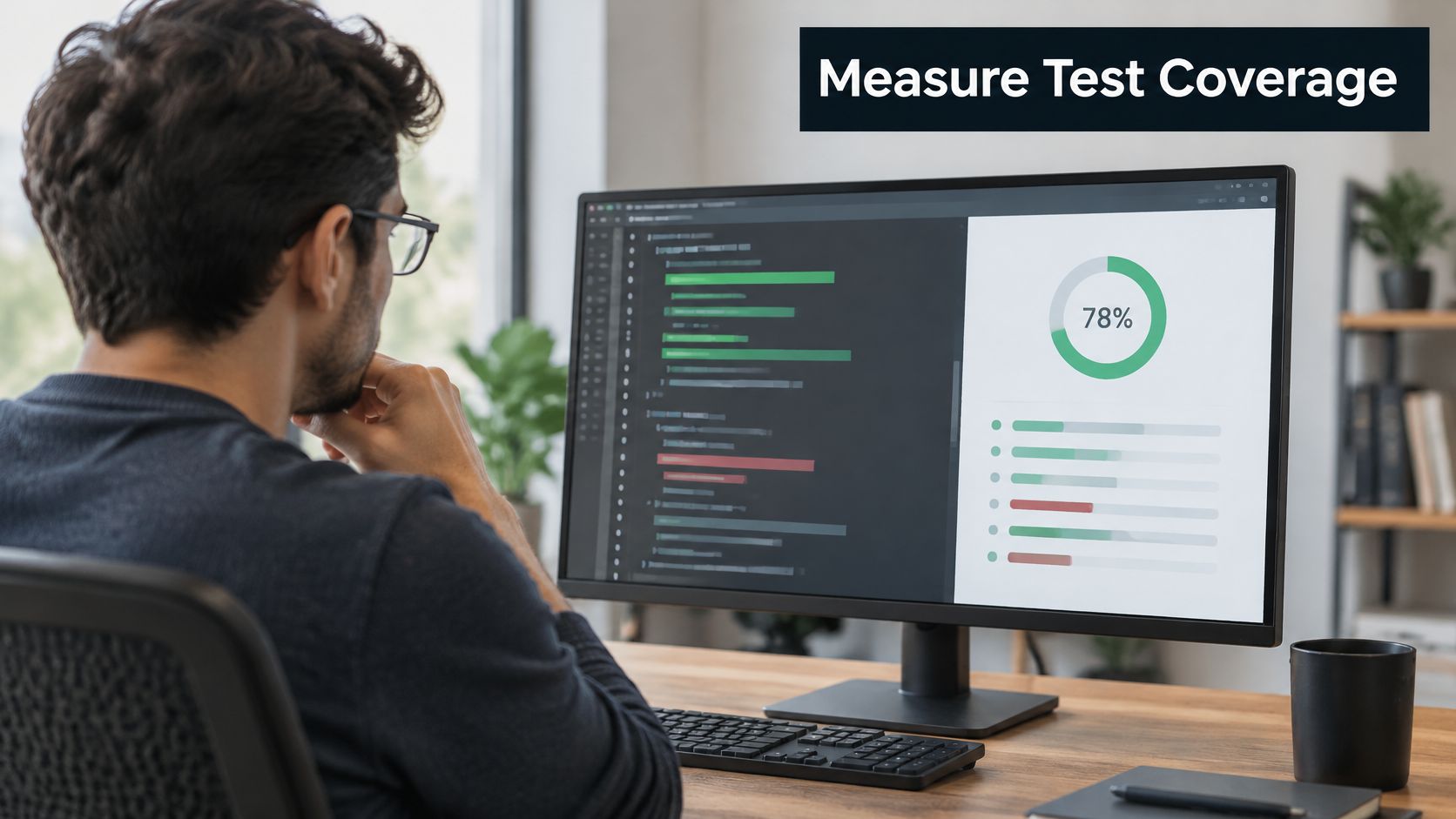
Collect per-test coverage maps periodically, not on every commit. The instrumentation overhead isn't worth it per pull request. Refresh the maps nightly, then use them at merge to run the fewest tests that cover all changed modules first.
A peer-reviewed empirical study of microbenchmark prioritization evaluated 54 combinations of coverage techniques and found mean APFD-P scores of 0.54 to 0.71, detecting the three largest performance changes after only 29% to 66% of the suite. That wide range is the warning. Results depend on your coverage dimension and suite structure, so validate on your own failures and pair coverage with risk scores.
3. Requirements and Business-Value Prioritization (MoSCoW)
Say your product team tags subscription upgrade acceptance tests as Must have. They run on every pull request. Nice-to-have reporting checks wait for nightly. That's requirements-based prioritization, and MoSCoW is the usual shorthand: Must have, Should have, Could have, Won't have.
This works because it forces an agreement before the pipeline runs. QA doesn't guess what matters. The business has already ranked it. To make it enforceable, tag every automated test with its requirement ID or user story, so CI can query Must-level tests directly. A software requirements traceability matrix gives you that link between requirement, test, and result in one place.
Keep the Must category small. If everything is Must have, nothing is prioritized, and your pull request gate becomes the full suite again.
Where It Fits
Use MoSCoW at pull request and release stages. Pull requests run Must tests. A time-limited release window runs Must plus Should. Nightly runs everything, including Could.
The trap is drift. Classifications set at project kickoff don't survive three quarters of roadmap change. Review MoSCoW labels at sprint or release planning, and pair requirement priority with risk scores. A lower-priority requirement in a fragile, high-impact area still deserves early execution.
4. Change-Based Prioritization and Test Impact Analysis
Change-based prioritization runs the tests that exercise code modified in the current commit first. Test impact analysis (TIA) goes further. It traces which tests depend on changed files or methods, selects only those for the pull request, and defers the rest.
Microsoft's Test Impact Analysis in Azure DevOps and Visual Studio runs only tests affected by a change during pull request validation. Google's Test Automation Platform does similar selection at a scale where running everything on presubmit isn't practical. In many cases, this is the fastest way to shorten pull request feedback without guessing. If your review process itself is slow, it helps to build a better pull request workflow alongside the test selection.
The Safety Net You Cannot Skip
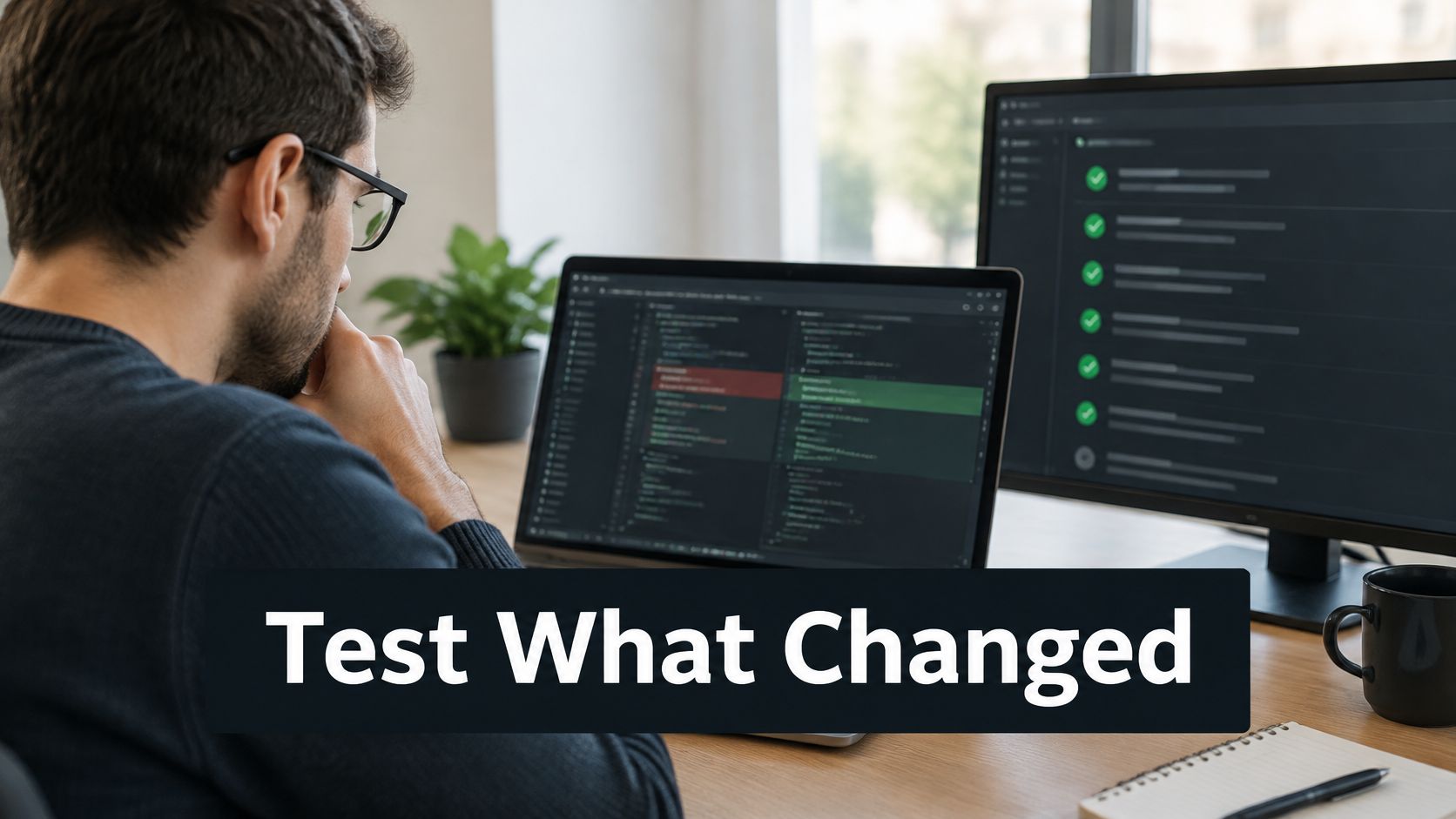
Start with file-level impact mapping. Refine to method level as tooling matures. But impact maps miss things: config changes, shared fixtures, dynamic wiring, data migrations. So keep a nightly or weekly full regression run as the safety net, and track escaped defects to verify selection isn't missing important tests. Our guidance on continuous integration and testing covers how to structure those stages.
My rule is simple. Change-based selection for pull requests, broader coverage at merge, full suite nightly and on release candidates.
5. History-Based Prioritization (Failure History)
You already generate the data for this one. History-based prioritization ranks tests by past results. Tests that failed recently or fail frequently run early. Long-stable tests run later. Most implementations weight recent results more heavily, often with exponential decay, so the order adapts as the codebase changes.
Facebook's predictive test selection, described by Machalica and colleagues, uses historical results as one input to predict which tests are likely to fail for a given change. Simpler versions work too. Many CI setups just reorder so tests with the most recent failures run in the first minutes of a build.
Three Rules Before You Trust History
- Quarantine flaky tests first: A flaky test that fails randomly will climb to the top and waste everyone's first five minutes. Down-weight or isolate it before you rank by history.
- Handle cold-start tests: New tests have no history. Give them a default mid-range priority until they accumulate runs, or they'll sink to the bottom and never prove themselves.
- Store results in a queryable format: You need test name, duration, outcome, and commit for every run. If results live only in CI logs, you can't rank with them.
This fits best at merge, where you have a slightly larger budget than a pull request. Track whether it reduces escapes by watching your defect escape rate, not just time to first failure.
6. Fault-Based Prioritization (Mutation-Based)
Mutation testing asks whether a test would fail if the code were wrong. It plants small deliberate faults, called mutants, then counts which tests kill them by failing. Tests that kill more mutants, especially in critical code, move earlier in the order.
Rank by detected faults per minute. Weigh how many mutants each test kills against how long that test takes. On Java services, collect the signal with a nightly PIT (pitest) run and promote tests that kill the most mutants in payment-critical packages. Apply that order on the next day's builds, after the job has finished.
Practical rule: Use mutation results to strengthen assertions in tests that already run early. A high-priority test with weak assertions is a false sense of security.
Where It Fits
Put this on the nightly release run. Each mutant needs its own execution, so the cost breaks a pull request budget and usually a tight merge gate too. Scope the run to changed or high-risk modules, not the whole codebase. Filter equivalent mutants with heuristics or a short manual review, or the score will credit tests for faults no assertion can catch. Track mutation score over time next to coverage.
The payoff is diagnostic. You will find tests that execute critical code and assert almost nothing. Fix those assertions before you write new tests. I would not ship a raw kill-count order into the pull request lane. Time-weight it, and only promote the order once the nightly job is done.
7. Search-Based Prioritization (Genetic Algorithms)
Search-based prioritization treats ordering as an optimization problem. Genetic algorithms, simulated annealing, or ant colony optimization explore many candidate orderings and keep the one that best maximizes your objective, such as APFD under a time budget. Li, Harman, and Hierons compared genetic algorithms, hill climbing, and greedy strategies and found search-based methods competitive on APFD.
The literature leans this way too. A 2013 systematic mapping study in Software Quality Journal screened 202 papers down to 120 relevant ones, and later tertiary evidence found genetic algorithms were the most frequently used search-based approach in three reviewed studies. Coverage-based criteria remained the most commonly preferred basis in four.
When Search Earns Its Complexity
Don't start here. Build a simple greedy baseline first, measure it, and adopt search only if the gain justifies the machinery. Search pays off when you must balance multiple objectives at once, for example early fault detection plus execution time plus flakiness, which is why research teams use multi-objective genetic algorithms for embedded automotive software.
Define the fitness function around your business objective, not raw APFD. Cap search cost with a time budget, run the optimization nightly, and apply the resulting order the next day. Validate against a random-order baseline. For context, a 2025 Linux Kernel study of similarity-based techniques reported a mean APFD of 0.7583, so a simpler method may already get you most of the benefit.
8. Machine Learning-Based Prioritization
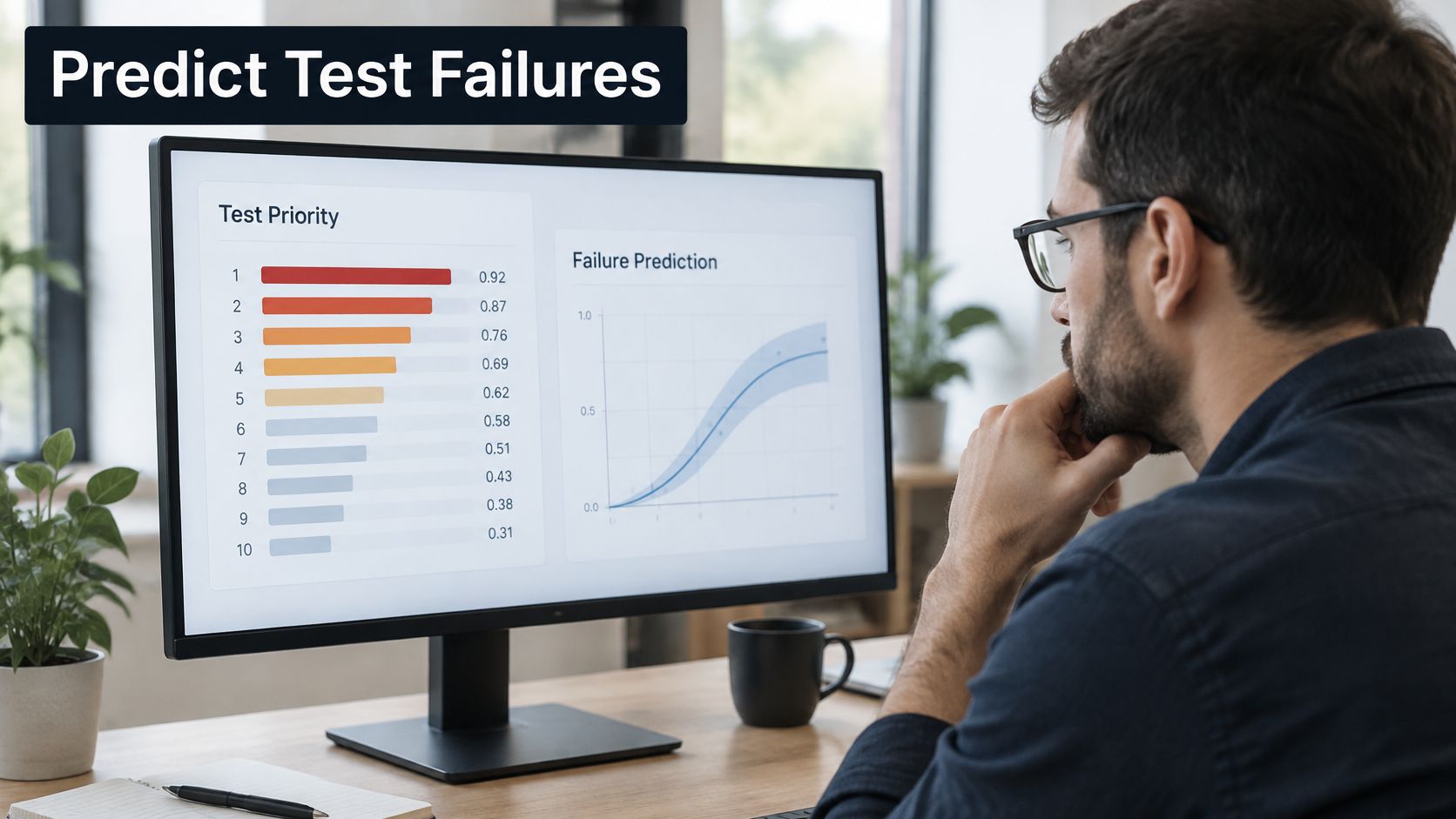
Machine learning models learn from code changes, test results, and failure patterns, then rank tests by predicted failure probability for a specific change. Facebook described its predictive test selection system in 2019, and Google's TAP uses learned and historical signals at massive scale. The appeal is real. Models capture interactions that fixed rules miss.
The evidence supports it, with a condition. An industrial IBM Open Liberty study presented at ICST 2025 found machine-learning-prioritized builds achieved a mean APFD 50% higher than non-prioritized builds, and models trained on recent data consistently beat models trained on older data.
What It Needs and When Not to Trust It
A systematic review summarized in this arXiv review of machine learning for test case prioritization covered 29 studies published from 2006 to 2020, and more recent work flags test churn, code churn, sparse failures, and flaky outcomes as factors that make historical rankings unreliable.
So treat the model as a monitored pipeline component. Feed it recent pass and fail history, duration, changed-code relationships, and flakiness. Retrain when the suite or architecture changes materially. Monitor precision and recall for missed failures, keep a risk-based fallback, and start with a simple classifier before investing in complex models. Fit it at merge, keep the full suite as the release gate.
How the 8 test case prioritization techniques compare at a glance
| Item | Primary input | Main strength | Main limitation |
|---|---|---|---|
| Risk-Based Test Prioritization | Failure likelihood and business impact | Aligns test order with business value and release risk | Scores can be subjective and become outdated |
| Coverage-Based Prioritization (Total and Additional Greedy) | Per-test code coverage data | Automatable and reduces redundant testing | Coverage does not ensure defects will be detected |
| Requirements and Business-Value Prioritization (MoSCoW) | Requirement or user-story priority | Clear traceability between business goals and testing | Business priority may not reflect defect likelihood |
| Change-Based Prioritization and Test Impact Analysis | Code changes and test dependencies | Speeds up feedback and reduces CI execution time | Incomplete dependency mapping can miss affected tests |
| History-Based Prioritization (Failure History) | Past test results, durations, and flakiness | Uses existing CI data to adapt test order | Needs sufficient reliable history |
| Fault-Based Prioritization (Mutation-Based) | Tests' ability to detect injected faults | Directly measures fault-detection effectiveness | Mutation analysis can be slow and resource-intensive |
| Search-Based Prioritization (Genetic Algorithms) | Optimization objectives and test data | Can balance multiple objectives across large suites | Requires tuning and is harder to explain and maintain |
| Machine Learning-Based Prioritization | Historical changes, test results, and failures | Learns complex patterns to prioritize tests at scale | Needs substantial data and engineering investment |
Choosing Your First Prioritization Rule for Next Release
Don't implement eight techniques. Implement one rule next release, measure it, then layer the next. Here's the sequence I'd use.
Step one, map your critical journeys. Pick the five flows your business depends on. Checkout, login, billing, onboarding, whatever earns or protects revenue. Score each on likelihood and impact using the 1 to 5 risk scale. Run those tests first on every pull request and mark them must always run. This costs you a workshop and some tags in your test management tool. It needs no new infrastructure, and it immediately changes which signal arrives first.
Step two, add change-based selection. Once the critical set is protected, use file-level impact mapping to add tests that touch changed code. Your pull request gate becomes critical journeys plus impacted tests. Everything else moves to a nightly full run. Track two numbers from day one: time to first failure and escaped defects. If escapes rise, your impact map is missing something. Widen the selection before you blame the technique.
Step three, add history when you have clean data. After a few weeks of stored, queryable results, reorder within each stage by recent failure history. Quarantine flaky tests first, or history will promote noise. This is also where coverage maps earn their keep, refreshed nightly and used at merge.
Step four, earn the advanced techniques. Mutation analysis, search-based optimization, and machine learning all need a stable baseline to beat and clean data to learn from. Without that, you're optimizing noise. With it, each one has a clear job: mutation strengthens weak assertions nightly, search balances competing objectives under a time budget, and ML re-ranks continuously as failure patterns shift.
The deeper point is that prioritization isn't a static ranking. Your code, test pool, and release risk change every build. A permanent order decays. What works is a small, high-signal set of tests protecting critical journeys, re-ranked by change and recent evidence, backed by a full nightly run so nothing escapes selection forever. Judge the system by whether it improves release decisions: faster detection of the failures that matter, fewer escapes, and a gate developers trust instead of retrying until it goes green.
If you want help building that starting point, book a free 20-minute call. We'll map your critical flows, look at your current pipeline stages, and show how fast a prioritized, high-signal suite can be running on every release.
If your suite is slow and the important failures still arrive last, we can help you fix the order before you add more tests. AskYourQA maps your business-critical user journeys, scores them by risk, and builds a prioritized automation system into your CI/CD pipeline so pull requests get fast, high-signal feedback and nightly runs catch the rest. Book a free 20-minute call to map your critical flows at AskYourQA.