
Release night arrives with a familiar question: which critical requirements are covered by evidence in this build? The product owner points to completed stories, developers point to merged pull requests, and QA points to a test report. Nobody can quickly follow a business need through design, code, automated checks, defects, and the final release decision.
That uncertainty is the operational problem a software requirements traceability matrix should solve. A useful RTM isn't a document someone completes at the end of testing. It's a living set of relationships that shows what changed, what must be revalidated, which evidence is current, and where release risk remains.
Table of Contents
- Why Most Releases Feel Risky Without an RTM
- What a Software Requirements Traceability Matrix Actually Is
- How to Build a Practical RTM Template for QA Teams
- Making the RTM Live in CI/CD and Automated Testing
- When Automation Alone Is Not Enough for Traceability
- RTM Implementation Patterns for Different Team Sizes
- Moving From Traceability Paperwork to Release Confidence
Why Most Releases Feel Risky Without an RTM
A late payment-workflow change can expose the limits of a green pipeline. The pull request updates an API contract, one end-to-end test passes, and deployment appears ready. Review then reveals related authorization rules, performance expectations, and an AI-generated fraud explanation that were never connected to the change. The report confirms a passing test, not coverage of every affected obligation.
That gap creates release uncertainty. A requirement-to-test link proves that someone created a test, but it does not prove that the current code satisfies the requirement, that the test ran against this build, or that its evidence remains valid after an acceptance criterion changes. Security controls, response-time targets, model behavior, and other non-functional requirements need the same traceability as user-facing features.
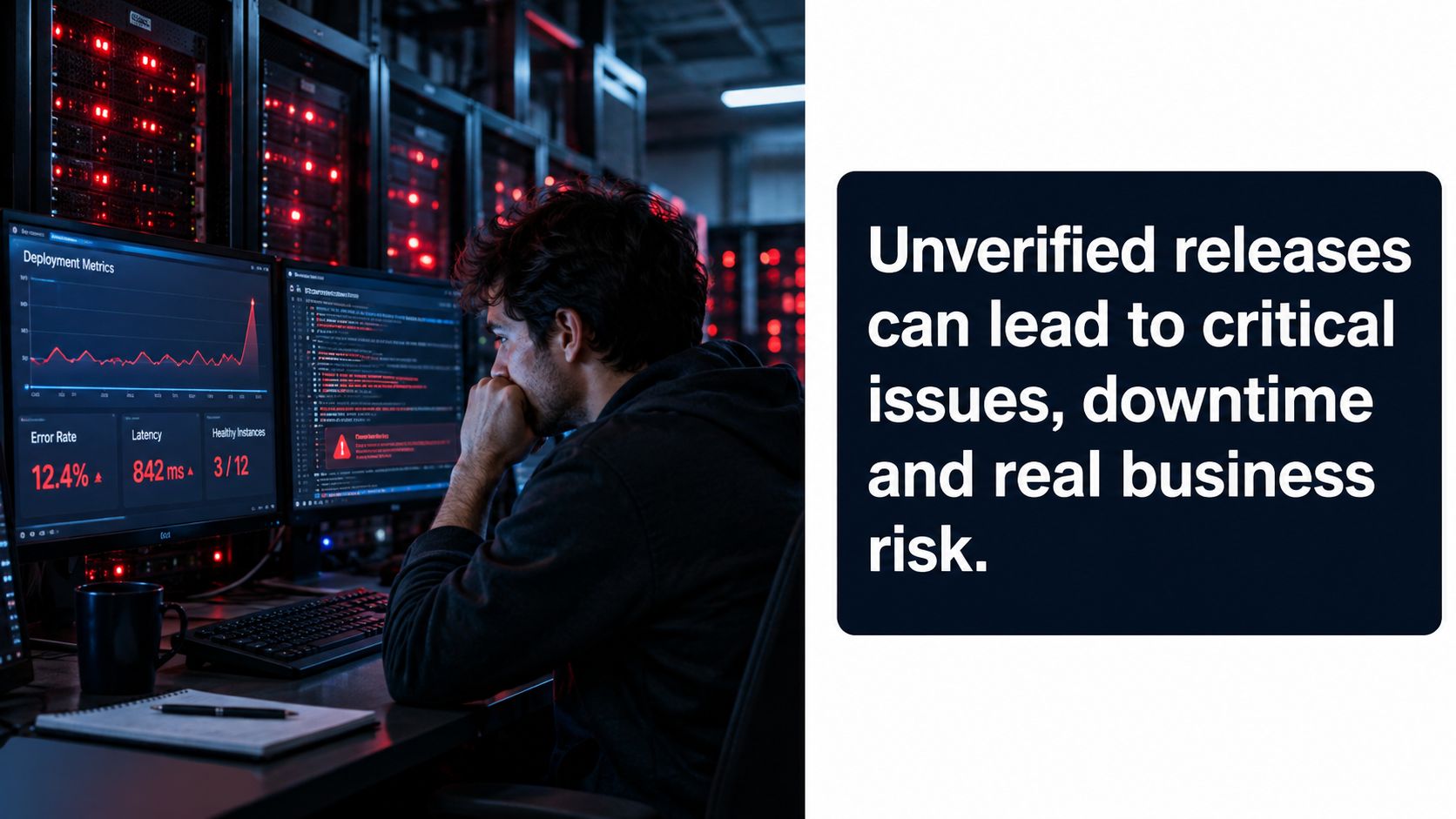
Release question: Can the team move from a critical requirement to the current implementation and verification evidence, then trace every shipped behavior back to an approved source?
The cost of treating traceability as paperwork
A spreadsheet may begin with requirement IDs, test-case references, and completion marks. Scope changes, tests are renamed, defects close, and services enter the architecture. If those relationships do not update with the work, the matrix becomes a historical snapshot instead of a release control.
NASA describes traceability as a “discernible association” between logical entities such as requirements, system elements, verification activities, and tasks, with those associations maintained throughout the lifecycle (NASA requirements management guidance). In release review, that relationship supports impact analysis. A changed requirement should reveal affected design artifacts, source code, documentation, tests, security checks, performance results, and model evaluations without relying on memory.
Automation makes this practical only when links travel with delivery events. Pull requests can reference requirement IDs, CI jobs can attach test results to those IDs, and failed checks can block approval when required evidence is missing or stale. A risk-based software testing approach helps teams decide which links need the strongest evidence first. The RTM then reflects release confidence rather than filled cells.
What a Software Requirements Traceability Matrix Actually Is
A Requirements Traceability Matrix, or RTM, is a structured record connecting requirements to their sources, system or software elements, verification activities, and evidence. It can be represented as a table, a connected set of records in an ALM platform, or a data model that links work items, code, tests, results, defects, and approvals.
NASA's guidance places special importance on bidirectional traceability. Forward traceability follows a higher-level requirement down into software requirements, design, implementation, and verification. Backward traceability follows a lower-level requirement, code artifact, or test back to its parent or originating need. Both directions are necessary.
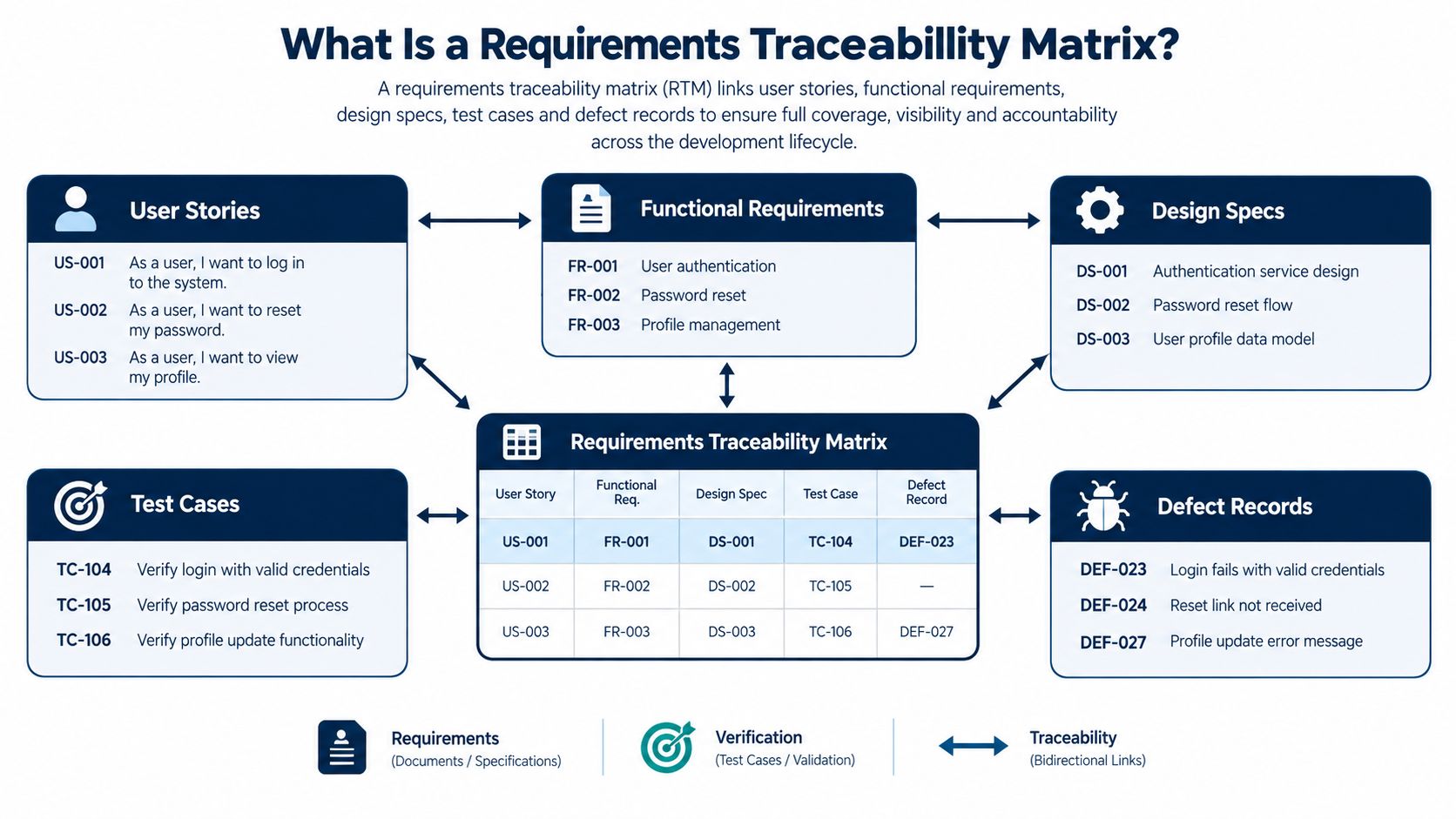
A forward-only matrix can show that a requirement has a test, while missing undocumented functionality that has no legitimate source. A backward-only view can expose unapproved implementation, but it won't prove that every approved requirement was verified. Bidirectional links provide the stronger chain from intent to evidence and from delivery back to intent.
The records that make an RTM useful
A practical matrix normally includes:
- Requirement identity: A unique ID, description, source, category, priority, and current version.
- Lifecycle relationships: Parent requirement, child requirement, linked design element, implementation artifact, and affected interface.
- Verification evidence: Test case or evaluation ID, verification method, environment, expected result, execution reference, and outcome.
- Defect and decision context: Defect IDs, waivers, approvals, validation notes, and release status.
A test list answers, “What did we run?” An RTM answers, “Why did we run it, what does it prove, what changed around it, and can we defend that conclusion?” The distinction is important because matrix completeness doesn't guarantee meaningful coverage.
NASA requires each requirement to have a defined verification method, such as test, analysis, inspection, or demonstration. If a requirement can't be verified, it should be rewritten (NASA guidance on writing good requirements). An ambiguous statement such as “the system responds quickly” may have a populated test link, but it doesn't establish a measurable pass condition. A useful RTM therefore records the condition, data, environment, expected result, evidence location, and verification outcome.
Verification and validation should also remain distinct. Verification checks whether the product meets the stated requirement. Validation checks whether the delivered behavior serves the intended user or mission purpose.
How to Build a Practical RTM Template for QA Teams
Start with the requirement model, not the spreadsheet layout. Before adding test IDs, identify where each requirement came from, who owns it, what risk it represents, and what evidence would persuade a reviewer that it works.
Assign identifiers that communicate lineage. Prefixes such as BR, FR, and NFR can distinguish business, functional, and nonfunctional requirements, while child identifiers can preserve hierarchy. The exact convention matters less than consistency, immutability, and use across tickets, test code, pull requests, and pipeline reports.
Core columns for the matrix
| Column | Purpose | Example Entry |
|---|---|---|
| Requirement ID | Provides a stable reference | FR-PAY-001 |
| Requirement description | States the behavior or constraint | Payment authorization rejects invalid credentials |
| Source and parent ID | Records origin and hierarchy | Checkout story, BR-PAY-01 |
| Category and priority | Supports risk-based decisions | Functional, critical |
| Design element | Connects intent to architecture | Authorization service |
| Implementation artifact | Identifies code or interface evidence | auth-service API module |
| Verification method | Defines how compliance is checked | API test and inspection |
| Test or evaluation ID | Links to executable evidence | API-PAY-014 |
| Environment and build | Makes execution reproducible | Staging, current release candidate |
| Result and evidence | Records outcome and location | Passed, pipeline run reference |
| Defect or exception | Captures unresolved risk | DEF-204, approved waiver |
| Verification status | Supports release gating | Verified, blocked, or stale |
The requirement description must be testable. For performance, record a measurable response-time threshold, throughput condition, error-rate limit, or availability expectation. For security, link the requirement to the relevant control, abuse case, scan, or adversarial test. For AI behavior, include the model or prompt version, evaluation dataset, safety criteria, threshold, environment, and human approval status.
Keep the matrix connected to test design
Don't paste long test scripts into the RTM. Link the requirement to a durable test or evaluation record, then store execution evidence with the run. A practical software testing scripts and templates workflow can help teams standardize naming, inputs, expected results, and reusable test assets.
A requirement may connect to several test types. An API check can verify contract behavior, an end-to-end test can validate the user journey, a security test can exercise authorization boundaries, and a performance test can evaluate the relevant threshold. The status should remain incomplete if an essential verification relationship lacks current evidence.
Making the RTM Live in CI/CD and Automated Testing
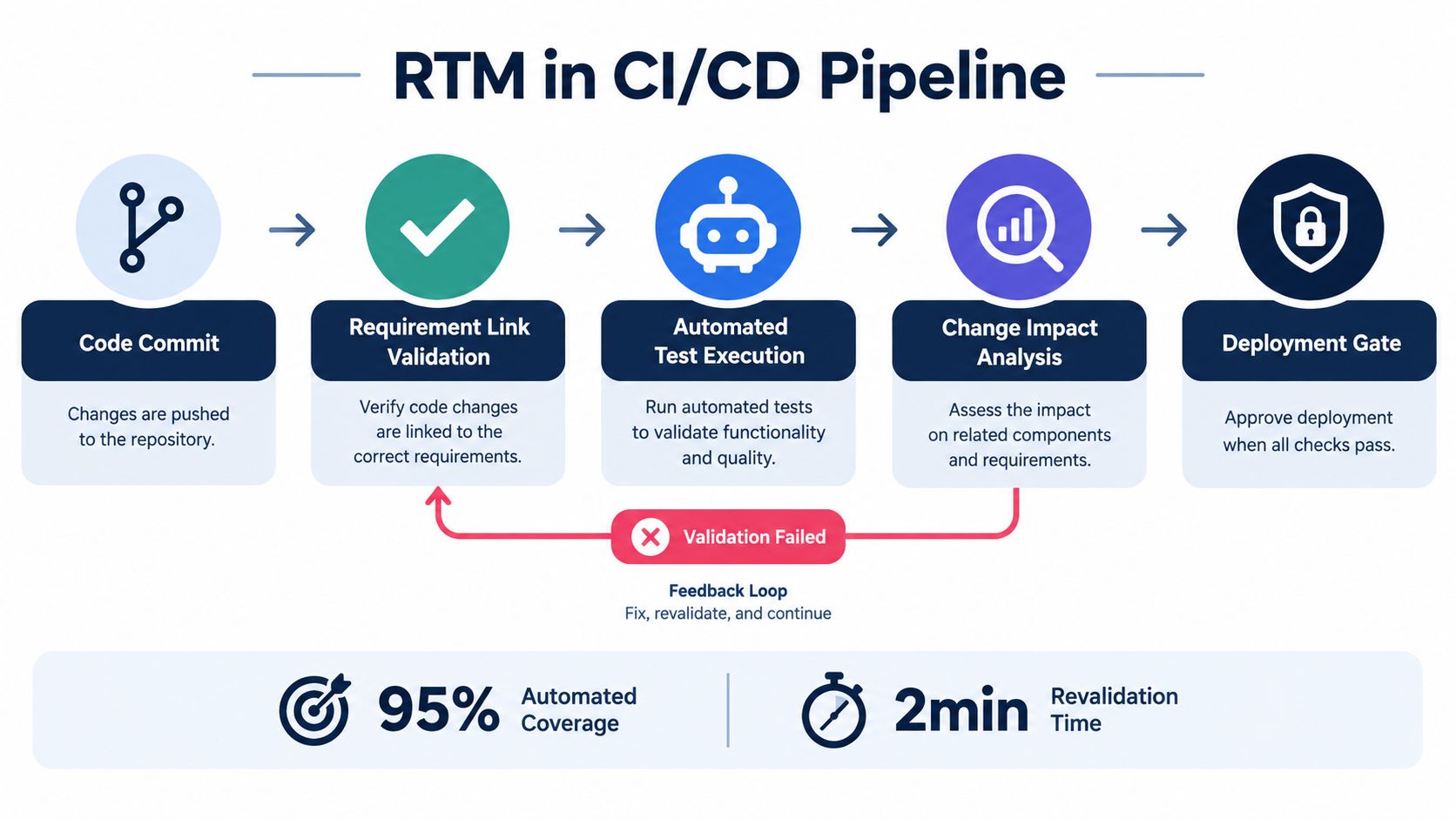
A living RTM is not necessarily a constantly edited table. It's a set of trace links that react to delivery events. A requirement ID should travel through the work item, branch or pull request, test definition, automated result, defect, and release record.
The pipeline can enforce that relationship in stages:
- Validate links at change time. Reject or flag a pull request when a changed requirement has no linked implementation or verification record, or when a referenced test no longer exists.
- Run impacted evidence. Use changed services, interfaces, risk labels, and requirement relationships to select API, end-to-end, security, performance, or AI evaluations.
- Store reproducible results. Record the build, commit, environment, test data, evaluator version, logs, screenshots, and result location.
- Invalidate stale relationships. If an acceptance criterion, interface contract, model version, or performance threshold changes, mark related evidence as requiring revalidation.
- Gate on risk, not row count. Block release when critical requirements lack passing current evidence, even if the overall matrix appears full.
Evidence must go beyond test-case IDs
A test-case ID without an execution record is only a promise. For an API test, retain the contract and response assertions. For an end-to-end journey, retain the build and environment. For security, preserve the finding, control, affected flow, and retest result. For performance, associate the run with workload, environment, threshold, and analysis. For AI, retain the model or prompt version, evaluation inputs, outputs, safety checks, and reviewer decision.
NASA recommends measuring relationships such as system-to-software requirements, software requirements-to-design, design-to-code, and requirements-to-test procedures. It also identifies orphaned and circular links as useful indicators (NASA software engineering handbook guidance). Those measures are more informative when shown as operational signals:
- Critical evidence coverage: The share of critical requirements with passing current evidence.
- Uncovered journeys: Business-critical flows with no valid end-to-end or supporting test chain.
- Invalidated links: Relationships affected by a recent change and awaiting revalidation.
- Orphan and circular links: Requirements, tests, or implementation artifacts that don't form a defensible chain.
- Evidence freshness: Whether the linked result belongs to the current build or an approved comparable baseline.
A CI/CD pipeline workflow should make these signals visible at pull request, merge, and release stages. The goal isn't to automate every decision. It's to make missing evidence difficult to overlook and easy to investigate.
When Automation Alone Is Not Enough for Traceability
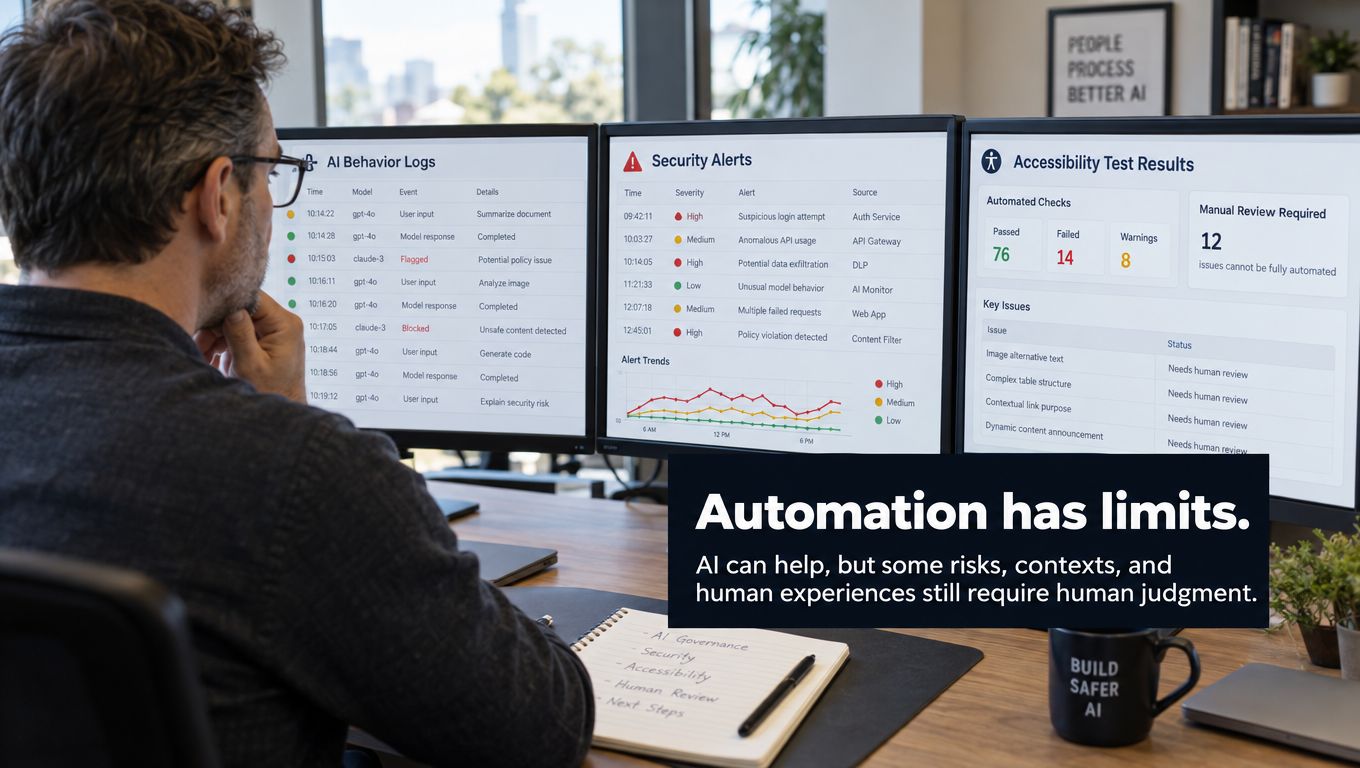
Automated link generation is valuable for scale, but a generated relationship isn't proof of semantic correctness. A language model may match similar wording between a requirement and a test while missing the actual risk. A security check may be linked to a general authentication requirement even though it doesn't exercise the privileged workflow that matters. A performance test may pass while measuring the wrong workload.
The problem is sharper for AI-enabled behavior. An evaluation can produce a result, but the team still needs to judge whether the dataset represents real use, whether the threshold reflects user or mission risk, and whether unsafe behavior is acceptable under any condition. Binary cells such as “covered” and “not covered” hide those decisions.
Richer links for nonfunctional requirements
A 2025 systematic review reports that nonfunctional requirements remain underexplored and benchmarks are insufficient. It also reports that AI work in requirements engineering is concentrated on determining, analyzing, consolidating, and tracing requirements, while early knowledge elicitation receives little support (2025 systematic mapping study).
That finding has a practical consequence. Teams should treat traceability as a confidence model, not just a coverage count. Each high-impact relationship should expose:
- Risk and scope: What could go wrong, who could be affected, and which journey is involved.
- Evaluation context: Dataset, workload, environment, model or prompt version, and security control.
- Decision quality: Reviewer, approval state, exception rationale, and expiration or revalidation trigger.
- Link confidence: Whether the relationship was generated automatically, reviewed, confirmed, or disputed.
Human review is essential for safety, privacy, security, accessibility, and high-impact AI behavior. Automation can suggest links, detect missing references, and compare changed artifacts. It can't independently accept residual risk or determine that a semantically weak test proves a critical requirement.
Measure false links and missed links as well as coverage. A matrix that reports excellent coverage but contains incorrect relationships can create more confidence than the evidence deserves.
RTM Implementation Patterns for Different Team Sizes
A small product team can start with a version-controlled spreadsheet when requirements are stable, the architecture is understandable, and one person owns updates. This approach is inexpensive and easy to inspect, but manual maintenance becomes the central risk. A renamed test, changed interface, or forgotten defect link can make the rows inaccurate without notice.
Tool-integrated traceability fits teams working across product management, development, QA, and security repositories. An ALM or issue-tracking platform can connect requirements to test management records, defects, code changes, and pipeline results. The trade-off is configuration effort. Teams must define identifiers, ownership, permissions, link rules, and failure handling before integrations provide trustworthy automation.
Choosing a pattern by operating need
| Pattern | Works well when | Main trade-off |
|---|---|---|
| Spreadsheet | Scope is limited and change is controlled | Easy to begin, difficult to keep current |
| ALM-integrated | Multiple disciplines share workflows | Better visibility, higher setup and governance cost |
| Code-first links | Tests and pipeline evidence are central | Strong automation, requires disciplined conventions |
| Hybrid model | Business records and technical evidence live in different tools | Flexible, but synchronization needs ownership |
A code-first model places requirement IDs in test metadata, fixtures, tags, or test annotations, then publishes results to a dashboard. It works well for API, end-to-end, security, performance, and AI evaluation suites, provided the pipeline rejects unknown or obsolete identifiers.
The hybrid pattern is often the most practical. Keep requirement ownership and approvals in the product or ALM system, keep executable evidence close to code and CI/CD, and expose a unified release view. Don't introduce a heavyweight platform merely to reproduce a spreadsheet. Introduce it when manual synchronization, audit demands, cross-team dependencies, or release frequency make the existing model unreliable.
Moving From Traceability Paperwork to Release Confidence
A release-ready RTM gives the team a defensible account of what was required, changed, verified, left uncertain, and accepted as residual risk. It supports release decisions without implying that the software has no defects.
Use an operating model that:
- Assigns stable identifiers, hierarchy, and ownership.
- Links requirements to design, code, tests, defects, and evidence in both directions.
- Defines measurable conditions and explicit verification methods.
- Rechecks links when acceptance criteria, interfaces, thresholds, code, or AI evaluation context changes.
- Gates releases on risk-weighted evidence, not populated-row counts.
- Requires human review for safety, privacy, security, accessibility, and high-impact AI decisions.
NASA's guidance connects traceability with impact analysis, verification completeness, change control, release readiness, and auditability (NASA requirements management reference). Those benefits depend on current links. A spreadsheet can capture yesterday's understanding. A living RTM connects today's build to current requirements, automated results, non-functional checks, and unresolved risk.
AskYourQA designs QA automation systems that connect business-critical user journeys with functional, AI, security, performance, and CI/CD evidence. Visit AskYourQA to discuss turning your RTM and automated testing pipeline into a clearer release-control system.