
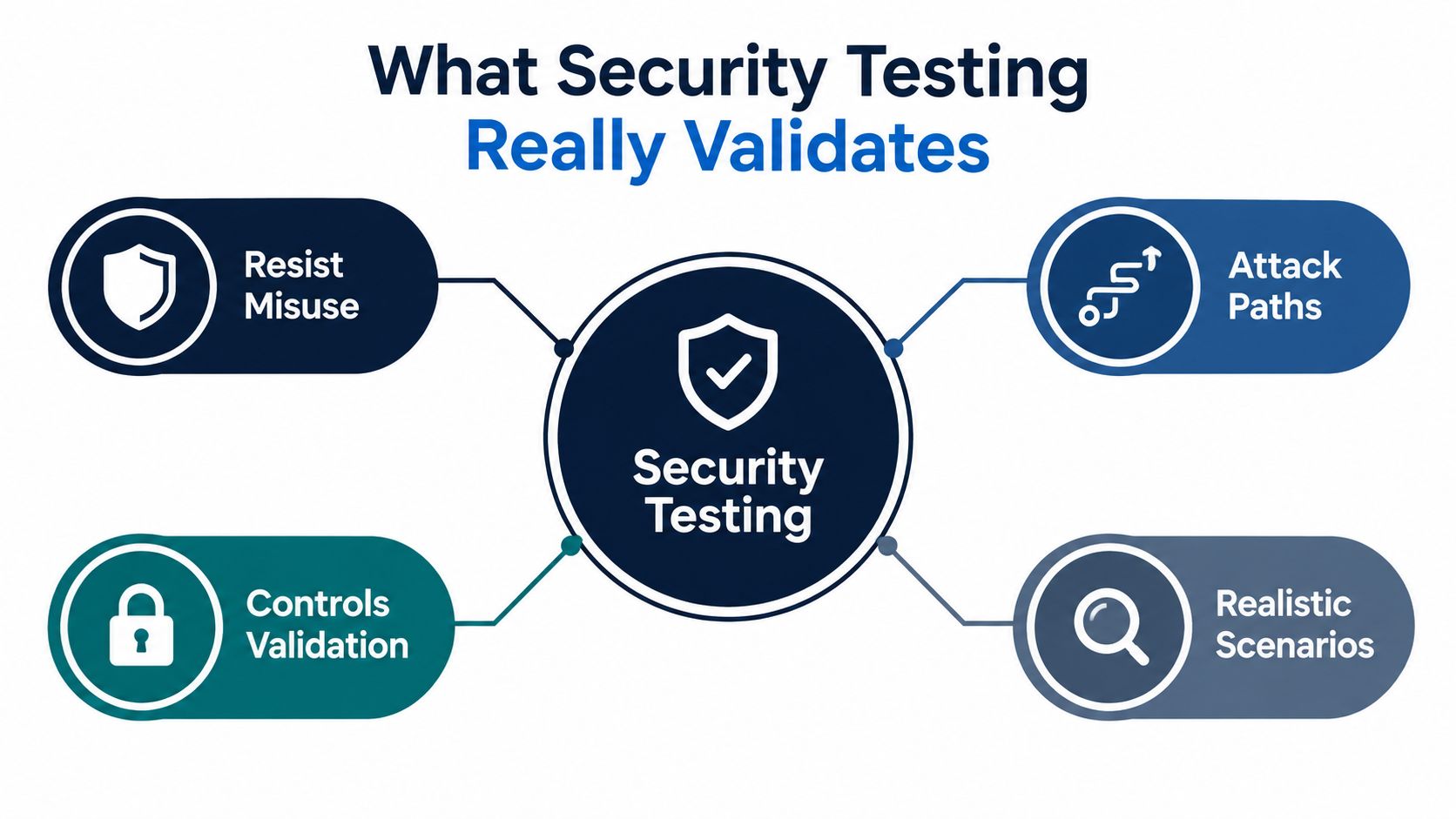
Security testing is the systematic validation that an application's security controls resist realistic misuse and attack paths, not merely a scan for coding defects. Verizon's 2025 report found that vulnerability exploitation represented 20% of initial access vectors, while exploitation increased 34% year over year, which shows why security testing belongs in release decisions, not only in a final audit. Verizon's 2025 Data Breach Investigations Report provides the broader context.
Your release pipeline is green. Functional tests pass, monitoring is quiet, and the team deploys on schedule. Then support forwards a customer report: after signing in, the customer could view another account's invoice. Nothing crashed. The login worked exactly as designed. The failure was that the system didn't enforce who was allowed to see which data.
That distinction explains what security testing in software testing really means. It checks whether authentication, authorization, confidentiality, integrity, logging, configuration, and other controls hold up when someone deliberately uses the product in an unintended way. It turns security from a specialist report into a practical signal for deciding whether a release is ready.
Table of Contents
- The Release-Day Wake-Up Call
- What Security Testing Really Validates
- The Main Types of Security Testing
- Where Security Testing Fits in the SDLC and CI/CD
- A Worked Example for a Critical User Journey
- Measuring Whether Security Testing Actually Works
- A Practical Security Testing Checklist for Your Pipeline
The Release-Day Wake-Up Call
The access-control defect in the opening scenario might have survived a conventional test suite because the suite proved that legitimate users could sign in, open invoices, and download documents. It didn't prove that one authenticated user was blocked from requesting another user's invoice by changing an identifier, replaying a request, or calling an endpoint outside the normal interface.
That's why security testing is broader than bug hunting. The U.S. National Institute of Standards and Technology defines information security testing as validating whether security controls are effectively implemented against an organization's security requirements. Its foundational information security testing guidance describes a repeatable process for planning tests, examining systems, analyzing findings, and developing mitigation strategies.
A production incident often begins with a small assumption:
- Authentication assumption: A valid login is treated as proof that the user may access every account-related resource.
- Authorization assumption: The interface hides an administrator action, so the API is assumed to protect it too.
- Configuration assumption: A staging setting is considered harmless when it reaches production.
- Logging assumption: A sensitive action is recorded, but nobody verifies whether the record is complete or tamper-resistant.
Security testing challenges those assumptions with realistic misuse. A tester may use two ordinary accounts, alter request parameters, replay a token, submit unexpected input, or combine individually harmless actions into a damaging workflow.
Practical rule: A release is not secure because every happy-path test passes. It is more defensible when the team has tested whether the important controls survive the misuse that matters to the business.
The business consequence is straightforward. A broken account boundary can expose customer records. A weak recovery flow can let an attacker take over an account. An insecure dependency can create an entry point outside the application code. Verizon's 2025 report also found that third-party involvement in breaches had doubled to 30%, so the testing boundary includes libraries, APIs, cloud services, VPNs, edge devices, and supplier integrations, not only the repository your team owns.
Teams that treat security as a final inspection usually discover problems when architecture and deployment decisions are expensive to change. Teams that treat it as release evidence can decide whether to fix, mitigate, defer, or stop a deployment with a clear connection to customer impact. For a useful companion discussion of the pressures behind deployment decisions, see why releases feel risky.
What Security Testing Really Validates
Security testing asks a different question from functional testing. Functional testing asks whether an authorized user can complete an expected action. Security testing asks whether an attacker can reach, alter, or abuse something they shouldn't, including through a sequence that the product team never intended.
OWASP's Web Security Testing Guide introduction presents security testing as an adaptable methodology covering infrastructure, identity, authentication, authorization, session management, input validation, cryptography, error handling, business logic, client-side behavior, and APIs. That breadth matters because a secure password check cannot compensate for an authorization flaw later in the request.
The difference between working and being safe
Consider a document-sharing application. A functional test might verify that a user can upload a file and share it with a colleague. A security test adds questions such as:
- Can another signed-in user guess the file identifier?
- Does the download endpoint check ownership every time?
- Does a revoked share stop working immediately?
- Can a user alter a request and grant access to an unauthorized account?
- Do error messages reveal information about private files?
The application may behave correctly for the intended user while failing each of these security checks. Security testing therefore combines threat modeling, source-code review, automated analysis, and runtime testing. Scanners are valuable for repeatable patterns, but manual reasoning is needed for workflow abuse, design mistakes, race conditions, and controls that only fail when several requests are combined.
| Aspect | Functional Testing | Security Testing |
|---|---|---|
| Primary question | Does the feature perform its intended function? | Can the feature resist unauthorized use and attack paths? |
| Typical user | Legitimate user following a supported workflow | Attacker, untrusted user, or compromised session |
| Evidence | Expected outputs and successful journeys | Denied access, protected data, safe failure, and resilient controls |
| Main risk | A feature is broken or inconsistent | A feature exposes, changes, or disrupts something it shouldn't |
| Pipeline role | Confirms product behavior | Supplies evidence for risk-aware release decisions |
A modern program uses both. Pull-request checks can identify risky code patterns and vulnerable dependencies. Integration tests can exercise API permissions and abuse cases. Runtime testing can examine the deployed application. A targeted penetration test can challenge assumptions that automated tools cannot understand.
Security testing isn't a single product category or a single scan. It's a layered way to validate whether the product remains safe when the user, request, environment, or sequence differs from the happy path.
The Main Types of Security Testing
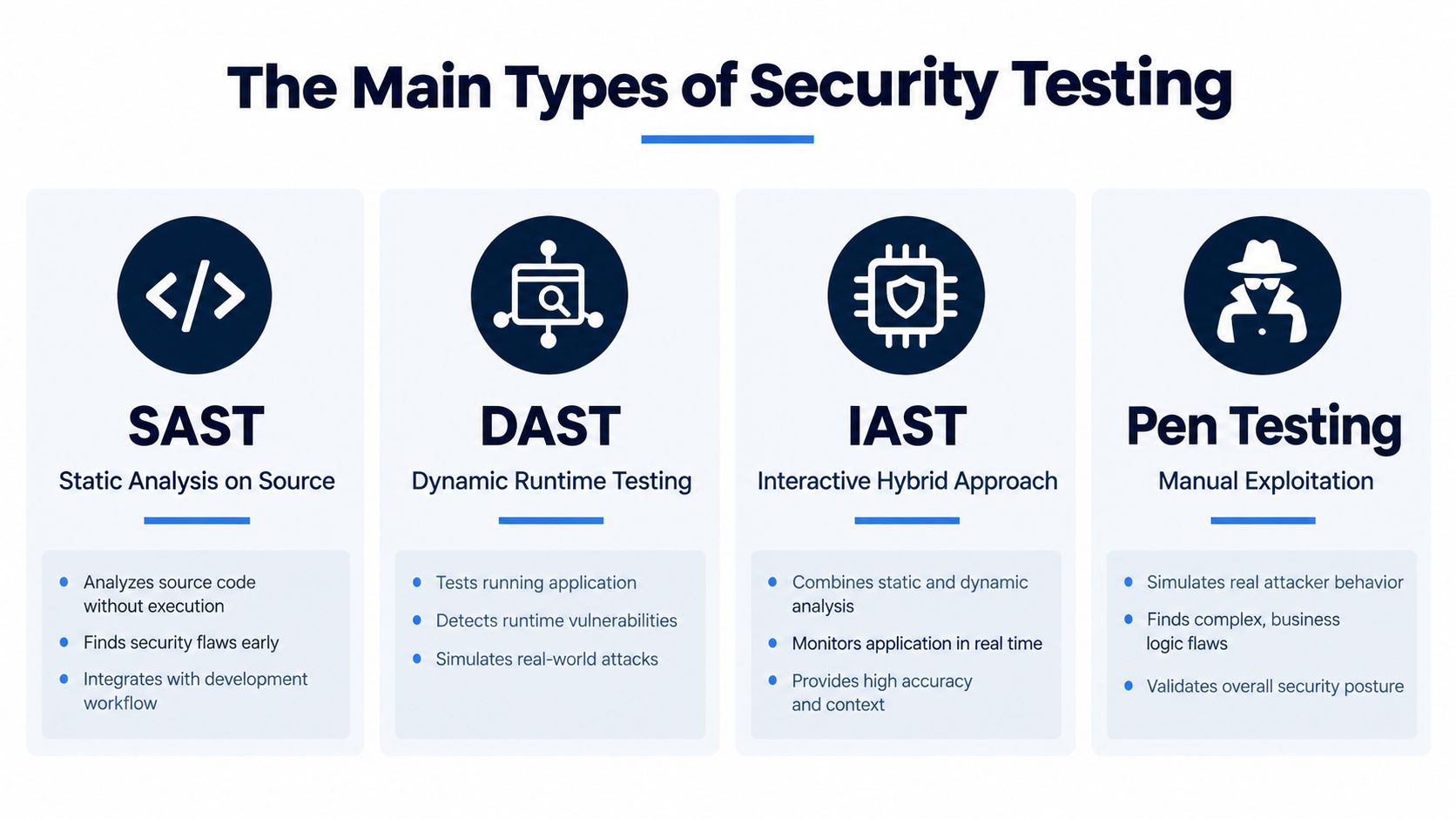
No single technique sees the whole application. Each method inspects a different representation of the system, so the useful question is not which tool wins. It's which uncertainty the team needs to reduce.
Static and dependency analysis
Static Application Security Testing, or SAST, examines source code, bytecode, or compiled artifacts without running the application. It can flag unsafe data handling, injection patterns, and insecure coding practices close to the change that introduced them. Its weakness is context. A static result may not know whether a route is reachable, whether a control exists elsewhere, or whether a business workflow can be abused.
Software Composition Analysis, or SCA, maps third-party libraries and checks them against known dependency risks. It helps teams identify vulnerable packages and outdated components, but it doesn't prove how a dependency is used or whether the application's own authorization model is correct.
Runtime and interactive analysis
Dynamic Application Security Testing, or DAST, probes a running application from the outside. It can find runtime behavior that source analysis cannot observe, but it needs an accessible environment and may miss flaws hidden behind complex workflows or unavailable states.
Interactive Application Security Testing, or IAST, observes an application during execution while combining runtime and code context. That can improve investigation detail, although it still depends on the user journeys and inputs exercised during the test.
Human-led validation
Authentication and authorization tests verify identity boundaries, role permissions, session handling, and access to protected resources. API abuse tests can send unexpected sequences, replay requests, modify identifiers, and test rate limits. Threat modeling happens earlier by asking what assets matter, who might attack them, and which paths could lead to impact.
Penetration testing brings manual exploration to the highest-risk areas. It can uncover business-logic flaws, workflow abuse, race conditions, and combinations of weaknesses that automated checks commonly miss. For API-specific considerations, teams can use security testing for APIs as a practical reference point.
The mental model is simple:
- SAST asks: What risky patterns exist in the code?
- SCA asks: What known risks enter through dependencies?
- DAST asks: What does the running application expose?
- IAST asks: What happens inside the application during exercised behavior?
- Manual testing asks: Can a person combine weaknesses into a meaningful attack path?
Collecting every tool without assigning each one a question creates noise. A smaller set of complementary checks tied to critical flows gives engineering leaders better release evidence.
Where Security Testing Fits in the SDLC and CI/CD
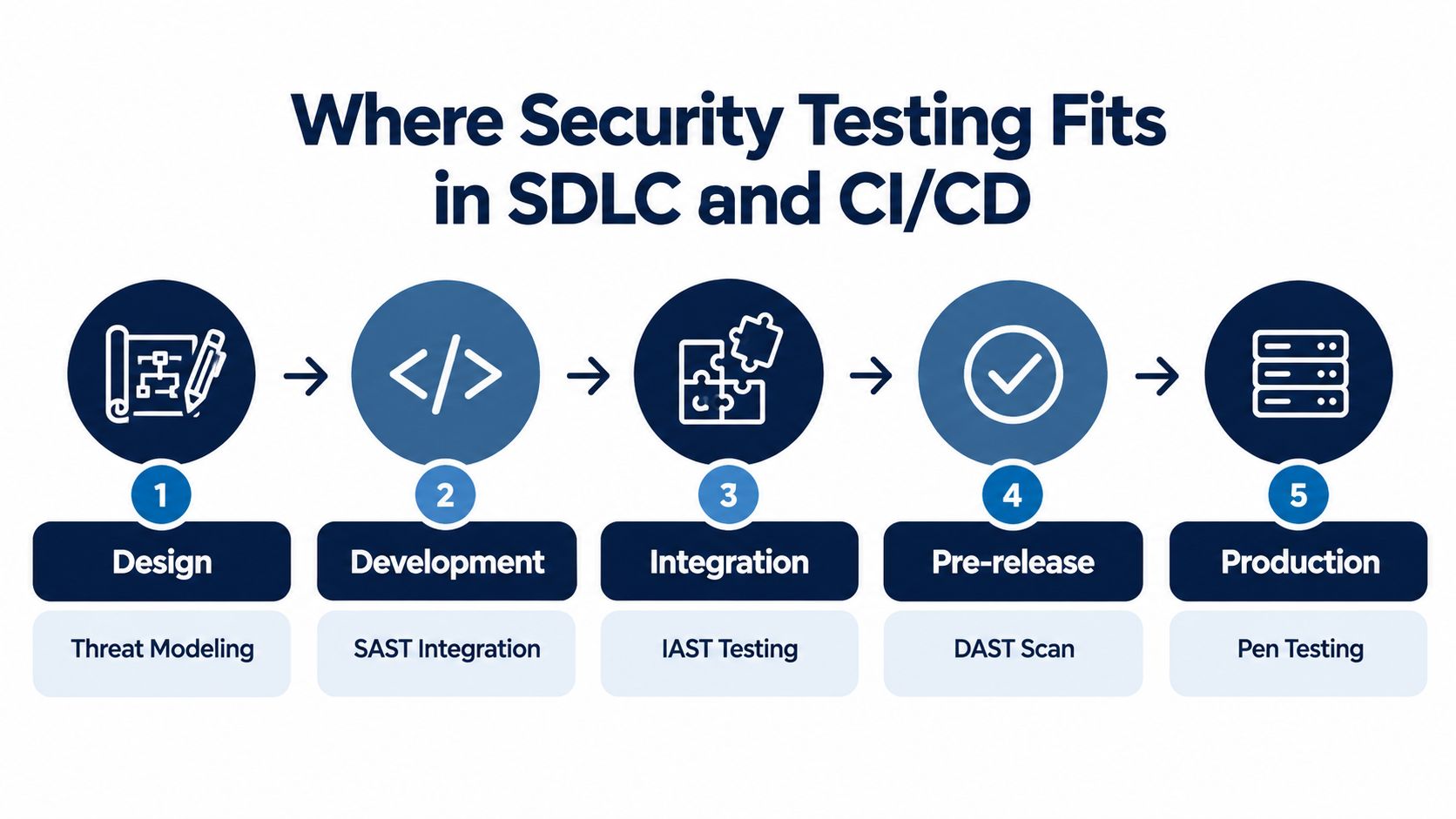
Security testing works best when depth changes by stage. The pipeline should not run the slowest, most investigative assessment on every small code change, but it also shouldn't postpone every meaningful check until release week.
Design
Start with threat modeling for new trust boundaries, sensitive data, administrative functions, account recovery, payment authorization, and external integrations. The output should be concrete: protected assets, likely abuse paths, required controls, and tests that will later prove those controls work.
Development and pull requests
Run fast SAST and dependency checks close to the code change. Add focused unit or component tests for authorization decisions, validation rules, token handling, and security-sensitive error behavior. A pull request should produce actionable feedback quickly enough that the developer still remembers the design decision.
Integration and merge
Once services can communicate, run deeper API and end-to-end abuse tests. Test different roles, expired sessions, altered identifiers, missing headers, replayed requests, unexpected input, and invalid state transitions. This stage catches problems that isolated unit tests cannot see because the vulnerability often lives between services.
Pre-release
Use DAST against a representative environment and validate the highest-risk user journeys manually or through targeted automation. Major architectural changes, new public APIs, identity-provider changes, and sensitive data flows justify risk-based penetration testing before release.
Production
Monitor security-relevant events, review configuration drift, and turn confirmed incidents or findings into regression tests. A production discovery shouldn't remain a report that disappears into a queue. It should improve the next test layer, whether that means a new API assertion, a threat-model update, or a release gate.
Release principle: Fast checks protect developer flow. Deeper checks protect system behavior. Manual assessment protects the assumptions that automation can't interpret.
This staged model fits a broader CI/CD pipeline because it treats security feedback as part of delivery rather than as a separate ceremony. The right gate depends on risk. A low-impact copy change and a redesigned authorization service shouldn't receive identical testing depth.
A Worked Example for a Critical User Journey
Take account recovery. It looks like a short feature, but it crosses identity, email delivery, tokens, sessions, rate limits, and account ownership. A functional test might request a reset email, follow the link, set a new password, and sign in. Security testing follows the same journey while trying to break its assumptions.

Start with the abuse paths
A threat model identifies the assets and boundaries first. The important questions include whether an attacker can take over an account, learn whether an email address exists, reuse a reset token, or move from password recovery into an administrative session.
Then map each concern to a test:
| Abuse path | Useful test layer | Pipeline placement |
|---|---|---|
| Bypass email verification | Authentication and API tests | Pull request and integration |
| Replay a reset token | Token and session tests | Integration |
| Guess or reuse a reset token | Runtime and manual testing | Integration and pre-release |
| Abuse reset-rate limits | API abuse-case tests | Integration |
| Manipulate session state after reset | End-to-end security tests | Merge and staging |
| Submit a cross-site request | SAST, runtime checks, and browser testing | Pull request and pre-release |
| Escalate from recovery into administration | Threat modeling and penetration testing | Design and major release |
The team can write a regression test for every confirmed weakness. For example, once a reset token is consumed, a second request using the same token should fail. Once the password changes, existing sessions should follow the product's documented security policy rather than keep their privileged access.
Connect the layers
SAST may identify unsafe token handling or missing validation, but it won't prove that a token can be replayed across the complete workflow. API tests can exercise that behavior quickly, while manual penetration testing can look for combinations such as account enumeration followed by rate-limit abuse and session manipulation.
Prioritization matters here. The team doesn't need an enormous suite that imitates every conceivable attacker. It needs a small, high-signal set around the account-recovery journey, with clear evidence of what passed, what failed, and which release decision follows.
A similar method works for payment authorization, customer-data export, role changes, and administration. Start with the business consequence, list realistic attack paths, assign each path to the cheapest test layer that can detect it, then reserve human investigation for the paths where context and chaining matter most.
Measuring Whether Security Testing Actually Works
The number of findings is a poor definition of security progress. A scanner can produce a long queue while critical flows remain untested, remediation stalls, and developers learn to ignore alerts.
The scale problem is visible in recent reporting. Verizon-related reporting cited by SC World described vulnerability instances increasing from approximately 68.7 million in 2022 to 527.3 million in 2025, nearly an eight-fold rise, while only 26% of vulnerabilities in the CISA Known Exploited Vulnerabilities catalog were fully remediated during the cited period, down from 38% previously. SC World's coverage of the 2026 DBIR vulnerability findings explains that context.
More output doesn't automatically mean more protection. It may mean the team has expanded scanning without expanding triage, ownership, or repair capacity.
Use risk-weighted indicators
A useful scorecard connects testing to decisions:
- Critical-flow coverage: Which account, payment, administration, export, or recovery journeys have tested abuse cases?
- Exploitable findings reaching production: Which confirmed weaknesses passed through the pipeline and became customer-facing?
- Time to validate a fix: How quickly can the team prove that a correction works and hasn't broken the intended flow?
- Recurrence rate: How often do previously fixed security defects return through later changes?
- High-risk issues blocked: How consistently does the pipeline stop material risk before merge or release?
- Signal quality: Can an engineer reproduce the finding, understand its impact, and identify the affected control?
These indicators also reveal trade-offs. Broad scanning may increase discovery, but a noisy result set can consume the same engineering capacity needed to fix urgent issues. A smaller number of tests tied to valuable user journeys may provide better release confidence than a larger collection with uncertain relevance.
A useful measure is not “How many alerts did we generate?” It is “Which meaningful attack paths did we test, and what did the team do with the evidence?”
For fast-moving products, continuous testing doesn't mean running every assessment on every commit. Lightweight checks belong in pull requests. Deeper API and end-to-end abuse tests belong at integration or pre-release stages. Targeted penetration testing belongs around material changes and high-impact attack paths. Effectiveness appears when those layers reduce uncertainty and create verified fixes, not when a dashboard becomes fuller.
A Practical Security Testing Checklist for Your Pipeline
A workable operating model can start small. Map the journeys where a failure would matter most, then assign each journey a set of checks that fit the delivery stage.
| Pipeline Stage | Security Activity | Definition of Done |
|---|---|---|
| Design | Threat modeling | Assets, trust boundaries, abuse paths, and required controls are documented |
| Pull request | SAST and dependency analysis | New high-risk patterns and dependency issues are reviewed or blocked according to policy |
| Merge and integration | Authentication, authorization, API, and abuse-case tests | Critical roles, sessions, identifiers, and invalid sequences behave safely |
| Pre-release | DAST and targeted manual validation | The representative environment exposes no unresolved release-blocking attack path |
| Major release | Risk-based penetration testing | High-impact workflows have been challenged by an authorized tester |
| Production feedback | Monitoring and regression tests | Confirmed findings become tracked fixes and repeatable tests |
Before approving a release, ask:
- Have the most valuable user journeys been identified?
- Can an ordinary authenticated user access another user's data?
- Have expired, replayed, and altered tokens been tested?
- Do API permissions match interface permissions?
- Are critical findings assigned, reproducible, and tied to an owner?
- Has each fix been verified in the environment where the risk exists?
- Is the decision to ship, defer, or stop documented against business impact?
AskYourQA provides functional, API, security, performance, and CI/CD testing services, including structured assessment of authentication, authorization, infrastructure, and business logic. Its approach can help teams build fewer, higher-signal automated checks around critical journeys rather than treating security output as an isolated queue.
The aim isn't to eliminate every theoretical weakness before every deployment. The aim is to give engineering leaders defensible evidence about the risks they are accepting, the controls they have tested, and the attack paths their pipeline would catch before customers encounter them.
If your team needs to turn critical user journeys into high-signal security and regression checks, explore how AskYourQA can design the automation, connect it to your CI/CD stages, and report release readiness in one practical testing system. Start with one sensitive flow, such as account recovery, payment authorization, or administration, and use the results to shape the next layer of coverage.