
Inadequate software-testing infrastructure cost the U.S. economy an estimated $59.5 billion annually in NIST's 2002 study, as discussed in Qase's analysis of testing economics. That historical estimate isn't a forecast for your company. It makes a more useful point: testing decisions have business consequences, and finding a defect matters less if the team finds it too late to respond effectively.
Table of Contents
- Why Testing Scope Decides Release Confidence
- Defining Integration and End-to-End Testing
- Comparing Scope, Speed, and Diagnostic Value
- Choosing the Right Test for Each Scenario
- Diagnosing Failing End-to-End Tests Without Losing Signal
- Impact on Release Risk and CI/CD Pipelines
- Combining Both Tests in a Practical Strategy
Why Testing Scope Decides Release Confidence
The choice isn't which test type deserves more coverage. It's which risk needs evidence before release. A pipeline can pass every check and still leave a critical assumption untested. Conversely, a failing check can stop delivery without identifying a meaningful product defect.
The NIST study introduced above illustrates the stakes. Its lifecycle cost models represented requirements or design repair at roughly 1×, while system-testing repair could reach 90× and post-release repair could reach 470× to 880×, depending on the dataset and lifecycle stage. These historical estimates shouldn't become universal cost multipliers in a business case. They support a narrower conclusion: delaying discovery can make diagnosis and remediation substantially more disruptive.
Choose evidence before choosing automation
A QA lead should begin with the release decision, not the automation framework. What would make this change unsafe to ship? What observation would demonstrate that the risk is controlled? Which test can produce that observation without involving unrelated behavior?
For a payment change, those questions might concern authorization, the order's recorded state, or whether the customer receives a completed purchase. Those are related risks, but they aren't identical. Treating them as a single coverage requirement makes it harder to explain what a passing pipeline proves.

Practical rule: Before approving a test, finish this sentence: “If this passes, we're more confident that this specific production risk is controlled.”
That discipline changes the conversation with engineering leadership. Instead of reporting how many checks ran, the team can explain which failure conditions it investigated and which assumptions remain open.
- Release relevance: Connect each check to behavior that would affect the decision to ship.
- Actionability: Decide who should investigate a failure and what evidence they'll need.
- Scope limits: Record what the test deliberately doesn't establish.
For CTOs and QA leaders, this is the useful starting point for end-to-end testing vs integration testing. Test scope determines the strength and limits of the evidence. Release confidence comes from understanding those limits, not from assuming that a larger suite is automatically more convincing.
Defining Integration and End-to-End Testing
Integration testing checks whether independently developed components work correctly when connected. It became prominent during the 1980s, when waterfall development commonly separated module design, implementation, and quality assurance into sequential handoffs. The historical purpose was straightforward: verify that separately built pieces could collaborate, within the broader discipline described by IBM's software-testing overview.
End-to-end testing exercises a complete business or user flow across the assembled product. Its scope can include the interface, application services, databases, external systems, and infrastructure. The defining characteristic is the outcome it validates from the user's perspective, rather than a particular tool or entry point.
The boundary matters more than the label
Martin Fowler's distinction between narrow integration tests and broader, system-like tests helps explain why teams sometimes use these terms differently. A narrow integration test checks selected connections. A broad integration test can resemble what another team calls a system or end-to-end test.
The practical response is to document the actual boundary. Name the participating components, identify which dependencies are real, and state which behavior is outside the test. A label alone doesn't communicate those details.
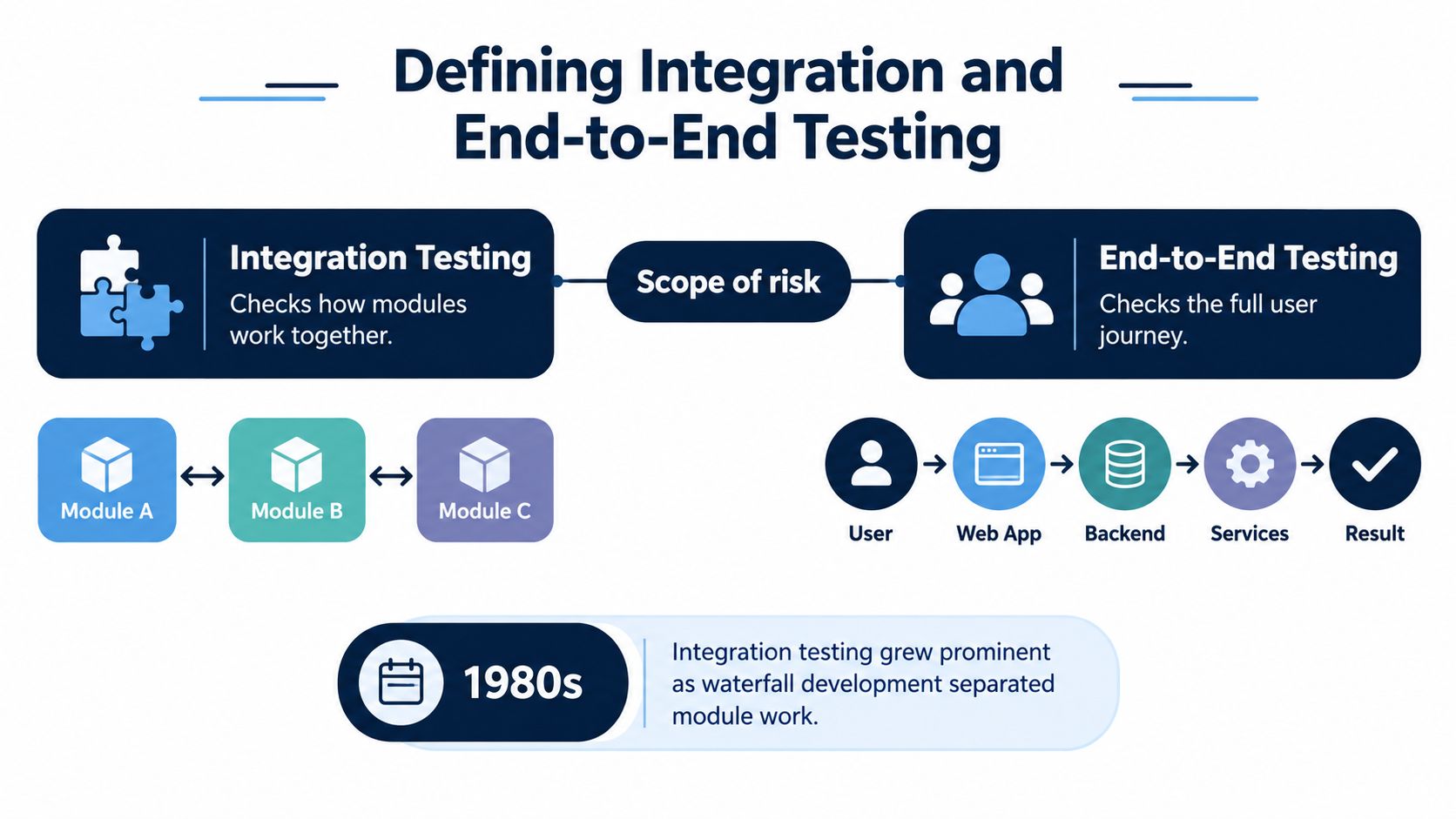
Consider a purchase involving a bank payment provider. An integration check could verify that the payment service communicates correctly with the order service and that the order records the expected authorization result. That establishes evidence about a selected collaboration.
An end-to-end check would start with the customer placing an order, continue through payment authorization and inventory updates, and verify confirmation and the completed purchase. The outcome depends on the assembled workflow, not merely the payment response.
- Integration evidence: The selected participants exchange and interpret information correctly.
- End-to-end evidence: The customer can complete the intended business journey across those participants.
The distinction also explains why API testing isn't automatically integration testing. Ask what the API check exercises, rather than classifying it by transport alone. This guide to API testing in software testing provides useful context for specifying that scope.
For team documentation, use descriptions such as “order-to-payment authorization check” or “customer checkout through confirmation.” They communicate more than an unqualified “integration test” or “E2E test.”
Comparing Scope, Speed, and Diagnostic Value
The most important difference isn't visible in execution time alone. A test can reveal a serious customer-facing failure while providing weak evidence about its cause. That distinction separates release confidence from diagnostic confidence.
Use the following comparison as a scope-based guide, not a promise about every implementation. A poorly bounded integration suite can involve substantial setup, while a carefully selected end-to-end journey can remain manageable.
Integration vs End-to-End Testing at a Glance
| Criterion | Integration Testing | End-to-End Testing |
|---|---|---|
| Primary scope | Selected component interactions and contracts | A complete business or user journey |
| Main question | Do these participants collaborate correctly? | Can the user achieve the intended outcome? |
| Execution characteristics | Focused scope supports earlier, faster feedback | Broader execution generally requires more work |
| Change exposure | Selected interfaces, data behavior, and dependencies | Changes across the participating workflow |
| Diagnostic value | Narrows investigation to a defined boundary | Establishes journey failure, but may leave several causes open |
| Confidence provided | Confidence in a specific collaboration | Confidence in the assembled business outcome |
| Main limitation | Doesn't establish that the complete journey works | Doesn't necessarily identify the broken contract |
Read speed and brittleness through scope
A focused order-to-payment check doesn't need to reproduce the customer's entire shopping session to inspect the payment handoff. That's why narrow scope is useful for feedback: the team can ask a specific question without arranging every prerequisite for a complete purchase.
However, faster doesn't mean more valuable in every situation. If the release risk concerns the customer's completed purchase, a fast check of a payment response doesn't answer the whole question. Comparing runtime without comparing the evidence can lead teams to optimize the wrong thing.
Maintenance follows a similar logic. An end-to-end test encounters changes across its journey, while a narrow integration check concentrates on a selected boundary. Neither category is guaranteed to be stable: unclear assertions, uncontrolled data, or unstable dependencies can weaken either approach.
A broad failure tells you where the customer loses value. A focused failure should help you identify where the system broke its agreement.
Diagnostic value deserves its own evaluation. If checkout fails after payment authorization, the investigation may involve order persistence, inventory, confirmation, or the displayed result. The test establishes an incomplete purchase, but the failure location alone may not identify the responsible component.
By contrast, a check that asserts how the order service interprets an authorization response has fewer competing explanations. Its conclusion is narrower, which is precisely why it can be more useful to the engineer making that change.
The trade-off is therefore breadth of outcome evidence versus precision of failure evidence. Neither dominates the other. A release decision needs the former for critical journeys, while efficient investigation benefits from the latter at important boundaries.
Choosing the Right Test for Each Scenario
Consider these as hypothetical design decisions, not reported customer results. The useful question in each situation is what changed and what remains uncertain.
A service contract changes
A team changes the payment authorization response consumed by its order service. The immediate concern is whether the consumer still interprets the response correctly, including unsuccessful outcomes.
Start with an integration check at that boundary. Exercise the producer and consumer behavior relevant to the changed contract, and assert the resulting order state. A full checkout test would involve extra behavior without necessarily examining the contract variations that prompted the concern.
A contract-level check is useful when the question concerns compatibility of expectations. An integration check that exercises connected behavior can then address whether the application handles the exchanged data correctly. Be explicit about which evidence the chosen setup supplies.
Checkout must work as an assembled journey
Now suppose the release changes checkout orchestration across payment, inventory, and confirmation. Each selected connection may behave correctly while the assembled sequence still fails to deliver the intended result.
Use an end-to-end journey to establish whether a customer can finish the purchase. Define completion in business terms: an authorized payment alone isn't the same as a completed order with the expected inventory and confirmation behavior.

A mobile client depends on an external adapter
A mobile team updates the adapter between its application and an external provider. Here, separating the questions is more useful than selecting a single test category.
- Inspect the adapter boundary: Verify how provider responses become application-level results, including the failure behavior the client must handle.
- Confirm the mobile outcome: Retain a journey that demonstrates whether the customer can complete the dependent task.
- Declare substitutions: If the provider is replaced during testing, state that the result doesn't establish live-provider compatibility.
Prioritize integration evidence when uncertainty is concentrated in a changed interface. Prioritize end-to-end evidence when uncertainty concerns orchestration or completion across the product. Use both when the release changes a boundary whose behavior also matters to a critical journey.
The decision isn't based on whether the feature is “backend” or “mobile.” Choose according to the claim you need to establish, then check whether the test environment can support that claim.
Diagnosing Failing End-to-End Tests Without Losing Signal
A failing end-to-end test isn't automatically a product defect, but it isn't harmless noise either. The team must distinguish a genuine journey failure from a problem in the test, its data, or its environment.
The supplied research on end-to-end testing and maintenance describes E2E testing as the slowest and most expensive testing layer and highlights maintenance burden. Asynchronous behavior, test data, and timing dependencies are important areas to investigate when a test behaves inconsistently. Rerunning until green doesn't resolve the uncertainty.
Preserve evidence before choosing a disposition
Capture the first failing run's relevant logs, requests, state, and assertion results. Locate the earliest observation that diverged from the expected behavior, rather than treating the final visible error as the cause.
Then apply an explicit policy:
- Retain: Keep the journey when it protects a high-value outcome that a lower-level check can't represent. Improve its observability if diagnosis is difficult.
- Decompose: Add or strengthen focused checks when the failure belongs to a service contract or component. Keep only the journey assertions that provide distinct outcome evidence.
- Quarantine temporarily: Assign a named owner, an expiration date, and a replacement validation method. Quarantine should create a repair obligation, not erase the risk.
- Delete deliberately: Remove a test when its requirement is obsolete or its evidence is redundant. Record what now protects the relevant behavior.
Failure policy: Don't delete a customer-risk signal merely because the team hasn't made it reliable. Decide how that risk will be checked while the signal is repaired.
Measure whether failures help decisions
Track pass/fail validity, time to diagnosis, rerun rate, and escaped defects instead of relying on raw automation coverage. Define these measures consistently so the team can distinguish a better product signal from a quieter dashboard.
Pass/fail validity asks whether the result correctly represented the intended behavior. Time to diagnosis asks how long the team needed to identify the responsible boundary. Rerun rate exposes repeated verification work, while escaped defects help reveal risks the suite didn't establish.
Use test automation reporting tools to make those relationships visible. A report should help an engineer determine what failed, what evidence supports the diagnosis, and whether the release remains blocked.
Impact on Release Risk and CI/CD Pipelines
Pipeline placement should follow the evidence needed at each decision point. Early feedback should help developers assess a change. Later checks should establish whether the assembled candidate is safe enough to release.
DORA's continuous-delivery guidance emphasizes fast, reliable automated tests and describes broader acceptance and nonfunctional checks against software deployed to a running environment. It also sets a demanding reliability standard: tests should indicate real defects, rather than forcing teams to tolerate flakiness.
Give each stage a distinct gate
A practical pipeline can run focused integration checks on pull requests, then exercise selected end-to-end journeys against a deployed candidate. This is a recommended arrangement, not a rule that every integration test must run early or every journey must wait until release.
Environment requirements still matter. A test belongs at the earliest stage where the required dependencies and conditions can produce trustworthy evidence.
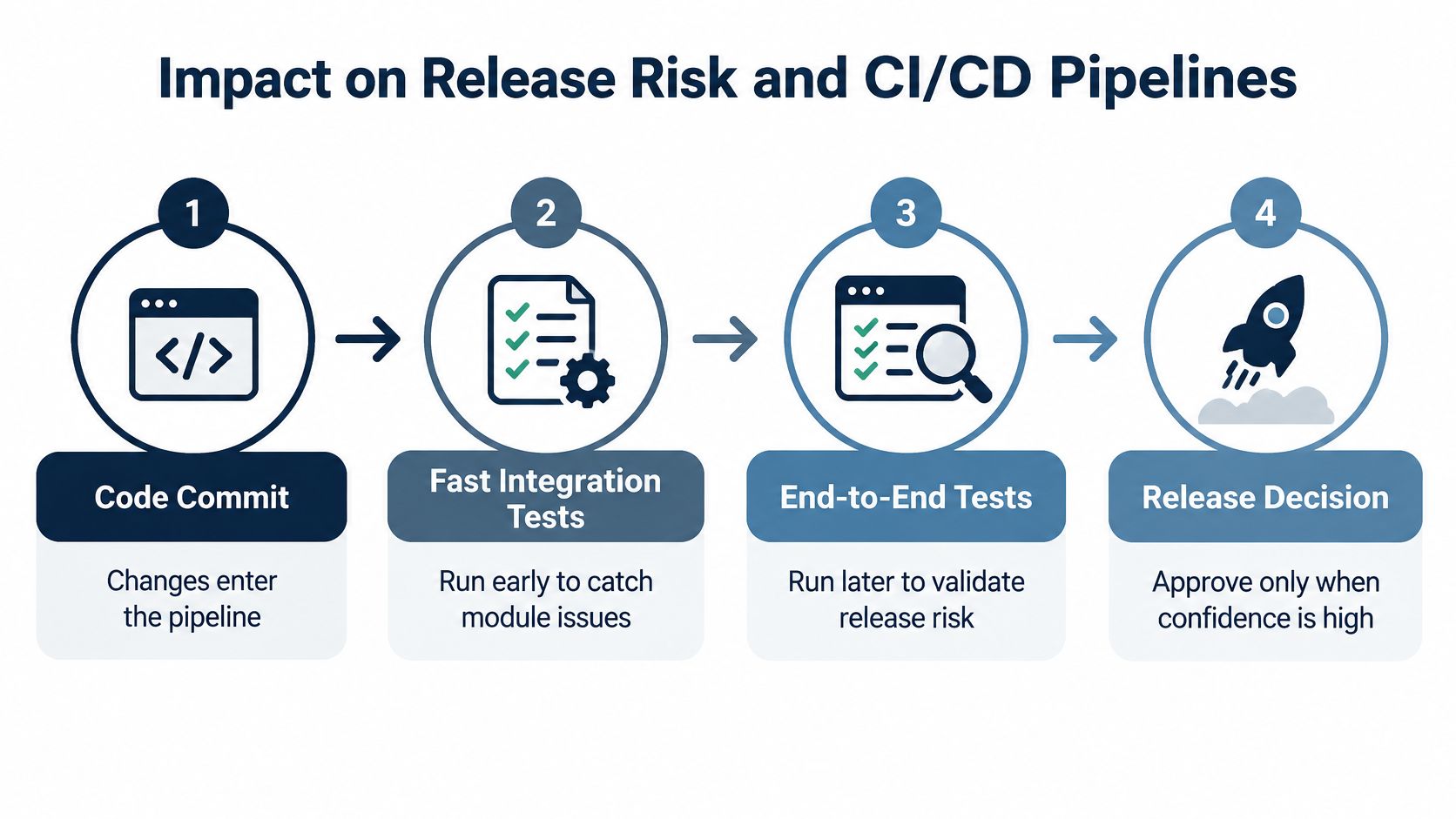
- Code commit: Identify the changed behavior and the boundaries it could affect.
- Integration gate: Require the relevant collaboration checks to pass before accepting the change.
- Journey gate: Validate selected business outcomes in the assembled candidate.
- Release decision: Review failures, known gaps, and any explicit acceptance of unresolved risk.
Treat a gate as a decision contract
For each blocking check, specify what failure means, who investigates it, and what permits the pipeline to continue. Without that agreement, engineers may interpret the same red result as a product defect, an environment issue, or an acceptable exception.
A trustworthy checkout failure should block release when it demonstrates that customers can't complete a critical purchase. An inconclusive test failure calls for investigation and an alternative way to establish the outcome. It doesn't justify treating an unverified journey as safe.
Use risk-based software testing to decide which unresolved conditions require a stop. The decision should account for customer impact and available evidence, not whether the pipeline can be made green.
An approved exception should identify the unresolved behavior, the person accepting the risk, and the evidence supporting that decision. A release gate is valuable only when the team understands what passing or bypassing it means.
Combining Both Tests in a Practical Strategy
Build a boundary map, not a target ratio of test types. Begin with the business journeys that would make a release unacceptable if they failed, then trace the production boundaries each journey depends on.
For checkout, the map might connect authorization, order state, inventory, and confirmation. For onboarding, it might connect account creation, authentication, permissions, and access to the intended product experience. Cross-platform journeys should identify where web and mobile clients depend on shared behavior and where their completion paths differ.
Rank the boundaries before funding coverage
Use a lightweight worksheet to make prioritization explicit. The following criteria are a proposed decision method, not a scoring formula that guarantees an optimal suite.
| Decision factor | Question for the team |
|---|---|
| Customer impact | What can't the customer accomplish if this boundary fails? |
| Change frequency | How often do we alter either participant or their agreement? |
| Failure cost | What operational, financial, security, or compliance consequences follow? |
| Diagnostic value | Would a focused check materially narrow the investigation? |
Assign integration or contract evidence to high-risk boundaries. Reserve end-to-end checks for outcomes whose value depends on several boundaries working together. For AI workflows, distinguish the boundary's input and output obligations from the complete user task; don't assume that a successful request establishes a satisfactory outcome.
Turn the map into an operating agreement
For every selected risk, record the test that supplies evidence, the pipeline stage where it runs, the owner, and the response to failure. Include environment assumptions so reviewers know whether a passing result relied on substituted dependencies or a deployed system.
- Payments: Separate authorization compatibility from completed-purchase evidence.
- Authentication: Identify both the identity handoff and the customer's resulting access.
- Onboarding: Define the usable final state, not just successful account creation.
- Cross-platform behavior: Record which client-specific outcomes require their own validation.
Start with a small, manageable set of critical journeys and review the map with engineering and product owners. Look for unsupported assumptions, duplicate assertions, and checks whose failures no longer influence a decision.
Decide whether your team can own the mapping, framework work, and pipeline integration internally or needs an outside QA partner. Evaluate either route against maintainability and diagnostic usefulness. The practical goal is a defensible release decision: clear evidence about important boundaries, clear evidence about customer outcomes, and a clear response when either fails.
AskYourQA offers test strategy, critical-journey prioritization, and CI/CD-integrated automation across frontend, backend, APIs, and mobile. Visit AskYourQA to discuss mapping your production boundaries and building complementary integration and end-to-end coverage around the risks that matter to your releases.