
API testing is the systematic validation of an API's externally observable behavior without relying on its user interface. You're testing endpoints, methods, headers, authentication, request bodies, response schemas, status codes, error handling, state transitions, and downstream integrations directly, the way real clients call them.
Table of Contents
- What Is API Testing in Software Testing
- Checks That Prove an API Contract Holds
- REST gRPC GraphQL and WebSocket Differences
- Choosing the Right Layer for Each API Check
- Authorization Failures a Green Suite Can Hide
- How to Choose an API Testing Approach
- Test Case Patterns and Your Next CI/CD Step
What Is API Testing in Software Testing
Your release looks clean. The web screen loads, the checkout button works, and nobody on the team sees an error. Then a partner messages you that their integration just started receiving an empty field, or your mobile app shows a spinner because a status code changed from what the client expected.
That's the gap API testing covers. When people ask what is API testing in software testing, the useful answer isn't that you send a request and check a response. It's that you validate externally observable behavior without going through the screen, so you see the contract your clients depend on.
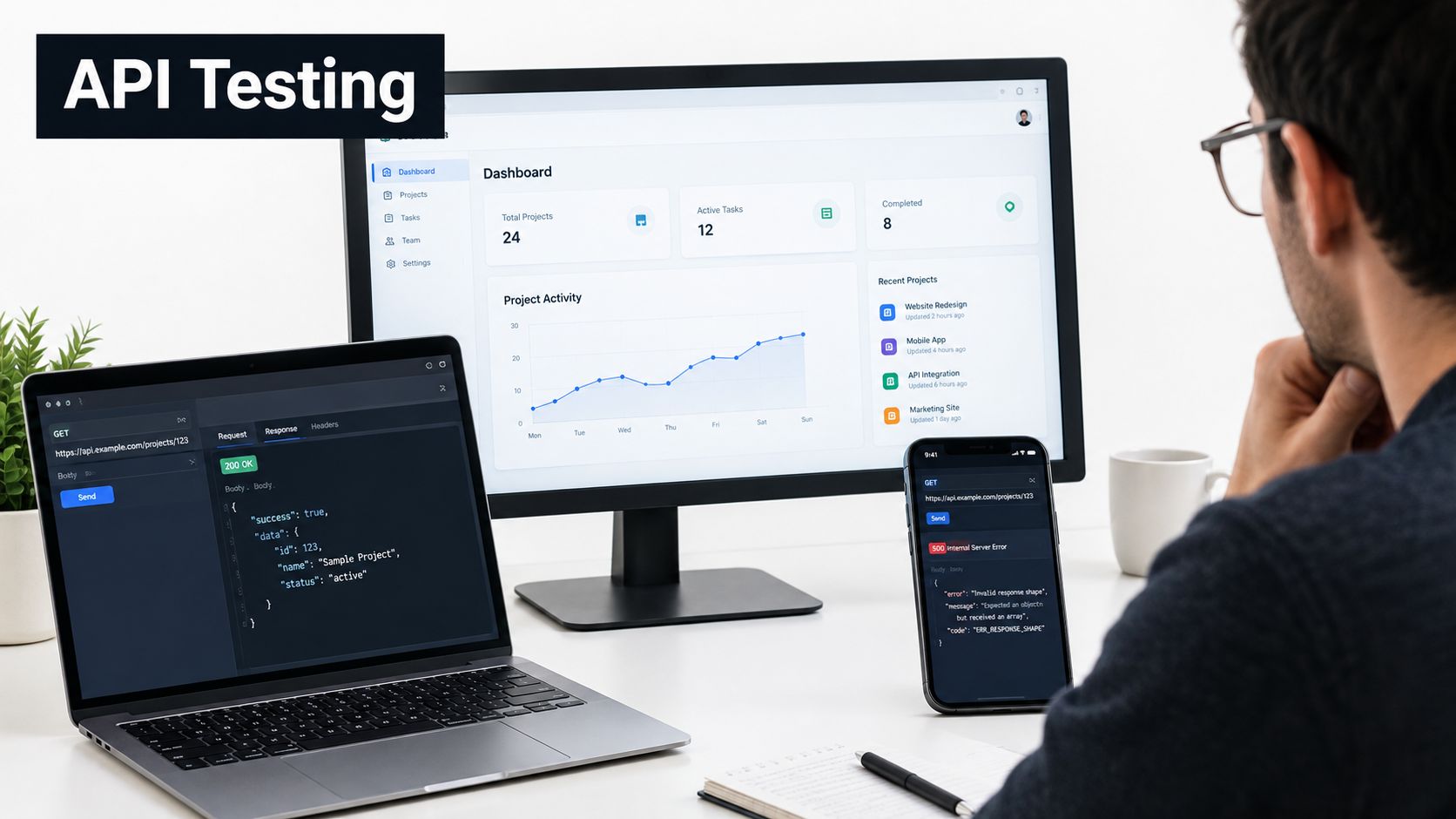
What a test actually touches
A single API test might call GET /orders/123 with a valid token and check that the response returns the documented status, the right content type, and an order object with the expected fields. Another test changes one thing, such as removing the token, sending the wrong type for a field, or asking for an order that doesn't exist.
Those small variations cover a lot of surface:
- Endpoints and methods: the operation you're calling and whether it behaves as documented
- Headers and authentication: content types, tokens, and identity rules
- Request and response bodies: field names, types, required values, and response schemas
- Status codes and errors: whether success and failure are reported clearly
- State transitions: whether creating, updating, then reading a resource leaves it in the expected state
- Downstream integrations: whether a call that depends on another service still returns a coherent result
Why clicking the UI isn't enough
A UI can hide a broken contract. Your web app might fill a missing value with a default, ignore an extra field, or retry after a failure. A mobile build from last month or a partner's server won't be that forgiving, because they're reading the raw response.
Practical rule: If a client you don't control can call it, test the response they'll receive, not just the screen you'll see.
That's why this isn't a tool catalog question. The key decisions are which checks prove a contract holds, how those checks change across protocols, where each check should live in your pipeline, and which authorization failures slip past a functional suite that looks green. Get those decisions right and the tools become the easy part. Get them wrong and you'll have hundreds of passing tests that still let a breaking change reach a client.
Checks That Prove an API Contract Holds
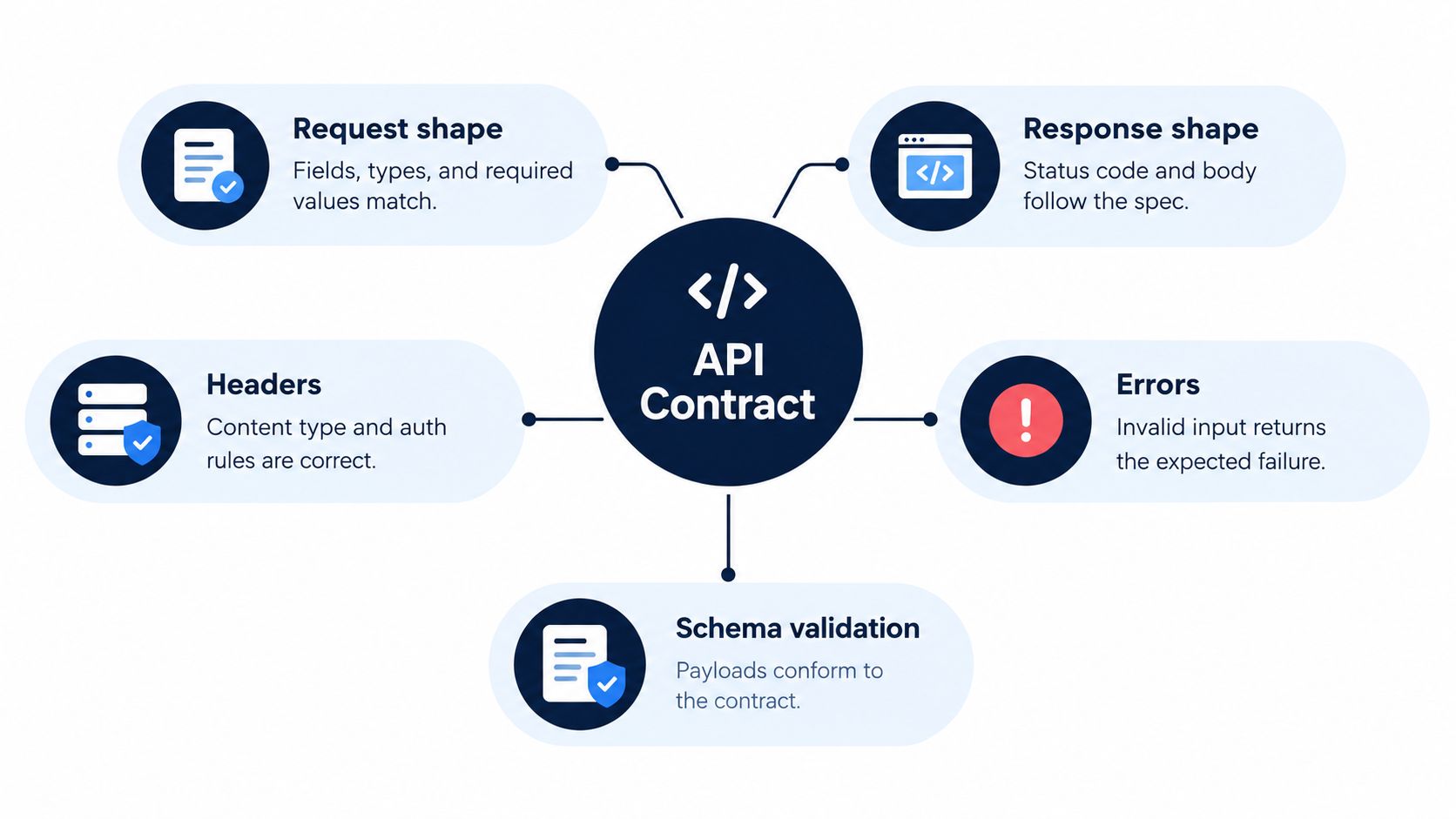
Treat your OpenAPI document, or the equivalent contract for your protocol, as an executable specification. It isn't documentation that someone wrote once and left to drift. It's the source your tests run against, so if the implementation and the contract disagree, a test fails.
The diagram below maps the parts of that contract you'll assert again and again.
Positive cases prove the happy path matches
Start with a valid request. Send correct fields, a correct token, and values inside the allowed range. Then assert more than a 200 status.
Check the response shape against the schema, confirm required properties are present, and verify enum constraints so a status field only returns documented values like pending or shipped. Check the content type too, because a client expecting JSON can't usefully parse a success response that arrives as plain text.
For list endpoints, assert pagination behavior, such as page size and the cursor or offset rules. For create or update calls, test idempotency where it applies, so repeating the same safe request doesn't create duplicate records.
Negative and boundary cases prove the edges hold
Now send requests that should fail in a controlled way:
- Missing fields: omit a required property and expect a specific client error, not a crash
- Incorrect types: send text where a number belongs
- Empty values: send an empty string, an empty array, or null where the contract forbids it
- Maximum lengths: send a value at the limit, then one just past it
- Extreme numeric values: send zero, negative numbers, or very large numbers where they're invalid
Weak APIs get exposed when an endpoint passes its happy path test but still violates the contract by returning undocumented fields, using the wrong error code, accepting input it should reject, or throwing a server exception.
OWASP's DevSecOps guidance on API security testing recommends schema and contract testing with positive, negative, and boundary cases, and states that invalid requests should return controlled errors rather than HTTP 500 responses or sensitive data leaks. That distinction matters to a client developer, because a clear validation error is something they can handle and show to a user.
A
200response only tells you the server didn't fail. It doesn't tell you the contract held.
The same idea carries beyond REST. GraphQL schemas, gRPC protobufs, and WebSocket message contracts all define shapes that tests can validate. And whatever the protocol, backward compatibility belongs in the assertion set, because removing a field that clients still read is a breaking change even if every new test you wrote passes today. In CI/CD, those contract checks should run on every provider or consumer change, with failures blocking merges when a breaking change shows up.
REST gRPC GraphQL and WebSocket Differences
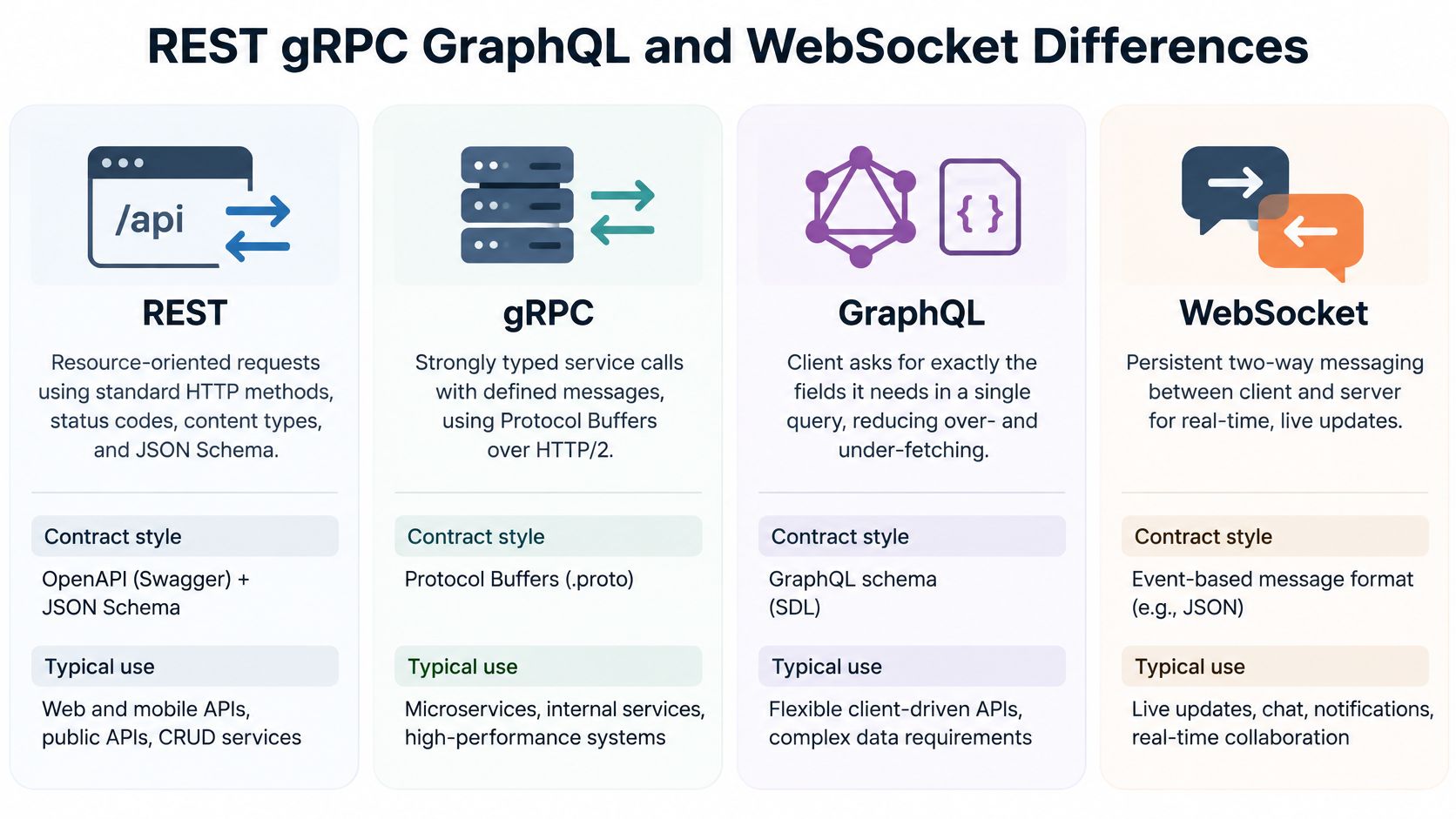
The contract idea stays the same across protocols. What changes is how the contract is written down, and therefore what a test asserts and what a false pass looks like.
The comparison below gives you the quick visual before we walk through each style.
REST and gRPC
REST is resource oriented. You call endpoints like /users/42/orders, and status codes, content types, and JSON Schema carry most of the contract. A typical assertion checks that creating an order returns the documented success status and a body that matches the schema, including required fields. A false pass looks like this: the test checks only that the status is successful while the server renames a field your mobile client reads.
gRPC replaces ad hoc JSON with strongly typed protobuf service definitions. The generated contract defines messages and methods, and gRPC has its own status model separate from HTTP codes. A tester asserts that a call with a valid message returns the expected response message, and that invalid input returns the documented gRPC error status. The false pass is testing only unary calls while a streaming method drops messages or ends the stream early.
GraphQL and WebSocket
GraphQL usually exposes a single endpoint, so route level thinking breaks down. The risk lives in the schema and the query, in nullability, in clients over-fetching fields they shouldn't need, and in authorization that must apply per field rather than per route. A useful assertion asks for specific fields and confirms the response contains exactly the allowed shape for that identity. The false pass is a query that returns data successfully for an admin test account while the same field leaks to a regular user.
WebSocket is a long-lived conversation, not one request and one response. Message order, reconnect behavior, and event payloads matter more than a single status code. A tester subscribes to an event, triggers an action, and asserts the right message arrives in the right format. The false pass is confirming the connection opens while never checking what happens after a reconnect, when messages can duplicate or arrive out of order.
The video below walks through API testing concepts you can map onto whichever style your team ships.
Most real estates mix these styles, maybe REST for partners, gRPC between services, GraphQL for the web client, and WebSocket for live updates. A REST-only checklist under-tests that product. The next decision isn't which protocol wins. It's which test layer should own each check you've just seen.
Choosing the Right Layer for Each API Check
Here's the trap many teams fall into. Unit tests are fast, so teams pile checks into them, but a unit test with mocked dependencies can't prove two real services agree on a contract. So teams swing the other way and build broad end-to-end suites that deploy everything together, and those suites run slowly and break for reasons nobody can trace quickly.
Consumer-driven contract testing is the middle layer that resolves that false choice. A consumer records the interactions it expects, such as the request it sends and the response fields it uses. The provider then verifies those expectations on its own, without standing up every dependent service.
Where an API check belongs
| Layer | Best question it answers | What it should not replace |
|---|---|---|
| Schema validation | Does this response match the documented contract shape | Checks that a real consumer can still use the fields it needs |
| Consumer contracts | Did the provider break an interaction a known consumer depends on | Full business journeys across several services |
| Integration tests | Do these components, data stores, or services work together correctly | Fast feedback on every small change |
| Business-critical journeys | Does the whole flow a customer pays for still work end to end | Broad contract coverage for every endpoint |
A review of microservices testing hosted by the University of Helsinki recommends combining unit, component, consumer-driven contract, and selective end-to-end tests rather than treating API testing as one test type. It also describes contract testing as valuable for REST, GraphQL, and message-based systems, so this placement logic isn't REST-only. If you're working through the wider service environment, this guide to testing microservices covers how those layers fit together in a distributed system.
The ownership questions tool lists skip
Placement is only half the decision. The other half is socio-technical, and it's often harder than picking a framework.
Decide who owns the contract when a consumer needs a change. Decide how versions move, what counts as a backward-compatible change, and how long an old version stays supported. Adding an optional field is usually safe. Removing a field, renaming it, or tightening validation usually isn't.
Promotion rule that works: A provider or consumer change that breaks a verified contract blocks the merge. No exceptions filed as tickets for later.
That rule only works if teams communicate before the red build, not after. A consumer team that records a new expectation is really making a request to the provider team, and both sides need a shared habit for reviewing it. Keep the end-to-end layer small and deliberate, a few journeys that represent real revenue or real risk, and let contracts do the heavy compatibility work underneath.
Authorization Failures a Green Suite Can Hide
Run this test in your head. User A logs in, requests their own order, and gets a valid payload with the right schema and status. The suite is green. Now User A changes the order ID in the request to User B's order, and the API returns that order too. Nothing in your functional suite fails, because you never asked that question.
That's the blind spot. Functional correctness tells you an endpoint returns valid data. It doesn't tell you the data went to the right identity.
The checks functional suites usually skip
Stronger coverage needs tests written around identity and abuse, not just payloads:
- Object-level authorization: one user requests another user's record by ID and must be refused
- Horizontal access control: a user tries to act on a peer's resources at the same privilege level
- Vertical access control: a regular user attempts an administrative operation, the classic privilege escalation path
- Token handling: expired tokens, tokens for the wrong audience, and missing tokens are rejected consistently
- Rate-limit and abuse testing: repeated or automated calls hit the limits you intended
- Malformed-input and fuzz testing: unexpected payloads return controlled errors and don't expose internals
- Data leak checks: error messages and older API versions don't reveal sensitive fields
OWASP-oriented API testing guidance emphasizes testing token handling, privilege escalation, and horizontal and vertical access-control failures, not just whether an endpoint returns the expected payload. The scale behind that advice is worth sitting with. Imperva reported more than 40,000 API incidents across 4,000-plus monitored environments during the first half of 2025, averaging about 220 incidents per day, as cited in that same guidance summary.
Authorization is business logic not a security add-on
Your APIs serve web clients, mobile apps, partners, and internal services, often through the same endpoints. When an endpoint exposes another customer's record, that's not a niche security finding. It's the product behaving incorrectly for a real user journey, and it erodes trust faster than a visible crash.
That's why the direction is layered API assurance, combining static analysis, dynamic testing, fuzzing, and runtime monitoring instead of relying on one functional regression run before release. Each layer catches a different failure shape, and no single layer sees them all.
If you want the deeper security checklist behind these cases, this guide to security testing for APIs walks through the approach in more detail. The habit to build first is simple though. For every endpoint that returns user-owned data, write at least one test where the wrong user asks for it, and make the expected refusal part of your definition of done.
How to Choose an API Testing Approach
Choosing an approach isn't about collecting tool logos. It's about who designs the checks, who maintains them when the API changes, and whether the suite gives you signal you trust on every pull request. Three patterns show up in most organizations.
Three ways teams organize the work
A script-heavy suite owned by one engineer starts fast. One person writes request scripts for the endpoints they know, and early coverage feels good. The weakness appears when that person is away, when protocols multiply, or when scripts assert payloads without a clear contract strategy behind them. Maintenance becomes archaeology.
A framework the product team maintains spreads ownership. Developers and QA engineers share conventions for test data, environments, and assertions, so new endpoints get checks as part of normal delivery. This works well when the team has time to design the framework properly and agreement on which journeys matter most. It struggles when delivery pressure means the framework itself never gets finished.
A system built by a specialized automation team starts from critical journeys instead of endpoint lists. That team maps the flows the business depends on, designs the framework architecture, and wires execution into the pipeline while the product team keeps shipping. The trade-off is coordination cost up front, because the mapping conversations have to happen before the building pays off.
Criteria that separate signal from noise
Whichever pattern you pick, judge it on a few concrete questions:
- Signal versus noise: when a test fails, can an engineer tell within minutes whether the API broke or the test rotted
- Protocol coverage: does the approach handle REST, gRPC, GraphQL, and WebSocket, or only the style you started with
- Pipeline fit: do smoke checks run on pull requests, fuller regression on merges, and release candidates get the business-critical journeys
- Room to grow: can security and performance checks join the same pipeline instead of becoming a separate program later
This is the model AskYourQA works in, as a QA automation consultancy that designs the automation system rather than assigning a single engineer. Its team covers functional API and protocol testing plus security and performance, integrates suites into CI/CD, and builds fewer high-signal tests instead of a large brittle suite. The stated proof points are 15+ years of QA automation experience and a 4.9/5 Clutch rating.
That structure speaks directly to the problems behind most struggling suites, slow sequential QA that delays releases, under-tested critical journeys, and noisy results nobody trusts. Your decision is really about which of those problems you're solving first, and which approach gives you trustworthy feedback before the next release, not after it.
Test Case Patterns and Your Next CI/CD Step
You don't need a hundred tests to start getting value. Four patterns cover the failure modes that matter most, and each one has a natural home in your pipeline.
Four patterns worth copying
Pattern 1, positive schema check. Send a valid create request, then assert the response status, required properties, and full schema match. Run it on every provider change, because it catches accidental renames and type changes the moment they land.
Pattern 2, boundary rejection. Send a field at its maximum length, then one character past it. The first request succeeds. The second returns the documented validation error, and not an HTTP 500. That single assertion protects every client's error handling.
Pattern 3, consumer contract change. The consumer records that it needs a new field, or still depends on an existing one. The provider build verifies that expectation and fails if a change breaks it. This runs on every provider or consumer change, and the failure blocks the merge until both teams agree on the change.
Pattern 4, cross-user authorization. Create a record as one user, then request it with a second user's token. Assert the API refuses. Run this in your regular regression set, and always before release, because it guards data your customers assume is private.
If you want a structure for writing these up clearly, this sample test case format shows how to document steps, data, and expected results so another engineer can maintain them.
Habits that keep the suite trustworthy
A few practices keep these patterns high-signal as the suite grows:
- Stable test data: create and clean up your own records instead of depending on shared fixtures someone else edits
- Explicit contract versions: tests name the version they verify, so an old client contract doesn't disappear unnoticed
- Blocking rules: breaking changes fail the build, while flaky infrastructure issues get quarantined and fixed, not ignored
- Risk-based reporting: reports show coverage and release risk, which critical journeys passed, instead of a raw pass count nobody can interpret
One trustworthy slice beats a wide suite the team has learned to ignore.
Here's your next step for this week. Pick one business-critical API journey, the flow your customers would notice first. Write its positive schema check, one boundary rejection, and one cross-user authorization check. Run that small slice on the next pull request and watch what it catches before you expand anything.
Once that slice is green and trusted, you'll know exactly which journey deserves the next set of checks, and you'll be building a system instead of a pile of scripts.
If you'd like that first critical journey mapped and turned into a high-signal API test slice wired into your CI/CD pipeline, AskYourQA designs and builds complete test automation systems covering functional, security, and performance testing. Visit the site to start a conversation about what that system would look like for your product and your release cadence.