
You've pushed a small fix, but your pull request is waiting on tests for features you didn't touch. Running everything feels wasteful. Skipping tests without a clear reason feels worse, especially when your team owns checkout, authentication, or another flow customers depend on.
Test impact analysis offers a middle path: use evidence about which tests exercise changed code to choose a smaller regression run. The shortcut is useful only if your team can also detect when that evidence is incomplete.
Table of Contents
- What Test Impact Analysis Means in Plain Terms
- Full Runs Versus Impact-Based Test Selection
- How Test Impact Analysis Selects Tests
- How Reliable Test Impact Analysis Selection Is
- Where Test Impact Analysis Misses Regressions
- Ranking Selected Tests by Risk and Impact
- Adding Test Impact Analysis to Your CI/CD Pipeline
- Start a Safe Test Impact Analysis Rollout
What Test Impact Analysis Means in Plain Terms
After an electrician rewires a circuit, an inspector checks the rooms connected to it rather than inspecting the entire building. That approach makes sense only if the circuit diagram is accurate. An undocumented connection changes what needs checking.
The same comparison helps explain change-based testing.

Test impact analysis, or TIA, selects tests connected to code that has changed. In a coverage-based implementation, the team combines two inputs: a previously recorded map of which tests execute which code, and the changes in the new commit.
Say a developer edits the shopping cart's discount calculation. The map connects that calculation to cart unit tests, a pricing API test, and an end-to-end purchase journey. TIA selects those tests while deferring an unrelated profile-photo test.
The important distinction: No recorded connection isn't the same as proof that a change cannot affect a test.
TIA doesn't choose randomly, and it isn't a tester guessing which checks look relevant. It makes an explainable selection using recorded relationships.
For a large suite, that can remove unnecessary work from a pull request. But understanding the selection rule is only the start. Teams also need to judge its reliability, recognize missing dependencies, prioritize useful failures, and control how skipping works in CI/CD.
Full Runs Versus Impact-Based Test Selection
Test selection strategies compared
| Strategy | How it chooses tests | Relative speed | Missed-regression risk | Best fit |
|---|---|---|---|---|
| Full suite on every change | Runs every test | Slowest for the same suite and resources | Lowest selection-related risk | Small suites or release gates |
| Test impact analysis | Runs tests linked to changed code | Faster when changes affect a subset | Low when mappings are current and dependencies are represented | Large suites with frequent pull requests |
| Predictive test selection | Picks tests likely to fail based on history | Faster when it selects a subset | Higher with sparse, noisy, or unrepresentative history | Teams with long, clean CI history |
| Manual test picks | Testers choose by experience | Fast for a narrow selection | Highest exposure to unmapped omissions | Very small projects |
Full-suite execution avoids selection omissions, but it still can't detect defects that the tests don't cover. It's the simplest choice when the complete run already fits your feedback window.
TIA provides a reason for including each selected test: a connection to changed code. Its usefulness rests on how well those connections represent the application.
Predictive selection answers a different question: which tests are likely to fail? Clean failure history matters because infrastructure failures and flaky tests can distort that signal.
Manual selection can capture business knowledge that tooling lacks, but individual memory isn't a repeatable dependency model. Use it to supplement systematic selection rather than replace it.
Choose around your actual bottleneck
Don't introduce selection machinery just because your suite is growing. First record the suite's wall-clock runtime, daily pull-request volume, and time developers spend waiting for actionable results.
If full runs are already quick enough, keep them. If repeated broad runs delay localized changes, investigate impact-based selection. Also check whether slow environment startup or poor parallelization, rather than test volume, is causing the delay.
How Test Impact Analysis Selects Tests
Selection is a lookup, not a guess. A coverage-based selector checks whether recorded test execution overlaps the code affected by a commit.
This diagram shows the core lookup before safety rules are added.
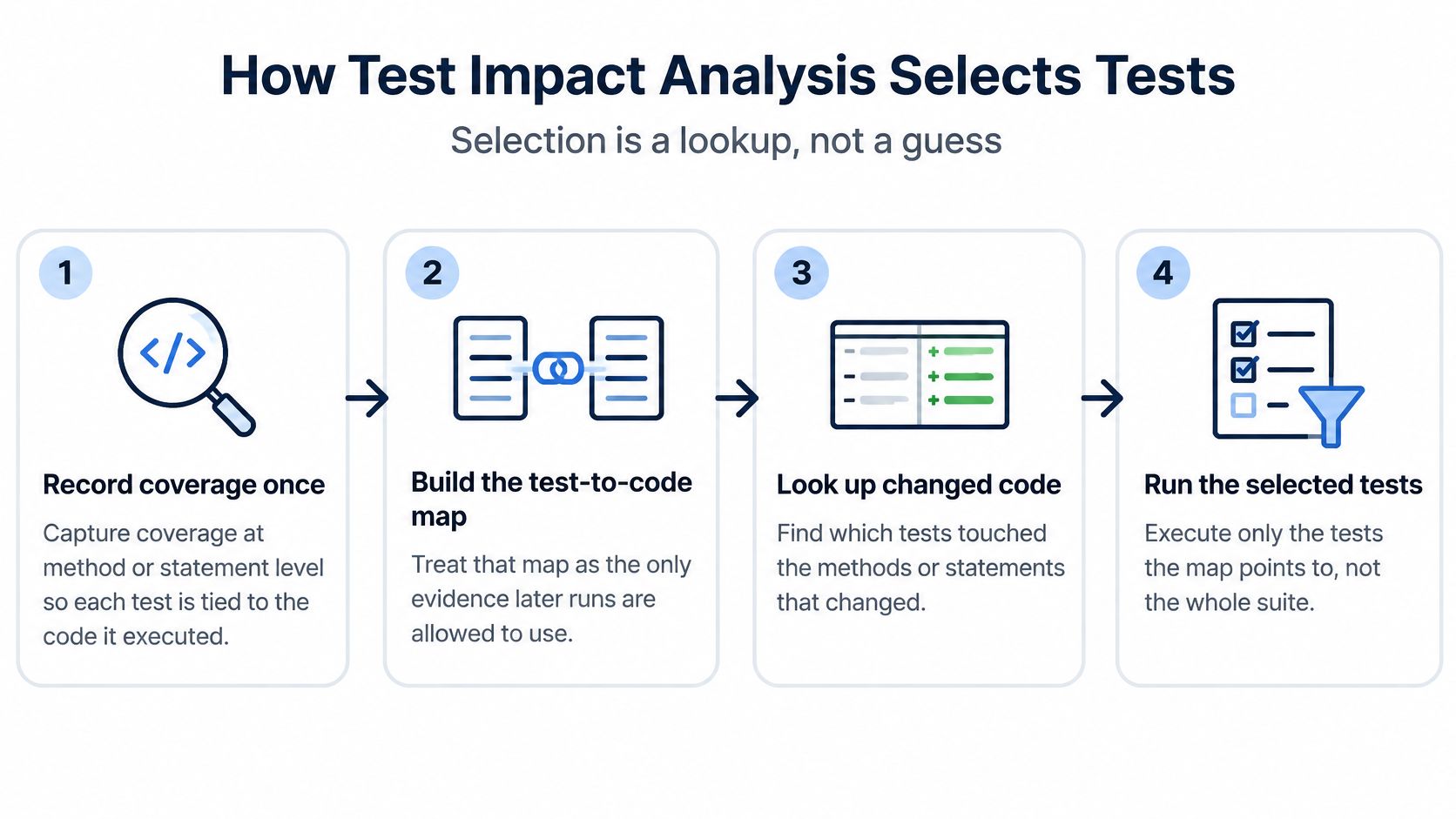
- Record per-test coverage. During a complete baseline run, capture the methods or statements each test executes. An aggregate coverage percentage isn't enough, because the selector needs test identities attached to code locations.
- Build the test-to-code map. Store those relationships as the evidence for later coverage-based decisions. Don't invent links because test names happen to resemble filenames.
- Identify changed code. Compare the candidate commit with its baseline and identify changed methods, classes, and files. Deleted or renamed code needs explicit handling rather than a failed lookup.
- Select connected tests. Include tests whose recorded execution touches affected code. Defer tests without a recorded connection only when the safety policy permits it.
- Add mandatory checks. Include the smoke tests that must run regardless of the lookup. These are policy-based additions, not evidence that the coverage map detected every effect.
- Order the resulting set. Start with tests closest to the change and those exercising strongly connected components. Selection determines membership; ordering determines when feedback arrives.
Check the map before trusting the lookup
Say a discount method moves into a shared pricing module. A selector using old code locations may fail to connect the purchase test to its new implementation.
New tests create a similar problem: until their coverage is recorded, the map has no execution evidence for them. Treat unknown tests and unmapped changes conservatively, rather than interpreting missing information as permission to skip.
Before enabling selection on pull requests, confirm that a service can produce usable per-test coverage from a complete run. Inspect a known code change and verify that the expected tests appear.
For a video companion to the selection workflow, use the embedded walkthrough.
How Reliable Test Impact Analysis Selection Is
A test impact analysis study covering real-world Java systems reported 99.26% overall reliability across 12 systems, with 90.6% reliability for the weakest individual system. Those results support using dependency-based selection for faster regression feedback, but they don't establish a guarantee for another application.
Reliability concerns whether selection preserves the tests needed to reveal regressions under the study's evaluation. It isn't the percentage of application code covered, the proportion of tests passing, or a promise that releases will be defect-free.
The difference between the overall result and the weakest system matters. A strong combined result can conceal a codebase whose dependency relationships are harder to capture.
A reliable selector is useful. A selector whose reliability your team never checks is an assumption.
Measure your own selection quality
Treat selection recall as a release-quality measure: among the regression-revealing tests found during a comparable full run, which ones did the selector include? Compare results on the same revision and investigate differences in environment, test data, and flakiness before classifying an omission.
Keep the study's reliability result separate from your operational metric unless you've reproduced its definition and evaluation method. Similar labels don't automatically mean identical measurements.
Assign an owner to review missed selections and define a fallback before enabling skipping. Missing coverage, unsupported code paths, or deteriorating recall should trigger a broader run.
Set your target based on product risk and the consequences of delayed detection. Record both the acceptable selection behavior and the conditions that suspend optimization.
Where Test Impact Analysis Misses Regressions
Were the skipped tests safe to skip? That's harder to answer than how many tests you avoided running. The CloudBees explanation of test impact analysis describes the dependency-mapping approach and its limitations, which matter when runtime behavior extends beyond visible code relationships.
Blind spots and safeguards
| Blind spot | Why it is missed | Safeguard |
|---|---|---|
| Reflection and dynamic loading | A static map may not see the runtime link | Run a conservative baseline suite on every change |
| Shared databases and configuration | The dependency sits outside the code diff | Widen selection for configuration and schema changes |
| Generated code | The source diff may not expose the generated behavior | Run scheduled full-suite audits and inspect generated outputs |
| API contract changes | Consumers aren't linked to the changed producer | Add contract tests for each interface |
| Flaky or outdated tests | Noisy results obscure failures and mappings become stale | Track flakiness, maintain tests, and rebuild the map |
These safeguards reduce exposure; none guarantees that every regression will be caught. A contract test, for example, must represent the consumer's actual expectations to be useful.
Consider a producer that changes a response field while its consumer lives in another repository. A local coverage map may correctly describe the producer's tests yet still omit the consumer journey that breaks.
Use a layered safety model
- Keep a conservative baseline. Run essential smoke, contract, and security checks independently of the selected regression set.
- Audit against complete execution. Use scheduled full runs to investigate failures that selection would have omitted. Preserve the candidate selection so the comparison is possible.
- Expand for high-risk changes. Authentication, payments, schemas, infrastructure, shared libraries, and production configuration should trigger explicit broader-test rules.
Use risk-based software testing to identify which changes deserve that expansion. Make the decision per test or test group, not as a single switch that turns testing on or off.
List your product's high-risk areas and attach a wider-run rule to each. Developers should be able to override selection when they know about a dependency the tooling cannot represent.
Ranking Selected Tests by Risk and Impact
Signals for ordering selected tests
| Signal | What it tells you | Example |
|---|---|---|
| Change proximity | The test covers modified code | Cart test after a cart logic edit |
| Structural coupling | The test exercises connected components | API test crossing dependent services |
| Historical failure rate | The test has revealed failures in this area | Login test that failed after authentication changes |
| Business criticality | The test guards revenue or compliance | Payment or account recovery flow |
| Escaped defects | The area has previously produced production bugs | Search journey linked to a past incident |
Selecting tests and ordering them are separate decisions. A slice-based test prioritization study used changed program regions and affected-component coupling to rank tests; its mutation experiments found that tests exercising those regions were more likely to reveal faults early.
That supports a practical starting point: execute tests near the change and strongly connected code early. Don't assume it establishes the best ordering for every suite.
Let business consequences override proximity
A nearby formatting test shouldn't automatically run before a selected payment test. Use business criticality to raise the priority of checkout, login, account recovery, and regulated workflows, even when another test has a closer technical connection.
Historical failures also need interpretation. A test that frequently fails because its environment is unreliable isn't necessarily a strong regression detector.
A review of AI-assisted testing identifies limitations in industrial validation, reproducibility, and downstream outcome measurement. Keep humans responsible for business-risk rules rather than allowing an automated score to authorize skipping critical checks.
Use explicit test case prioritization techniques to document how competing signals are resolved.
Measure useful feedback: An early infrastructure failure isn't the same as an early diagnosis of a product regression.
Track time to first actionable failure, selection recall, and escaped defects. A faster first failure is valuable only when developers can use it and the selection hasn't hidden more important failures.
Adding Test Impact Analysis to Your CI/CD Pipeline
Make selection a visible pipeline policy, not a command whose behavior only its author understands. Assign ownership for the coverage artifact, expansion rules, and audit results.
The integration needs both fast pull-request feedback and an independent release safety gate.
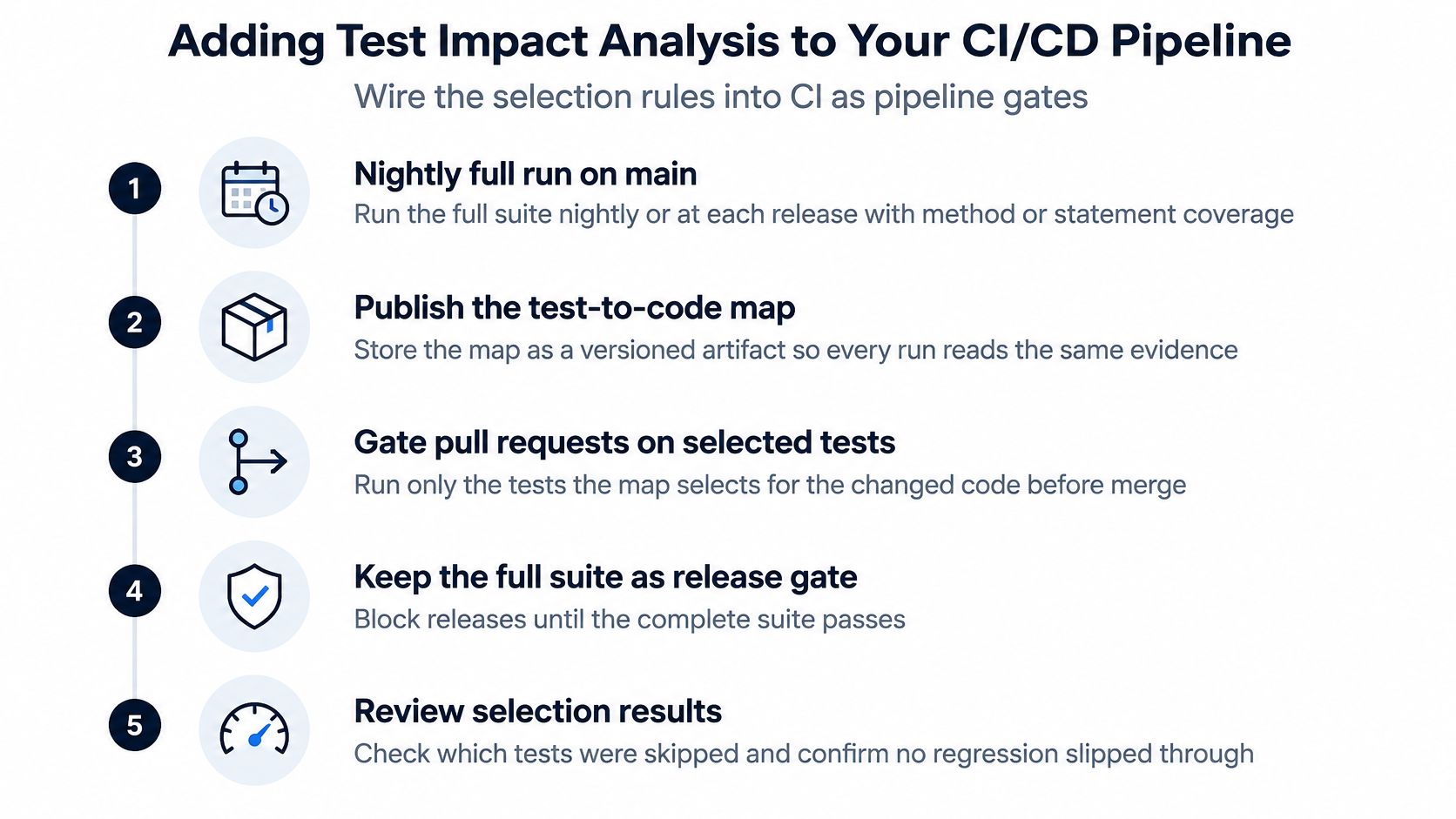
Wire selection into explicit gates
- Publish a trustworthy baseline. Run the full suite on main with method- or statement-level coverage, on a nightly schedule or at your release checkpoint. Publish the map with its commit, test inventory, and instrumentation version.
- Pin the artifact for each pull request. Download a compatible, identified baseline. Don't replace complete coverage with evidence from a partial run.
- Build the impacted set. Apply the commit diff to that baseline. Missing artifacts, incompatible versions, or unmapped changes should widen execution rather than produce an empty success.
- Apply mandatory policies. Run smoke checks and required high-risk groups. Configure broader runs for sensitive paths such as payment code, schemas, shared dependencies, and deployment configuration.
- Execute and report. Run the prioritized impacted set after required gates. Report the selected tests, policy additions, and time to first actionable failure on the pull request.
- Audit after merge. Run the full suite, or use a broader sample for intermediate checks while retaining complete scheduled audits. A sample alone cannot establish recall against the entire suite.
- Explain every skip. Log the baseline version and absence of a recorded dependency for skipped tests. Provide a developer-controlled full-run override.
Use your CI/CD pipeline test automation design to decide which failures block merges and which block releases. Keep the complete suite as a release gate while validating the optimization.
For applications with analytics events, Trackingplan's resource on automated tracking QA in release pipelines is also relevant when planning release checks beyond conventional functional assertions.
Pipeline review checklist
- Artifact integrity: The map matches a known successful complete run.
- Mandatory coverage: Sensitive changes activate broader test groups.
- Recall audit: Main retains evidence needed to investigate omissions.
- Skip visibility: Build logs explain selection decisions.
- Override path: Developers can request complete execution without editing pipeline code.
Start a Safe Test Impact Analysis Rollout
Put the pilot's acceptance measures on its ticket before skipping any tests: time to first actionable failure, selection recall against scheduled full execution, and escaped defects after release. Assign someone to investigate omissions, not just maintain the dashboard.
Choose a service with frequent pull requests and a regression runtime the team already finds disruptive. Prefer a service whose tests and dependencies are understandable enough to inspect, rather than beginning with the application's most interconnected component.
Prove the decision before using the shortcut
Start in shadow mode: calculate the selected set while still executing the full suite. Compare what the selector would have run with the tests that reveal regressions.
Once the evidence meets your target, enable skipping for eligible changes while preserving the independent audit. Don't expand to another service until recall remains acceptable across a sustained period and a representative mix of changes.
A quiet period with no regression-revealing failures doesn't prove the selector works. Review known incidents or use controlled fault injection to challenge whether the mapping would select the relevant tests.
- Name never-skip journeys: Start with checkout, login, account recovery, and regulated workflows.
- Record exit conditions: Suspend skipping when selection evidence is missing or quality falls below your target.
- Require an expansion decision: Treat each additional service as a new risk review, not a configuration copy.
At AskYourQA, we map the current testing process and identify where automation can help during discovery. That mapping should begin with the journeys the business depends on, not merely the checks that are easiest to automate.
Your first action is concrete: set the recall target, name the protected journeys, and run a single-service pilot with full-suite auditing still active.
AskYourQA offers a free 20-minute call to map your critical flows and show how fast the automation framework can be up and running. If you'd like help connecting those flows to a safer test impact analysis rollout and automated execution in CI/CD, visit AskYourQA to book the call.