
The usual advice about test strategy vs test plan starts with document templates. That's the wrong starting point. A perfectly formatted strategy won't tell your release manager whether an unresolved failure should block deployment, and a detailed schedule won't tell your CTO which risks the business has agreed to accept.
Separate these artifacts because they govern different decisions, not because you need more paperwork. Keep durable risk decisions in the strategy. Put change-specific commitments, exceptions, and release evidence in the plan.
Table of Contents
- Why the Distinction Matters More Than Most Teams Realize
- Defining Test Strategy and Test Plan Through Standards and Practice
- Side-by-Side Comparison Across Decision Horizon, Ownership, and Lifecycle
- Responsibilities and Ownership Across Roles
- Real-World Scenarios Where Each Document Earns Its Place
- Mapping Strategy and Plan to Automation and CI/CD Pipelines
- When to Skip, Merge, or Override a Plan
- Practical Checklist and Recommendation for QA Leaders
Why the Distinction Matters More Than Most Teams Realize
A testing document becomes useful when someone can make a decision with it. If your team can't identify who may reduce coverage, approve an exception, or accept an unresolved defect, another template won't solve the problem.
Treat the distinction as release governance. Engineering leaders establish the boundaries within which teams can ship. Release teams then demonstrate how a particular change meets those boundaries, or explain why an authorized exception is justified.
Diagnose the decision gap
Look at your most recent release discussion. Did engineers debate whether a failing check mattered only after it failed? Did someone remove a slow suite without recording which risk it covered? Those are governance failures, even when the test documentation looks complete.
Combining strategic rules with release tasks makes those decisions harder to inspect:
- Auditability: Reviewers can't distinguish an approved testing policy from a temporary workaround.
- Accountability: Teams confuse responsibility for executing checks with authority to accept business risk.
- Pipeline control: Engineers inherit blocking checks without a clear reason for blocking deployment.
- Change management: Someone edits a release checklist and unintentionally changes the organization's testing expectations.
My recommendation is to judge both artifacts by the decisions they support. Ask whether a new engineer could identify the release conditions without attending a planning meeting. Then ask whether a product leader could identify the remaining uncertainty without reading individual test logs.
Practical rule: If a testing decision affects future releases, treat it as governance. If it commits people and evidence to the current change, put it in the plan.
This doesn't require separate files. It requires an explicit boundary between reusable policy and release-specific execution. Without that boundary, teams can't tell whether they're adapting responsibly or lowering their standards.
Defining Test Strategy and Test Plan Through Standards and Practice
The distinction isn't just testing folklore. ISO/IEC/IEEE 29119-3 separates Organizational Test Strategy and Test Plan documentation, giving teams a defensible basis for treating them as different artifacts.
Use the following working definitions internally. They're practical paraphrases, not quotations from the standard.
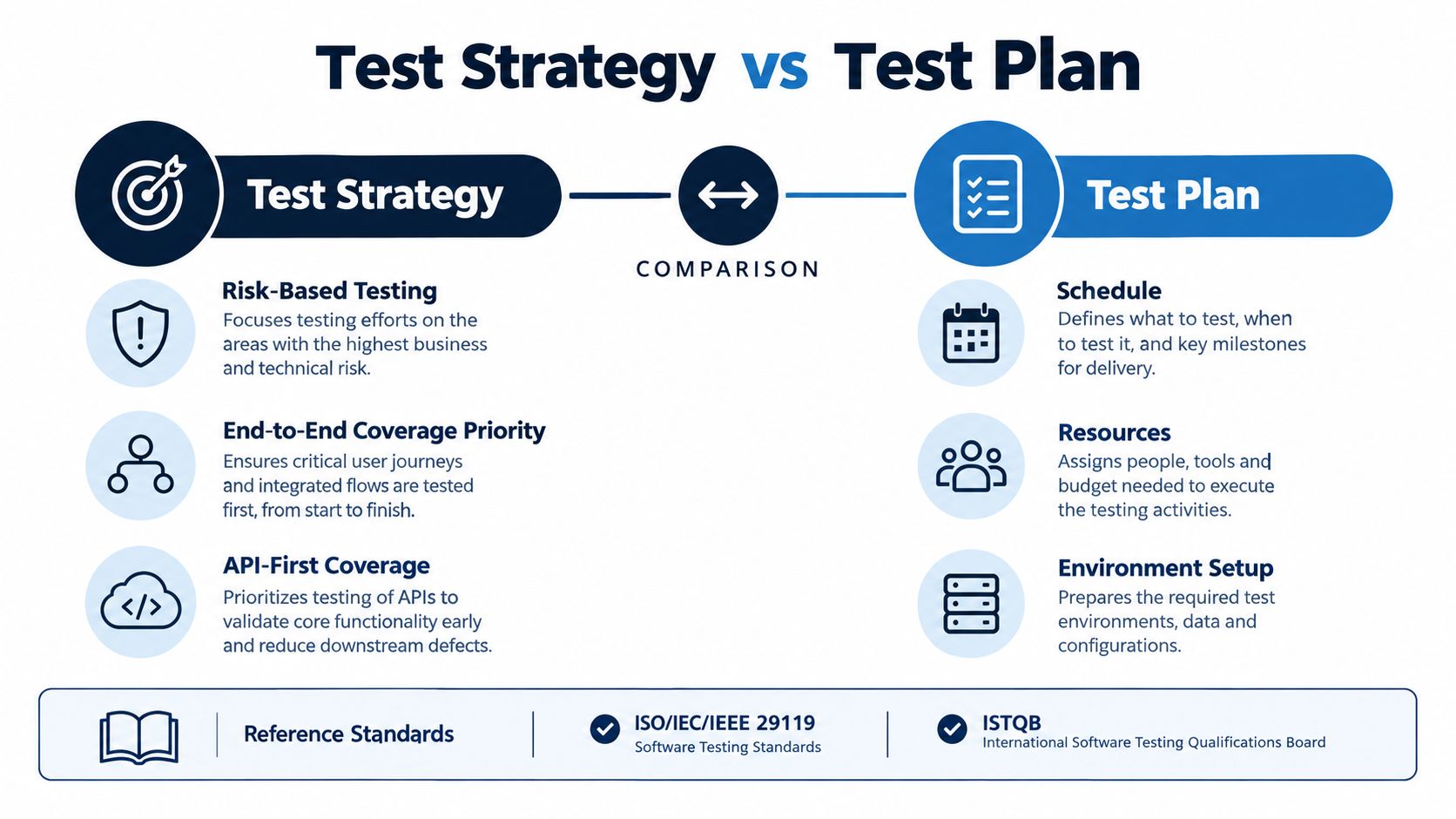
Test strategy: The durable decision framework for managing product quality risk, including testing priorities, test levels, automation boundaries, environments, defect governance, and quality objectives.
Test plan: The executable application of that framework to a bounded release, project, or testing activity, including scope, people, resources, execution arrangements, and completion criteria.
The concept map below illustrates the separation between testing principles and delivery arrangements.
Turn definitions into usable content
A strategy should contain decisions, not aspirations. “We care about quality” doesn't guide anyone. “Protect business-critical transactions through service-level checks and targeted end-to-end validation” gives engineers a basis for choosing coverage.
A plan should make that direction executable. Identify the affected transactions, required checks, environment constraints, evidence location, and person responsible for reviewing the results.
ISTQB-aligned test-planning guidance describes the plan as documenting objectives, resources, processes, means, and schedules while demonstrating adherence to the established strategy or explaining deviations. That last part matters: alignment doesn't mean copying the strategy into every release record.
Keep scope explicit in both definitions. A strategy may govern a product rather than an entire company. A plan may cover an integration activity rather than a complete release. Breadth alone doesn't determine the artifact's identity; the decision it controls does.
Avoid turning the hierarchy into a rigid approval chain. Engineers should be able to apply established rules without asking a committee to reinterpret them. Escalation belongs where a change exceeds those rules, not wherever someone needs to update a test case.
Side-by-Side Comparison Across Decision Horizon, Ownership, and Lifecycle
“High level versus detailed” is too weak a distinction for engineering leadership. A strategy can contain precise architectural constraints, while a plan can remain short. Compare them by decision horizon and measurable control instead.
Test Strategy vs Test Plan at a Glance
| Dimension | Test Strategy | Test Plan |
|---|---|---|
| Decision horizon | Recurring product or organizational risk | A bounded change, release, or testing activity |
| Recommended accountable owner | Quality Engineering leader | Release QA lead or test manager |
| Controls | Testing principles, architecture, escalation rules | Scope, execution, assignments, readiness evidence |
| Changes when | Risk assumptions or operating constraints change | The change under test or execution conditions change |
| Lifecycle | Maintained across releases | Updated during delivery, retained with release evidence |
| Measures | Whether the testing system supports quality objectives | Whether this change satisfies agreed release conditions |
| Excludes | Individual execution schedules | Unapproved changes to testing policy |
These ownership assignments are a recommended operating model, not mandatory job titles. Small teams can assign both responsibilities to the same person without collapsing the distinction.
Measure the right level
At the strategy level, review whether the testing approach produces useful feedback. Examine flaky-test rate, median feedback time, and defect escape rate as signals for investment decisions. A recurring environment problem may justify changing provisioning architecture rather than repeatedly extending release schedules.
At the plan level, inspect the evidence for the affected scope. Which critical journeys were exercised? Which environment produced the result? Which failures remain unresolved, and who accepted them?
Established test-plan structures include scope exclusions, pass/fail criteria, suspension and resumption rules, deliverables, responsibilities, schedules, risks, and contingencies. Use those categories selectively to make decisions inspectable, not to inflate the document.
Classify statements by their consequences
“Use service virtualization where an external dependency prevents reliable validation” belongs in strategy. It establishes a reusable architectural choice.
“This release uses the simulated payment dependency because the provider's sandbox is unavailable” belongs in the plan. It identifies a specific execution constraint and should explain what remains unverified.
A useful editing test is to remove the release name. If the statement still governs future work, it probably belongs in the strategy. If removing the release context makes it meaningless, keep it in the plan.
A strategy isn't a schedule. A plan isn't an architectural manifesto. Moving content to the right place should make both shorter and easier to maintain.
Responsibilities and Ownership Across Roles
Assign accountability before asking anyone to rewrite the documents. Otherwise, your most conscientious tester becomes the unofficial owner of business risk.
Assign decisions rather than paperwork
Make the Head of QA or Quality Engineering leader accountable for strategy maintenance. Require executive sponsorship for decisions involving risk appetite, investment, and acceptable customer impact. The quality leader can recommend a posture, but shouldn't unilaterally decide which commercial risks the company will accept.
Give the release QA lead or test manager responsibility for assembling the plan, coordinating execution, and keeping evidence current. Give the release manager responsibility for coordinating the promotion decision under the agreed approval rules.
Distribute contributing responsibilities explicitly:
- Developers: Maintain component-level checks, identify affected interfaces, and investigate failures associated with their changes.
- DevOps or platform engineers: Provide reproducible execution infrastructure, artifact retention, environment controls, and deployment mechanisms.
- Product managers: Identify business-critical behavior, resolve ambiguous acceptance expectations, and explain customer consequences.
- Security and performance specialists: Define relevant evaluation methods and review evidence in their domains.
Separate recommendation from acceptance
A QA lead may recommend shipping with a known defect. That doesn't automatically make them the appropriate person to accept its customer, security, or commercial consequences.
Record the acceptance decision with the authorized owner and a plain-language description of the exposure. “QA approved” is inadequate when the actual decision concerns incorrect billing or inappropriate AI output.
In a small team, the engineering lead may own both strategy and plan. Keep the responsibilities distinct anyway: changing an execution date is an operational update; removing a required security check is a policy exception.
For retrospectives, ask who supplied evidence, who interpreted it, and who accepted the remaining risk. Those questions produce a more useful accountability discussion than asking who last edited the document.
Real-World Scenarios Where Each Document Earns Its Place
Consider these hypothetical release scenarios. They illustrate recommended practice, not reported client results.
A SaaS permissions feature
A team is adding workspace-level access controls. Its strategy prioritizes business-critical journeys, favors API coverage for authorization rules, and reserves end-to-end checks for representative user interactions.
The release lead applies that direction through risk-based software testing. The plan includes role-assignment changes, unauthorized-access attempts, permission revocation, and interactions with existing sessions.
Rather than list “run regression,” the lead identifies the authorization suite, the workspace administration journey, seeded accounts with different roles, and the staging configuration. Exit criteria require expected access decisions and investigation of unresolved failures affecting protected actions.
The team discussion should focus on these concrete execution commitments.

The retained evidence connects each critical authorization rule to its result and unresolved issues. A green pipeline without that mapping would establish that checks passed, but not whether the team covered the relevant permissions risk.
An AI feature in a regulated product
Now consider an assistant that summarizes sensitive customer information. Assume the product's internal governance requires specialist review before release; don't infer a particular legal obligation from this example.
The default functional plan isn't sufficient. The release lead adds prompt regression, output-quality evaluation, sensitive-information handling, and safety guardrail checks. The plan records this extension, the review owner, and the reason for departing from the default template.
Evaluation inputs should include representative requests, ambiguous instructions, and adversarial attempts to expose restricted information. Expected behavior needs more detail than “the response looks correct”: reviewers need explicit acceptance conditions for factual consistency, permitted content, and refusal behavior.
The release evidence should identify the evaluated model configuration, prompt version, dataset, findings, and approval decision. If the team changes the prompt after evaluation, the previous result no longer establishes readiness for that changed configuration.
Both teams apply a common testing framework. Their plans differ because their risks differ, not because either team misunderstood the strategy.
Mapping Strategy and Plan to Automation and CI/CD Pipelines
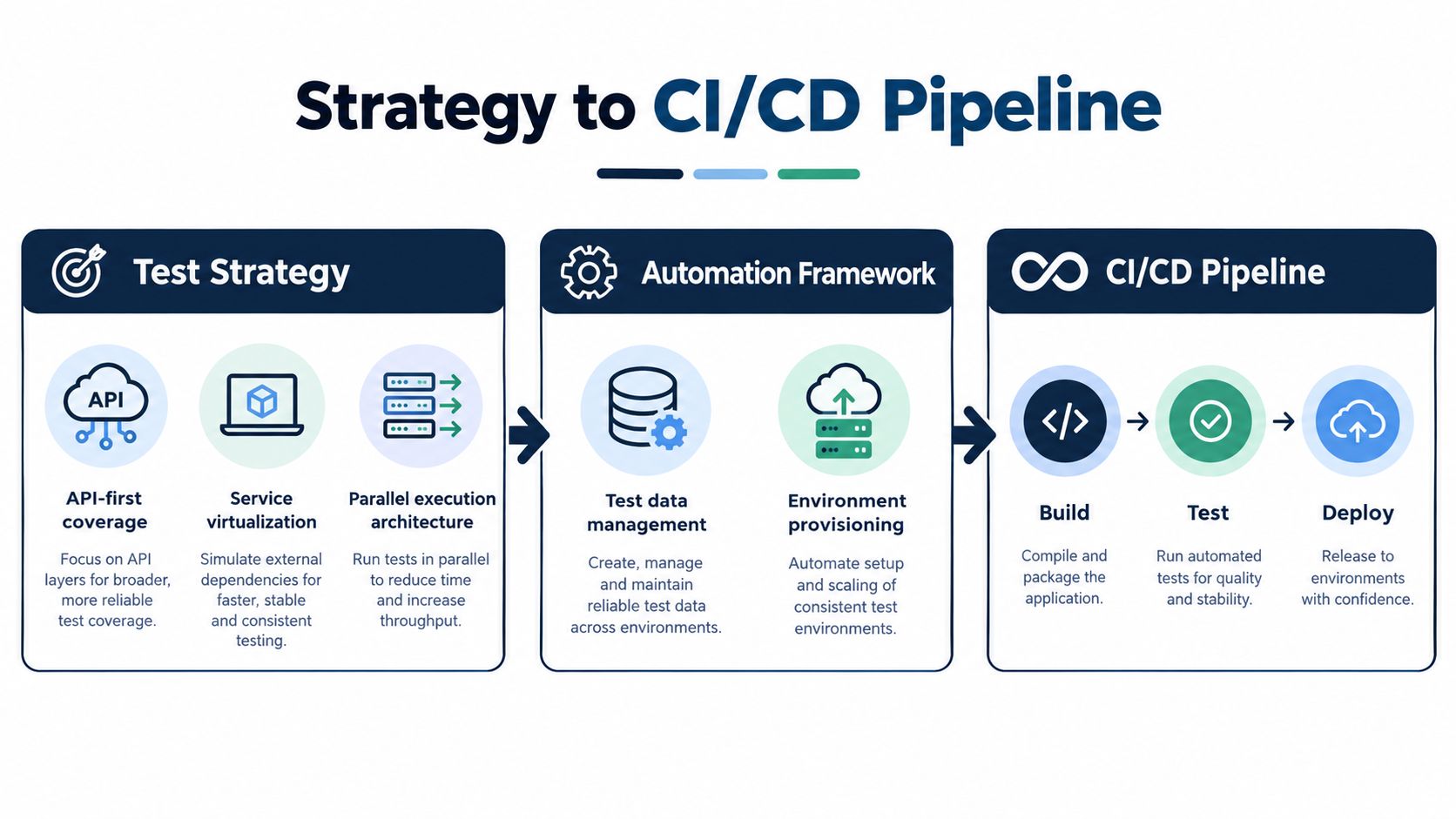
Choose automation architecture at the strategy level. Name the suites and evidence required for a change in its plan. Don't let the pipeline configuration become an undocumented substitute for either.
The diagram shows how reusable testing decisions connect to execution infrastructure.
Choose architecture deliberately
Prefer API-first coverage for rules that don't require browser interaction. Use service virtualization when dependency behavior needs controlled simulation, while preserving appropriate checks against real integrations. Parallel execution is a useful design choice only when test data and environments support isolated runs.
These choices involve trade-offs. Browser journeys validate interactions across layers but can require more maintenance. Simulated dependencies improve execution control but leave real-provider behavior unverified.
For QA test automation, optimize for actionable signal per unit of pipeline time, not the largest possible suite.
Bind execution to pipeline events
Use a named execution contract for each stage:
- Pull request: Run component checks and affected API contracts. Add targeted end-to-end smoke checks where the changed journey warrants them.
- Merge: Execute integration regression against the merged application, retaining the build identifier and environment configuration.
- Release promotion: Require the designated critical-journey results and any performance or security evidence demanded by the change.
- Hotfix: Select checks against the incident mechanism and affected dependencies, then record deferred validation and its owner.
Make gates objective without inventing universal thresholds. For example, compare p95 latency against the product's approved service-level threshold. Block protected-journey failures unless an authorized exception applies.
Quarantined tests need maintenance ownership, not silent deletion. If a quarantined check covers a release-critical risk, require replacement evidence or explicit acceptance of the gap.
The following video provides an additional visual resource for the pipeline discussion.
Regenerate from changed risk
Update the executable plan whenever a change invalidates its assumptions: affected dependencies, feature-flag exposure, deployment scope, environment, model, prompt, or evaluation data. Don't regenerate it merely because another calendar period started.
A machine-readable change record can hold affected journeys, required suites, owners, evidence references, and rollback triggers. Automate selection where dependency information supports it, but require human review where impact is uncertain.
For AI changes, include the evaluated configuration in that record. A code-only trigger won't cover a prompt or model update that changes user-visible behavior.
When to Skip, Merge, or Override a Plan
A shorter, justified plan is stronger than a long checklist nobody trusts. The distinction is whether the team preserves the decision record, not whether it produces a separate attachment.
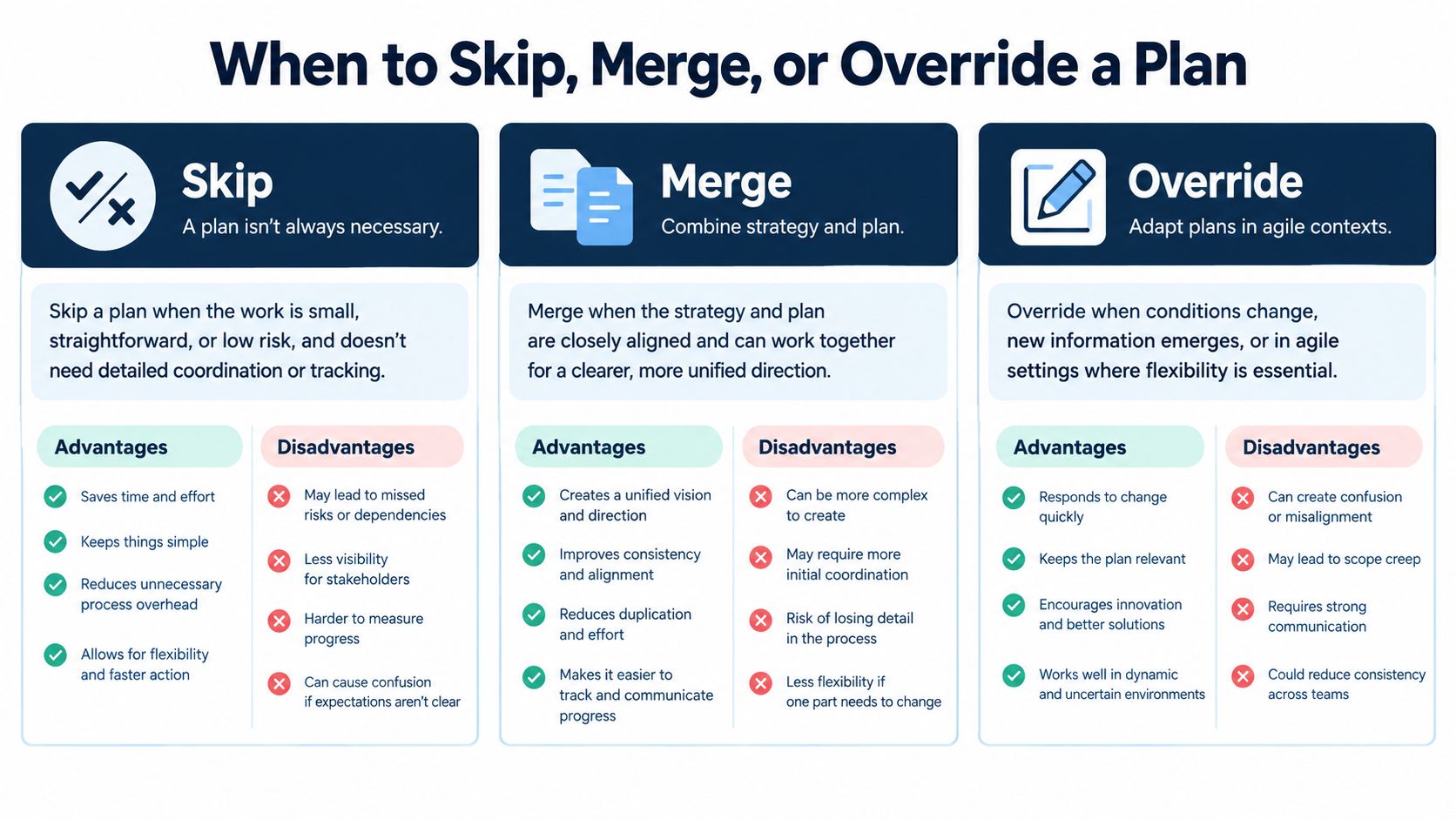
Use this comparison to discuss the available documentation choices.
Skip the separate document
For a small maintenance change, put the plan in the change request if that record already captures scope, selected checks, evidence, and approval. Don't skip the reasoning.
Omitting an end-to-end level may be reasonable when the team demonstrates that the change doesn't affect the user journey and targeted checks address the identified failure mechanism. “We're short on time” isn't equivalent evidence.
Merge the container
A small product team can keep strategy and plan in the same workspace. Label reusable rules separately from current execution commitments.
The benefit is less navigation and duplication. The trade-off is accidental policy editing, so distinguish who may change each part and retain revision history.
Override an assumption openly
The strategy discussion on adapting plans and documenting deviations supports treating exceptions as explicit decisions. My recommendation is to make every material exception inspectable through:
- Justification: The changed risk, supporting evidence, and proposed scope adjustment.
- Authorization: The person able to approve the departure.
- Residual exposure: What remains untested and what customer impact is possible.
- Follow-through: Compensating controls, deferred work, and conditions for reconsideration.
A payment change may need additional recovery checks. An AI change may need specialist evaluation beyond the normal release template. Exceptions can increase testing as well as reduce it.
Repeated exceptions to the same rule are a reason to review the strategy, not normalize the workaround.
Keep an emergency route for urgent fixes, but require retrospective completion of the decision record. Urgency changes the execution sequence; it shouldn't erase accountability.
Practical Checklist and Recommendation for QA Leaders
Start with the missing control. If teams disagree about which risks matter or who can accept them, establish a concise strategy first. If the principles are clear but release decisions rely on verbal reassurance, fix the plan and evidence trail before commissioning another strategy workshop.
Use this checklist in the next release review.
Quick Reference Checklist
| Strategy owns | Plan owns |
|---|---|
| Risk posture and quality objectives | Affected journeys and scope exclusions |
| Test levels and automation boundaries | Selected suites and exploratory work |
| Environment and data principles | Actual environments, datasets, and configurations |
| Gate policy and exception authority | Applicable gates and approved deviations |
| Governance and escalation | Execution owners and decision records |
| Measurement approach | Results, unresolved findings, and exit assessment |
Make readiness inspectable
Connect requirements, risks, checks, and results through a software requirements traceability matrix or an equivalent maintained record. The format matters less than the ability to follow a release claim back to its evidence.
Before approving the next change, ask:
- Coverage: Can we identify the business-critical behavior protected by the selected checks?
- Evidence: Does the result apply to the exact configuration we intend to release?
- Exceptions: Can the approver see what remains uncertain and who accepted it?
Keep the strategy stable enough to guide engineering choices. Refresh the plan whenever changed risk makes its commitments or evidence obsolete, including AI configuration changes outside the code repository.
The goal isn't more documentation. It's a release decision that another qualified person can inspect and understand without reconstructing the conversation.
For specialist support alongside your internal team, AskYourQA designs test automation systems covering functional, AI, security, and performance testing, with CI/CD integration. Visit to discuss mapping your critical journeys into a reusable strategy and release-specific plans with clear gates, evidence, and exception ownership.