
A release candidate looks clean. Every unit test is green. Then a signed-in shopper opens checkout, the price has changed since they saved the item, and they pay with a stored card. The charge fails, the cart vanishes, or the order is written twice. Nobody owned that path, because each function underneath looked fine on its own.
That is the gap use case testing in software testing is meant to close. You are not short of checks. You are short of proof that a person can finish a real job when the data, the session, and the price are no longer the happy defaults.
Table of Contents
- Why Use Case Testing Still Matters
- Map Each Journey into Executable Cases
- Validate the Use Case Before Automation
- Rank Journeys by the Failures They Catch
- Automate a Small High-Signal Suite
- Checkout and AI Answers as Worked Cases
- Pick the First Journeys to Automate
Why Use Case Testing Still Matters
Use case testing checks a complete business interaction, not a single function.
Use case testing means checking whether an actor can finish a business goal on the main success path, on useful alternate flows, and when something goes wrong.
A tester inherits seven parts from the requirement: the actor, the goal, the preconditions, the main success scenario, the alternate flows, the exceptions, and the postconditions. Think of a trip. The use case is the route from the front door to the destination. A unit test is one traffic light on that route. Green lights do not prove you arrived.
People mix up three artifacts that sit on top of each other.
The use case is the business contract: who wants what, and what "done" looks like.
The test case is one path through that contract, with its own data and expected end state.
The script is the steps an automation tool runs.
The technique itself is old on purpose. It came from Ivar Jacobson's use-case work at Ericsson and was later folded into UML, which is why a journey still reads as actor, goal, and flows rather than as a pile of screens.
Timing matters more than the lineage. In 2025, Applause's State of Digital Quality Report found that 54% of organizations addressed quality assurance during planning, while 59% addressed it during development. If organizations touch quality before code freeze, the use case has to be testable while the story is still being written. A vague journey that reaches automation late becomes a flaky script and an argument about the expected result. A practical walkthrough of where those checks sit in a release is in a guide to software quality assurance.
| Technique | Starting artifact | Unit of test | Main gap |
|---|---|---|---|
| Use case testing | Actor-goal use case with flows | End-to-end path toward a business goal | Inherits any ambiguity in the use case |
| Scenario testing | Narrative user scenario | One story through the system | Often misses alternate and exception branches |
| Requirements-based testing | Single requirement statement | One requirement and its checks | Misses the order of steps across requirements |
| Unit testing | Function or class | One isolated behavior | Cannot show that a journey was completed |
From here the work is concrete. Map one journey into flows, refuse any use case that is not ready, rank what is left by the failures it can catch, and keep a small automated suite.
Map Each Journey into Executable Cases
Take one journey and stop there until it is executable. Call it Place order and pay, for a signed-in shopper.
Actor: a returning customer.
Goal: pay for the items in the cart and receive an order.
Preconditions: a valid account, the item in stock, a saved card, and a shipping address already on file.
Do not collapse this into one happy path. Split it into flows that change a decision the business cares about. We start by mapping the journeys the business depends on, not only the flows that are easy to click through.
Main path and the alternates worth keeping
Main success. The shopper opens the cart, confirms the address, pays with the saved card, and sees a confirmation. The system stores one order id. Money is captured once. Inventory drops by the quantity bought.
Guest checkout. There is no account. Email is captured at pay. The order is tied to that email, and the system does not invent a second account.
A second payment method. Same goal, different instrument, so a wallet or a new card is not treated as a copy of the saved-card path.
A coupon that changes tax. A valid percent coupon lands on a taxed item. Discount and tax have to match the pricing rules, not a hard-coded total.
Retry after a gateway timeout. The first provider times out and a second provider succeeds. The customer pays once. There is no double capture.
Exceptions that must have a visible ending
Empty cart. Pay is refused before any charge.
Declined card. The issuer declines an otherwise valid cart. The shopper sees a clear error, the cart stays, and no order id is created.
Expired session. The auth token dies after the address step. Re-login returns the shopper to a recoverable cart.
Out of stock between cart and pay. Stock hits zero. Payment is not captured, and the shopper is told the item is gone.
For every flow, write four things before anyone opens an editor: the trigger, the data that must differ, the system responses, and the postcondition a release can trust.
Two tests can hit the same "customer can pay" requirement and still cross different edges. One succeeds on the first gateway. The other times out and falls back. Same requirement, different decision edges, different bugs.
Put the check on the layer that can fail. Money and inventory belong on the API or service. The path the customer sees belongs on UI or mobile, kept thin. A short smoke path is enough for a pull request. Copying the narrative into fifty UI clicks hides a payment bug behind a banner change. If you want a filled example of how one path is written as steps, data, and expected results, use a sample test case as the pattern, then fill this blank for the next journey: actor, goal, preconditions, three to five flows, oracle, layer.
| Flow | What changes | Expected outcome | Automate on |
|---|---|---|---|
| Main success, saved card | Signed-in shopper, in-stock item, valid card | One charge, order id, inventory reduced once | API plus a thin UI smoke |
| Guest checkout | No account, email captured at pay | Order tied to email, no duplicate account | UI and API |
| Coupon changes tax | Valid percent coupon on a taxed item | Discount and tax match the pricing rules | API |
| Gateway timeout then fallback | First provider times out, second succeeds | Customer pays once, no double capture | Service-level with stubs |
| Declined card | Issuer decline on an otherwise valid cart | Clear error, cart kept, no order id | UI and API |
| Expired session at pay | Auth token dies after address step | Re-login returns the shopper to a recoverable cart | UI |
| Out of stock at pay | Stock hits zero between cart and pay | Payment not captured, shopper told the item is gone | API |
Validate the Use Case Before Automation
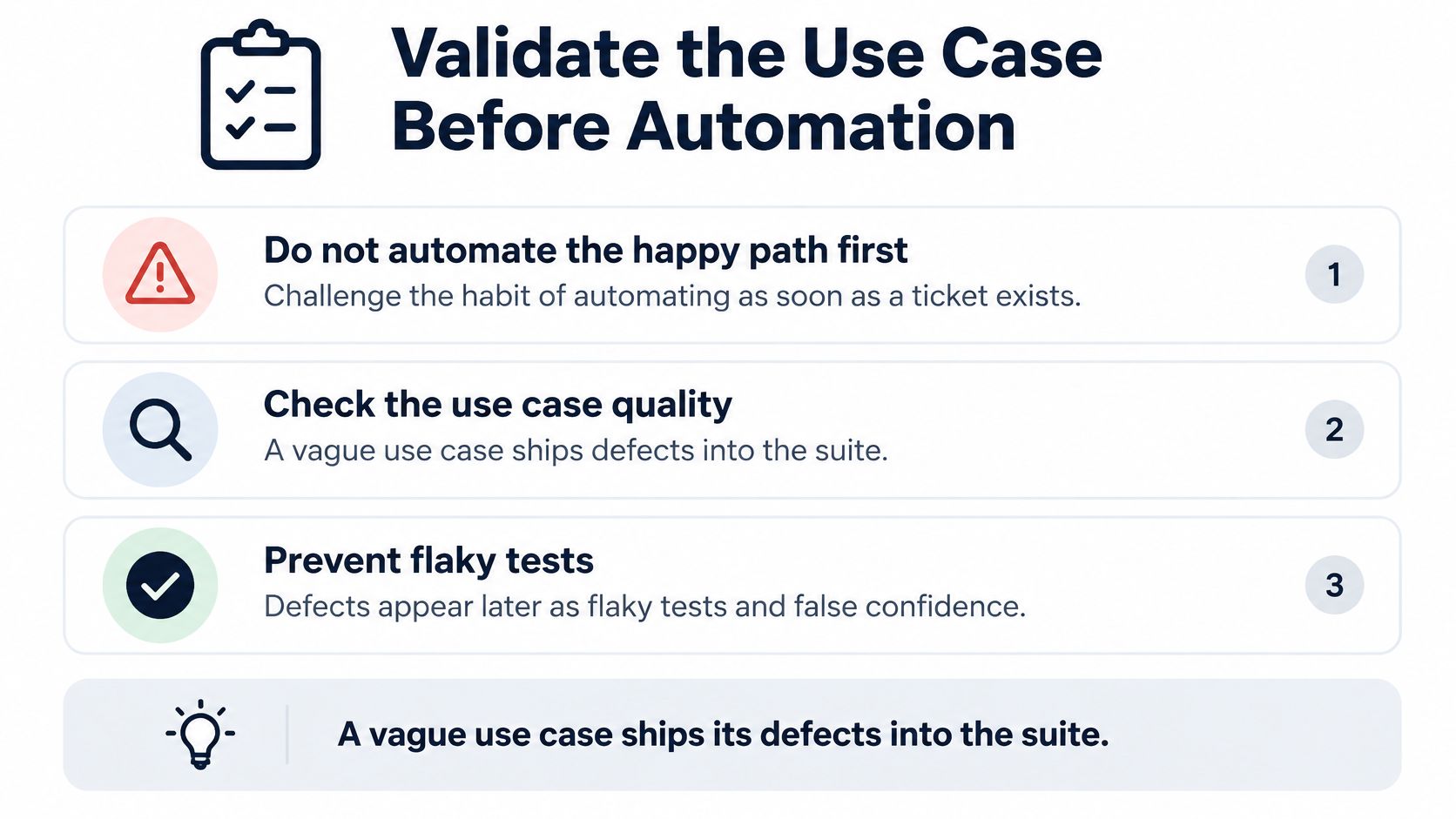
Do not automate the happy path the morning a ticket appears. A vague use case ships its defects into the suite. They show up later as flaky tests and as arguments about what the screen was supposed to do.
The harder check happens before any script exists. An ACM-published study found that a structured validation technique detected defects more efficiently than manual inspection in two case studies. Manual detection efficiency was 47% and 44%, an average of 45.5%. The study was preliminary and used 19 students, so it is not a production benchmark. It still supports a blunt rule: the highest-value pass may be the one that rejects a bad use case.
A one-page readiness check
Run this on a single page before anyone estimates automation.
Name one actor and one goal. "Users complete checkout" is two journeys pretending to be one. A guest and a member do not share permissions.
List what each role must not do. A guest cannot see another shopper's saved card. A member cannot refund their own order. An admin cannot skip the capture rules that apply to everyone else.
Turn business rules into a decision table. Two rows cannot both claim the tax. If a coupon says "tax on the discounted price" and a region rule says "tax on the list price," that contradiction is a blocker, not a test to guess.
Require at least one alternate and one exception, each with a response a person can see. A timeout that only appears in a log is not a finished flow.
Mark blockers and stop. Missing data, an undefined timeout, and contradictory postconditions are blockers. They are not tests.
A bad line says "user completes payment." A testable line says the cardholder is charged once, sees an order id, and inventory drops by the quantity bought.
The output of this pass is a trace from rule to flow to a future check. It is not a larger UI pack. If a P0 journey fails the blocker list, leave it unautomated until the product owner fixes the contract.
Rank Journeys by the Failures They Catch
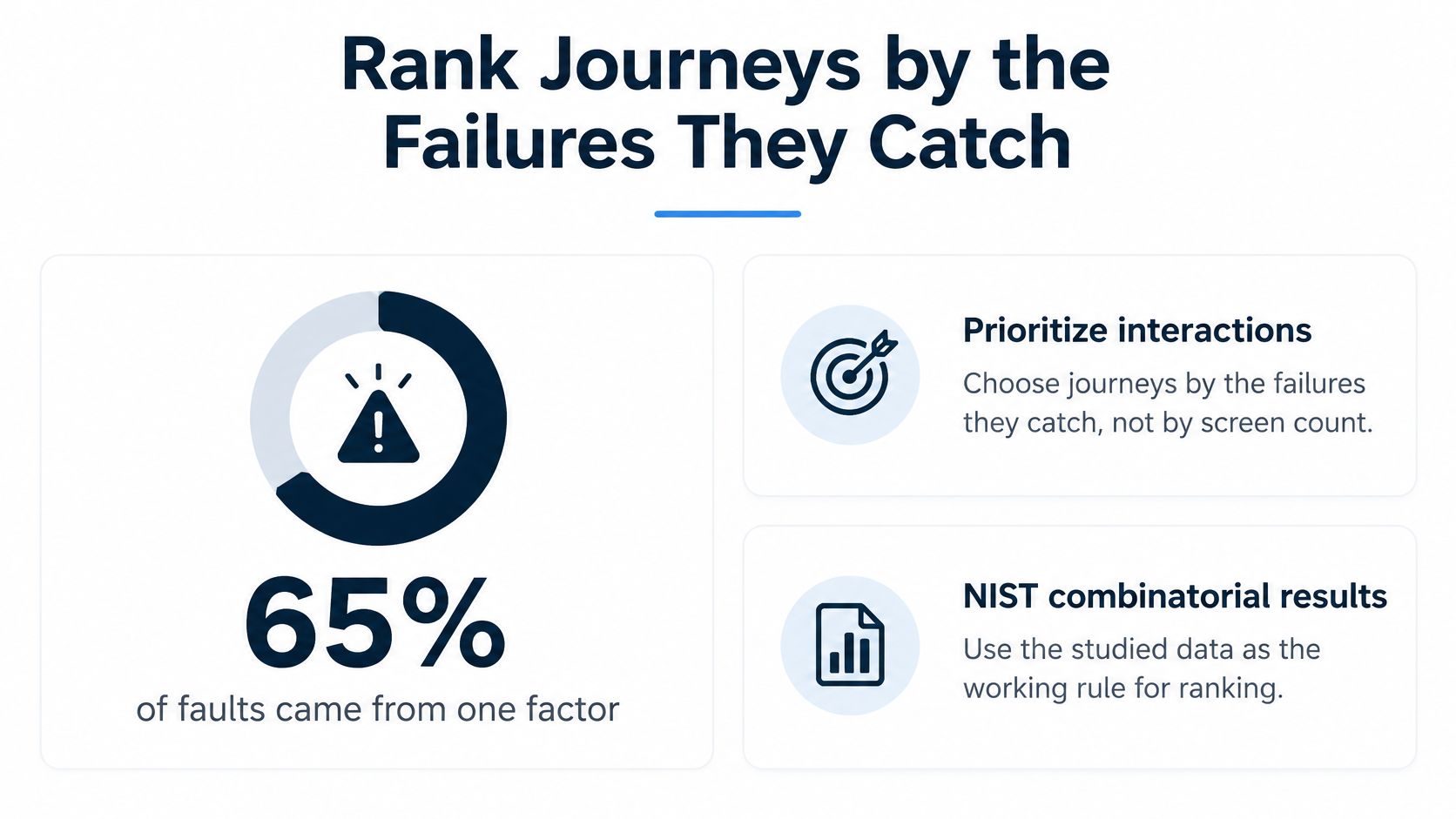
Prioritization is about interactions, not about collecting more screens.
NIST research on combinatorial testing reports that 65% of faults in the studied data were caused by a single factor, while 96% were caused by either a single factor or a two-factor interaction. A separate NIST presentation cites research in which 98% of flaws in a medical-device software study were triggered by pairwise interactions, and no fault required more than a four-way interaction to trigger. Your product will not match those percentages. The working rule still holds. A few deliberate combinations catch most of the failures a giant grid would catch.
Keep the checkout goal fixed and vary what collides: payment method, currency, signed-in versus guest, stock, and a slow network. That is a designed set, not every cell of a spreadsheet.
A score you can do in a workshop
Score each surviving journey on four plain questions.
Business loss if it fails. Money moved wrong, an account taken over, or customer data exposed sits at the top.
How often customers take it. A rare admin path can still be P0 if the loss is severe, but frequency breaks ties.
How many systems it crosses. Cart, tax, gateway, inventory, and email is a wider fault surface than a profile form.
How often that area already breaks. Recent production incidents outrank a theoretical edge that has never failed.
Band the result, then stop adding paths.
| Band | Example journey | Variations to keep | When it runs |
|---|---|---|---|
| P0 money or identity | Pay, transfer, sign-in | Payment method, auth state, stock, timeout | Every pull request |
| P1 recovery | Reset password, resume cart | Expired token, wrong device, rate limit | Nightly |
| P2 account upkeep | Edit profile, change locale | Empty required field, unsupported locale | Release candidate |
| P3 low stakes | Marketing opt-in, theme | Copy and layout only | Manual or skip |
Add a pairwise twist only where the score is high. Drop a near-duplicate that changes nothing a customer or a ledger would notice. A second browser on the same saved-card success path is usually that duplicate.
Start from five to eight P0 journeys, not from a percentage of the backlog.
If you want a fuller scoring pass for the rest of the suite, risk-based software testing is the place to extend the same four questions past checkout.
Automate a Small High-Signal Suite
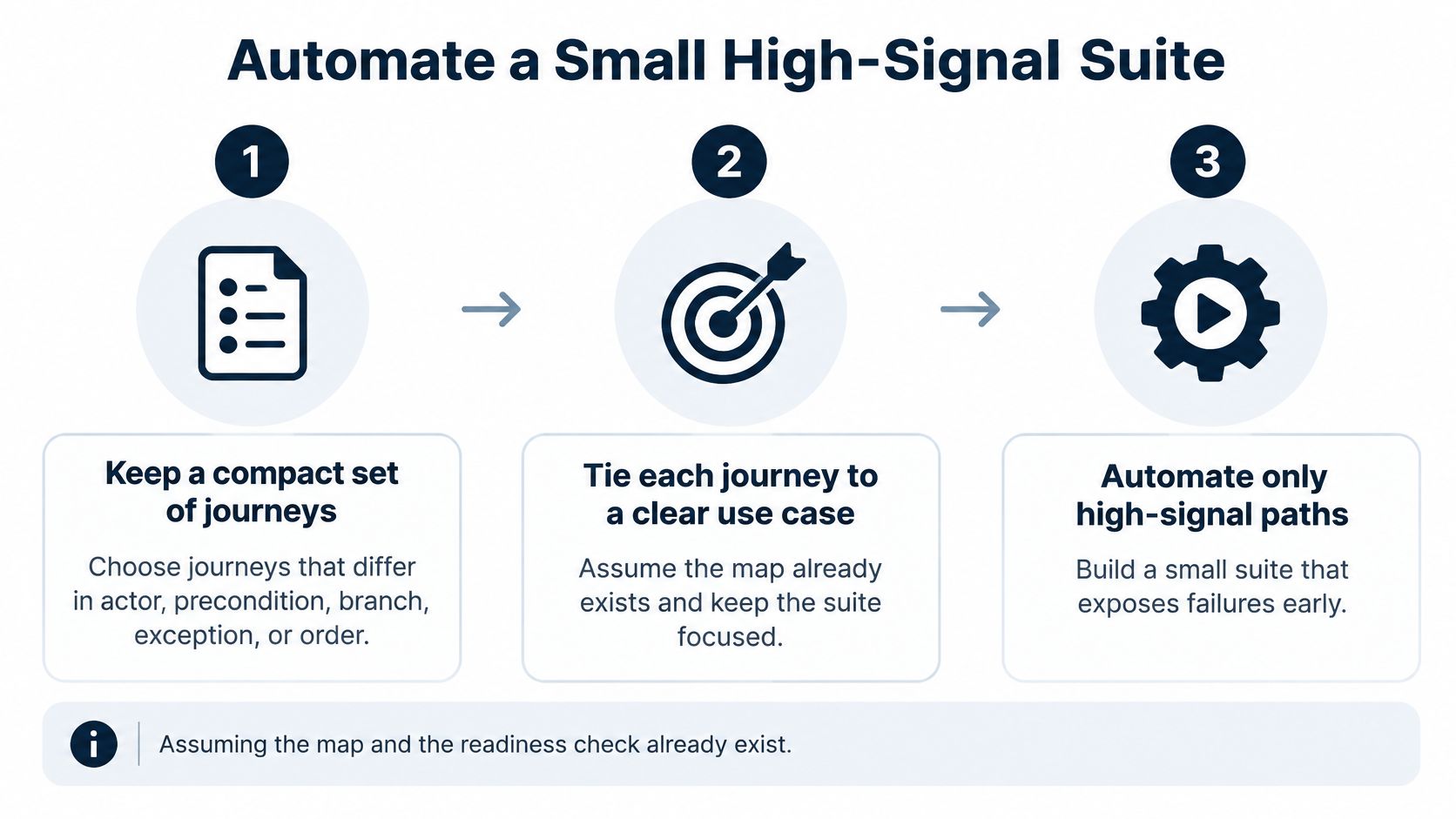
The map exists. The readiness check passed. Automation is now a build, not a brainstorm.
-
Keep journeys that differ, and park the rest. A flow earns a slot when the actor, the precondition, the branch, the exception, or the order of steps is different. Near-duplicates go to a parking list. An empirical study of RUCM scenarios found that a (1+1) evolutionary algorithm with Needleman–Wunsch similarity selected only 50% of the generated scenarios and still detected all seeded defects in every case study, across one real-world study and six literature-based ones (Empirical Software Engineering, via ACM). That is not permission to delete half of any suite you already have. It is evidence that behavioral difference, not test count, is the thing to optimize.
-
Write setup, actions, oracle, and teardown so they can be reused. The saved-card shopper, the guest, and the timeout path should share the cart builder. If each script invents its own user, the suite drifts.
-
Split the oracle. Hard asserts cover money, permissions, schemas, and ids. Timeouts and declines get explicit stubs, so a green run is not an accident of a live gateway.
-
Put the risky middle on the service. REST, gRPC, GraphQL, or WebSocket can prove capture, tax, and stock. Keep the UI or mobile check thin. A layout tweak should not be able to hide a double charge.
-
Match the run to the band. P0 smoke runs on the pull request. The wider alternate set runs nightly or on a release build. A slow fallback path does not belong on every commit.
-
Read defect yield and missing edges, not a rising count. An industrial model-based testing study found that a model built from requirements and existing tests was more complete, from testers' point of view, than a model from requirements alone. Generated tests were longer, reached better edge coverage, exercised requirements in more varied orders, and hit the same overall requirements coverage as manual cases. The study also found model-based testing more effective at logical and requirements faults. Unchanged requirement coverage with new edges is progress. A missing edge is a gap you can name.
The suite we want is smaller on purpose. Fewer, better tests show whether the product works, instead of thousands of noisy checks. End-to-end coverage follows critical flows from start to finish, not isolated features. Those checks run inside the delivery pipeline, so a release gets feedback before it ships.
The failure mode to avoid is a large brittle UI pack that stays green while the ledger is wrong.
Checkout and AI Answers as Worked Cases
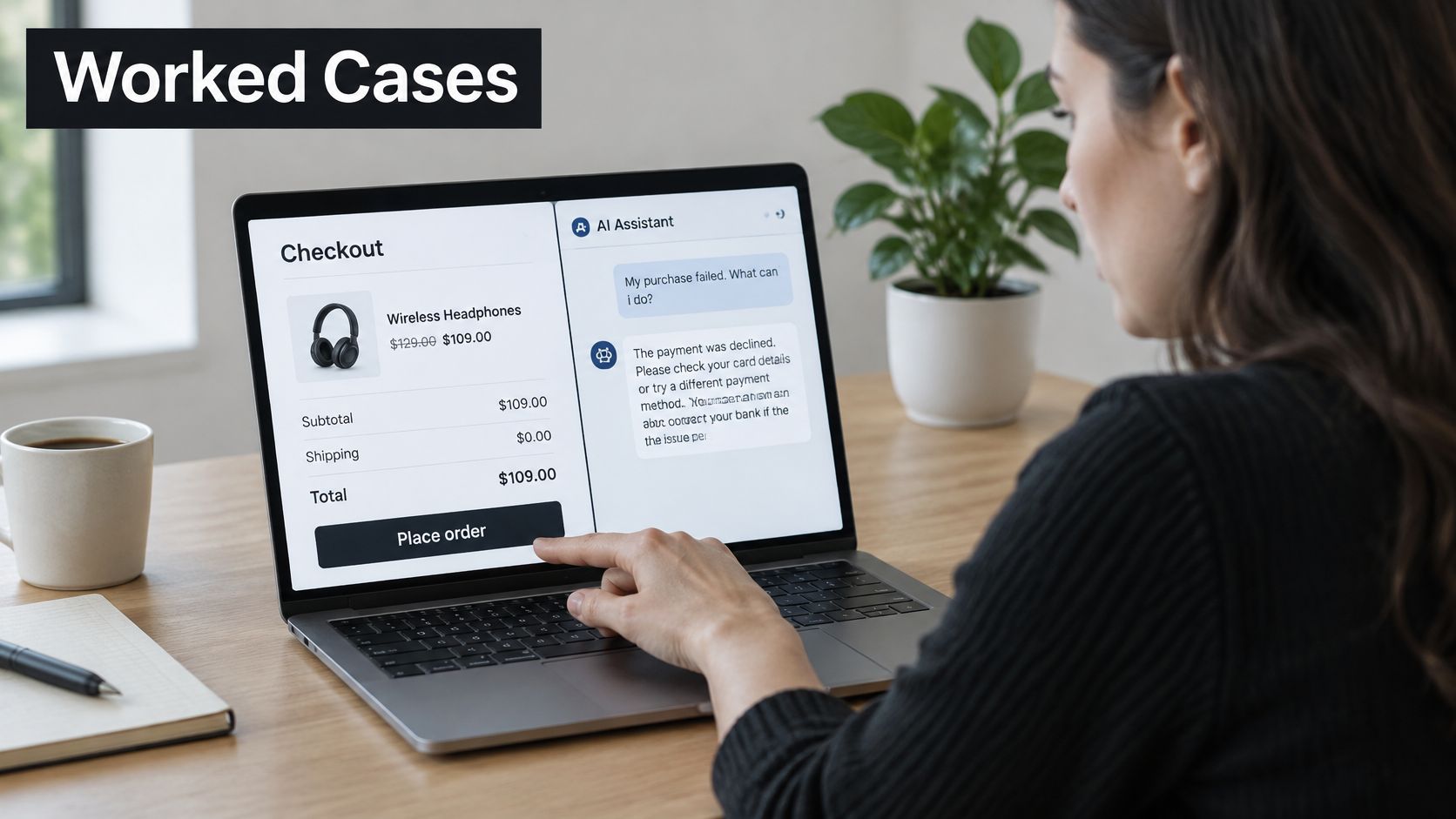
Place order and pay after a price change
Return to the shopper whose saved card meets a new price. The kept set is short: main success, coupon-and-tax, timeout-then-fallback, and declined card.
The oracle is boring on purpose.
One capture. The gateway is hit for the new total, not the stale one.
One inventory decrement. The quantity bought, not the quantity that was in the cart yesterday.
A customer-visible order id when the charge succeeds.
No order when the card is declined, and the cart is still there.
Theme, banner copy, and a second browser stay out. They do not change the business outcome. A layout regression can live in a visual check. It does not earn a P0 slot next to money.
Customer gets an accurate answer
A single expected string fails as soon as the product is an assistant. Applause's AI quality report says 54.5% of surveyed organizations had already released AI features, and 40.3% said more than half of their AI initiatives had reached full-scale production. Many acceptable answers can exist. A harmful one cannot.
Split "accurate answer" before you write a check:
- Factuality: the claim matches a source the product is allowed to use.
- Safety: no instructions that the policy forbids.
- Authorization: no other user's orders, cards, or messages.
- Tone: plain and useful, not a wall of hedging or a fake certainty.
- Latency: a bound the journey can live with.
- Refusal: a disallowed ask is declined, not half-answered.
- Consistency: paraphrases of the same question stay inside the same bounds.
Hard fails are narrow. Leak another user's data, call a tool the user may not use, break the response schema, or answer a disallowed request, and the check fails. Whether the wording is good enough is a rubric or a human review, not a string compare.
Operating habits that a classic use case skips still belong on this journey. Version the prompt and the model. Watch scores drift from one release to the next. Report risk on the journey, not as a pass count that hides one dangerous answer inside ninety green ones.
AI testing here is wider than a chatbot assert. It covers five pillars: the app around the model, security, quality, performance, and monitoring. A practical place to start that split is how to test AI agents.
Checkout wants one correct state. The assistant wants no harmful state, plus a bounded answer that is good enough.
Pick the First Journeys to Automate
List the journeys that move money, identity, or customer data. Run each one through the readiness check. Score whoever survives with the four questions: loss, frequency, systems crossed, and how often it already breaks.
Circle five to eight P0 flows. For each one, commit in writing.
One main path and one nasty alternate. Not the whole tree.
A hard oracle. Charge once, session restored, record absent, or whatever "done" means for that journey.
A named owner. Someone who can say the expected result is wrong.
A pull-request smoke run for that pair. Book the remaining alternates nightly.
Give it two weeks. Week one is the map and the blocker list. Week two is the first smoke path running in the pipeline.
Done has a narrow meaning. A failed P0 test names the broken journey. A green run means those journeys completed. It does not mean every screen was clicked.
On a free 20-minute call we map the current testing process, name the first critical flows, and show how soon a framework could be running. A specialized team builds that framework in parallel across frontend, backend, and CI, instead of waiting on one engineer to do it in sequence.
AskYourQA designs the automation around the journeys your product depends on, from checkout and sign-in through API and mobile checks that run in the pipeline. We keep the suite small, tie each check to a business outcome, and extend the same discipline to AI features when a single expected string is not enough. If you want those first flows mapped before the next release, visit AskYourQA.